
Give an underused AI feature a better second release.
We find why the feature failed, separate the model problem from the product problem, and rebuild the part that keeps users away. You get a clearer experience, stronger safeguards, and a relaunch path tied to adoption or ROI.
- Failure diagnosis
- AI feature rebuild
- Experience rescue
- Reliability evaluation
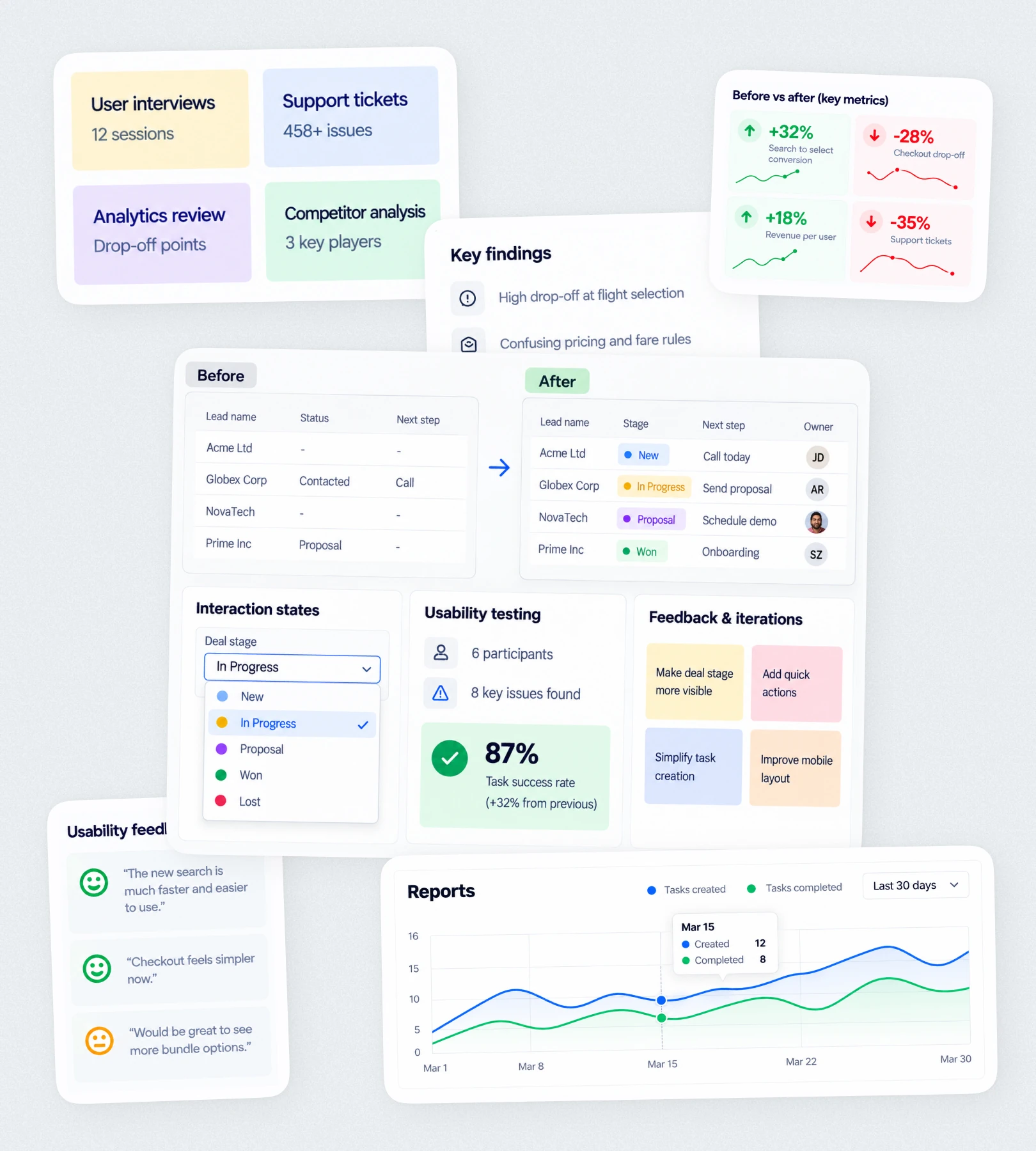
Answers used
31%
Down from 44%
Wrong answers
9.2%
Flagged by users
Fallback rate
2%
Too low, hides misses
Thumbs down by intent
Billing questions fail most
The assistant answers billing without account data. Route those to the billing API or a person.
Reliability check
A launch is not proof that the feature works.
An underused AI feature can fail at many layers. The job may not matter, the entry point may be hidden, the answer may lack evidence, or the workflow may leave people alone with a wrong result.
We do not rebuild everything by instinct. We trace the drop from discovery to action, keep what is working, and fix the smallest set of product, experience, data, and reliability problems that can earn a second release.
The demo looked good and the feature shipped. Then usage flattened. People do not understand the result, trust it enough to act, or know what to do when it misses.

- 40%+of agentic AI projects predicted to be canceled by the end of 2027Gartner prediction, 2025
- 66%of people rely on AI output without checking its accuracyKPMG and University of Melbourne, 2025
- 56%say they have made mistakes in their work because of AIKPMG and University of Melbourne, 2025
We diagnose the miss, then rebuild the part that matters.
- 01
Failure diagnosis
Separate demand, scope, data, model, workflow, and experience problems before changing the code.
Targets clarity - 02
AI feature rebuild
Keep what works, remove what does not, and rebuild the path that blocks useful adoption.
Targets adoption - 03
Experience rescue
Improve prompts, feedback, sources, recovery, and handoff so the feature fits the product.
Targets trust - 04
Reliability evaluation
Test real cases, expose weak responses, and add the safeguards the feature needs to earn use.
Targets reliability - 05
Second release
Ship the improved feature in your existing stack, patterns, design system, and deployment process.
Targets relaunch - 06
Adoption tracking
Measure whether the fix changes use, retention, conversion, efficiency, or the agreed outcome.
Targets ROI
A rescue is not a cosmetic refresh. It is a focused second release with a reason for every change.
From an ignored feature to a better release.
Read the evidence.
We review usage, sessions, support questions, outputs, and the workflow around the feature.
Week 1Name the real failure.
We separate a weak use case from a bad entry point, unreliable output, missing context, or poor recovery.
Week 2Design the second path.
We shape the smaller, clearer experience and define what the feature should do when it is unsure.
Weeks 3-4Build and evaluate.
We rebuild in your patterns, test real cases, and harden the states that caused the first release to fail.
Weeks 5-8Relaunch against a number.
We ship the second release with instrumentation and a measurement plan for the outcome that matters.
Week 9
From an ignored feature to a better release.
Read the evidence.
We review usage, sessions, support questions, outputs, and the workflow around the feature.
Name the real failure.
We separate a weak use case from a bad entry point, unreliable output, missing context, or poor recovery.
Design the second path.
We shape the smaller, clearer experience and define what the feature should do when it is unsure.
Build and evaluate.
We rebuild in your patterns, test real cases, and harden the states that caused the first release to fail.
Relaunch against a number.
We ship the second release with instrumentation and a measurement plan for the outcome that matters.

A rescue process built around evidence.
We use product behavior, real cases, and reliability checks to decide what deserves a second release.
- 01Product evidenceUsage, activation, retention, conversion, support questions, and the places people leave.
- 02Experience reviewSessions, flows, entry points, prompts, outputs, sources, and recovery states.
- 03Evaluation casesA representative set of real inputs used to test quality before the second release.
- 04GuardrailsSource boundaries, confidence states, fallbacks, review points, and explicit refusal.
- 05Release hardeningTests, error handling, edge cases, and the deployment checks needed for a safer relaunch.
- 06Outcome trackingEvents and dashboards that show whether the feature earns more use after the fix.
A second release with a reason behind every change.
- Failure diagnosisA clear account of what blocked adoption, trust, reliability, or value.
- Rescue planThe changes ranked by expected outcome, effort, and confidence.
- Improved AI experienceThe entry point, core flow, feedback, source, and recovery states redesigned.
- Evaluation setReal cases that make quality and failure visible before relaunch.
- Production second releaseThe improved feature shipped in your existing product and deployment process.
- Adoption measurementEvents and a review plan tied to the outcome the rescue is meant to move.

The Ship-It Guarantee
We agree on the scope and launch date before the build begins. You always know what is included, what is out of scope, what comes next, and when it will ship. If we miss the deadline because of our work, the final payment is on us.
Clear scope, close collaboration, useful handoff.
The same operating commitments apply whether you start with an audit, a build, a rescue, or growth work.
- Founder inevery engagement
- Senior teamno shared pool
- Fixed scopeprice agreed first
- Weekly reviewshared channel
- Your repodesign files
- Stop anytimeno notice period
- 01Start here
AI Experience Audit
A fixed price, two week audit that finds where AI can move a metric in your product, and where it cannot.
- Ranked AI opportunities
- Projected return by metric
- Adoption and friction review
- 02
AI Experience Build
We build the opportunity your audit proves. Fixed scope, fixed price, same team from strategy through handoff.
- AI experience design
- Production build in your stack
- Guardrails and fallbacks
- 03
AI Growth Sprints
Keep improving the AI layer after launch. Book one sprint at a time when the next improvement is clear.
- Plan against the audit projection
- Evals and live monitoring
- One improvement per sprint
Design the layer people use and agents can understand.
Your buyers use agents to research products, and your users will ask agents to complete work inside them. We design the boundaries, sources, and actions for both sides of that interaction.
Agentic website
A site with clear, machine-readable answers that agents can cite for buyers. Your team keeps approval over what gets published.
yoursite.com/llms.txt- Structured source
- Machine-readable pages
- Review before publish
- This service
Agentic application
An agent inside the product that plans and acts with visible steps, clear approval points, and a way to undo the work.
- Planning
- Needs approval
- Completed
- Handed back
Agentic workflows
Agents that run repeatable work behind the product, with checks, logs, and a human checkpoint when a wrong action is expensive.
TriggerAgentReviewSystem of record
Not sure which one you need? The AX Audit covers AI and agentic experience: how people use your AI, and how agents read and act on your product.See the AX Audit
Senior product, design, and engineering in one room.
- 11companies the team has built insideEmployment and contract work, 2019 to today
- 13products shipped to productionCounted, not estimated
- 8industries servedThe same eight on the industries page
- 7+years shipping softwareFounder, first production release to today
- 10+senior designers and engineersEvery one has shipped to production











I had to hire Shahriar twice, once at Agora and once at Timescale and hiring him was one of the best decisions I made. He is so reliable, hardworking, and always willing to go the extra mile to get the job done. His technical skills are top-notch, and save a lot of time and effort for the team. I cannot recommend him enough!
 Emily KimChief of Staff, ElectricSQLHired 2x, @Agora and @Timescale
Where this service does its best work.
A revenue product, a healthcare workflow, and a developer tool need different boundaries. See how the work changes with the context.








Questions your team may ask.
How do you know whether the model is the problem?
We look at the complete path, including demand, scope, data, model behavior, entry point, trust signals, and recovery. A weak model is one possible cause, not the default answer.
Do you replace the whole feature?
Can you relaunch inside our existing product?
How do you decide what to fix first?
What if the feature cannot be saved?
How do we know the relaunch worked?
A rescue turns a sunk cost into evidence.
The first release already taught you where the product, workflow, or model failed. We use that evidence instead of starting again with a larger feature list.
The audit can identify the highest-value fix. Rescue carries that decision through diagnosis, redesign, engineering, and a measured relaunch.
- This serviceAI Redesign & RescueGive an underused AI feature a better second release.Failure diagnosisAI feature rebuildExperience rescueReliability evaluationSecond releaseAdoption trackingYou are here
- 01AI Experience (AX) AuditKnow where AI is worth building before you spend on it.Opportunity mapMetric modelAdoption teardownData readinessWorking concept demoStop listExplore service
- 02AI Product & UX DesignDesign AI people understand before they decide to trust it.Copilot and assistant designPrompt experienceTrust and confidenceFailure recoveryAI onboardingHuman-in-the-loop flowsExplore service
- 03AI SaaS & MVP DevelopmentBuild the product foundation your AI layer needs.Product strategyMVP experience designProduct architectureFull-stack developmentAI feature engineeringTesting and refinementExplore service
- 04AI Automation & GTM AgentsAutomate the work that slows the team down.Workflow automationAI agentsCRM and GTM operationsSupport automationDocument processingAgentic GTM systemsExplore service
- 06AI Discovery & GrowthMake your product easier to find, understand, and choose.AI discovery reviewAnswer monitoringStructured product contentOnboarding and activationConversion and upgrade flowsGrowth feedback loopExplore service




Give the feature a second release worth using.
We find what failed, rebuild what matters, and relaunch against a number. Start with the AX Audit to separate a fixable miss from an opportunity to stop.
- NDA from the first conversation.
- Response within 24 hours, guaranteed.
- Founder-led from first call to handoff.
