What belongs in an AI ROI report
An AI ROI report should prove one thing: did the feature move a metric you already track. The four-part structure, the metrics, and what to cut.
 Sohanur RahmanAI ROI & Strategy7 min read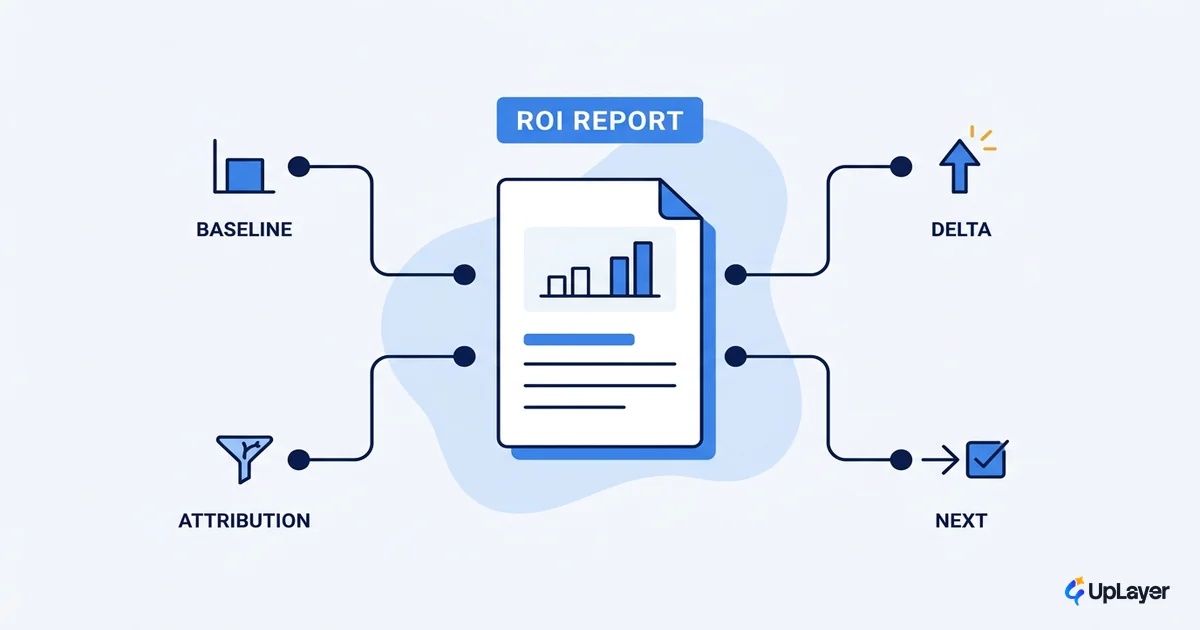
Most AI ROI reports prove activity, not value. They open with a chart of prompts served, tokens processed, or "hours saved," and a reader who controls budget quietly stops trusting the document. A wall of usage charts is not a result.
An AI ROI report exists to answer one question honestly: did the feature move a metric you already track, and is the change attributable to the feature or to noise? That is the whole job. Everything else is decoration. The fastest way to write a report nobody believes is to skip the baseline and lead with the dashboard.
This is the structure that survives a finance review. We will give you the four parts a credible report contains, the metrics that belong in it, how to attribute the delta without fooling yourself, and what to do when the honest answer is "no return yet." The discipline is the same one we use to tie the feature to one metric you already track before a line of model code gets written.
What an AI ROI report actually proves
A good report proves a single causal claim: this feature changed this metric by this much, and here is why we believe the feature caused it. Usage is not that claim. People can use a feature heavily while it moves nothing.
This matters because unmeasured value is what kills AI work, not bad models. Gartner predicts at least 30% of generative AI projects will be abandoned after proof of concept by the end of 2025, citing unclear business value among the top reasons. A project does not get cut because the demo was unimpressive. It gets cut because nobody could show what it was worth.
A report that cannot name the metric it moved is a status update, not an ROI report.
So the test for every chart you include is blunt: does this line connect the feature to money, retention, or a metric leadership already cares about? If it does not, it does not belong in the report.
What should an AI ROI report include: the four-part structure
A complete report has four parts, in order. Baseline, delta, attribution, next action. Each one answers a question a skeptical reader will ask, and skipping any one of them is where reports lose credibility.
| Part | The question it answers | What it contains |
|---|---|---|
| Baseline | Where were we before? | The metric's value and trend for 4 to 8 weeks pre-launch |
| Delta | What changed? | The metric after launch, the absolute and percent change |
| Attribution | Was it the feature? | Holdout or cohort comparison, confounders ruled out |
| Next action | What now? | Keep, iterate, expand, or kill, with the reason |
Written as a skeleton your team can copy:
AI ROI REPORT: <feature name>
1. BASELINE   metric = <name>  |  pre-launch value = <x>  |  window = <weeks>
2. DELTA      post-launch value = <y>  |  change = <y - x> (<pct>%)
3. ATTRIBUTION  method = <holdout | cohort | pre-post>  |  confounders = <list>
4. NEXT ACTION  decision = <keep | iterate | expand | kill>  |  because = <reason>
That is the entire ai roi report template structure. It fits on one page. If your draft does not map cleanly onto these four parts, the missing part is usually attribution, and that is the part finance will press hardest.
The AI ROI metrics that actually matter
The metric in your report should be one the company already tracks: churn, activation, conversion, or expansion. A new metric invented for the launch is a metric nobody trusts, because there is no history to compare against. Pick the number that already sits on a dashboard someone reviews.
Keep hard and soft metrics separate. Hard metrics show up in revenue or cost. Soft metrics (time saved, satisfaction) are real but easy to inflate, so they support the case rather than carry it. For more on choosing the number, see the AI ROI metrics that actually matter.
Honesty about the size of the delta is what makes the report believable. Among organizations that report a financial impact from AI, most teams that see a financial impact see a small one: cost savings are most commonly under 10%, and revenue increases are most commonly under 5%, per Stanford's 2025 AI Index. A report claiming a 40% lift invites disbelief. A report claiming a measured 6% activation gain, attributed cleanly, gets funded.
WARNING
Tokens processed, prompts served, and "hours saved" with no counterfactual are vanity charts. They demo well and prove nothing. Cut them before the report leaves your desk.
How to measure AI ROI and attribute the delta
Because ROI is a measurement, as IBM puts it, it requires numerical data on business outcomes, not a narrative. So the work of the report is arithmetic, and the formula is simple:
ai_roi = (value_of_metric_movement - cost_to_build_and_run) / cost_to_build_and_run

value_of_metric_movement = delta_in_metric x value_per_unit_of_metric
The hard part is not the formula. It is making the delta trustworthy, and that is attribution. You cannot attribute a change you never baselined, so set a baseline before you ship, then use a holdout group or a matched cohort so you can say the feature moved the number rather than seasonality or a pricing change. Pre-launch versus post-launch alone is the weakest method, because the world moved too.
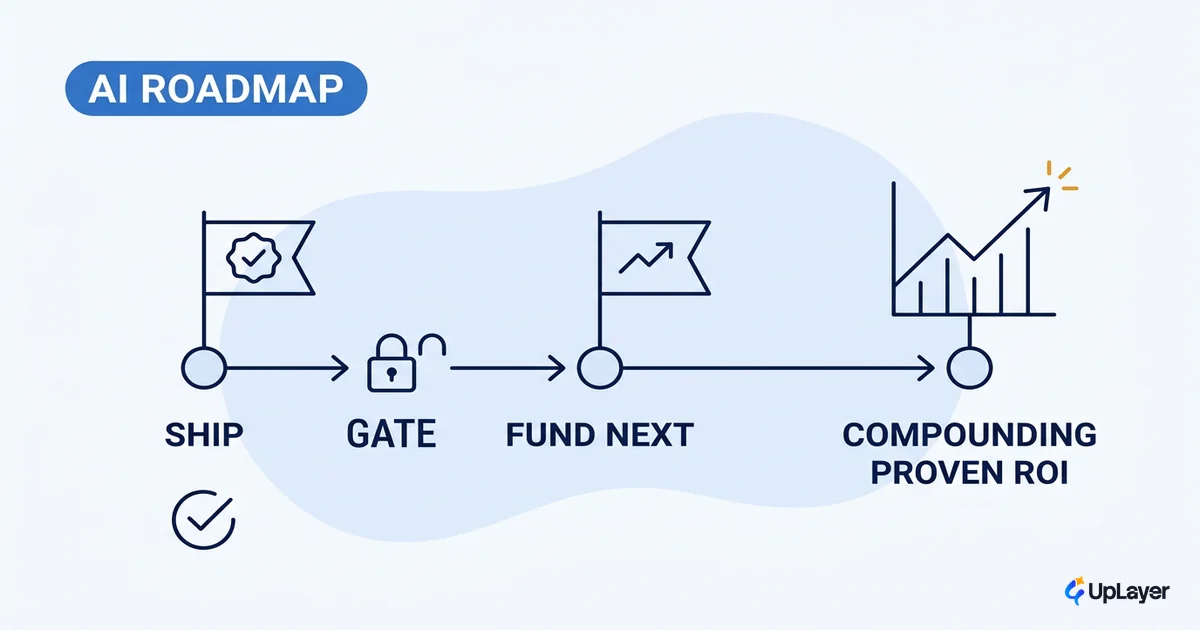
Set expectations on timing in the report itself. Deloitte's 2025 survey found returns are slow to materialize and hard to measure: most respondents reached satisfactory ROI within two to four years, far longer than the 7 to 12 month payback expected of typical technology investments, with only 6% seeing payback in under a year. A report that promises returns next quarter is setting up its own failure.
NOTE
Label every forward number as projected until you have a measured delta. "Projected" and "measured" are different claims, and conflating them is how a report loses a finance reader on page two.
How do I report AI ROI to leadership
Give leadership one page, in the four-part order, with the decision at the top. Executives read the recommendation first and the evidence second, so lead with "keep and expand" or "kill," then show the baseline, delta, and attribution that justify it. Bury the recommendation and you lose the room.
This is where the report becomes an ai business case. The same numbers that prove the last feature paid off justify the next investment, so write the report so it can report AI ROI to your leadership and feed the next funding decision in one pass.
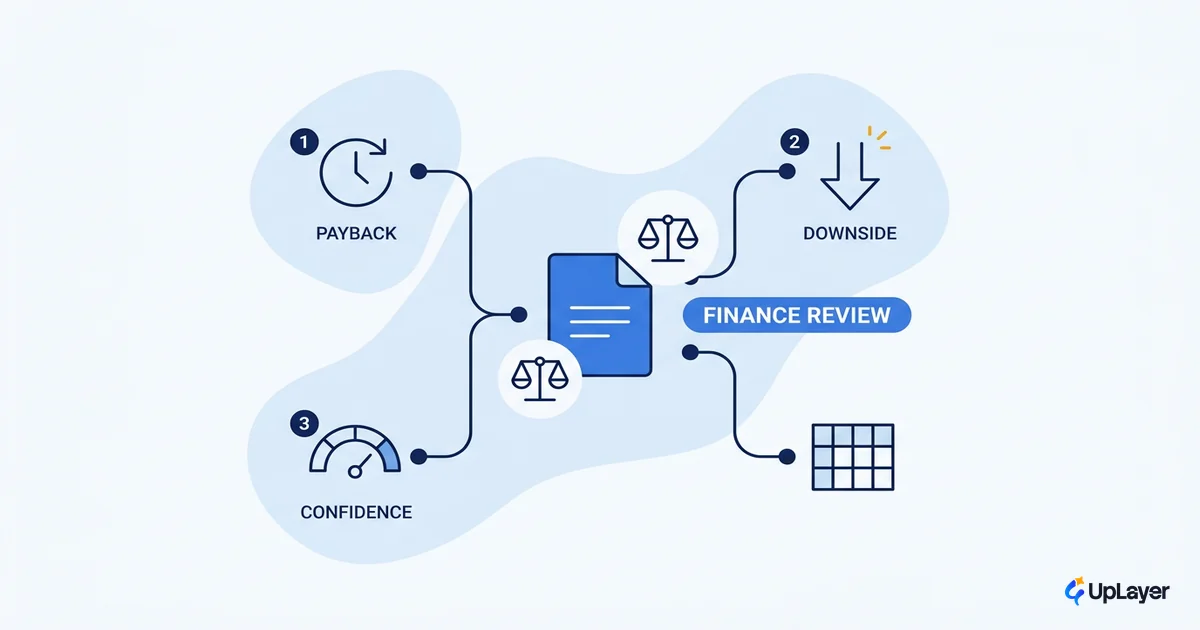
A finance reader checks three things: is the metric one we already trust, is the attribution method sound, and are the costs complete (build, inference, and maintenance, not just build). Borrow the structure from NIST's AI Risk Management Framework, which defines a structured, measurable process across govern, map, measure, and manage. Trustworthy attribution is a governance habit, not a chart style.
IMPORTANT
A report that can survive finance is the report that funds your next feature. Our 3X Guarantee runs on the same logic: the audit either finds AI worth 3x the fee, or it is free, because a claim you cannot measure is a claim we will not make.
What to do when the report shows no projected ROI
Sometimes the honest answer is that the feature did not move the metric, or the projected ROI never materialized. That is a valid report outcome, not a failure of the report. Saying no on purpose is the point of measuring at all.
When the delta is flat, you have three moves: re-baseline if attribution was muddy, iterate if the mechanism was right but the execution was thin, or kill if the metric simply did not respond. In a Concept Demo we build the report to make that call cheap, with the metric and the holdout defined up front so a "no" costs a week, not a quarter. A report that can recommend killing a feature is a report leadership will trust the next time it recommends shipping one.
The teams that win with AI are not the ones with the most features. They are the ones whose every ai roi report ends in a clear decision, backed by a baseline, a delta, and honest attribution. Write the report that way and the document stops being a defense and starts being a planning tool.
TIP
Want the baseline, delta, and attribution defined before you build, so the report writes itself? How the AX Audit works.