How to defend an AI business case to finance
Your AI business case dies in the finance meeting unless it carries a conservative number, a sensitivity range, and a payback period a CFO trusts.
 Shahriar P. ShuvoAI ROI & Strategy8 min read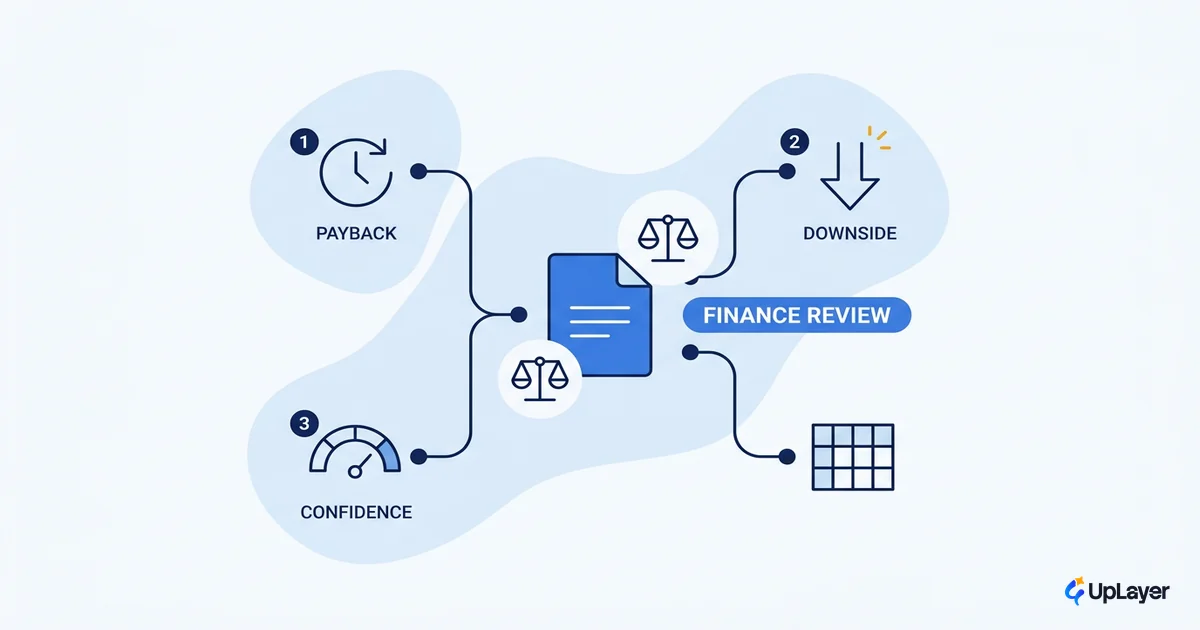
The AI business case that demos beautifully in product review often dies in the finance meeting. Same slides, different room, and suddenly the projection that felt obvious gets discounted to zero. The CFO is not anti-AI. They are anti-unhedged-projection, and a vision with one optimistic number is exactly that.
Finance buys a number and a risk profile, not a story. A vision gets discounted. A conservative figure with stated assumptions, a sensitivity range, and a payback period gets funded. The difference between those two outcomes is rarely the idea. It is whether you walked in ready to defend the math.
This is the room where most AI spend gets approved or killed, so it deserves its own playbook. We assume you have already done the upstream work and can write the AI business case first: the metric, the cost, the projected delta. This piece is about surviving the read that follows.
What finance actually wants from an AI business case
Finance wants the same three things they want from any capital request: a return, a payback period, and a downside they can live with. Say those out loud and you are already speaking their language.
The skepticism is earned. Across large studies, most AI investments report little measurable impact, with seven out of ten companies seeing minimal or no business effect and 40% of organizations making significant AI investments reporting no business gains. Your CFO has read those headlines. The base rate they apply to your slide is not neutral. It is "prove this one is different."
So the burden of proof sits with the case, not the reviewer. That is not unfair. It is the job. A defensible case answers the skepticism before it is voiced, in the units finance already tracks.
| What finance wants | What a weak case brings instead |
|---|---|
| A conservative number with a range | One optimistic number presented as fact |
| Explicit assumptions they can test | Assumptions buried in the model |
| A payback period and break-even point | A percentage with no time horizon |
| A named downside and a kill rule | Upside only, no failure case |
| A metric they already report | A new vanity metric invented for the deck |
Lead with a conservative base case, not your best case
Present your base case as a floor, not a ceiling. The number you defend should be the one you are confident you can beat, not the one that needs everything to go right.
The mechanism is simple. Tie the projection to a metric finance already reports, then tie one feature to one metric you already track so the delta is auditable later. If the AI feature is meant to cut churn, your case moves the churn line, not a usage stat nobody on the finance team recognizes. The projected roi becomes a movement in a number they already forecast.
Conservatism also buys you the timeline argument. Returns on AI arrive slower than teams promise. Deloitte's 2025 survey of 1,854 executives found that most teams reach satisfactory AI ROI in two to four years, against the seven-to-12-month payback finance expects from typical technology spend.
Only six per cent of organizations reported AI payback in under a year, and even among the most successful projects, just 13 per cent saw returns within 12 months. (Deloitte, 2025)
If your case promises a six-month payback, finance has data that says you are guessing. A conservative base case that clears the bar on a realistic horizon is harder to attack and easier to fund.
Show your assumptions (the line finance attacks first)
WARNING
The fastest way to lose the room is to hide your assumptions inside the model. Finance will find them, and a buried assumption reads as a concealed one. Put every input on the table before they ask.
When founders ask how do I justify AI spend to finance, the honest answer is: by exposing the assumptions, not the conclusion. A projection is only as credible as the assumptions under it. List them explicitly: adoption rate, the size of the metric delta, the full cost basis, and time-to-value. Each one is a number you chose, so each one is a number you should be able to defend.
This is the discipline of a full-cost AI cost benefit analysis. Count the model and inference cost, the build, ongoing maintenance, and the risk reserve, not just the license. The case that shows its working gets trusted. The case that shows a clean answer with no inputs invites the question you cannot dodge: "where did this number come from?"
Adoption is usually the assumption that matters most and the one teams inflate hardest. If you assume 60% of users adopt the AI feature and the honest number is 25%, the entire case inverts. Name your adoption assumption first, and name it low.
Run a sensitivity table so the case survives a hostile read
A single number invites a single objection. A sensitivity table absorbs it. Show the case across a range of the assumption most likely to be challenged, usually adoption or the metric delta, and let finance see that the math still holds at the pessimistic end.
Start from the break-even, the line finance cares about most:
payback period (months) = total AI investment / projected monthly benefit

projected monthly benefit = users affected
                          x adoption rate
                          x metric delta per user per month

break-even = the month where cumulative benefit >= total investment
Then run the driving assumption across three columns. Here adoption is the variable; the build cost is fixed at a projected $60k for a single feature.
| Scenario | Adoption | Annual benefit (projected) | Payback | Verdict |
|---|---|---|---|---|
| Base | 35% | $140k | ~5 months | Fund |
| Conservative | 20% | $80k | ~9 months | Fund |
| Pessimistic | 10% | $40k | ~18 months | Marginal, revisit scope |
The table does two jobs. It shows you have already imagined the bad case, which builds trust. And it tells you honestly whether the feature is worth building: if the pessimistic column does not clear the bar, you have a weak bet, not a finance problem. That is how a sensitivity range helps you de-risk the decision instead of decorating it. (Treat these figures as a Concept Demo of the format, not a promised result; your real inputs replace them.)
State a payback period finance recognizes
Lead with payback and break-even, not a return percentage floating in space. "32% ROI" means little to a CFO without a time horizon. "Break-even in month nine, positive contribution thereafter" is a sentence they can take to a board.
Frame the horizon honestly against the AI benchmark. If your conservative case pays back in nine months, you are beating the two-to-four-year norm and you should say so plainly. If it pays back in two years, do not dress it as nine months. Set the expectation, then beat it. This is also how you protect the ROI on AI investments after approval: the payback line becomes the commitment you report against, the spine of the eventual ai roi report.
NOTE
Payback period answers "when do we stop losing money." Net present value answers "is this the best use of the capital." Bring payback to win the room; have the NPV-style comparison ready for the CFO who thinks in cost of capital.
How to defend an AI budget request when the downside comes up
Name the failure case before finance does. Pre-empting the risk is what funds the request, because it proves you have thought past the demo. An AI budget request that only describes the upside reads as a pitch. One that describes the downside and the exit reads as a plan.
State three things: the failure mode (low adoption, no metric lift, reliability complaints), the early signal that you are in it, and the kill criteria. "If adoption is under 15% at 60 days, we stop and reallocate" is the most reassuring line in the deck. It tells finance the loss is bounded.
Give the risk a recognized structure. Mapping the case to a recognized risk framework, which organizes AI risk into govern, map, measure, and manage, signals that you treat reliability as a discipline, not an afterthought. Reliability guardrails and human-in-the-loop on high-trust actions are not just safety features. They are adoption levers, and adoption is the assumption your whole case rides on.
What does finance want from an AI business case: the meeting checklist
Walk in holding the answers to the three questions a CFO will ask in some order: what is the payback, what is the downside, and how confident are you. Everything below is in service of those three.
- One metric they already report. Churn, activation, conversion, or expansion. Not a new number.
- A conservative base case. The floor you can beat, not the ceiling you hope for.
- Every assumption listed. Adoption first, and set low.
- A sensitivity table. Base, conservative, pessimistic across the driving assumption.
- A payback period and break-even month. Time horizon, not a bare percentage.
- A named downside and kill rule. The bounded loss and the exit.
- A reliability plan. Guardrails and human-in-the-loop where trust matters.
If a line on that checklist is missing, that is the line finance will pull, and the case unravels from there. Build the case to be pulled at, and most of the meeting is already won.
Most AI cases fail in finance not because the idea is wrong but because they arrive as a story when finance needed a number and a risk profile. Defend the assumptions, show the range, state the payback, and name the downside, and a strong ai business case stops being a pitch you hope survives and becomes a request that is hard to say no to. The next AI feature you take to finance should be one you would fund yourself.
TIP
Want a conservative, defensible projection on a metric you already track, with the assumptions and sensitivity already built for the finance meeting? How the AX Audit works.