Turn your AI adoption roadmap into proven ROI
Build an AI adoption roadmap that proves ROI release by release. Sequence each item as a metric bet, validate the delta, then fund the next layer of work.
 Sohanur RahmanAI ROI & Strategy7 min read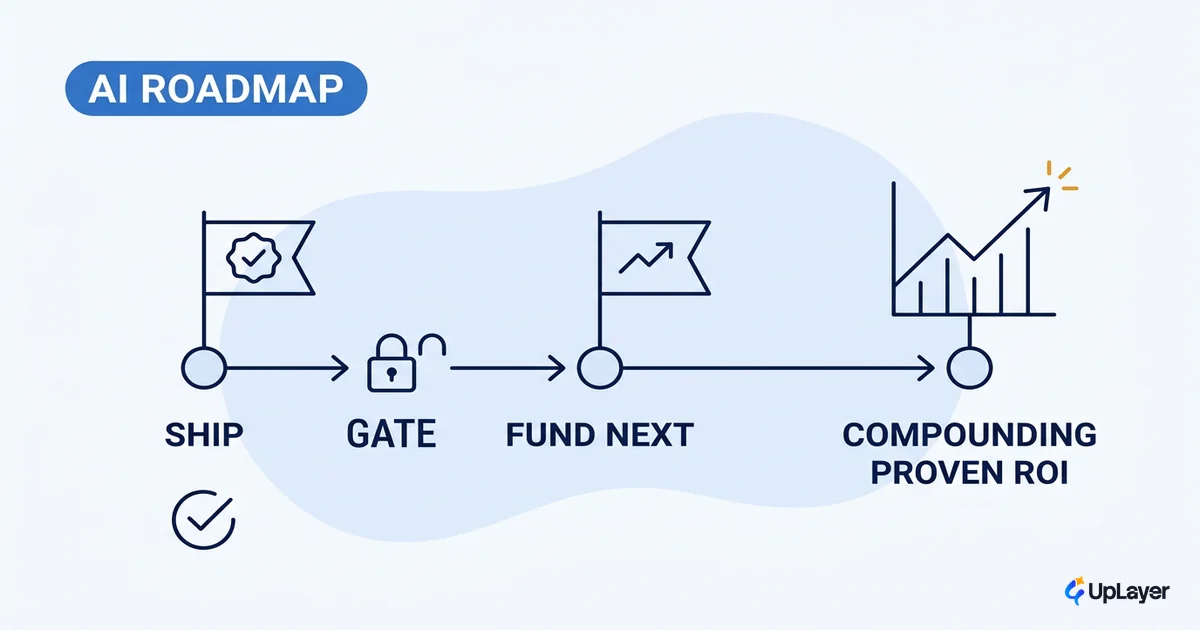
Most AI roadmaps are calendars of promises. Q1 ships a copilot, Q2 ships search, Q3 ships an analytics assistant, and somewhere in there a slide says "ROI." Nobody checks whether Q1 paid before Q2 starts. So the roadmap rolls forward on a calendar instead of on evidence, and the bill comes due later.
An AI adoption roadmap that holds up does the opposite. It treats every item as a metric bet with a baseline, a projected delta, and a check. You ship the highest-confidence bet first, read the real number against the baseline, and only then fund the next layer. The roadmap is a chain of proven returns, not a list of things you intend to build. If you want the unit underneath all of this, it is the same discipline you use to measure the ROI of a single AI feature, applied across a sequence.
This is the difference between a roadmap that survives a budget review and one that quietly gets defunded. We will walk the loop: define the bet, tie it to a number, sequence by confidence, validate each release, and report the delta before the next item ships.
What a proven-ROI AI adoption roadmap actually is
A proven-ROI AI adoption roadmap is an ordered list of metric bets where each release has to clear a check before the next is funded. The roadmap advances on results, not on the calendar.
That framing matters because the calendar version fails at scale. MIT's NANDA study of enterprise AI found that roughly 95% of generative AI pilots delivered little to no measurable impact on the bottom line, with only about 5% reaching real revenue acceleration. The gap was not model quality. It was integration and measurement, the part a promise-calendar skips.
The MIT report attributes the 95% failure to a learning gap, not a technology gap. Companies ship the feature and never instrument the return.
Here is the contrast in one view.
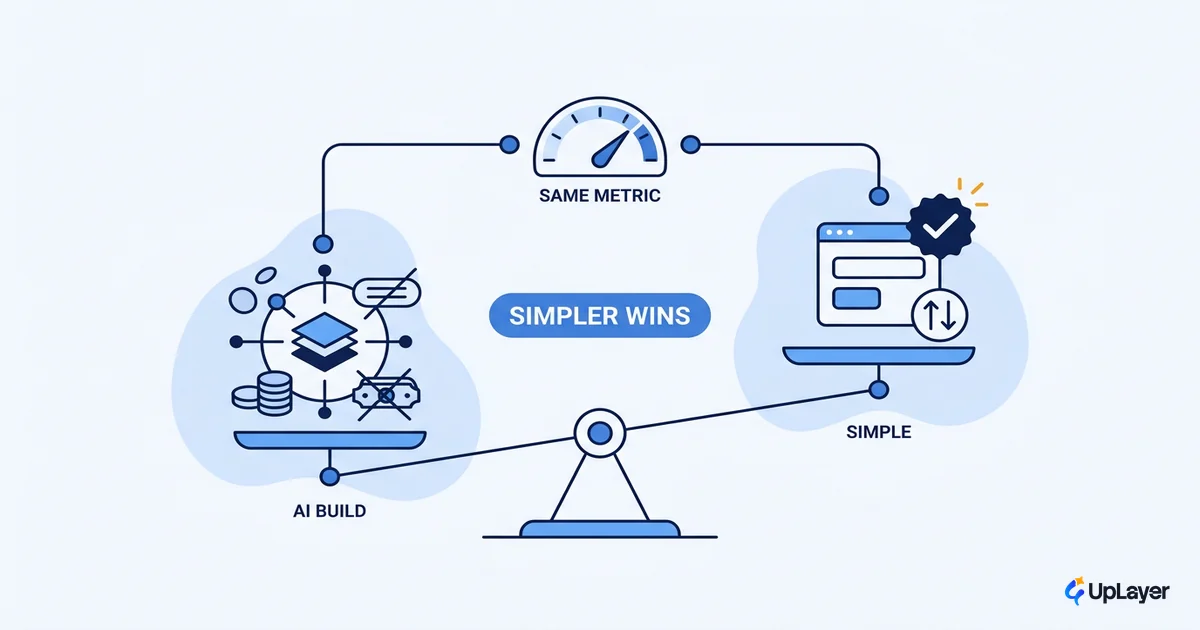
| Dimension | Promise-calendar roadmap | Proof-chain roadmap |
|---|---|---|
| Advances on | A date | A validated metric delta |
| Unit | A feature to build | A metric bet with a baseline |
| ROI shows up | Closing slide | The gate between releases |
| When it stalls | After spend, with no number | Early, on a failed check, cheaply |
| Funding review | Defensive | A record of returns |
The proof-chain version costs more discipline up front and far less money later. A bet that fails its check gets killed after one release, not after a year of compounding it into the next three items.
How do I tie an AI roadmap to ROI?
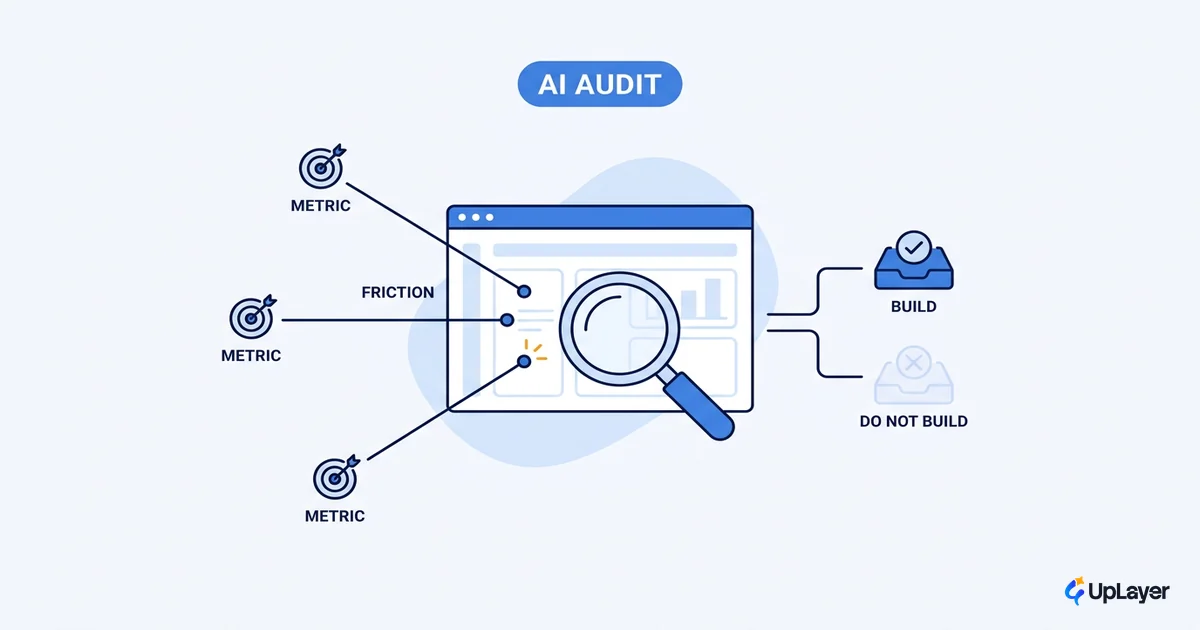
You tie a roadmap to ROI by making each item carry the same four facts before it gets built: the metric it should move, the current baseline, the projected delta, and the cost. No item enters the roadmap without them.
This is where the staged nature of AI returns helps you. Deloitte found that only about 15% of organizations using generative AI report significant, measurable ROI today, while roughly 38% expect it within a year, and nearly half use different timeframes for generative versus agentic returns. Returns arrive on a curve, so you measure release by release rather than betting the whole year on one launch.
Every roadmap item should reduce to a record like this.
| Item | Metric it should move | Baseline | Projected delta | Monthly cost | Check date |
|---|---|---|---|---|---|
| Onboarding copilot | Day-7 activation | 41% | +6 pts | $2,100 | T+30 |
| In-app answer search | Ticket deflection | 0% | +12% | $1,400 | T+30 |
| Churn-risk summary | Logo retention | 88% | +1.5 pts | $1,900 | T+45 |
Each row is a bet you can defend. If you cannot fill the baseline column, the item is not ready for the roadmap. It goes back to instrumentation first. An AI feature that ships to move a metric you do not yet track produces a number nobody can read.
Sequencing: ship the highest-confidence bet first
Order the roadmap by confidence times projected return, not by what demos best. The first release has one extra job: it has to produce a clean, believable win that funds the rest of the ai adoption strategy.
This is why sequencing is a money decision, not a product-taste decision. Google Cloud's 2025 ROI study reports that a 74% average of organizations now see a return on at least one use case, and the early adopters who embed and sequence their AI deliberately reach 88%. The teams capturing measurable value are the ones shipping into production and reading the result, not the ones still debating the plan.
Two sibling decisions sit next to this one, and they are not the same job:
- Building the list in the first place. If you have not yet picked the phases and the first layer, start by learning how to build the AI adoption roadmap itself.
- Ranking the backlog. To order the roadmap by projected return across your whole ai product roadmap, the ranked-bet method is its own piece.
This post is about what happens after the list exists and between shipped items: the validation gate. Sequencing feeds the gate; the gate decides whether the sequence continues.
How to validate each step of an AI roadmap
You validate each step with a release-and-check loop: set the baseline, ship behind a flag, isolate the variable, read the delta at the check date, then decide go or kill. The next item does not start until the current one clears.
The loop is short and the same every time.
for each roadmap_item:
    1. baseline   = current value of the target metric   # measured, not guessed
    2. ship       = release behind a flag to a cohort
    3. isolate    = hold a control; change one thing
    4. read       = delta = cohort_value - baseline at check_date
    5. decide:
         if delta >= projected_delta * 0.6  -> GO   (fund next item)
         elif delta is positive but small   -> ITERATE (one cycle, then re-decide)
         else                               -> KILL  (retire the layer, log why)
The 0.6 floor is a deliberate haircut: a bet does not have to hit the full projection to earn the next release, but it does have to move the number in the right direction by a meaningful amount. Anything that only moves feature-usage and not the real metric fails the check, no matter how good the demo looked.
WARNING
Shipping a roadmap item without a baseline is the most common way to lose the ROI argument. With no before-number, your after-number means nothing, and the bet becomes a story instead of a measurement. Set the baseline before you ship, not after.
Get the before-number right and the rest of the loop is arithmetic. The mechanics of that step are worth their own read on how to set a baseline before you ship.
What goes in the AI ROI report between releases
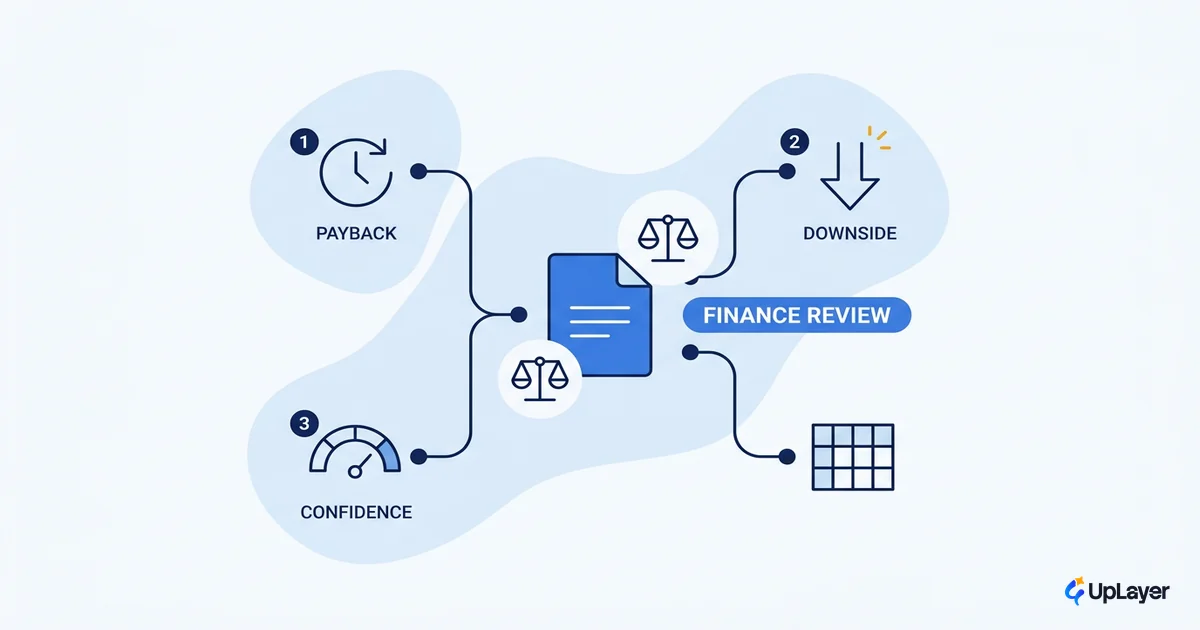
The ai roi report that funds the next release is four lines, not a deck: the baseline, the measured delta, the attribution method, and the go-or-kill decision. Finance approves the next item off those four lines.
Keep it honest and keep it short.
- Baseline. The metric value before the release, with the date and the cohort.
- Delta. The measured change, against a held control where possible.
- Attribution. What you isolated, and what you cannot rule out.
- Decision. Go, iterate, or kill, with the number that justified it.
Anything past those four lines is usually there to flatter the result. A vanity chart of feature clicks belongs nowhere near the funding decision. When the report is this tight, it travels: it is the same evidence you use to prove the AI ROI to leadership and the same evidence that defends the next line of the budget. Framed this way, even Gartner's projection that at least 30% of generative AI projects get abandoned after the proof of concept stops being your story, because you are killing weak bets on purpose and on schedule, not stalling on all of them by accident.
How to prove the AI roadmap is working
You prove the AI roadmap is working by showing the trend of validated deltas across releases, not by pointing at a single launch. One green check is a data point. Three in a row, each funding the next, is a working prove ai roi machine.
That trend is the artifact that keeps a roadmap funded. It says: this team ships, measures, and only continues when the number moves. As a Concept Demo, picture a four-release sequence where activation, deflection, and retention each clear their checks in turn. The projected compounding is modest per release and meaningful by the fourth, precisely because nothing weak was carried forward.
NOTE
Proof is a direction, not a single peak. A roadmap that posts smaller wins it can defend will outlast one that posts one big number it cannot.
The roadmap that survives the next budget review is the one that already paid for itself, item by item. Sequence your ai adoption roadmap so each release proves its return before the next is funded, and the plan stops being a promise you defend and becomes a record you point at.
TIP
Want to know which roadmap item will pay first? How the AX Audit works.