How to run an AI opportunity audit on your SaaS
An AI opportunity audit walks your existing SaaS surface, maps each friction point to a metric you already track, and ranks every candidate by projected ROI.
 Anamoul RoufAI ROI & Strategy8 min read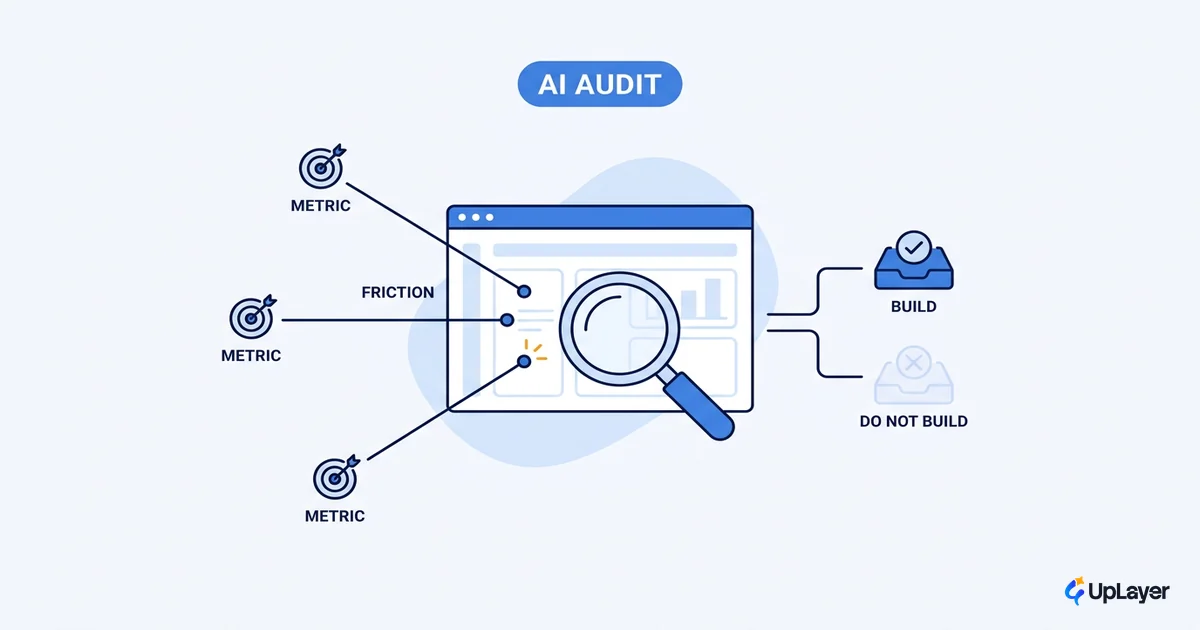
Your SaaS already works. The product ships, the funnel converts, and the backlog has a dozen tickets that all start with "add AI to." None of them tell you which one pays. That is the exact problem an AI opportunity audit solves: it walks the product you already have, finds the few places a supportive AI layer could move a number your board already watches, and ranks them so you build the ones that earn their slot.
Here is the contrarian part. The most valuable thing the audit produces is not the build list. It's the pile of things you decide not to build, ranked below the line on purpose. Most AI is theater, and the pressure to "do AI" on a mature product is how good teams ship features that demo well and move nothing.
This is the operational version of the discipline. If you want the general method first, run a structured AI opportunity assessment to see the five-step model in the abstract. This post applies that model to a specific, existing SaaS surface, ties every candidate to a metric, and hands back an artifact you can defend. The job is to decide which AI features to build on evidence, not enthusiasm.
What an AI opportunity audit actually is
An AI opportunity audit is a structured walk of your live product that maps each point of user friction to a metric you already track, prices the smallest AI intervention that could move it, and ranks every candidate by projected ROI. The output is two lists: a short stack worth building, and an explicit "do not build" pile. It is a filter, not a brainstorm.
The audit differs from a generic assessment in one way that matters: it runs against a real product, not a blank doc. An assessment can theorize about where AI belongs in a category. An audit names the actual screen, the actual metric, and the actual number. Same scoring discipline, scoped to the surface you ship today.
The reason the audit exists is the value gap, and the data on it is blunt. MIT's 2025 study, The GenAI Divide, found that 95% of enterprise generative AI pilots produced no measurable impact on profit and loss, and traced the failures to integration and a learning gap, not model quality. Gartner reached the same wall from the other side, predicting that at least 30% of generative AI projects would be abandoned after proof of concept by the end of 2025, citing unclear business value as a leading cause.
Access is not the bottleneck anymore. 78% of organizations reported using AI in 2024, up from 55% the year before, per Stanford's AI Index. When almost everyone has shipped something, the question is no longer whether you use AI. It's which opportunities you pick. The audit is how you pick.
Where can AI add value in my SaaS
Start with the surfaces, not the models. In an established product, value hides at the points where users stall, wait, or leave, because each of those points already maps to a metric you report. Walk the product in the order a user does and tag every friction point with the number it touches.
| Product surface | Where AI could sit | Metric it would move | Supportive-AI pattern |
|---|---|---|---|
| Onboarding | First-run guidance, setup summarizer | Activation rate | In-product copilot |
| Support | Ticket triage, answer drafting, deflection | Support cost per ticket | Classification, summarization |
| Core workflow | Inline assist on the slow, manual step | Time-to-value, feature adoption | Copilot, semantic search |
| Retention | Churn-risk flags for CSMs | Net retention | Triage, scoring |
| Expansion | Usage-based upsell prompts | Expansion revenue | Recommendation, summarization |
Every row anchors an AI opportunity to a metric you already track, which is the only way the candidate can later be scored. A friction point with no metric attached is not an opportunity. It's a guess wearing a roadmap. Notice that none of these patterns replace the core engine. Supportive AI sits above the product as a layer, so a model swap never takes the workflow down, and the audit can price each candidate without betting the architecture on it.
How do I audit my SaaS for AI opportunities
You run it in five steps, scoped to the product you already operate. The whole thing fits in a week for a team that knows its own funnel. You don't need a data science org. You need honesty about what each candidate is actually worth before anyone writes code.
- Instrument the metrics first. Confirm activation, retention, conversion, expansion, and support cost are actually measured today. If a metric is not instrumented, you cannot read the delta later, so it drops out of scope until it is.
- Walk the surface. Go screen by screen through the live product and mark every place a user stalls, waits, or churns. Each mark is a candidate location, tagged with the metric from the table above.
- Propose the smallest intervention. For each friction point, name the smallest AI feature that could plausibly move the number. A summarizer, a triage step, a copilot, a semantic search. Smallest version that could work, not the most impressive.
- Score by projected ROI. Estimate the metric move, your confidence in it, and the build cost including reliability. Multiply and divide. This is where the list finally gets a top and a bottom.
- Cut below the line. Draw a threshold. Everything under it goes in the documented "do not build" pile, named and dated so it doesn't sneak back next quarter.
Steps 2 through 4 are where teams cheat, so be strict. The whole point is to measure the ROI of an AI feature before it exists, not after it disappoints. Keep the scoring formula this plain on purpose.
opportunity score = (metric_impact x confidence) / build_cost

metric_impact = projected change in the tracked metric, normalized to dollars
                (e.g. a 2-point activation lift = $X in annual expansion)
confidence    = 0.1 to 1.0  (how sure are you the move happens at all)
build_cost    = design + build + ongoing reliability cost, in dollars

Build only candidates above your threshold.
Everything else is documented and shelved, not silently dropped.Score and rank each AI opportunity by projected ROI
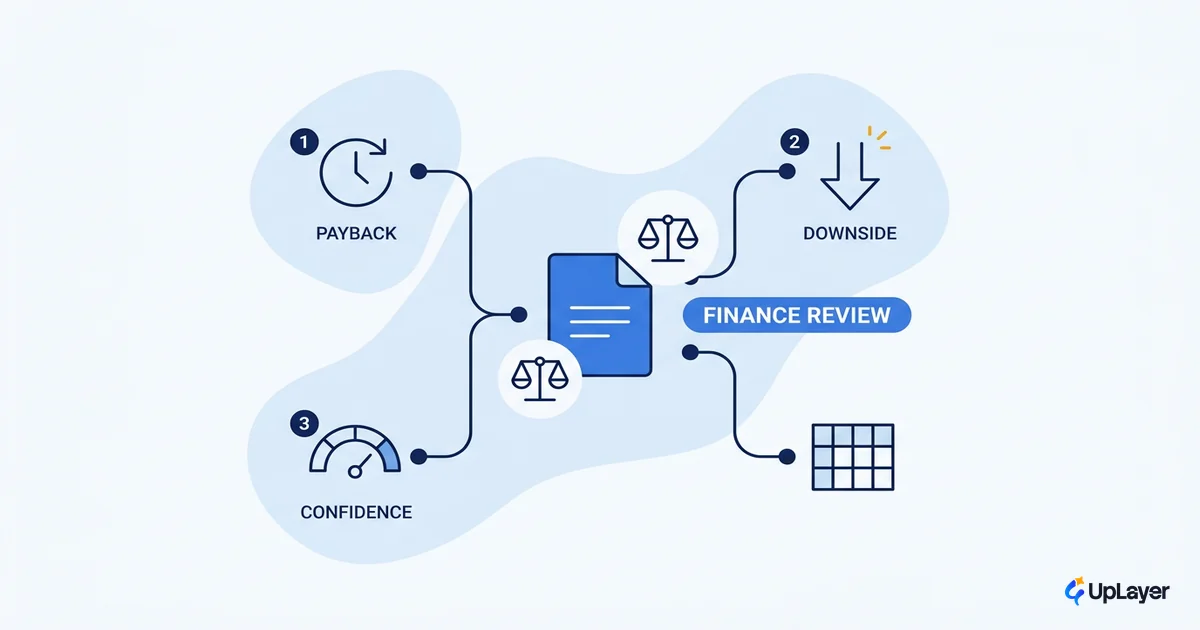
The scoring sheet is the artifact the audit hands back. One row per candidate, sorted by score, turning a debate about which AI feature is coolest into arithmetic about which one pays. Good AI use case prioritization is just this table applied consistently to every idea, including the one a senior person is attached to. The discipline of AI feature prioritization lives entirely in refusing to skip the math.
| Candidate | Metric it moves | Projected impact | Confidence | Build cost | Score | Verdict |
|---|---|---|---|---|---|---|
| Churn-risk copilot for CSMs | Net retention | >$140k retained/yr (projected) | 0.6 | $24k | High | Build first |
| Onboarding setup summarizer | Activation | +6 pts activation (projected) | 0.5 | $18k | Medium | Build next |
| Support triage classifier | Support cost | -12% cost/ticket (projected) | 0.4 | $20k | Medium | Hold |
| Generative "ask anything" chatbot | None named | Unclear | 0.2 | $30k+ | Low | Do not build |
The numbers above are a Concept Demo of the method, framed as projected, not achieved. The shape is the lesson: the chatbot everyone keeps asking for sits at the bottom because it has no named metric and the lowest confidence. That is the audit doing its job.
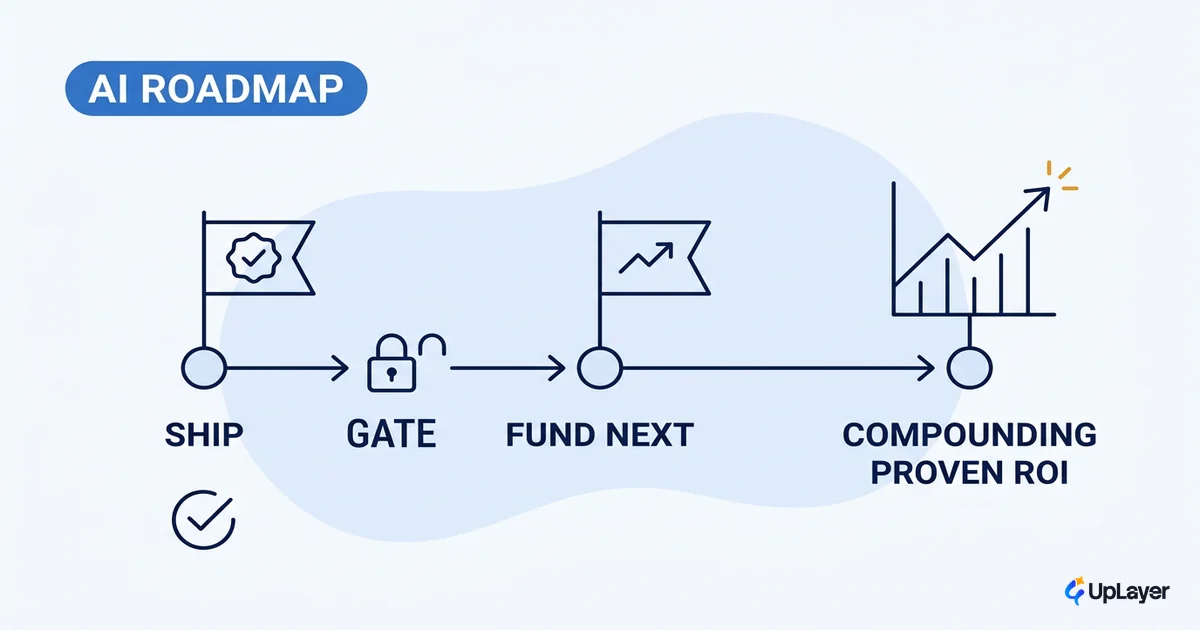
The evidence says cutting hard is the winning habit, not listing wide. BCG found that AI leaders pursue about half as many opportunities as their less advanced peers and expect more than twice the ROI for it, with software firms among the highest concentration of leaders.
Leaders pursue, on average, only about half as many opportunities as their less advanced peers ... and they expect more than twice the ROI. (BCG, Where's the Value in AI?)
If your audit leaves you with more ideas than you started with, it failed. A working AI value framework produces a shorter list, not a longer one.
Readiness is a gate, not the goal
Before a candidate earns a build slot, three things have to be true about the live product. The metric is instrumented so you can read the delta. The data the feature needs is actually accessible. And the surface can tolerate a wrong answer, or has a human in the loop where it can't. An AI readiness assessment that stops at "do we have the data" misses the point, because readiness re-ranks the list, it doesn't replace it.
Running an AI audit for an established product, readiness usually moves things down, not up. A candidate with a huge projected impact and a broken metric pipeline drops, because you can't yet move a metric you can't read. A candidate on a high-trust surface (anything touching money, compliance, or an irreversible action) needs reliability guardrails priced into its build cost, which lowers its score. Reliability is not a tax here. It's the lever that protects the metric you were trying to move, since one confidently wrong answer on a trust surface can cost more adoption than the feature was ever going to win.
WARNING
Define the metric before the model. If a candidate can't name the number it moves and the size of the move, it is not an opportunity yet. It's a hope, and a mature product has no slack for hopes.
What the audit should tell you not to build
The "do not build" pile is the highest-value output of the whole exercise, and it's the part every vendor audit quietly skips, because saying no to a build is saying no to revenue. We do it anyway. Shipping the wrong AI feature into a product people already rely on costs more than the build. It costs the trust users lose the first time the model is confidently wrong on a surface they trusted.
Three kinds of candidate usually belong below the line:
- No named metric. If nobody can say which number it moves, it can't be scored, so it can't be ranked.
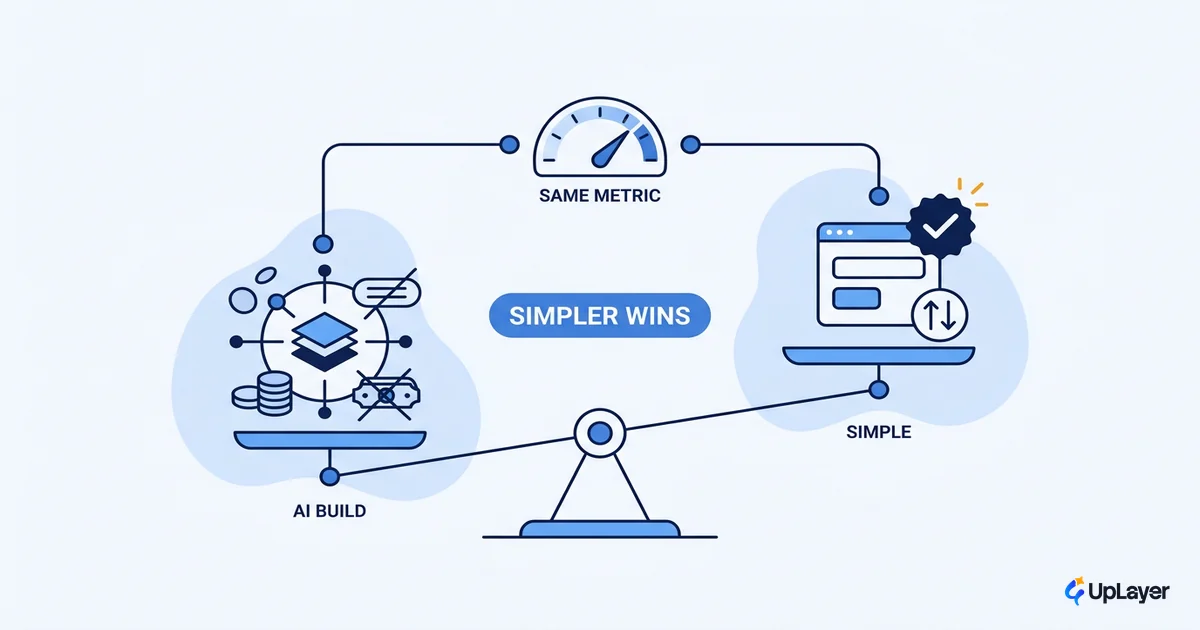
- A simpler fix wins. When a rule, a sort, or a form moves the same metric for a tenth of the cost, the AI version is theater.
- Trust risk outweighs the upside. On a high-trust surface, one hallucination does more damage than the projected gain is worth.
Knowing what stays in this pile is the same skill as knowing what ships. They are two ends of one ranked list. Run the AI opportunity audit this way and the next AI feature you put into your SaaS will be one you can defend with a number, not a demo, and the things you skipped will be documented choices instead of quiet regrets.
TIP
How the AX Audit works. We run the audit on your product, rank every candidate by projected ROI, and hand back the "do not build" pile too. Find AI worth 3x the fee, or it's free.