How to decide which AI features to build
A scoring framework for deciding which AI features to build. Rank every idea by projected ROI, reliability, and effort, then build only the ones that pay off.
 Shahriar P. ShuvoAI ROI & Strategy10 min read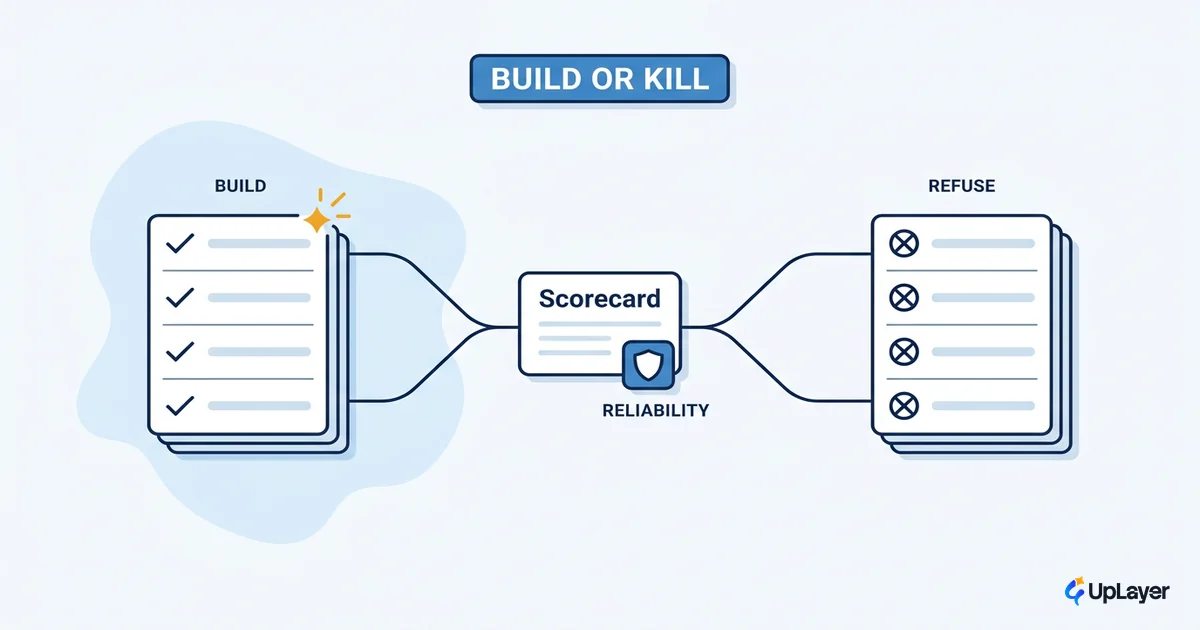
Most AI features move nothing. They demo well, ship to applause, and then sit in the product with single-digit usage while the metric they were supposed to lift stays flat. That is why deciding which AI features to build is the highest-leverage call your product team makes this year. The question is not whether your SaaS should add AI. The question is which one or two ideas to greenlight when a wrong call costs you a quarter and a real chunk of budget.
The teams that win do not pick the most impressive idea. They pick the idea that scores highest against a number they already care about, that they can ship reliably, and that costs less to build than it returns. Before you score anything, it helps to know how to measure the ROI of an AI feature so the inputs to your ranking are real numbers, not optimism.
This is the prioritization piece for the rest of the cluster. You get an original scoring framework you can run on your own backlog this week, a worked example that shows how to read the results, and a kill list of the features to drop before they reach a sprint. The goal is a ranked list and a defensible verdict, not a longer roadmap.
Start with the metric you already track, not the feature
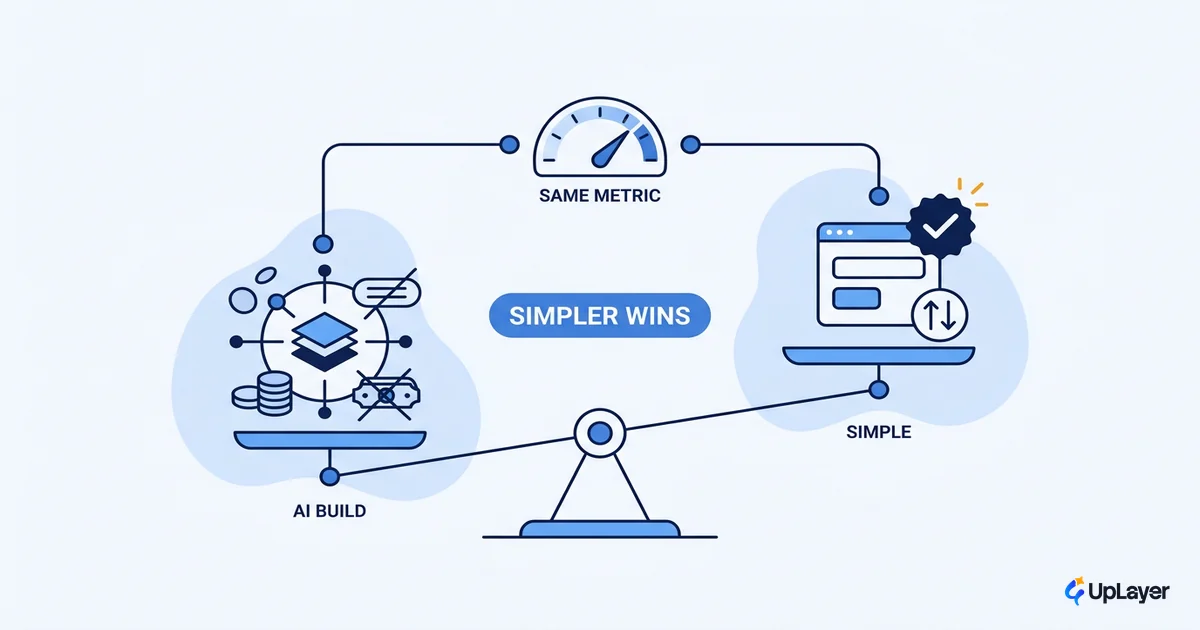
The selection error happens at the very first step: teams start from the idea. Someone says "we should add a copilot," and the whole conversation is now about copilots. Start from a number instead. Pull up a metric already on a dashboard your leadership reads every week: churn, activation rate, time-to-first-value, support ticket resolution time, conversion on a key flow.
This reframe matters because the data on AI projects is brutal when there is no metric anchoring the work. In MIT's State of AI in Business 2025 report, about 95% of enterprise generative AI pilots showed no measurable impact on the bottom line, and only around 5% produced rapid revenue acceleration. The report's own diagnosis is telling: the failures are not about model quality. They are about integration and selection. Teams pick features that never connect to a number anyone owns.
The 95% failure rate for enterprise AI solutions represents the clearest manifestation of the GenAI Divide. (MIT NANDA, The GenAI Divide: State of AI in Business 2025)
So before an idea earns a score, it has to name its metric. If a proposed AI feature cannot point at a number you already track and say "I expect to move this by roughly X," it is not ready to be ranked. That single rule kills more bad ideas than any framework, and it is the foundation of a sane ai product strategy.
Finding those metric-anchored candidates in the first place is its own pass: an AI opportunity audit of your SaaS walks your existing product surface, ties each friction point to a number you already track, and hands you a ranked shortlist to score here.
There is a practical reason to insist on an existing metric rather than a new one. A metric already on a dashboard has a baseline, an owner, and a history. You can read the delta the week after you ship and know whether the line moved. A brand-new metric invented to justify the feature has none of that. It is unfalsifiable by design, which is exactly why teams reach for it when the real numbers are not cooperating. The discipline is simple: pick the number first, confirm someone already watches it, then ask which AI idea would move it most.
A scoring framework for which AI features to build
Here is the framework. To decide which AI features to build, score every idea on four axes and combine them into one number. We call it the IRE score, for Impact, Reliability, and Effort, with confidence folded in.
IRE score = (Metric Impact x Confidence) / (Reliability Risk x Effort)

Metric Impact     1-5   how much the target metric moves if this works
Confidence        0-1   how sure you are the projection holds (evidence, not hope)
Reliability Risk  1-5   blast radius when the model is wrong, and how often
Effort            1-5   build months, in person-months, until it ships
Higher is better. A feature that moves a metric a lot, that you are confident about, that fails quietly, and that ships fast will score high. A feature that moves a metric a little, that you are guessing about, that fails loudly in front of customers, and that takes half a year will score near zero. That is the point.
If this looks familiar, it is a deliberate evolution of the RICE scoring model that Intercom popularized for product roadmaps. RICE scores Reach, Impact, Confidence, and Effort. It is a good model. It was built before generative AI, so it has no axis for the one risk that defines AI features: being wrong in public. A search filter that breaks shows zero results. An AI summary that breaks invents a number a customer then quotes to their boss. The reliability axis is the difference between classic ai feature prioritization and prioritizing AI specifically.
Here is what each axis means in practice.
| Axis | What it measures | Score 1 (low) | Score 5 (high) |
|---|---|---|---|
| Metric Impact | Expected movement in the target metric | Marginal nudge | Material, visible swing |
| Confidence | Strength of the evidence behind the projection | A hunch | Baseline data and a comparable result |
| Reliability Risk | Damage when the model is wrong, times how often | Wrong is invisible and rare | Wrong is public and frequent |
| Effort | Person-months to ship, not to prototype | Days | A quarter or more |
The escape valve people miss: Reliability Risk and Effort are in the denominator on purpose. A modest, boring feature with a 1 on both can outrank a flashy feature with a 5 on impact. That asymmetry is what protects you from theater.
How to prioritize AI features once you have the scores
Once every idea has an IRE score, you sort the list and read it from the top. That is the whole of how to prioritize AI features: the ranking does the arguing for you, and you stop relitigating opinions in a room. Here is a worked example for a typical B2B SaaS. These are illustrative ideas, not UpLayer clients, and every number is a projection labeled as such.
| Idea | Metric Impact | Confidence | Reliability Risk | Effort (mo) | IRE Score |
|---|---|---|---|---|---|
| In-product copilot that answers anything | 5 | 0.5 | 4 | 4 | 0.31 |
| Smart triage that routes incoming tickets | 3 | 0.8 | 2 | 2 | 0.60 |
| Auto-summary of long records on open | 3 | 1.0 | 1 | 1.5 | 2.00 |
The open-everything copilot scores worst, and that is the lesson. It is the idea every board asks for. It has the widest surface, the lowest confidence (you cannot project what "answer anything" is worth), the highest reliability risk (it will be wrong in public), and the largest effort. Impressive in a demo, last in the ranking. The auto-summary wins precisely because it is narrow, confident, low-risk, and cheap.
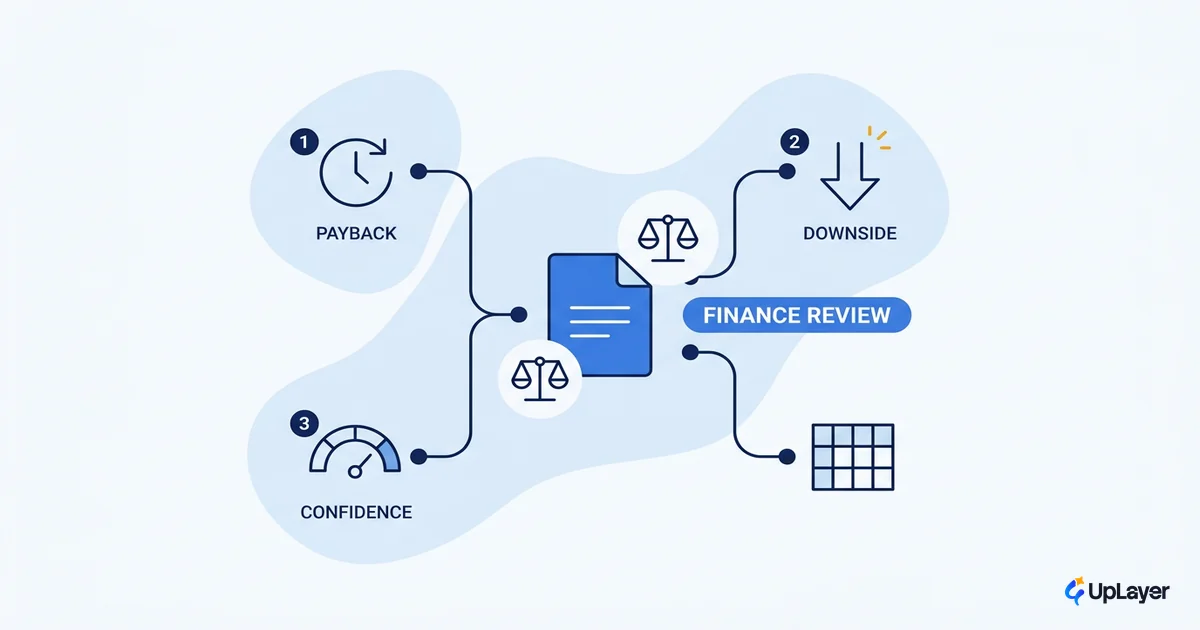
The cost of getting this wrong is not abstract. Gartner has predicted that at least 30% of generative AI projects will be abandoned after proof of concept by the end of 2025, citing poor data quality, weak risk controls, escalating costs, and unclear business value. Gartner also pegs typical generative AI deployment costs between $5 million and $20 million. You do not need to be at that scale to feel it. The point is that effort and reliability are real costs, and a scoring model that ignores them sends you straight into the abandoned-pilot statistic. For a deeper run at the math, see how to prioritize AI features by projected ROI.
Which AI features to kill or skip
A ranked list is only half the job. The other half is the kill list, and saying no out loud is the part most teams skip. This is the heart of ai use case prioritization: deciding what not to build is as valuable as deciding what to build, because every idea you kill returns a quarter of engineering time to something that pays.
Four patterns belong on the kill list almost every time.
- The open-ended copilot with no job. "Ask anything" has no metric, no confidence, and an unbounded reliability surface. Replace it with a narrow assistant tied to one task and one number.
- AI for a metric you do not track. If you cannot baseline it, you cannot prove it moved. Build the measurement first or pick a different idea.
- The feature a rule or a filter would solve. If a deterministic lookup, a sort, or a saved view gets you 80% of the value with zero hallucination risk, the AI version is a liability dressed as innovation.
- Anything where being wrong is unrecoverable. Auto-sending, auto-deleting, auto-charging. If a confident wrong answer causes harm a user cannot undo, the reliability risk caps the score no matter how high the impact looks.
WARNING
The most-requested AI feature is usually the one to kill first. The open-everything copilot demos beautifully and scores worst on every axis that matters. Build the boring summary that moves a number, not the impressive chat box that moves a screenshot.
For the full version of this list with more patterns and the reasoning behind each, read the AI features you should not build. The discipline is the same: rank by projected roi, then cut everything that cannot earn its place.
How do I choose which AI feature to build first?
Build the highest IRE score that touches a metric tied to revenue or retention. When two ideas score close, break the tie toward the one with lower reliability risk, because a quiet failure buys you time to improve while a loud one burns trust you may not get back.
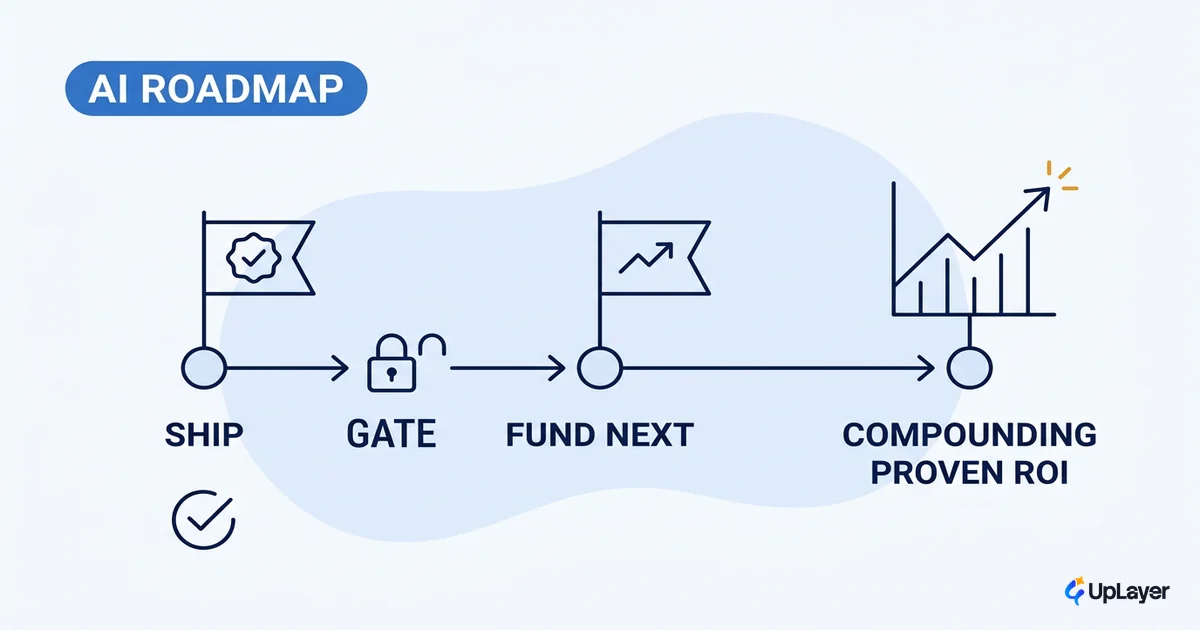
Ship it narrow. Do not build the platform version. Build the single, scoped feature, point it at the one metric, and instrument the before-and-after so you can read the delta in weeks, not quarters. A small win you can prove beats a large win you can only assert. Once the number moves, you have both the evidence and the credibility to fund the next item on the list, and your confidence scores on everything below it just got more honest.
That sequence (one feature, one metric, measured delta, then decide again) is also what keeps an ai product strategy from drifting back into a wish list. Each shipped feature either earns the next investment or tells you to stop.
A quick note on confidence, because it is the axis people fudge. Confidence is not how excited you are. It is how much evidence you have that the projection holds. A comparable feature you already shipped, a clean baseline, a small prototype that an early cohort actually used: those raise confidence. A slide deck and a strong opinion do not. When you are honest about confidence, the framework self-corrects. Speculative ideas score lower until you do the cheap work to de-risk them, and that cheap work (a fake-door test, a baseline measurement, a one-week prototype) is almost always worth doing before you commit a quarter of engineering. The score tells you where to spend your validation budget before it tells you where to spend your build budget.
Which AI feature should a SaaS build, and how to rank AI feature ideas by ROI
So which AI feature should a SaaS build first? The one that scores highest on a metric you already report to your board, ships in weeks, and fails quietly when it fails. In practice that is almost never the headline feature. It is the supportive layer: the summary, the draft, the suggestion, the triage. Supportive AI sits above your core engine, moves a real number, and stays out of the way when the model is uncertain.
The method for how to rank AI feature ideas by ROI is the same loop every time. Project the return before you write code, score the idea against the cost, and only build when the projected roi clears the build. That projection step is worth doing rigorously, so project the ROI before you write code rather than scoring on instinct. A backlog ranked this way is short, defensible, and boring in the best sense. It contains the few features that will actually pay, and none of the ones that only demo well.
Deciding which AI features to build is not a creativity problem. It is a ranking problem, and the teams that treat it that way ship less AI and get more from it. Score every idea against a metric and a cost, build the top of the list, kill the rest without apology, and let the measured delta tell you what to fund next. Do that for a few cycles and you stop guessing about which AI features to build at all, because the scoreboard already answered.
TIP
Want a ranked, ROI-scored shortlist of the AI features worth building in your product? How the AX Audit works.