How to prioritize AI features by projected ROI
How to prioritize AI features in five steps: tie each idea to a metric you already track, score it by projected ROI, and ship the cheapest proof first.
 Sohanur RahmanAI ROI & Strategy7 min read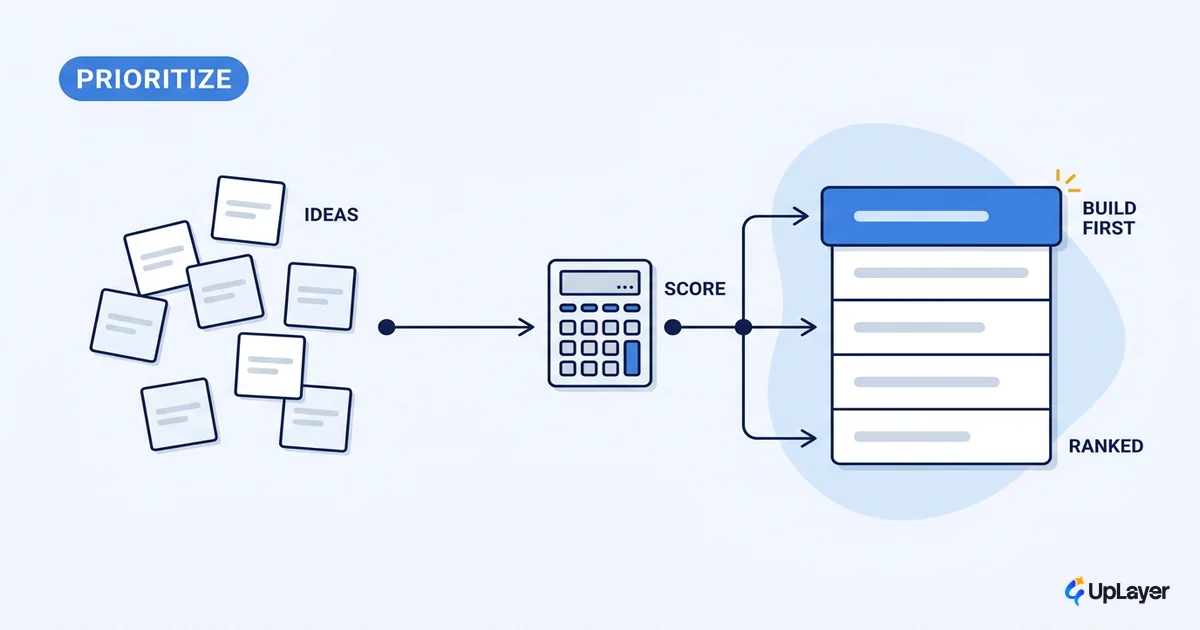
You have a list of ten AI ideas, a board asking when "the AI" ships, and no defensible reason to build one before another. That is the moment most teams guess. They pick the idea with the loudest internal champion or the flashiest demo, build it, and watch it move nothing.
Learning how to prioritize AI features is not a strategy debate. It is arithmetic. The moment you tie each idea to a metric you already track and score it by expected return, the order picks itself, and the argument in the room turns into a number you can defend. This is the step-by-step walkthrough: a procedure you can run this week to turn a pile of ideas into a build sequence, where the highest-confidence proof ships first.
This piece sits inside the broader decision of which AI features to build. That cornerstone covers the build-or-skip judgment. Here we assume you already have candidates worth considering, and you need the order.
Why most AI feature lists never get ordered
Unordered lists do not stall because teams are lazy. They stall because every idea sounds reasonable, and without a shared number, ranking becomes a contest of opinions. So nothing gets killed, three pilots run at once, and none of them prove anything.
The cost shows up downstream. Gartner projected that at least 30% of generative AI projects would be abandoned after proof of concept by the end of 2025, citing unclear business value and escalating cost among the reasons.
At least 30% of generative AI projects will be abandoned after proof of concept by the end of 2025, due to poor data quality, inadequate risk controls, escalating costs or unclear business value.
A POC gets abandoned when nobody decided, before the build, what number it was supposed to move. Prioritization done right front-loads that decision. You rank by expected return first, then you build, so the work that ships is the work most likely to pay.
How to prioritize AI features: the five-step walkthrough
The whole procedure is five steps. Run them in order.
- Tie every idea to one metric you already track.
- Score each feature on expected return, not vibes.
- Rank the list and sequence the build.
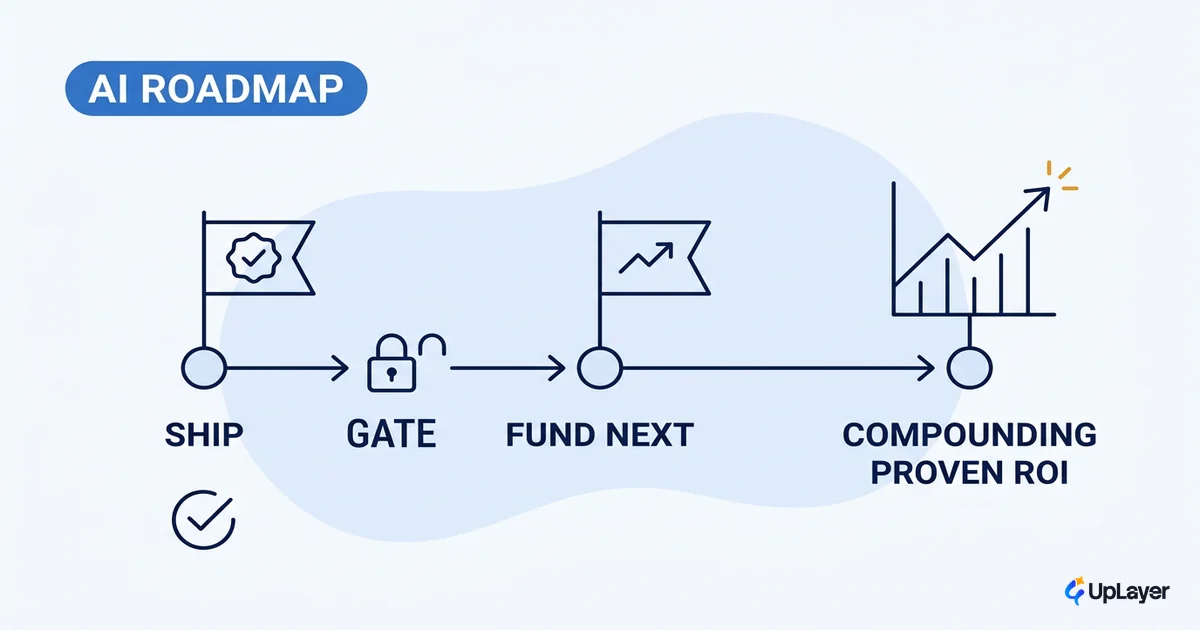
- Build the first layer and measure the delta.
- Re-score on real data and kill what did not pay.
Steps one and two are where the ranking is won or lost. The rest is execution and discipline. Each step below is short on theory and long on what you actually do.
Step 1: Tie every idea to one metric you already track
Before any scoring, give every AI idea a single owner metric: retention, activation, conversion, or expansion. If an idea cannot name the metric it moves, it does not enter the ranking. It goes to a parking lot.
This step matters more than the math that follows it. RAND found that the most common reason AI projects fail is that the team misunderstands or miscommunicates the problem the AI is meant to solve. A feature tied to "make the product smarter" has no problem statement and no metric. A feature tied to "cut time-to-first-value so activation rises" has both.
Use a metric you already report, not one you would have to start tracking. You want the baseline to exist before the build, so the delta is measurable the day the feature ships.
| AI idea | Owner metric | Why this metric |
|---|---|---|
| In-app answer assistant | Activation | Cuts time to first successful action |
| Churn-risk summary for CSMs | Retention | Flags at-risk accounts before renewal |
| AI-drafted onboarding emails | Activation | Speeds setup completion |
| Smart search over the docs | Expansion | Surfaces features users miss |
| "Explain this chart" tooltip | (none yet) | Parking lot until a metric is named |
Step 2: Score each feature on projected ROI, not vibes
Score every surviving idea on the same scale so you can compare them at a glance. Generic product scoring uses the RICE framework, which ranks ideas as reach times impact times confidence, divided by effort, to get total impact per unit of work. That lineage is sound, but AI features need two inputs the standard model leaves out: recurring cost and reliability risk.
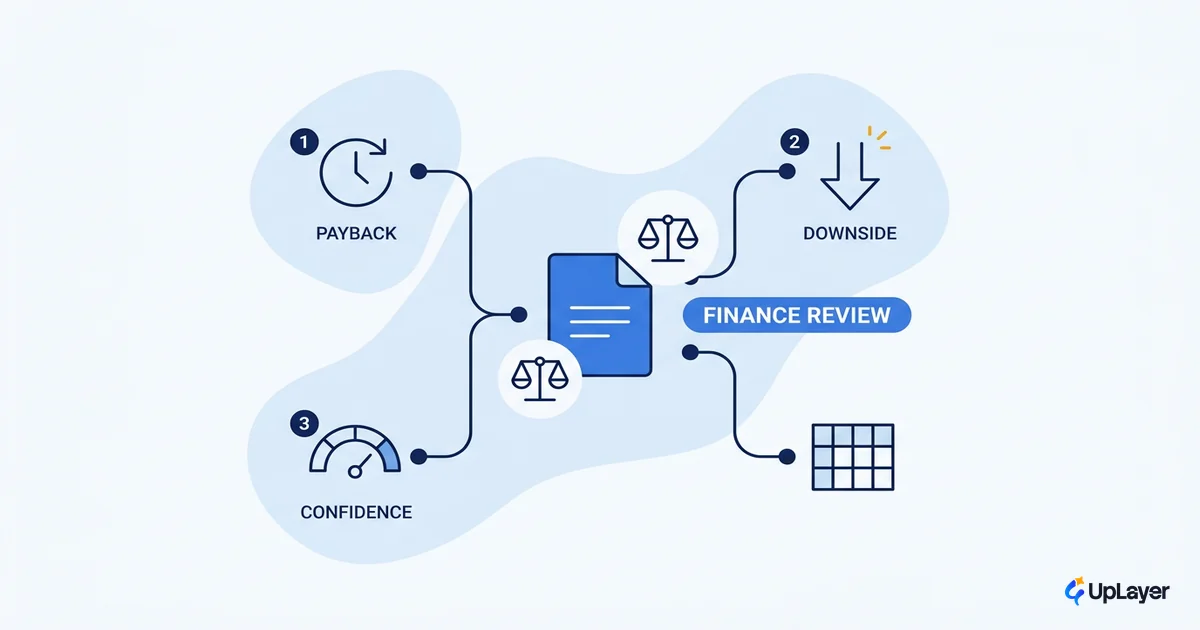
A backlog feature is built once. An AI feature keeps charging you for inference on every call, and a model that hallucinates can push the metric backward instead of forward. Both belong in the score.
Projected ROI score =
  (metric_impact x confidence x adoption)   ← upside, weighted by how sure you are
  ----------------------------------------
  (build_effort + recurring_cost + risk)    ← total cost of owning it, not just shipping it

metric_impact   = projected delta on the owner metric, in dollars or points
confidence      = 1.0 high, 0.8 medium, 0.5 low  (how good is the estimate)
adoption        = realistic % of users who will actually use it
build_effort    = person-months to ship the first version
recurring_cost  = monthly inference + maintenance, normalized
risk            = reliability and trust penalty if the model is wrong
Keep the estimates rough. The goal is a relative ranking, not a forecast. For the full scoring model and how to weight each input, see the full AI feature prioritization framework, which goes deeper on the math than this walkthrough does. Here, the point is that every idea gets the same arithmetic, so the order stops being a matter of who argued hardest.
Step 3: Rank the list and sequence the build
Sort by score, high to low. Then do one more pass: resequence so the highest-confidence ROI ships first, even if a lower-confidence idea scored slightly higher. A prioritization matrix works because it lets you base the order on objective criteria instead of subjective opinions, and confidence is part of that objectivity.
The first thing you build is not the biggest bet. It is the cheapest credible proof that a model moves a metric you already track. Here is a worked example, with projected numbers for illustration (a Concept Demo, not a real client).
| Feature | Metric impact | Confidence | Recurring cost | Score | Rank |
|---|---|---|---|---|---|
| In-app answer assistant | High | 0.8 | Medium | 8.4 | 1 |
| Churn-risk summary | High | 0.5 | Low | 6.1 | 2 |
| Smart docs search | Medium | 0.8 | High | 4.2 | 3 |
| AI-drafted emails | Low | 0.8 | Low | 3.0 | 4 |
The assistant ranks first not because it is the most ambitious idea but because it pairs a high projected impact with high confidence and a containable cost. It is the safest proof. Build that, prove the model, and you have earned the right to fund rank two.
Step 4: Build the first layer and measure the delta
Ship the top-ranked feature as a supportive layer above your core product, not as a rebuild of it. A copilot, an assistant, or a summary sits on top of the engine you already trust, so a bad model output is a contained miss rather than an outage.
Then measure. Compare the owner metric against its pre-launch baseline. This is the entire point of the order: the first ship is the one most likely to produce a clean, defensible number, and that number funds the next build. The mechanics of attributing the lift belong in how to measure the ROI of an AI feature, which covers baselines and isolation properly.
Modest, provable wins are the realistic target. McKinsey's 2025 survey found that meaningful bottom-line impact from AI is still rare: only 39% of organizations attribute any EBIT impact to AI, and most of those put it below 5%. One feature tied to one metric, measured honestly, beats a portfolio of pilots nobody can score.
WARNING
The trap is recurring cost. A feature that scored well on day one can go underwater once inference volume scales and the expected return never materializes. Re-check the cost line every quarter, and treat a model that drags the metric backward as a failure to roll back, not a feature to defend.
How to prioritize AI features for a roadmap
Turning the ranked list into a roadmap is the same arithmetic on a calendar. Take the sorted list, slot the top one or two items into the current quarter, and leave the rest in priority order. Do not promise the whole list. Promise the next proof.
Deciding which AI features to build first is now a sorted list, not a meeting. A simple AI ROI calculator (a spreadsheet with the Step 2 formula) keeps the roadmap honest as estimates change, which is the right tool for ongoing AI use case prioritization. When a stakeholder pushes a pet idea up the queue, you point at its score and its missing metric rather than litigating taste.
| Quarter | What ships | Why now |
|---|---|---|
| Q1 | Rank 1 (highest-confidence proof) | Prove the model, get a clean number |
| Q2 | Rank 2, if Q1 paid off | Funded by the Q1 delta |
| Backlog | Everything else, in score order | Re-scored before it moves up |
Common questions about prioritizing AI features
How do I decide the order to build AI features? Score each one on metric impact over total cost (build plus recurring plus risk), sort high to low, then move the highest-confidence idea to the front. Order by certainty of proof, not size of bet.
What comes first when prioritizing AI features? Naming the metric. An idea without an owner metric you already track does not get scored. It waits in a parking lot until someone defines what it would move.
Do I need a heavy framework for this? No. A spreadsheet with the five steps beats a portfolio tool nobody updates. The discipline is in re-scoring on real data and killing what did not pay, not in the sophistication of the model.
Knowing how to prioritize AI features is what separates a roadmap that compounds from a graveyard of abandoned pilots. Rank by projected ROI, ship the cheapest credible proof first, measure the delta against a metric you already track, and let each win fund the next. The order stops being an argument the day it becomes a number.
TIP
Want the ranked, ROI-scored list built for your product instead of a generic template? How the AX Audit works.