AI feature prioritization without the guesswork
AI feature prioritization is arithmetic, not opinion. Score each idea on projected metric impact and cost, discount for confidence, then sort the list.
 Shahriar P. ShuvoAI ROI & Strategy8 min read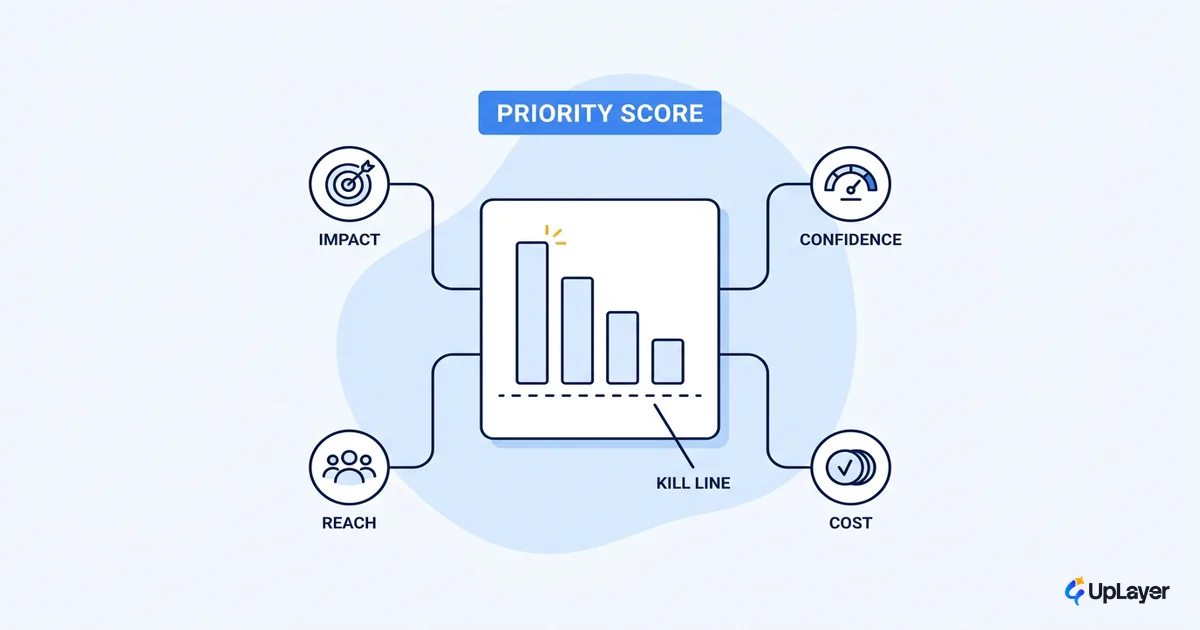
Most AI roadmaps are ordered by whoever spoke last. Someone demos a chatbot, someone else wants summarization, a board member read about agents, and the backlog gets sorted by volume and seniority instead of value. The meeting reconvenes a week later and reopens the same argument. AI feature prioritization is the thing that ends that loop, and it is closer to arithmetic than to debate.
The fix is not a better meeting. It is a score. Give every AI idea a number built from projected metric impact and cost, then sort the list. Once the number exists, the order stops being a matter of opinion and starts being a matter of math. This post is the scoring layer of the decision: how to turn a pile of AI ideas into a ranked, defensible list, and how to draw the line below which an idea does not get built. It sits under our cornerstone on deciding which AI features to build, and goes deep on the mechanics that cornerstone introduces.
AI feature prioritization is a scoring problem, not a meeting
The short version: score every AI idea on projected metric impact and cost, then sort descending. The team's job is to fill in the inputs, not to argue about the output.
Meetings lose this argument for predictable reasons. The loudest opinion wins (the HiPPO problem), the most recent demo feels most urgent (recency bias), and the idea with the biggest addressable audience feels safest even when it moves nothing. None of those are evidence. They are vibes wearing a suit. A score does not remove judgment. It moves judgment to the inputs, where it is visible and can be challenged, instead of leaving it in a vote where it cannot.
This matters because unscored AI work has a habit of dying late and expensively. Gartner projects that at least 30% of generative AI projects will be abandoned after proof of concept by the end of 2025, citing unclear business value among the leading causes.
A project abandoned after proof of concept is a prioritization failure dressed up as a technical one. The value was never scored, so nobody noticed it was low until the bill arrived.
Prioritization is arithmetic once you stop arguing about opinions. The rest of this post is the arithmetic.
What framework prioritizes AI features (and why generic ones break)
Two product frameworks already do most of the work, and you should borrow from both before inventing anything.
The first is the RICE scoring model from Intercom, which scores each idea as Reach times Impact times Confidence, divided by Effort, to get "total impact per time worked." The second is Weighted Shortest Job First, which divides Cost of Delay by Job Size. Both encode the same instinct: value per unit of effort, ranked high to low. That instinct is correct.
They break on AI in two specific places.
First, the impact term cannot be a vibe. "High impact" means nothing you can sort on. For AI, impact has to be expressed as projected movement on a metric you already track: churn, activation, conversion, expansion, support cost. If the idea cannot be tied to one of those, it is not ready to be scored, and a feature you cannot connect to a metric is the first thing to question, not the first thing to build.
Second, confidence is the dominant variable, not a footnote. In a normal RICE score, confidence nudges the result. In AI, model behavior is probabilistic, the data may not support the use case, and the "impact" is a projection two steps removed from anything observed. Confidence is where most of the risk lives, so it deserves real weight. This is the part generic frameworks under-price, and it is why an AI value framework built specifically around these inputs beats a borrowed PM template.
How to score AI features against each other
Here is the mechanism for how to score AI features against each other. Use four inputs, each normalized to a comparable scale so the multiplication is honest.
- Metric impact (1 to 10): projected movement on the one metric this feature targets, sized against your current baseline. A feature projected to cut churn by two points scores higher than one projected to cut it by half a point.
- Confidence (0.1 to 1.0): how much you trust the impact estimate, given the data you have and how the model behaves on it. Be stingy. New, unproven AI on thin data rarely clears 0.5.
- Reach (1 to 10): the share of active users who actually touch this feature in a normal week. A power-user-only feature caps low here.
- Cost (1 to 10): total build and run cost, where build effort plus inference and monitoring both count. Higher number means more expensive.
The score is value over cost, with confidence applied as a discount on the value:
priority_score = (metric_impact × confidence × reach) ÷ cost

# worked example, three projected AI ideas on a churn-heavy B2B SaaS
# (illustrative inputs, not measured results)

inline_summarizer   = (7  × 0.8 × 9) ÷ 4   = 12.6
predictive_churn_flag = (9 × 0.5 × 4) ÷ 6  = 3.0
autonomous_agent    = (8  × 0.3 × 6) ÷ 9   = 1.6
Run every idea through the same arithmetic and you get a sortable column. The projected example above produces this ranking:
| Rank | AI idea | Metric impact | Confidence | Reach | Cost | Priority score |
|---|---|---|---|---|---|---|
| 1 | Inline summarizer (activation) | 7 | 0.8 | 9 | 4 | 12.6 |
| 2 | Predictive churn flag (churn) | 9 | 0.5 | 4 | 6 | 3.0 |
| 3 | Autonomous support agent (cost) | 8 | 0.3 | 6 | 9 | 1.6 |
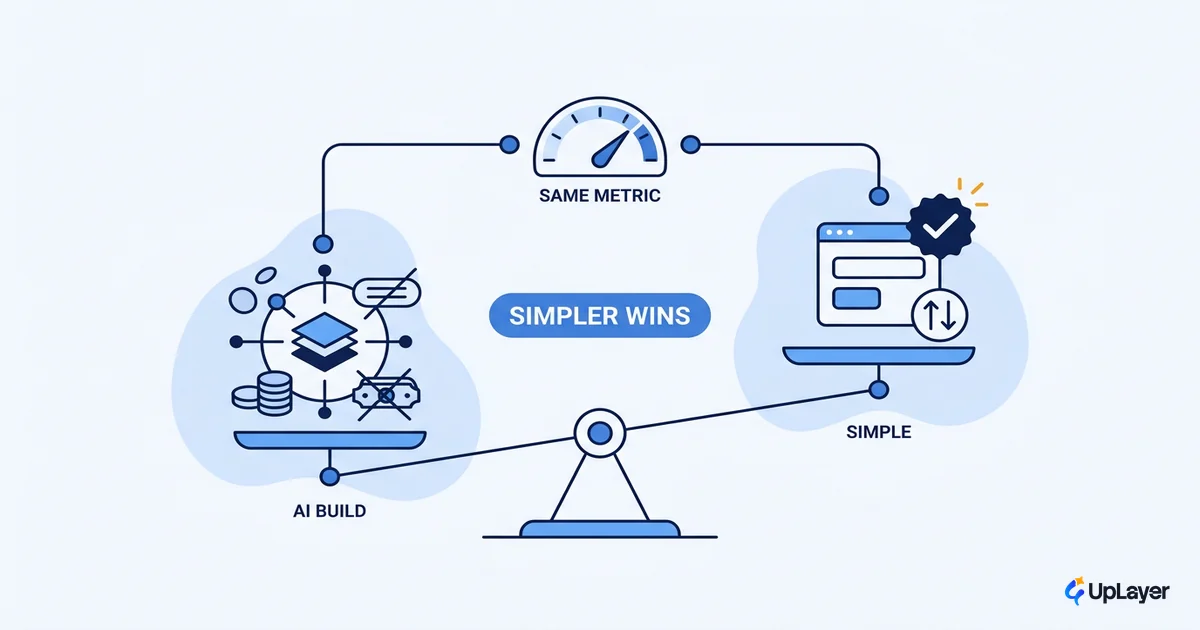
Notice the autonomous agent has the second-highest raw impact and still lands last. Low confidence and high cost dragged it down. That is the framework doing its job: catching the expensive, shiny idea before it becomes a proof of concept nobody can justify.
WARNING
The confidence term is where AI prioritization lives or dies. A feature projected to move a metric a lot, at 0.3 confidence, is a bet, not a plan. If you find yourself wanting to round confidence up so a favorite idea ranks higher, that is the exact moment the score is earning its keep. Leave it low.
How to prioritize AI features once you have the scores
Once every idea has a number, how to prioritize AI features becomes mechanical: sort descending and build from the top. The arguing is over. What remains is the handling of edge cases.
When two scores are close, break the tie in this order:
- Higher confidence wins. Between two equal scores, take the one you are more sure of. A smaller, surer win beats a larger, shakier one.
- More reversible wins. Prefer the feature you can pull back if the projection is wrong. Reversibility is cheap insurance on an uncertain bet.
- Lower cost wins. If everything else ties, the cheaper feature frees budget for the next one sooner.
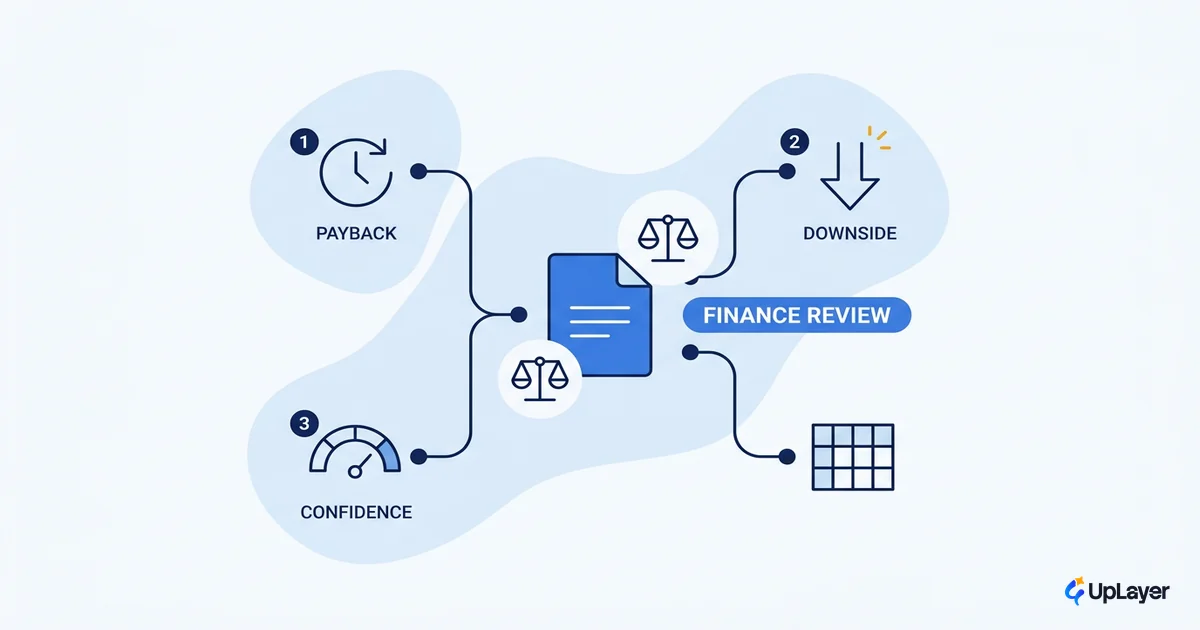
Then draw the kill line. Set a floor, and anything below it does not get built this cycle, no matter who proposed it. A low score is not a failure of the idea. It is information you got for free instead of paying to learn it in production. To set the cost side of that line honestly, run an AI cost benefit analysis on the contenders near the threshold, because the difference between rank two and rank five is often a cost estimate nobody pressure-tested.
The cost of skipping this step is well documented. MIT's NANDA initiative found that roughly 95% of enterprise generative AI pilots delivered no measurable impact on P&L, with only about 5% reaching rapid revenue acceleration. The gap was not model quality. It was building the wrong work. A kill line is how you avoid being in the 95%.
AI use case prioritization beyond a single sprint
AI use case prioritization is not a one-time sort. The scores are estimates, and estimates decay as you learn.
Re-score on a fixed cadence, monthly or per planning cycle, because three things move underneath you. Confidence rises once you ship the first feature and see how the model behaves on real traffic. Cost estimates firm up once inference and monitoring leave the spreadsheet and hit the bill. And the metric baseline itself shifts as the product changes. An idea that scored below the line in Q1 can clear it in Q2 on nothing but a confidence update.
Sequence by dependency, not just by score. If your top-ranked feature needs a data pipeline that a lower-ranked feature would build anyway, the order changes. Treat the ranked list as a living document, not a contract.
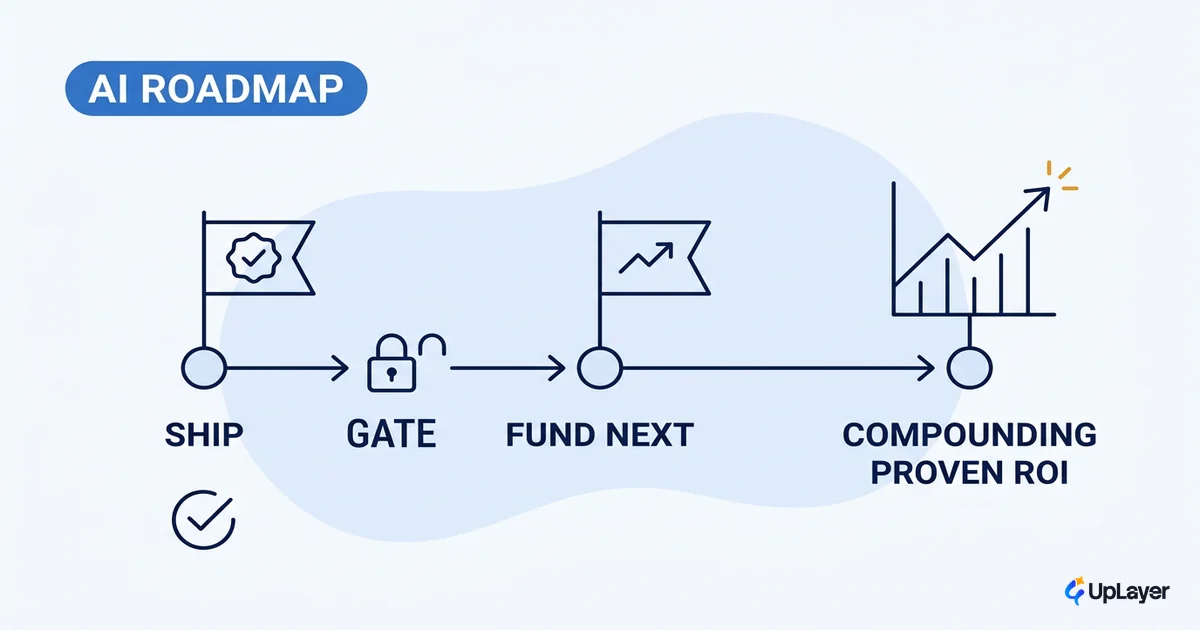
The list also closes a loop. Every projected score is a hypothesis, and the only thing that confirms it is shipping the feature and watching the metric. Once it is live, measure the ROI of an AI feature after you ship and feed the real delta back into the next round of scoring. Projected ROI gets you the order. Measured ROI tells you whether your projections were any good, which is what makes the next prioritization sharper than the last.
How do I prioritize AI features without perfect data?
You never have perfect data, and waiting for it is how backlogs ossify. The honest answer to "how do I prioritize AI features" is that the confidence term exists precisely because the data is incomplete.
Score with ranges instead of points when you are unsure. Run the math at the low end and the high end of each estimate, and if an idea ranks well even at its worst case, that is a strong signal. Where confidence is genuinely low, prioritize the cheap experiment over the big build: ship the smallest version that touches the metric, set a baseline, and let real usage tighten the estimate before you commit the full cost. Imperfect data is not a reason to skip scoring. It is the reason confidence is in the formula.
Done this way, AI feature prioritization stops being a quarterly argument and becomes a number that updates as you learn. Pick the metric first, score honestly, discount for confidence, and sort. The next idea someone demos in a meeting gets a row in the table, not a place at the front of the line, and which ai features to build becomes a question the arithmetic answers for you.
TIP
Want this scoring run on your real backlog, against the metrics you already track, with a defensible ranked list at the end? How the AX Audit works.