How to prioritize AI use cases that pay off
AI use case prioritization decides ROI before a line of code. Learn to rank capability bets by projected metric impact and feasibility, then kill the rest.
 Sohanur RahmanAI ROI & Strategy7 min read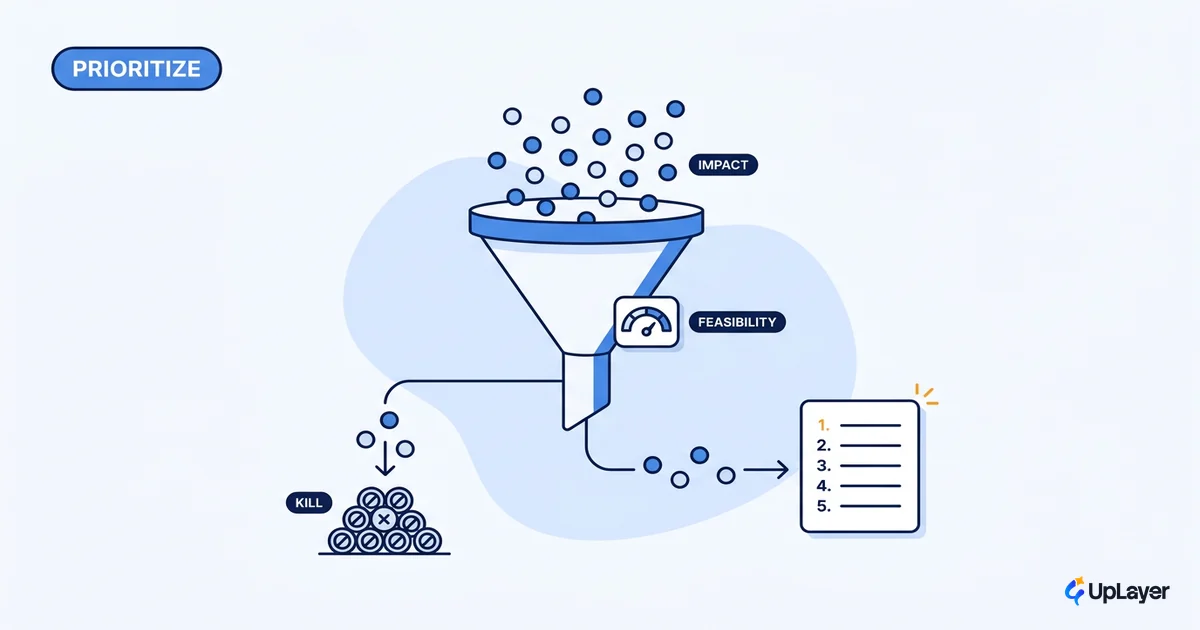
Most teams lose the ROI argument before they write any code. They open a spreadsheet of AI feature ideas, score each one, and pick a winner. The problem is upstream: they never decided which AI use case deserved a spreadsheet in the first place. AI use case prioritization is the step where you choose the capability to bet on, and it is where the return is won or lost.
A use case is a bet on a capability. A copilot. Semantic search. Summarization. Triage. A feature is one screen inside that bet. If you rank features before you rank use cases, you spend a sprint optimizing a bet that should never have made the list.
This piece gives you a portfolio-level method: rank candidate AI use cases by projected impact on a metric you already track and by feasibility, then say no to the ones with no line to a number. Feature scoring comes after, and we link to it. The verdict on what to kill comes first.
AI use case prioritization happens above the feature list
Prioritizing AI use cases is choosing which AI capability to pursue, not which screen to build. It runs one altitude above feature work, and it runs on two axes: business value and feasibility.
This is not a UpLayer invention. Gartner tells CIOs to establish "a standardized AI use case prioritization framework" with "clear criteria based on business value and feasibility" so they can consistently decide which AI opportunities to pursue, scale or stop, and to assemble "a high-value AI portfolio aligned to business outcomes" rather than a collection of disconnected experiments. The language is enterprise, but the discipline is the same at $1M to $20M ARR: pick the bets, sequence them, and cut the rest.
The reason the altitude matters is that the most expensive mistakes are made at the use-case level, not the feature level. A well-scored feature inside the wrong use case is still wasted budget. You can perfect the copilot UI for a workflow that no metric depends on and move nothing. Choosing the use case is the high-leverage decision. Choosing the feature, which our cornerstone covers when you decide which AI features to build, is the follow-through.
| Layer | The question | The unit | Where ROI is decided |
|---|---|---|---|
| Use case | Which capability do we bet on? | A copilot, search, summarization, triage | Here. This article. |
| Feature | Which exact thing do we build inside it? | One screen, one flow | The next altitude down |
| Measurement | Did the metric move after ship? | The delta vs baseline | After launch |
Get the top row right and the rest of the table is execution. Get it wrong and no amount of feature scoring saves you.
Which AI use case should I build first? Start from a metric you already track
The first use case to build is the one with the shortest line to a number your team already watches: churn, activation, conversion, or expansion. If a candidate use case can't be tied to a metric you already report, it is not a priority. It is a science project.
The data backs the metric-first cut hard. MIT's NANDA initiative found that about 95% of enterprise generative AI pilots delivered no measurable impact on P&L, and the failure traced to integration and a learning gap, not model quality. The same research found a telling misallocation: more than half of generative AI budgets went to sales and marketing tools, while the biggest return sat in unglamorous back-office automation.
About 95% of enterprise generative AI pilots delivered little to no measurable impact on the P&L. The constraint was almost never the model.
Read that as a use-case selection failure, not a technology failure. The teams bet on the use cases that demo well, not the ones that move a metric. The fix is to start from the metric and work backward to the capability. If activation is the number, the candidate use cases are the ones that shorten time-to-first-value, not the ones that look impressive in a board deck. The build decision comes once the metric is named; this article is the step before it, where you cut the use-case list down to the bets worth scoring.
How to rank AI use cases by value and feasibility
To rank AI use cases by value, score each on two axes and multiply: projected impact on the chosen metric, and feasibility given your data, your stack, and the reliability bar the workflow demands. This is the core of an honest ai opportunity assessment. High impact times low feasibility is a trap. Low impact times high feasibility is a distraction.
Keep the math visible so the ranking is an argument you can defend, not a vibe.
Use-case priority score
========================

  priority = projected_metric_impact  x  feasibility

  projected_metric_impact = baseline x reachable_delta x value_per_unit
      (in the currency of the metric: retained ARR, activated accounts,
       converted trials, expansion seats)

  feasibility = data_readiness x integration_effort_inverse x reliability_headroom
      (0.0 = blocked, 1.0 = ships clean)

  Cut rule:  drop any use case where projected_metric_impact has no line
             to a metric you already report, OR feasibility < 0.3.
Run your candidate list through it and the portfolio sorts itself. A worked example for an activation-focused product:
| Candidate use case | Projected metric impact | Feasibility | Verdict |
|---|---|---|---|
| Onboarding copilot that shortens time-to-first-value | High (activation) | High | Build first |
| Semantic search across the user's own data | Medium (activation, retention) | High | Build next |
| In-app summarization of long records | Medium (retention) | Medium | Queue |
| Auto-generated marketing copy | Low (no tracked metric) | High | Kill |
| Predictive "churn risk" model with no intervention attached | Low (no action on the metric) | Low | Kill |
The two kills matter more than the three builds. They are the use cases that look like AI progress and produce none.
Which AI use cases to kill before you score features
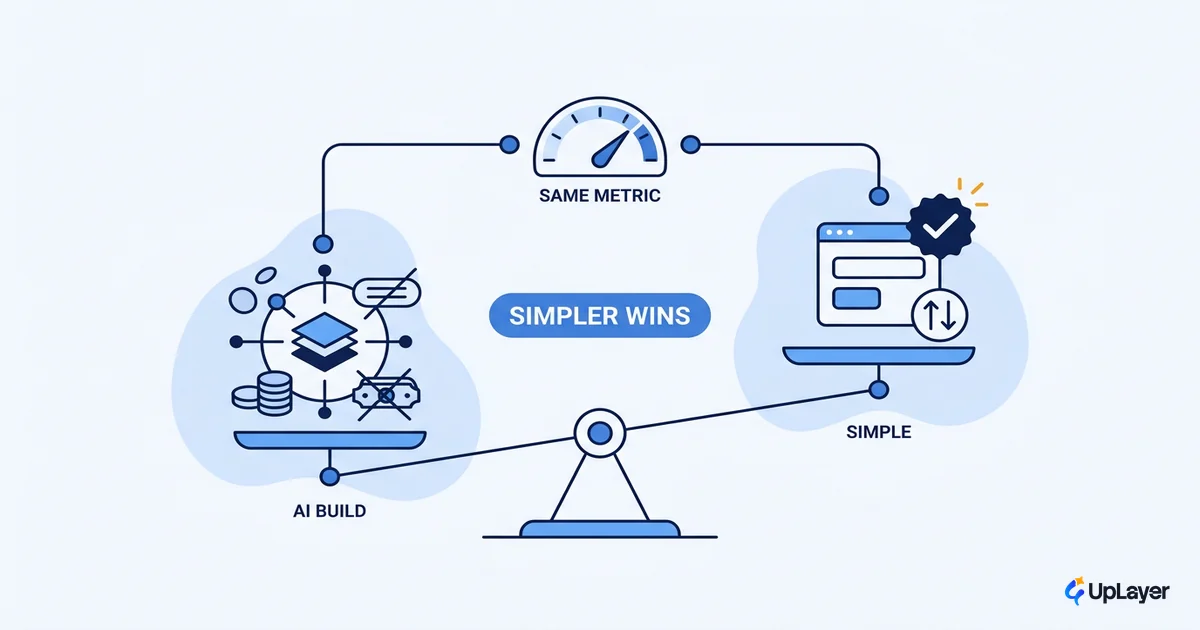
Kill any use case that has no line to a tracked metric, carries a run cost the metric can't repay, or sits on a reliability cliff where a confident wrong answer destroys trust. Killing at the use-case level is cheaper than killing after a sprint, and it is where this work diverges from generic AI feature prioritization. Feature prioritization assumes the bet is sound and scores the options inside it. Use-case prioritization questions the bet itself.
WARNING
A use case with no named metric is the single most common thing on an AI list, and the most expensive to build. Gartner predicts at least 30% of generative AI projects will be abandoned after proof of concept by the end of 2025, citing unclear business value among the top causes. Kill those before they reach a sprint, not after.
The kill list is short and unsentimental. Cut the use case if any of these is true:
- No tracked metric. It can't be tied to churn, activation, conversion, or expansion. It is theater.
- Run cost outpaces return. Inference and monitoring bills exceed the projected metric gain. The ROI math is already negative.
- Reliability cliff with no guardrail. A wrong answer in this workflow costs trust faster than a right answer earns it, and you can't put a human in the loop.
- Better solved without AI. A rule, a default, or a simpler design moves the metric more cheaply. AI is not the only layer that moves numbers.
Saying no here is the work. It is also the trust signal. A team that kills three of five candidate use cases is prioritizing correctly.
How do I prioritize AI use cases on a real roadmap?
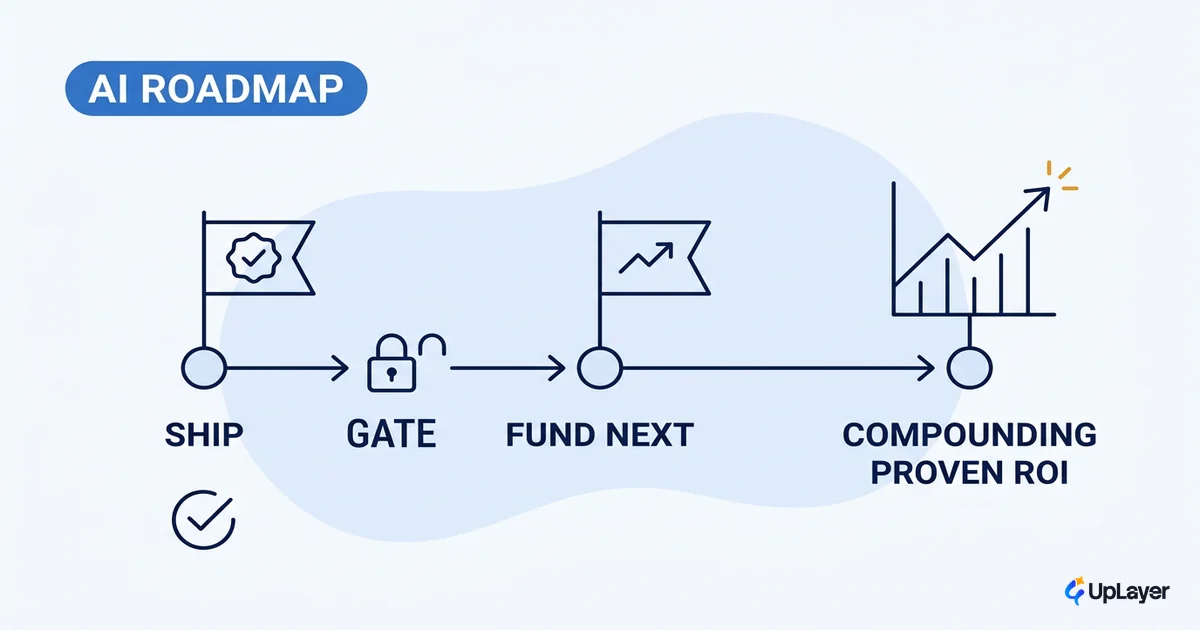
Sequence by confidence, not by ambition. Build the highest-confidence ROI bet first, the one where the projected metric impact is strong and the feasibility is clean. Ship it, measure the delta against a baseline you recorded before launch, and let the proven number fund the next bet.
This protects you from the portfolio failure mode, which is funding five medium-confidence use cases in parallel and proving nothing on any of them. One bet, proven, beats five bets, blurred. Once the first use case is live and measured, drop one altitude and rank the features inside the next bet. Our walkthrough on how to prioritize AI features by projected ROI picks up exactly there, and the foundational piece on how to measure the ROI of an AI feature closes the loop after ship.
NOTE
Concept Demo framing: when we run an AI opportunity assessment, every candidate use case carries a projected metric impact with the assumptions shown, not an achieved result. The number is designed to move a metric, and the projection is the thing we defend before anyone writes code.
The order is the strategy. A roadmap that ships the boring, high-confidence bet first earns the credibility to fund the ambitious one later.
The teams that win at AI use case prioritization treat the no list as the asset. Every use case you decline is budget you keep, trust you protect, and a metric you don't put at risk on a bet that was never going to move it. The list you build is short. The list you kill is where the discipline shows.
TIP
Want the projected-ROI ranking on your actual use-case list, with the kills called out? How the AX Audit works.