How to build an AI product roadmap by ROI
Build an AI product roadmap that ranks features by projected ROI, not by what demos best. Get the scoring method, the kill list, and a clear 5-step build.
 Sohanur RahmanAI ROI & Strategy7 min read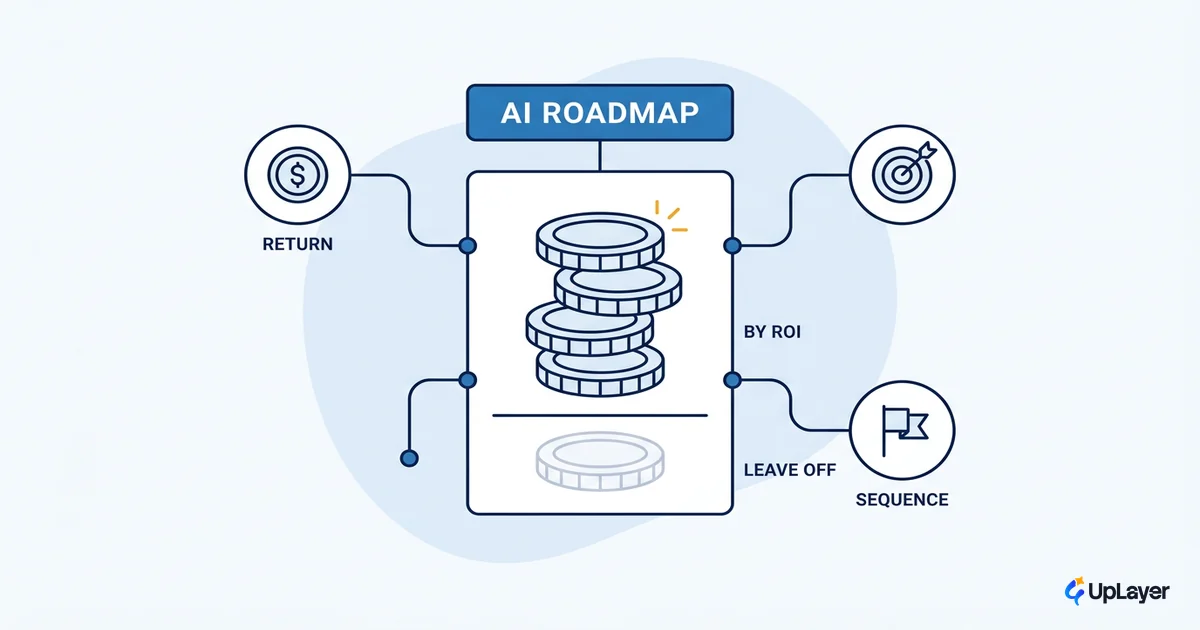
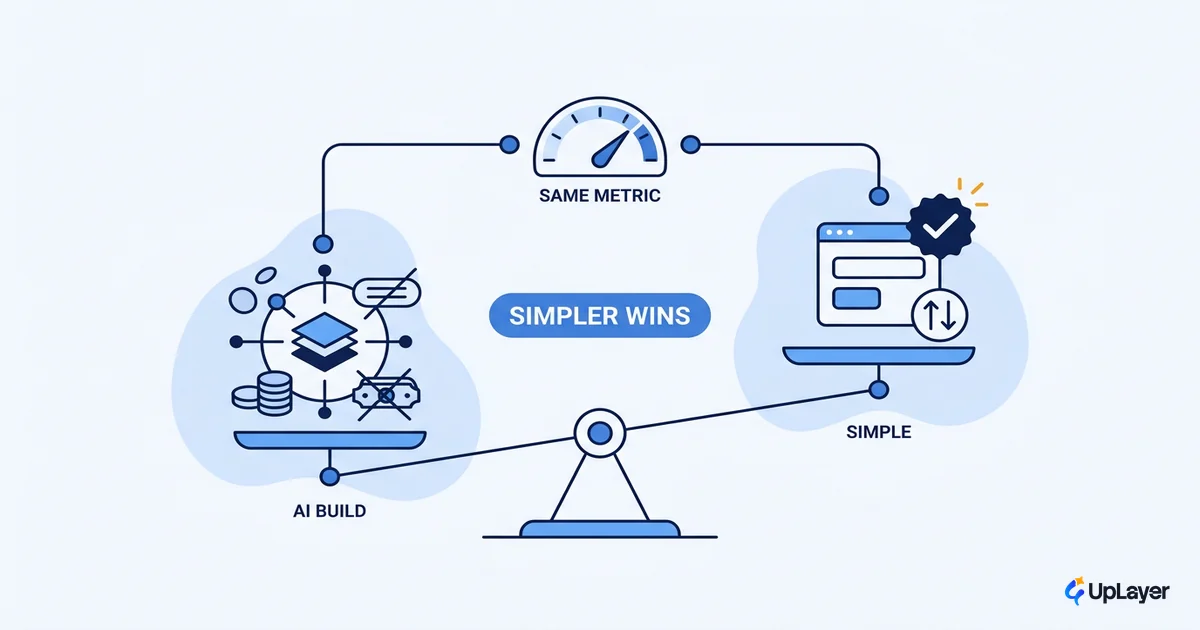
Most AI product roadmaps are sorted by what demos best. That is why most of the features on them ship and move nothing. The flashy assistant goes to the top because it looks good in a board review, and the unglamorous feature that would actually lift retention sits three rows down, unbuilt.
An AI product roadmap is not a now/next/later board with a coat of AI paint. It is a ranked list of metric bets. You score each AI idea against one metric you already track and one honest cost, sort by projected return, and the roadmap is whatever survives the sort. Everything else gets cut on purpose.
This piece gives you the scoring method, the sequencing rules, and a five-step build you can run this week. It pairs with the cornerstone work on how to decide which AI features to build in the first place.
Why most AI product roadmaps are sorted wrong
The default failure mode is sorting by demo appeal instead of return. A feature that wows in a meeting earns a roadmap slot; a feature that quietly moves a number does not. The result shows up in the data: MIT's GenAI Divide study found that roughly 95% of enterprise AI pilots show no measurable impact on the P&L, with only about 5% driving real revenue acceleration.
About 5% of AI pilot programs achieve rapid revenue acceleration; the vast majority stall, delivering little to no measurable impact on P&L. (MIT NANDA, The GenAI Divide: State of AI in Business 2025)
The pattern repeats at the project level. Gartner predicted that at least 30% of generative AI projects would be abandoned after proof of concept by the end of 2025, citing unclear business value as a leading cause. These are not model failures. They are roadmap failures. The work got prioritized before anyone asked what metric it would move.
Fix the sort order and the rest follows. Rank your AI product roadmap by projected return, and the features that demo well but project flat fall to the bottom where they belong.
What an AI product roadmap actually is
An AI product roadmap is an ordered list of AI features, each tied to one metric and one fully-loaded cost, sequenced by projected return. That is narrower than a general product roadmap and narrower still than a company-wide AI adoption roadmap, which also covers data, governance, and capability-building. Here we mean the product surface: what AI ships, in what order, and why.
The ordering is the whole point. Gartner's guidance on building an AI roadmap is to skip the generic template, pick the activities that matter to your strategy, and sequence them properly, from initial to advanced. A roadmap is a sequence, not a wishlist. If two features sit next to each other, the one above should have a better reason than "it was easier to picture."
That reason is a number. Each item carries a projected ROI, and the list is sorted by it. When a stakeholder asks why feature B comes before feature A, the answer is on the roadmap, not in someone's head.
How to score each AI feature by projected ROI
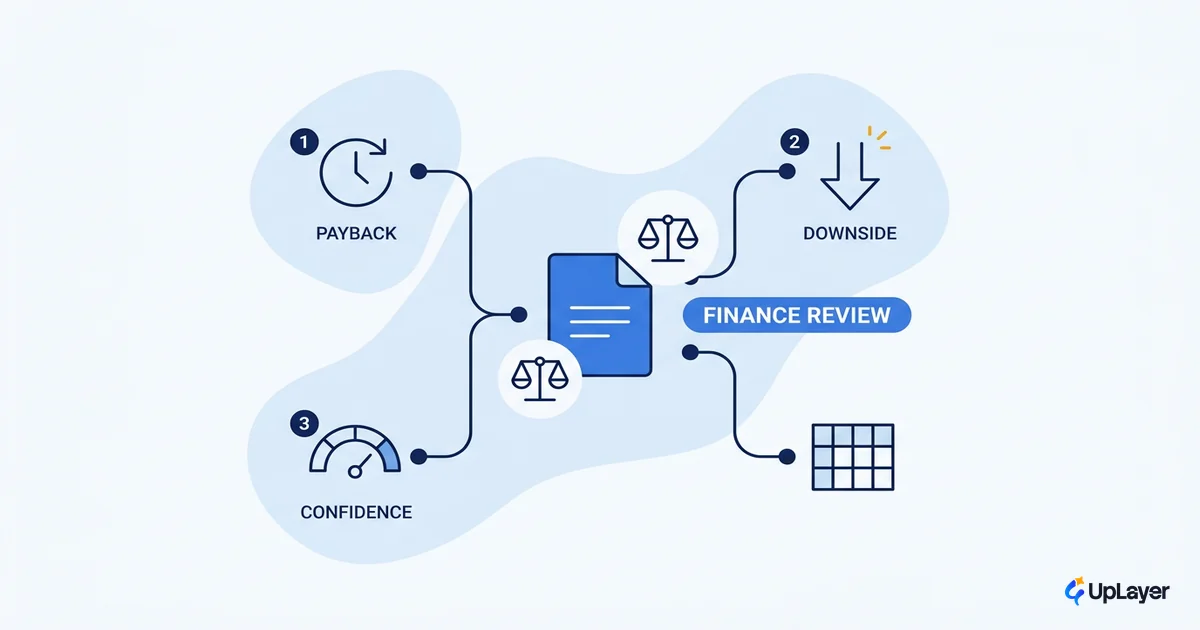
Score every AI idea the same way, so you can compare them on one axis. We adapt the RICE scoring model that Intercom built for general prioritization, then bend it toward the thing AI roadmaps get wrong: cost. AI features carry costs that traditional features do not, so the denominator has to be honest.
The projected ROI score is the metric you expect to move, weighted by how confident you are, divided by the fully-loaded cost to build and run it.
projected_roi_score = (metric_delta × confidence) / fully_loaded_cost

metric_delta        = expected change in ONE metric you already track
                      (retention %, activation %, conversion %, expansion $)
confidence          = 1.0 high, 0.8 medium, 0.5 low (be honest)
fully_loaded_cost   = build + inference + evaluation + reliability guardrails
The denominator is where most roadmaps lie to themselves. Build cost is easy to estimate; the recurring costs are not. The table below is the per-feature scorecard we use before anything reaches the roadmap.
| Scoring input | What it means | Common mistake |
|---|---|---|
| Metric delta | The change in one metric you already track | Picking "engagement" instead of a metric tied to revenue |
| Confidence | How sure you are the delta is real (1.0 / 0.8 / 0.5) | Logging 1.0 because the demo felt good |
| Build cost | Design plus engineering to ship it | Counting only the happy path |
| Run cost | Inference and per-call spend at real volume | Pricing it at demo volume, not production |
| Eval & guardrails | Quality checks, reliability work, human-in-the-loop | Treating <eval> as optional until it breaks |
| Projected ROI | (delta × confidence) / fully-loaded cost | Skipping the math and sorting by gut |
Tie each score to a metric you already report. If a feature cannot name one, it is not ready to be scored, and it is definitely not ready for the roadmap. For the full method behind the delta, see how to measure the ROI of an AI feature.
How to sequence AI features on a roadmap
Sort by projected ROI first, then resequence for two real-world constraints: dependencies and baselines. Knowing how to sequence AI features on a roadmap means accepting that the highest-scoring item is not always the first one you can responsibly build.
A feature that needs a clean data pipeline, a working eval setup, or a measurable baseline has to wait for those to exist. The honest move is to schedule the enabling work as its own roadmap item rather than pretend the dependent feature is ready. This is also why you set a baseline before you ship: without a pre-launch number, the projected delta is unfalsifiable, and an unfalsifiable bet does not earn a roadmap slot.
WARNING
Never sequence a feature ahead of the metric that proves it. If you cannot measure the baseline before launch, you cannot measure the lift after, and the feature becomes theater the moment it ships.
So the sequence is: rank by projected ROI, pull any item that lacks a baseline or a dependency down to where its prerequisites land, and let the order re-settle. The roadmap stays sorted by return; it just respects what has to come first.
How do I build an AI product roadmap, step by step
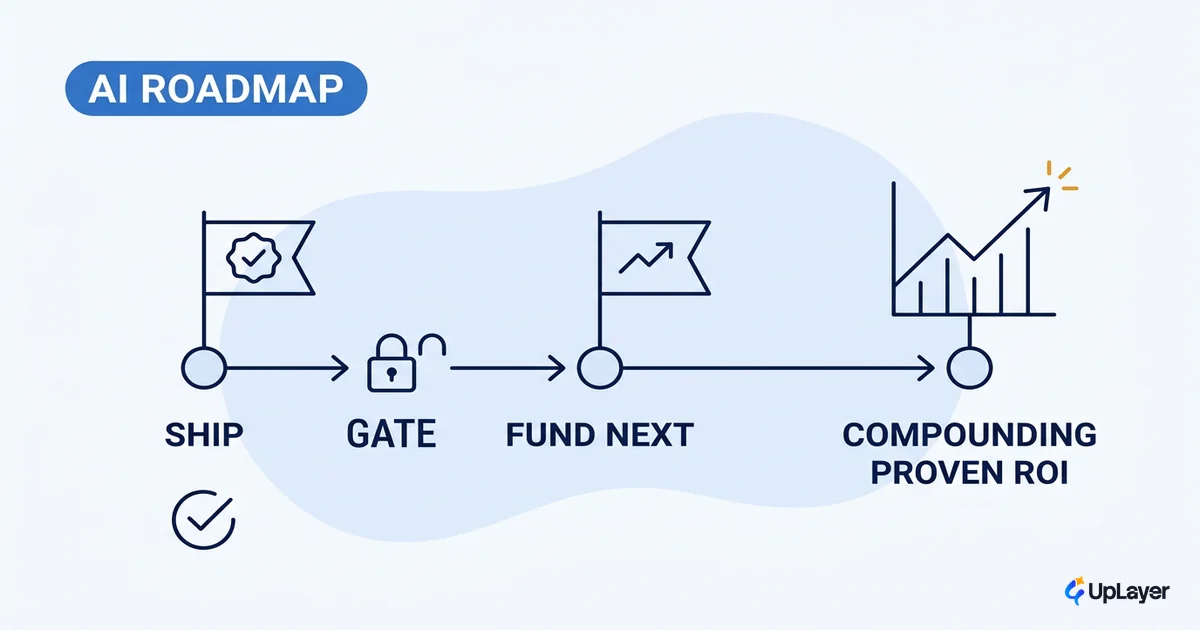
Run these five steps in order. Each one is a gate; nothing advances until it passes.
- List every AI idea against one metric. No metric, no entry. The metric must be one you already track.
- Project the delta and set confidence. State the expected change and how sure you are, in numbers, not adjectives.
- Cost it fully. Build plus inference plus evaluation plus reliability work. Price it at production volume.
- Score and sort. Apply the projected ROI formula and rank the list top to bottom.
- Resequence and commit. Adjust for baselines and dependencies, then publish the order with the score next to each item.
This is the same discipline Gartner now recommends for funding decisions: assess each use case for feasibility, risk, cost, and expected business impact, and use a shared scoring model to compare and rank them. The roadmap is the output of the model, not an input to it. The upstream input is your AI product strategy, which sets the metrics that matter; the roadmap sequences the bets that serve it.
NOTE
An AI roadmap prioritized by return is a living document. Re-score quarterly. A feature that scored well in Q1 can drop once a cheaper non-AI fix lands or once real inference costs come in higher than the estimate.
What to leave off the roadmap
The kill list matters as much as the build list. The features you leave off are the ones that demo well and project flat: the broad assistant nobody asked for, the chatbot bolted onto a workflow that already works, the generative gimmick with no metric behind it. If a feature cannot earn its place on projected ROI, it does not ship, no matter how good the demo looked.
This is disciplined AI feature prioritization, and it is uncomfortable on purpose. Saying no to a feature an executive is excited about is the cost of a roadmap people can trust. The number does the arguing for you.
We prove this with Concept Demos, not invented case studies: working prototypes built to show the thinking, with metrics framed as designed-to-move and projected, never claimed as achieved. The discipline is the product. The roadmap is just where it becomes visible.
A roadmap built this way changes what your team argues about. Instead of debating which AI feature is most exciting, you debate which projected ROI you believe, and that is a far more productive fight. The next move is to validate each release against its projection so you can turn the roadmap into proven ROI, funding the following layer only once the last one moved its metric. Treat your AI product roadmap as a ranked list of metric bets, keep the scores honest, and the features that survive will be the ones that actually move a number.
TIP
Want the highest-ROI AI feature on your roadmap found, scored, and proven on a metric you already track? How the AX Audit works.