How to build an AI adoption roadmap
Build an AI adoption roadmap that ships the highest-ROI layer first and validates the number before the next release. Phases, gates, and what to leave off.
 Sohanur RahmanAI ROI & Strategy8 min read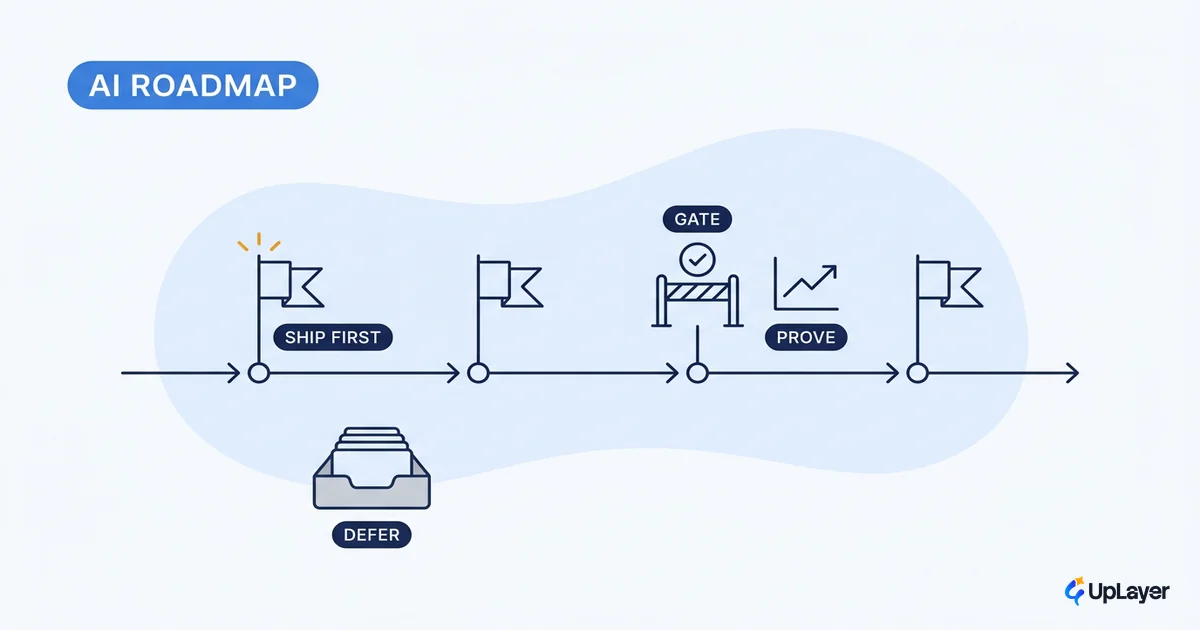
Most AI adoption roadmaps are a budget with quarters drawn on it. A list of features to build, sequenced by what looks impressive or what a vendor is selling, with a launch date on each. That is not a roadmap. That is a wish list with deadlines.
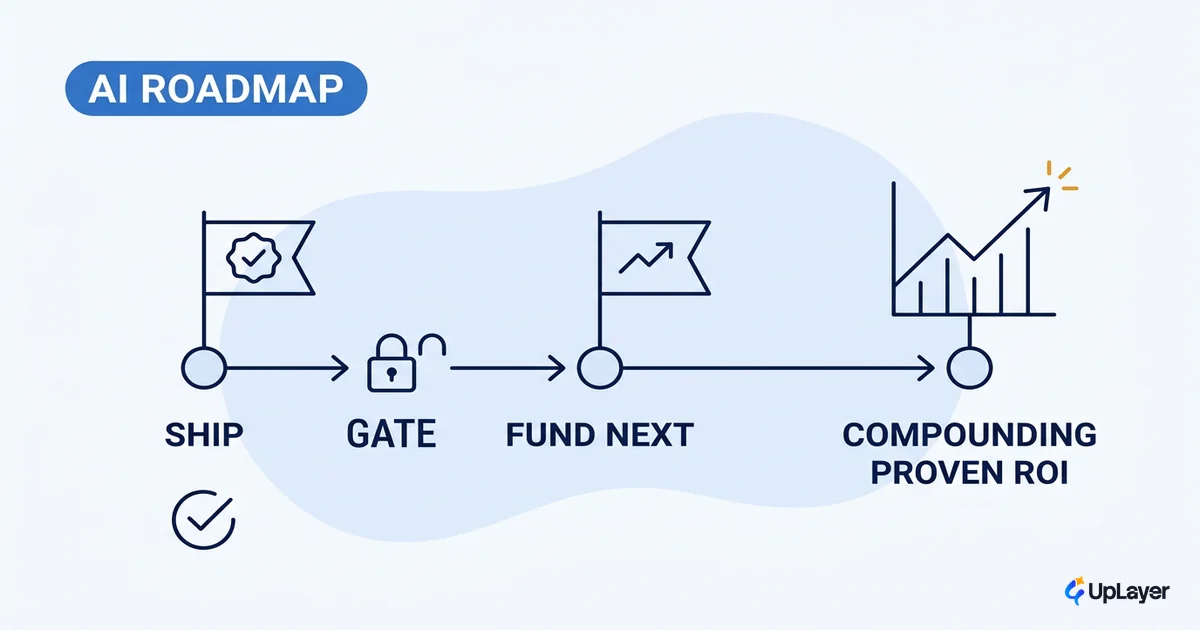
An AI adoption roadmap that actually pays off does one thing the templates skip: it ships the single highest-ROI layer first, then validates the number against a metric you already track before it funds the next release. Retention, activation, conversion, expansion. Pick the one your board asks about, and make the roadmap answer to it.
We build AI as a supportive layer on top of established SaaS products, and we have learned to start with the number instead of the feature list. If you only take one idea from this, take the gate: prove this layer moved the metric before you build the next one. Everything else here is how to measure the ROI of an AI feature and sequence the work around it.
What an AI adoption roadmap actually is
An AI adoption roadmap is a sequenced plan that ships the highest-projected-ROI AI layer first and validates its impact on a tracked metric before the next release is funded. The order is set by projected return, not by readiness scores or calendar quarters.
That sounds obvious until you look at what gets shipped. The ship-everything roadmap funds phase two regardless of whether phase one moved anything. So the failures pile up quietly. Gartner projects that at least 30% of generative AI projects will be abandoned after proof of concept by the end of 2025, citing escalating costs and unclear business value as primary causes. A roadmap with no validation gate is a machine for producing exactly that outcome.
The fix is structural, not motivational. You do not need more discipline. You need a gate between phases that makes the next release contingent on the last one proving out. The roadmap is the sequence plus the gate, and the gate is the part that makes it a roadmap instead of a spending plan.
What phases belong in an AI adoption roadmap
Five phases, each with one owner, one output, and one exit gate. You do not move forward until the gate clears.
| Phase | What happens | Owner | Output | Exit gate |
|---|---|---|---|---|
| 1. Baseline | Pick the metric, measure where it sits today | Head of Product | Documented baseline number | Baseline is recorded and agreed |
| 2. Prioritize | Rank candidate AI layers by projected ROI on that metric | Product + UpLayer | Ranked opportunity map | Top layer has a projected delta and assumptions shown |
| 3. Ship the #1 layer | Design and build the highest-ROI layer as a supportive layer on top | Eng + Design | Live feature, instrumented | Feature is in production and tracking the metric |
| 4. Validate | Measure the delta against the baseline | Head of Product | Measured result vs. projection | Decision made: fund, iterate, or kill |
| 5. Expand or cut | Re-rank, ship the next layer, or stop | Product | Updated roadmap | Next layer cleared the same projection bar |
The sequence depends on knowing where you stand, which is why phase one is a real phase and not a footnote. Before any of this, run an honest AI readiness assessment and set a baseline before you ship, because a delta you cannot compare to a baseline is not a result.
Here is the gate logic, written out so it survives a planning meeting:
for each phase in roadmap:
    ship(phase.layer)
    measure(metric, against=baseline)
    delta = metric.now - baseline

    if delta >= phase.projected_delta * threshold:
        fund(next_phase)        # it earned the next release
    elif delta > 0 and fixable():
        iterate(phase.layer)    # close the gap, re-measure
    else:
        kill(phase.layer)       # it did not pay; stop funding it

# threshold is set in advance, not negotiated after the result
The threshold is set before you ship, not argued about after the dashboard comes in. That ordering is the whole point.
How do I create an AI adoption roadmap for an established SaaS
Start from a metric you already track, not a blank maturity model. An established SaaS has the one thing a maturity framework assumes you lack: real users, real usage data, and a baseline that already exists. You do not need to imagine where AI might help. You can measure where your product leaks today and aim the first layer at that leak.
That is what makes an ai roadmap for an established saas different from the enterprise transformation deck. You are not standing up an org-wide AI function. You are adding a supportive layer (a copilot, in-product search, summarization, triage) on top of a product that already works, pointed at a number that already moves money. A good ai product roadmap for this buyer is short and specific, not broad and aspirational.
The practical sequence, for a post-product-market-fit team:
- Name the metric the board asks about. One metric.
- Find where in the product that metric leaks (the drop-off, the churn surface, the slow path).
- List the AI layers that could plug it. Project each one's impact, with assumptions visible.
- Ship the top one. Validate. Then decide.
A real saas ai strategy is this loop run on repeat, not a twelve-month plan you commit to in a single offsite. Your ai readiness assessment tells you whether your data and team can support the top layer. If it cannot, that is a phase-one finding, not a reason to ship anyway.
Sequence by projected ROI, not by readiness
Rank candidate layers by projected impact on the chosen metric, ship the top one, validate, then re-rank. Readiness tells you what is possible. Projected ROI tells you what is worth doing first. Those are different questions, and the roadmaps that fail answer the first one and skip the second.
The reason ordering matters this much is that AI value concentrates. It does not spread evenly across a feature list. MIT Sloan Management Review found that only 10% of companies obtain significant financial benefits from AI, and the ones that do change processes intentionally around it rather than shipping more models. The lesson for your roadmap: a few layers will pay, most will not, and the job of sequencing is to find the few before you spend on the many.
WARNING
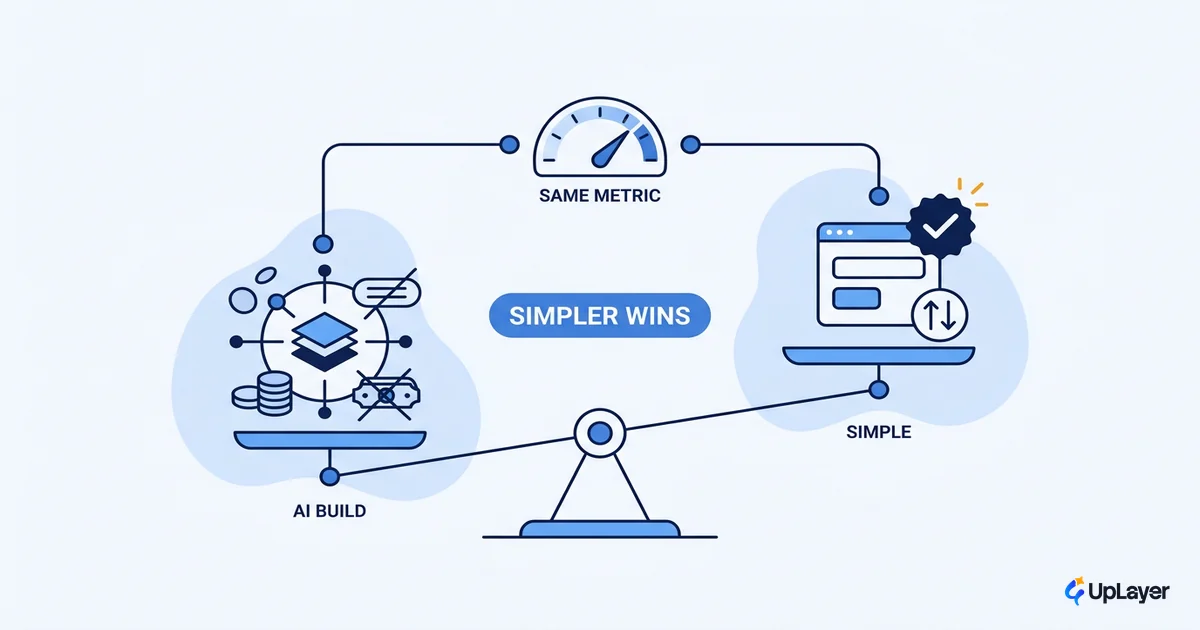
The ship-everything roadmap treats every AI layer as equally worth building and funds them in parallel. It feels like progress and produces the abandonment statistic. If your roadmap has no line that says "we will not build this yet, and here is why," it is not sequenced. It is just a list.
A real ai product roadmap ranks ruthlessly and revisits the ranking after every validation. The number you measured in phase four changes the order of everything after it. That is the feature, not a bug.
The validation gate that makes a roadmap real
The gate is one rule: baseline set, delta measured, decision made before the next release is funded. Skip it and your roadmap inherits the failure rate of every AI roadmap that came before it. Gartner now projects that over 40% of agentic AI projects will be canceled by the end of 2027, again on escalating costs and unclear value. The pattern repeats with every new wave of AI because the missing piece is structural, not technological.
A gate has three outcomes, and "kill" has to be a real one. If the layer moved the metric, fund the next phase. If it moved something but missed the projection and the gap is fixable, iterate and re-measure. If it did not pay, stop funding it. That is the discipline behind our Ship-It Guarantee: we build until it is live and working, and the work is not done until the metric has something to say.
This is also where a roadmap becomes proof. Once you have run the gate even once, you can turn the roadmap into proven ROI instead of a slide you defend on faith. One validated layer is worth more to your board than ten planned ones.
What to leave off the roadmap
The most useful artifact a roadmap produces is the list of things you decided not to build, with reasons. "What not to build" is a deliverable, not an apology. It is the part that proves your AI adoption strategy sequenced by ROI instead of by enthusiasm.
Vague roadmaps stall because nobody owns the cuts. Deloitte's research found that many organizations lack a clear, accepted vision for their automation work, with roughly four in ten missing an enterprise-wide strategy entirely. A roadmap that names its non-goals is harder to derail, because the deferred and killed items are documented decisions rather than open questions someone reopens every quarter.
Practically, the cut list holds three kinds of items:
- Defer: plausible layers that lose the ROI ranking this cycle. Revisit after the next validation.
- Kill: layers that failed their gate. Document why, so nobody re-pitches them in six months.
- Never: features that look like AI theater. Impressive demos with no path to a tracked metric. We say no to these on purpose, and so should your roadmap.
When we run a Concept Demo for the top opportunity, the projected metric movement is labeled "designed to move," not "achieved," until it ships and the gate measures it. That framing keeps the roadmap honest and keeps the cut list defensible.
A roadmap is only as good as its next validation. Build the layer, prove the number, then earn the next one. That is the whole loop, and an ai adoption roadmap that runs it will outperform any twelve-month plan that ships on faith. Sequence by ROI, gate on a real metric, and let the cut list do as much work as the build list.
TIP
Want the ranked opportunity map and the projected ROI before you commit a single sprint? How the AX Audit works. and we will find the highest-ROI layer to ship first, or the audit is free.