How to write an AI adoption strategy that ships
Write an AI adoption strategy from a metric and a buyer's job, not a model. The order of operations to build the business case, sequence the roadmap, and ship.
 Shahriar P. ShuvoAI ROI & Strategy8 min read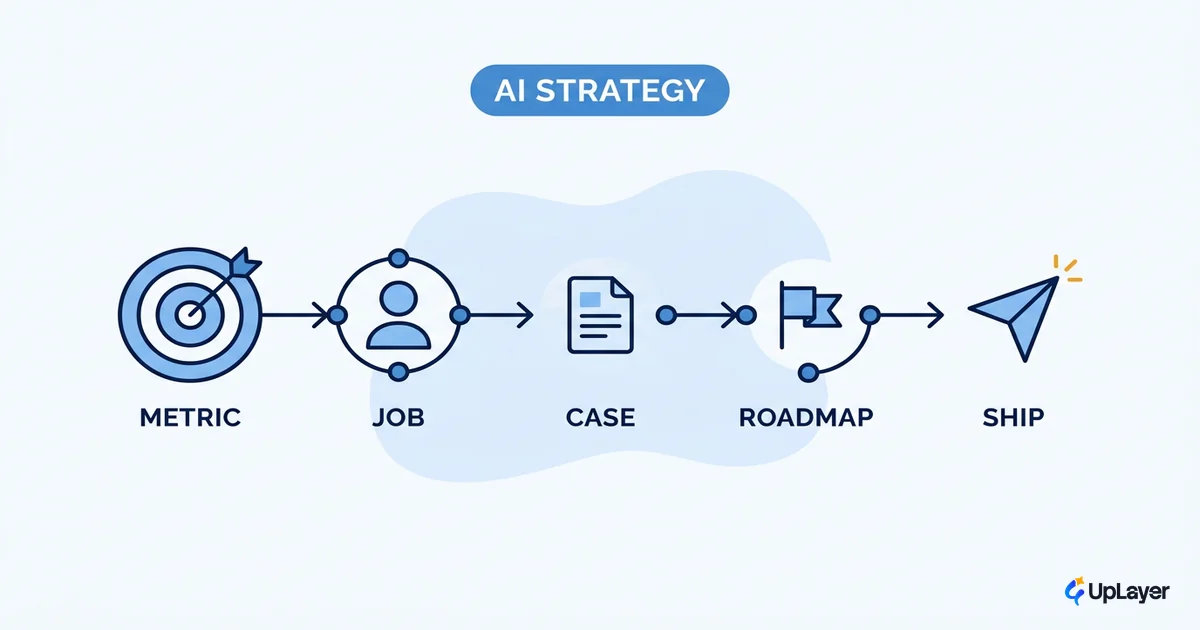
Most AI adoption strategies start with the wrong sentence. They start with "we will use AI to," then back-fill a use case to fit the technology. That order is why so much of the work dies right after the demo. Gartner predicted at least 30% of generative AI projects would be abandoned after proof of concept by the end of 2025, citing poor data quality, weak risk controls, escalating costs, and unclear business value. None of those are model problems. They are strategy problems.
A real AI adoption strategy starts from a metric your buyer already tracks and a job they are already trying to do. The model is the last decision, not the first. This piece gives you the order of operations: how to pick the first metric, build the business case, sequence the roadmap so each release earns the next, and decide what to leave out.
We write this as the team that builds the work. We will tell you what not to build, because that is usually the most valuable line in the plan.
What goes into an AI adoption strategy for SaaS
A useful SaaS AI strategy is a ranked, sequenced list of bets, where each proposed AI capability is tied to a metric, an owner, a reliability bar, and a kill condition. It is not a list of features. It is a list of bets with the assumptions shown, and the cut list is part of the document.
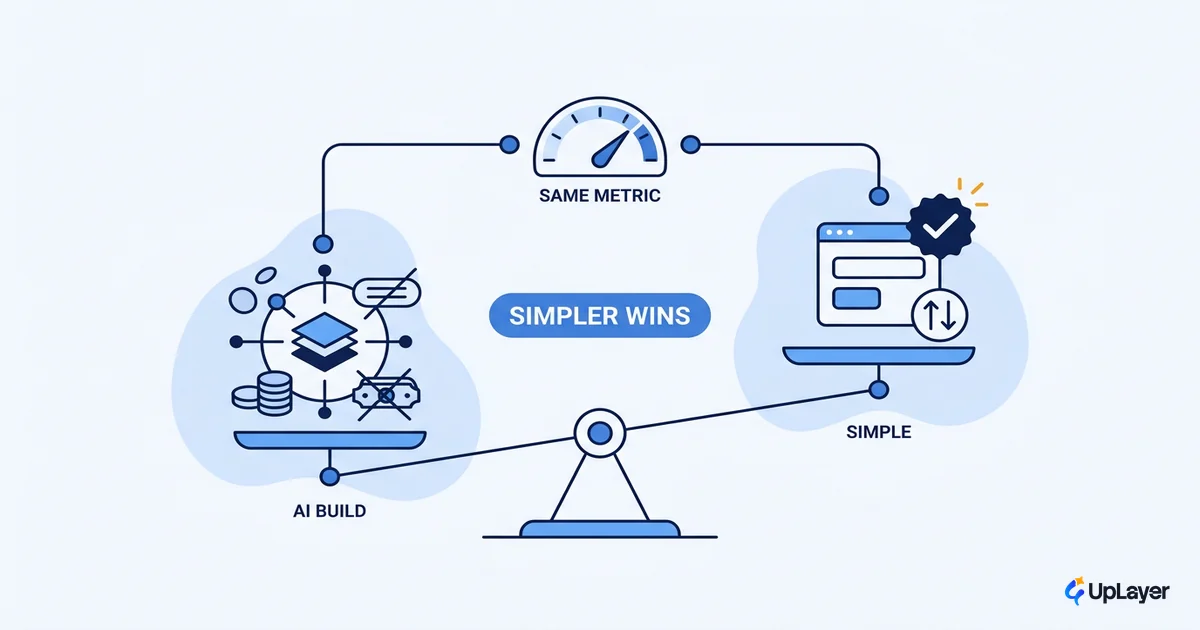
The reason this matters is that adoption is now near-universal and value is not. BCG's survey of 1,000 executives found that only 26% of companies have moved beyond proofs of concept to generate tangible value, and just 4% have built strong AI capability across functions. Most teams are not short on AI activity. They are short on a strategy that picks the few features that pay. The harder skill is the screen itself, which is why we treat it as its own discipline: how to decide which AI features to build before any of them reach a roadmap.
A complete AI product strategy answers five questions for every candidate feature:
- Metric. Which number this moves, and the baseline today.
- Job. The specific task the user is doing when the feature appears.
- Reliability bar. The accuracy or trust threshold below which it ships broken.
- Owner. Who is accountable for the metric, not just the release.
- Kill condition. The result that tells you to stop.
If a candidate cannot answer all five, it is not ready for the roadmap. It is ready for the cut list. Deciding what to skip is real work, and most plans skip the skipping. We wrote a whole companion piece on the AI features you should not build, because the no's protect the budget more than the yes's grow it.
How do I build an AI adoption strategy: the order that protects the budget
Build the plan in the order that protects your budget, not the order that flatters the technology. Start with the number. End with the model.
This is the sequence we run inside an AX Audit, and it is the same logic behind deciding which features earn a build at all. It front-loads the cheap decisions (which metric, which job) and defers the expensive ones (which model, which pipeline) until the bet is justified.
| Step | Question it answers | Output | Common mistake |
|---|---|---|---|
| 1. Metric | Which number are we moving? | One metric with today's baseline | Picking "engagement," a number nobody is accountable for |
| 2. Job | When does the user need this? | A named task in the existing flow | Designing for a demo, not a workflow |
| 3. ROI rank | Which bet pays most? | A ranked list with a cut list | Ranking by how impressive the feature sounds |
| 4. Model | What actually builds it? | The simplest pipeline that clears the bar | Choosing the model first, then hunting for a use case |
Notice the model is step 4, not step 1. By the time you choose it, the metric, the job, and the projected return are already settled. The expensive decision is the last one you make.
A useful projection stays this simple:
projected_value = (baseline_metric * expected_lift) * value_per_unit

# Worked shape (illustrative, not a client result):
#   baseline churn        = 5% monthly
#   expected lift          = 0.5 point reduction (4.5% monthly)
#   accounts at risk       = 1,200
#   value per retained acct = $1,800 / yr
# => guard the assumptions, not the decimals.
NOTE
The point of the formula is the assumptions, not the precision. If you cannot name the baseline and the value per unit, you do not have a business case yet. You have a hope.
The AI business case: project ROI before you write code
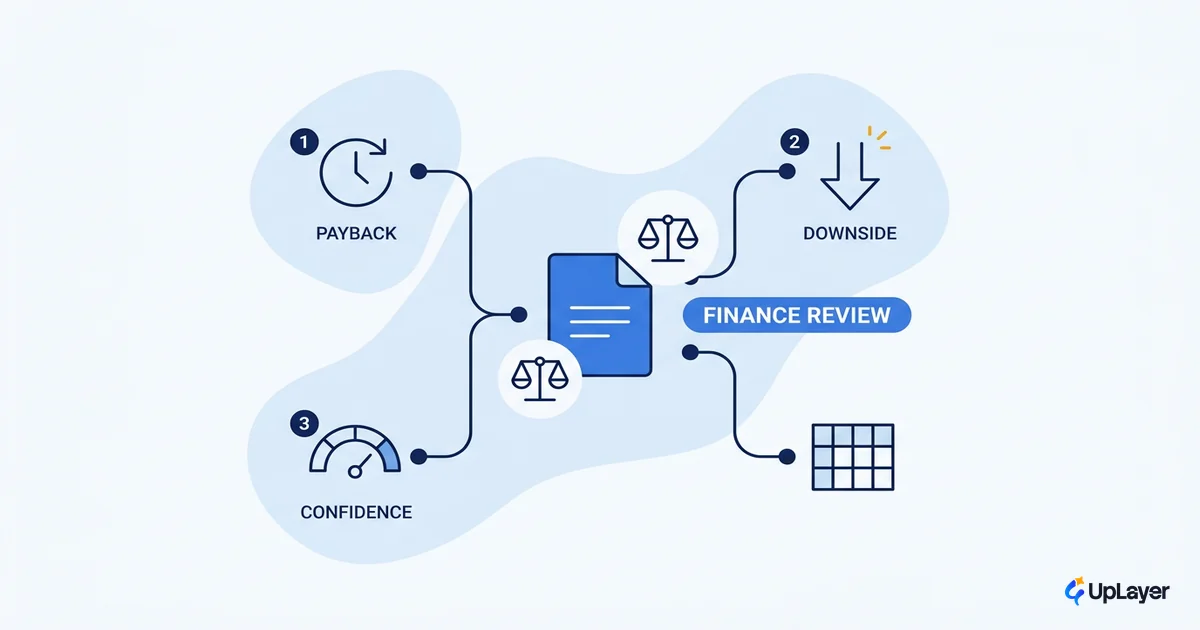
The AI business case is the projection plus the assumptions behind it, written down so finance can argue with the numbers instead of the vibe. You are not claiming a result. You are showing your work.
Frame every number as projected, never achieved, until the metric dashboard says otherwise. We build concept demos for exactly this reason: a working prototype of the top opportunity makes the projection concrete without betting the build budget on it. When the assumptions survive a skeptical reader, you have an AI business case that survives review. When they do not, you have saved a sprint.
Three assumptions decide whether the case holds: the baseline (where the metric sits today), the lift (how much this feature plausibly moves it), and the value per unit (what a point of movement is worth in revenue or retained accounts). Write each one as a range, not a single figure, and name the source. A board will forgive a conservative estimate. It will not forgive a number with no provenance. The discipline here is the same one that separates a strategy from a wish list: every claim carries its evidence, and the weak claims get cut before they cost anything.
WARNING
Most AI features ship and move nothing. Define the metric and the kill condition before you choose the model. A feature with no kill condition is not a bet. It is a subscription to sunk cost.
This is where the supportive-AI thesis earns its keep. The layer sits on top of the product you already built (a copilot, an assistant, search, summarization), tied to a metric you already report. You are not retraining a foundation model or rebuilding the core engine. You are adding intelligence above it, where the risk is contained and the value is measurable.
The AI adoption roadmap: sequence so each release earns the next
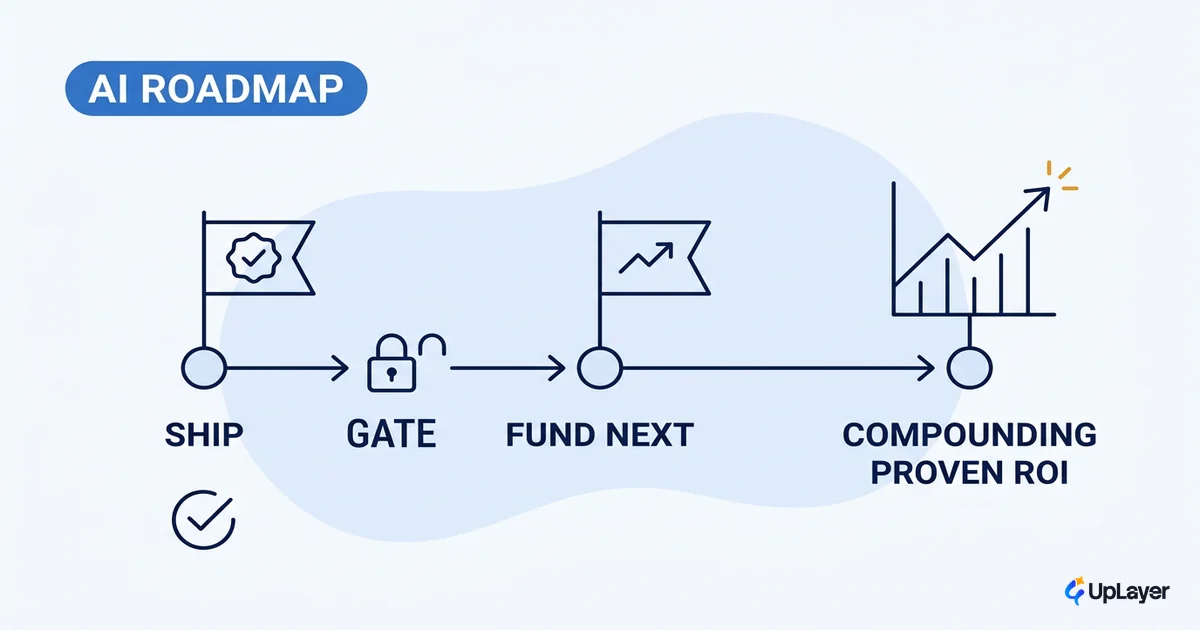
An AI adoption roadmap sequences the bets so each release earns the right to the next one. The first feature ships, proves its metric, and funds the second. Reliability is the gate between them: a release that erodes trust does not get to advance, however good the demo looked.
This is the discipline most plans lack, and the data is blunt about the payoff. BCG found that AI leaders pursue about half as many opportunities as their less advanced peers, yet expect more than double the ROI. They win by concentration, not coverage. A focused roadmap beats a long one.
Leaders pursue, on average, only about half as many opportunities as their less advanced peers, and expect more than twice the ROI. (BCG, Where's the Value in AI?, 2024)
Sequence by three filters, in order:
- Confidence. Where is the projected lift most defensible? Ship that first.
- Reliability. Where can you clear the trust bar with guardrails and human-in-the-loop, not luck?
- Compounding. Which release makes the next one cheaper or more credible?
For the mechanics of ordering and dependency, see how to build the AI adoption roadmap. The strategy decides which bets exist. The roadmap decides what order they ship in.
An AI adoption strategy for an established product
Adoption for an established product is a retrofit, not a clean build, and the constraints are the point. You inherit an existing UX, existing data, and existing user trust. Those are assets, not obstacles. The fastest credible win is usually a supportive feature inside a flow people already use, not a new surface you have to teach them.
That changes the math in your favor. A retrofit can borrow the baseline you already report, the segment that already converts, and the workflow your team already instruments. You are not standing up new measurement to prove a new thing. You are pointing the existing dashboard at one added capability and watching whether the number moves.
Keep the AI as a layer on top of the core engine, never inside it. That choice keeps the risk contained, keeps the rollback cheap, and keeps a single misfire from undermining the product your customers already rely on. The established product is exactly where supportive AI, tied to a tracked metric, pays off fastest.
A good plan is mostly a record of disciplined no's. Pick the one metric, prove the one feature, and let the result decide what ships next. That is the version of an AI adoption strategy that survives the demo and reaches production.
TIP
Want the ranked opportunity map, a working concept demo, and a projected metric lift for your product in 14 days? How the AX Audit works.. We find AI worth 3x the fee or it is free.