How to write an AI business case that survives review
Write an AI business case that survives finance review: one metric, a baseline, a projected delta, and an honest list of the features you chose to skip.
 Shahriar P. ShuvoAI ROI & Strategy8 min read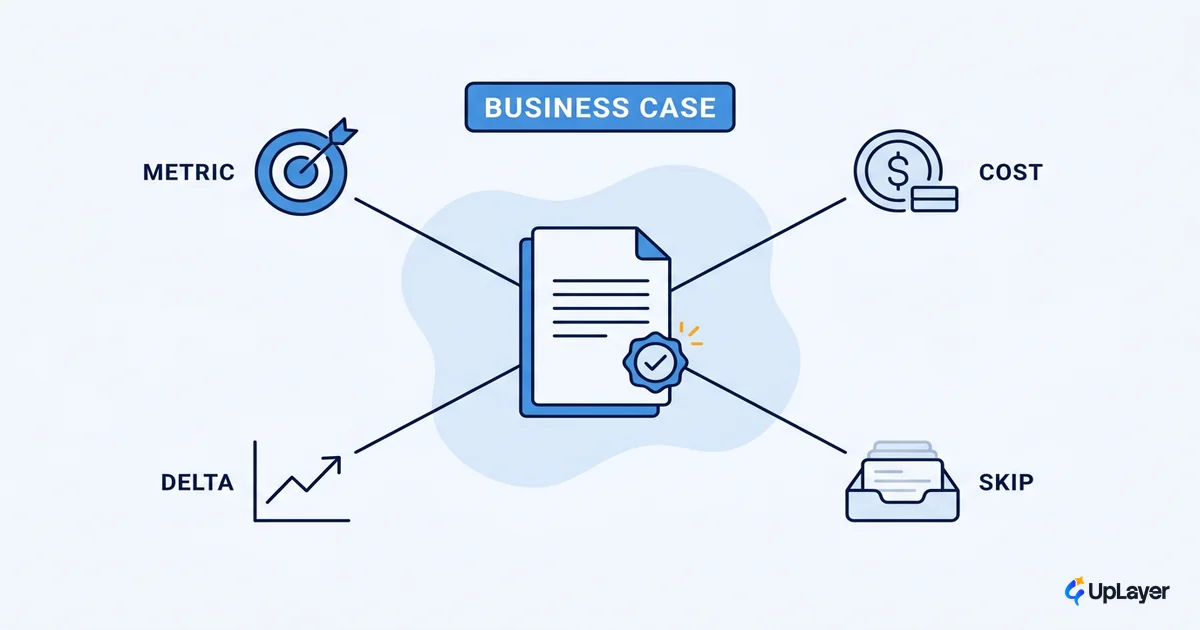
Most AI business cases read beautifully and die in the same meeting. The slide deck is clean, the language is confident, and then the CFO asks one question: which number does this move, and by how much? The room goes quiet. That silence is the whole problem.
An AI business case is a metric, a cost, and a projected delta. Everything else is theater. If you cannot name the single number the feature changes, name where that number sits today, and name where you think it lands after you ship, you do not have a case. You have a wish with a budget line attached.
This is the version that survives review. Not the one that wins the room on vibes, but the one a skeptical finance team can poke at, agree the assumptions are reasonable, and fund. We write these for a living, so this is the structure we actually use.
What an AI business case actually is (and what gets it killed)
An AI business case is a falsifiable bet: one metric you already track, the cost to move it, and the projected roi with your assumptions shown. Falsifiable is the operative word. If the case cannot be wrong, it cannot be evaluated, and finance treats anything it cannot evaluate as risk.
The most common cause of death is not a bad idea. It is an unmeasurable one. Gartner found that at least 30% of generative AI projects get abandoned after the proof of concept, citing unclear business value as a leading reason. Unclear business value is what you get when the case lists benefits instead of committing to a delta on a number the company already reports.
So the first move is subtraction. Pick one metric: churn, activation, conversion, expansion, support cost per ticket. Not a list, one. The discipline of choosing forces you to admit what the feature is really for. If you want the full mechanics behind that number, start with how to measure the ROI of an AI feature before you write a word of the case. The business case is the promise; the measurement method is what makes the promise honest.
NOTE
A case that moves "efficiency" or "productivity" in general is a case with no baseline and no owner. A case that moves "trial-to-paid conversion from 18% to 21%" has both. Specificity is not a nice-to-have. It is the thing being reviewed.
What does an AI business case need to include
A complete case has six parts, and a reviewer can tell within thirty seconds whether you skipped one. Productivity gains are not enough on their own, because as Gartner notes, those gains are difficult to translate into financial benefit. The financial benefit has to be stated, not implied.
Here is the structure. If a section is blank, the case is not ready.
| Part | What it answers | What kills it |
|---|---|---|
| The metric | Which single number changes? | "Multiple KPIs" or "overall efficiency" |
| The baseline | Where does that number sit today? | No baseline, so no delta is provable |
| The projected delta | Where do you think it lands, and why? | A number with no stated assumptions |
| The full cost | Build + run + model inference + maintenance | Build cost only; run cost hidden |
| The payback window | When does benefit > cost? | "Long-term value" with no date |
| What you're not building | Which AI ideas you cut, and why | Pretending every idea made the list |
The sixth row is the one teams skip, and it is the one that earns the most trust. Naming what you chose not to build tells a reviewer you ranked options by return rather than by enthusiasm. Before you fill any of this in, set a baseline before you ship. Without the recorded starting number, the projected delta is unfalsifiable, and an unfalsifiable case is theater.
How do I write an AI business case, step by step
Write it in the order finance reads it: number first, cost second, the part where you might be wrong last. This is also the order of an honest ai cost benefit analysis, so the case and the math stay in sync.
- Name the metric. One number the company already tracks and already cares about. If leadership does not already report it, pick a different metric.
- Record the baseline. The current value, the source, and the date you pulled it. This is what makes the delta provable later.
- Project the delta. State the lift, then state the three assumptions it rests on. A reviewer should be able to disagree with an assumption, not just the conclusion.
- Price the full cost. Design, build, model inference, monitoring, and the maintenance tail. Run cost is where AI cases quietly go underwater.
- Compute payback. Benefit per period against total cost, and the date the two cross.
- List the cuts. The AI features you considered and rejected, with the one-line reason each did not earn its place.
The arithmetic that makes or breaks the case is the projected ROI itself. Keep it visible and keep it simple:
projected_roi = (annual_benefit - annual_cost) / annual_cost

where:
  annual_benefit = baseline_metric_value
                 x projected_delta_percent
                 x value_per_unit_of_metric
  annual_cost    = build_cost (amortized)
                 + run_cost            # model inference + infra
                 + maintenance_cost

payback_months   = build_cost / (monthly_benefit - monthly_run_cost)
Show the inputs, not just the output. The number that survives review is the one whose assumptions are written down next to it. For the full treatment of cost lines and benefit modeling, work through a complete AI cost benefit analysis and bring the result into the case. That is also how you protect roi on ai investments over time: a case built on visible assumptions can be re-checked after launch instead of re-argued.
IMPORTANT
The projected delta is a range with assumptions, not a single confident number. "We project a 2 to 4 point conversion lift, assuming current trial volume holds and adoption reaches 40%" beats "AI will increase conversions" in every finance meeting ever held.
How to justify AI spend to leadership without hype
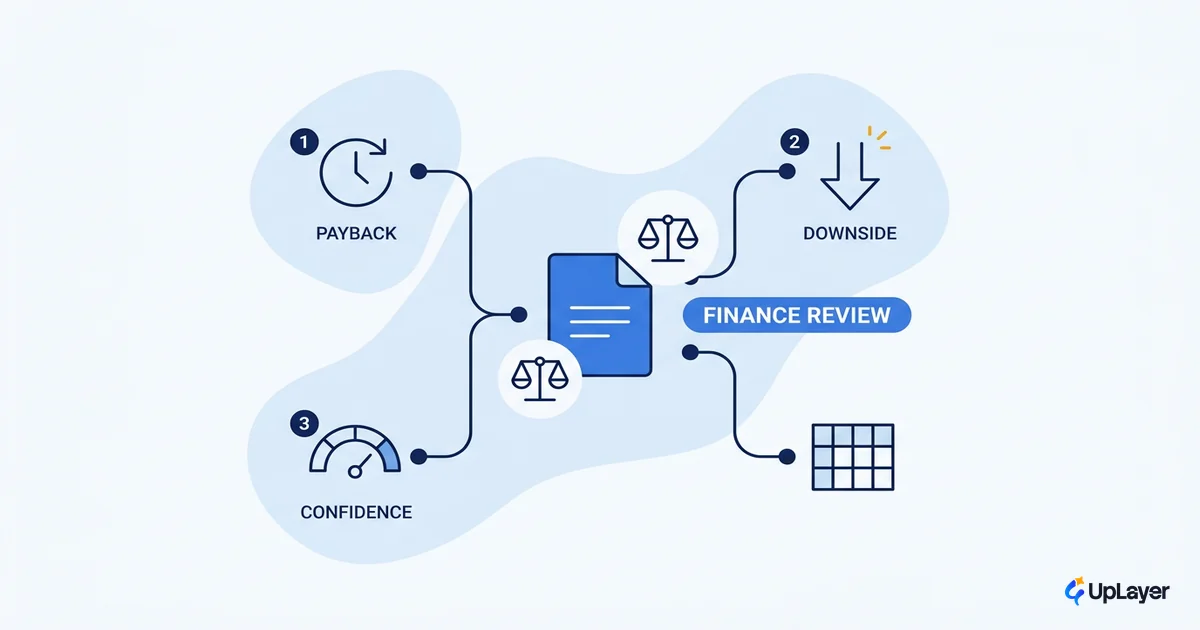
Justify the spend in the language leadership already uses for every other investment: payback period, downside, and the metric they report to the board. The fastest way to lose the room is to argue that the AI is impressive. Nobody approving budget cares that it is impressive. They care that it pays back and that it will not embarrass them.
The risk is real and it is rising. Gartner projects that over 40% of agentic AI projects will be canceled for escalating costs and unclear business value by 2027. Your reviewer has either lived through one of those cancellations or read about ten of them. The case that gets funded is the one that pre-empts the obvious objection: here is the downside, here is the kill criterion, here is the date we check.
That framing is what turns a spend request into a de-risk argument. You are not asking leadership to believe in AI. You are showing them a bounded bet with a stop-loss.
WARNING
The single most common rejection is "this is a solution looking for a problem." It happens when the case opens with the technology instead of the metric. Open with the number and the gap. Mention the model last, if at all. The model is an implementation detail; the metric is the case.
When the room pushes back hard, you defend the case the same way you built it: assumption by assumption. There is a full method for the high-pressure version of that conversation in how to defend it to finance, which is where most AI business cases are actually won or lost.
The AI ROI report your case becomes after you ship
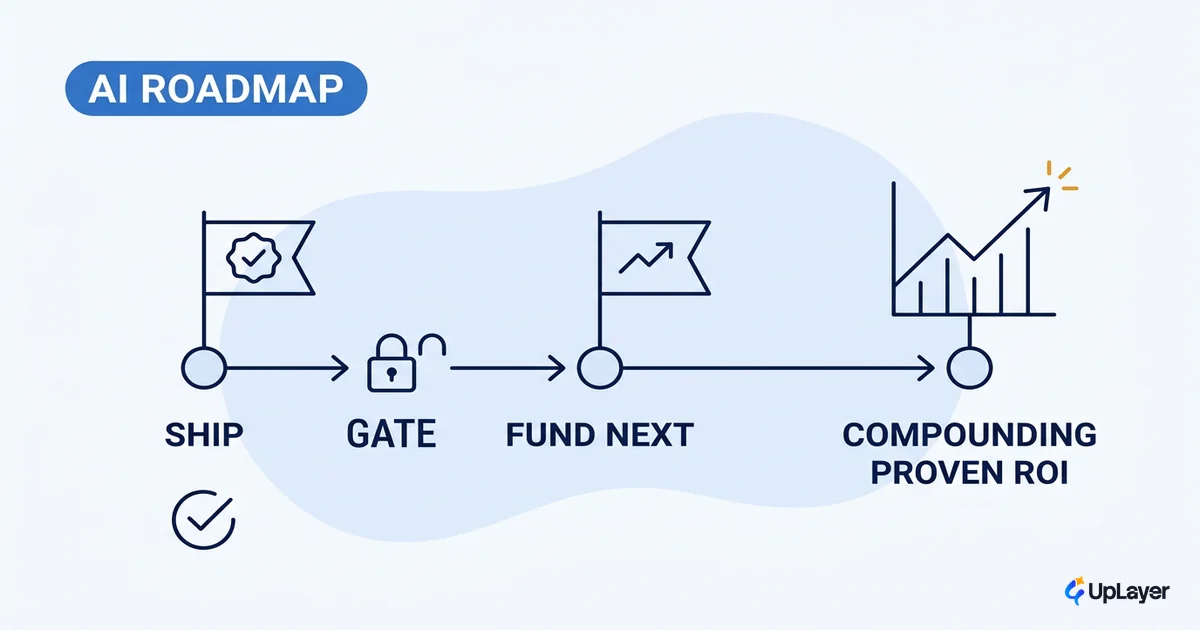
The business case is a promise. The ai roi report is the receipt. Closing that loop is what gets your next AI business case funded faster, because a reviewer who has seen one of your projections turn out roughly right will extend you credit on the next one.
This is the difference between teams that ship AI once and teams that ship it repeatedly. The repeat shippers treat every case as a hypothesis they will be graded on. They record the baseline, they state the projected roi as a range, and after launch they publish what actually happened against it. Most companies never get here. Recall that only 26% of companies move beyond proofs of concept into tangible value, per BCG's survey of 1,000 executives. The gap is rarely the technology. It is the missing loop between the case and the result.
When you do ship, write the report with the same six parts you used for the case, now filled with measured numbers instead of projected ones. The exact contents of what belongs in an AI ROI report follow the same spine, so the work compounds rather than restarting.
Funding AI twice is the real goal, and only a falsifiable first case earns it. The teams that win the budget meeting are not the ones with the most impressive demo. They are the ones whose AI business case named a metric, showed a baseline, projected an honest delta, and turned out to be roughly right. Write that case, and the second one is easy.
TIP
Want the projected ROI of your single highest-impact AI feature, scored against a metric you already track, ready to drop straight into the case? How the AX Audit works.