How to prove AI ROI to your leadership
How to prove AI ROI to your leadership: a before-and-after on a metric they already watch, set up so the win is undeniable and survives finance scrutiny.
 Sohanur RahmanAI ROI & Strategy7 min read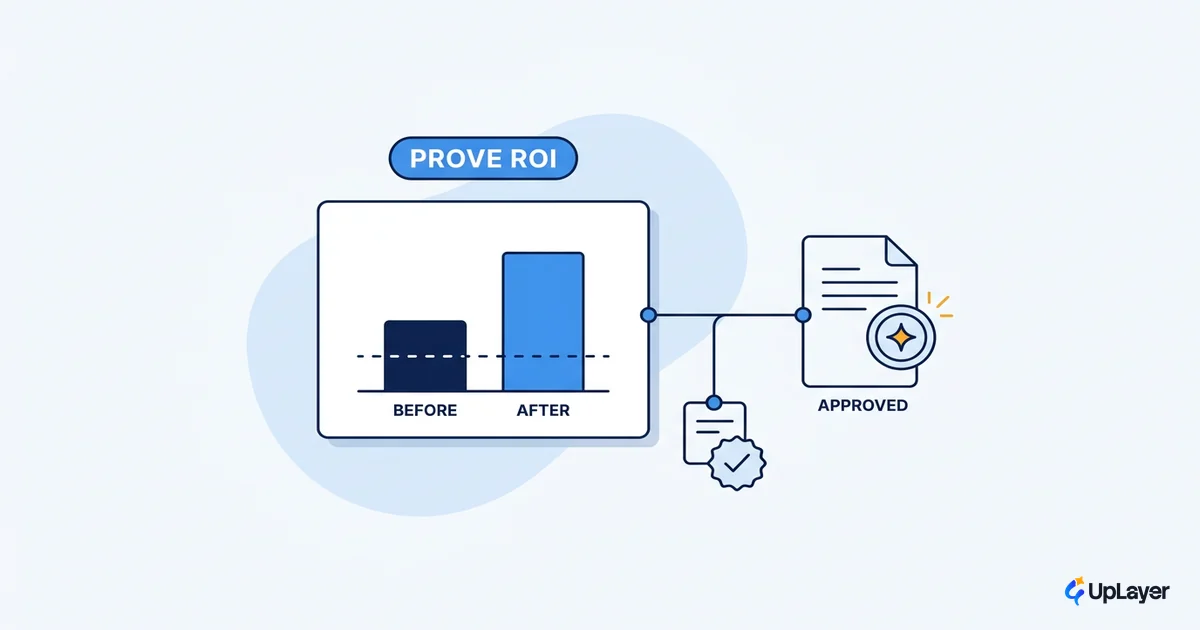
The feature shipped. The demo got applause. Now you are in the board meeting, and someone asks the only question that decides whether the work was worth it: "did it move a number we already care about?" If your honest answer is "we're seeing great engagement," you have already lost the room. To prove AI ROI to your leadership, you need a measured before-and-after on a metric they were watching long before the AI existed, with the model's contribution isolated cleanly enough that a skeptical CFO cannot wave it away.
That kind of proof is not reconstructed after launch. It is designed before it. The teams that walk out of the meeting funded did one thing the others didn't: they picked the metric, set the baseline, and planned the comparison before they wrote a line of code. This piece is about the proof, not the plumbing. For the underlying mechanics of how to measure the ROI of an AI feature, the cornerstone covers the math; here we cover the evidence that survives the room.
What it actually takes to prove AI ROI to your leadership
Proof is a measured change in a metric your leadership already tracks, attributable to the AI feature and to nothing else. That is the whole bar. Not adoption, not satisfaction scores, not tokens served. A line they already watch went up or down by a number you can defend.
The reason the bar sits there is that almost everyone clears the easy version and fails the real one. In MIT's State of AI in Business 2025 report, roughly 95% of enterprise generative AI pilots delivered no measurable impact on the P&L, while only about 5% drove rapid revenue acceleration. The teams in that 95% were not short on activity. They shipped, they demoed, they reported usage. What they could not produce was a number on a metric leadership already owned. That is the same reason AI pilots stall before they show ROI: they were designed to win applause at a demo, not to move a metric anyone tracks.
The vast majority stall, delivering little to no measurable impact on P&L. (Fortune, on MIT NANDA's The GenAI Divide: State of AI in Business 2025)
So the work of proof starts at the metric, not the model. If your AI feature cannot point at a line on a dashboard your leadership reads every week and say "I moved this, by this much, and here is why it was me," you do not have proof. You have a story. Stories lose to the seasonality question every time.
What evidence proves AI ROI (and what just looks like it)
The fastest way to lose credibility is to bring vanity proof to a finance audience. Feature usage, session counts, and "engagement" feel like evidence because they are numbers and they went up. They are not evidence, because none of them is a metric leadership was accountable for before the feature existed. Worse, leading with them signals that you could not find a real one.
Here is what convinces a board against what only looks like it does. The difference is whether the metric was on their dashboard yesterday.
| Vanity proof (lowers your credibility) | Real evidence (survives the room) |
|---|---|
| Feature adoption, daily active users of the AI | A baseline delta on a metric leadership already tracks |
| "Engagement is up" with no comparison | A held-out cohort or before/after window with a comparison |
| "AI did it" with no attribution | A conservative claim that isolates the AI's contribution |
| CSAT or NPS bumps with no link to revenue or retention | Movement in churn, activation, conversion, or expansion |
| Hours saved, estimated, never validated | Hours saved, validated against actual cycle-time data |
The stakes for getting this wrong are not hypothetical. Gartner predicts at least 30% of generative AI projects will be abandoned after proof of concept, and unclear business value sits right next to poor data quality and escalating cost on the list of reasons. A feature that ships without a metric to prove it is a feature already on the cancellation path. The ai roi metrics that matter are the boring ones leadership has tracked for years, not the new ones invented to flatter the launch.
How to show AI moved a metric they already watch
To show AI moved a metric, you need four things in order: a baseline, a clean ship, a read on the delta, and a way to rule out the other explanations. Skip any one and the proof has a hole a sharp CFO will find.
The hardest part happens before launch. You cannot reconstruct a baseline after the fact, so the work to set a clean baseline before you ship is the difference between a number that means something and a number that means nothing. Knowing how to measure AI ROI is really knowing how to set this up early; once the baseline exists, the rest is disciplined reading.
AI ROI proof, in four lines:

1. Baseline      metric value over a stable window BEFORE the feature
2. Treatment     same metric over a comparable window AFTER the feature
3. Delta         Treatment - Baseline, on the metric leadership tracks
4. Attribution   Delta minus what a held-out cohort moved on its own
                 = the part you can credibly claim the AI caused
That fourth line is where most proof falls apart and where yours has to be strongest. The first question from finance is never "what's the number," it is "how do you know the AI did that and not the pricing change, the new sales hire, or the season?" A held-out cohort answers it before they ask. When a true holdout is not possible, name the confounders out loud and show why they cannot account for the delta. The full sequence of how to measure AI ROI step by step lives in its own piece; the point for the board is that you isolated the variable, and you can say how. When you can show the AI, and only the AI, moved a metric they already watch, you have done the rare thing: you made AI move a metric and proved it.
Build the AI ROI report your board will believe
The number is not the deliverable. The decision is. An ai roi report exists to turn "the feature moved retention by 1.4 points" into "so we fund the next one, kill that other one, and here's why." A report that stops at a dashboard screenshot makes leadership do the reasoning, and leadership will reason their way to skepticism.
Keep it to four things: the metric and its baseline, the measured delta, the attribution argument, and the recommendation. Cut everything else. The full template for what belongs in an AI ROI report goes deeper, but the discipline is subtraction.
WARNING
Every vanity chart you add lowers the credibility of the real one. A slide of rising feature usage next to your retention delta invites the question "why are you showing me this instead of the money?" Lead with the metric they own. Delete the rest.
How do I prove AI ROI to my CEO, or CFO?
Lead with the metric they are personally accountable for, give a conservative number, and name your assumptions before they do. A CEO wants the strategic line moved. A CFO wants the number defended and the risk profile shown. Same evidence, different framing.
The reframe that helps most: the board does not read your feature as one ROI verdict. Gartner argues that CFOs misjudge AI when they treat it as a single ROI problem rather than a portfolio of very different bets, and that much of AI's value shows up first as better decisions and faster adaptation, before it reaches the P&L. So position your feature as one bet that paid, with a clean number, rather than as the proof that "AI works." The narrower claim is the one that survives. This is also why a tight ai business case beats a sweeping one. You are not selling a vision; you are clearing a hurdle.
You are not alone in finding this hard. In a 2026 Gartner survey, 31% of chief sales officers cited difficulty proving the ROI of AI tools as a top challenge, under pressure to show measurable value they could not cleanly explain. The fix is the conservative, attributable number, framed in their language. Being honest about the return you should actually expect up front is what keeps the projection conservative, so the measured result clears the bar instead of missing it. When you have to defend an AI business case to finance, the move is to undersell the projection and overdeliver on the proof, never the reverse.
A win nobody can argue with is built before launch, not rescued after it. Pick the metric leadership already watches, set the baseline, plan the comparison, and the day you have to prove AI ROI you will be reading a result, not spinning one. Do that once and the next feature gets funded on evidence instead of faith.
TIP
Want to know which AI feature will move a metric your board already tracks, before you build it? How the AX Audit works.