How to measure AI ROI, step by step
How to measure AI ROI honestly: a five-step loop and a clear formula to baseline, instrument, isolate the variable, and read the real, defensible delta.
 Shahriar P. ShuvoAI ROI & Strategy7 min read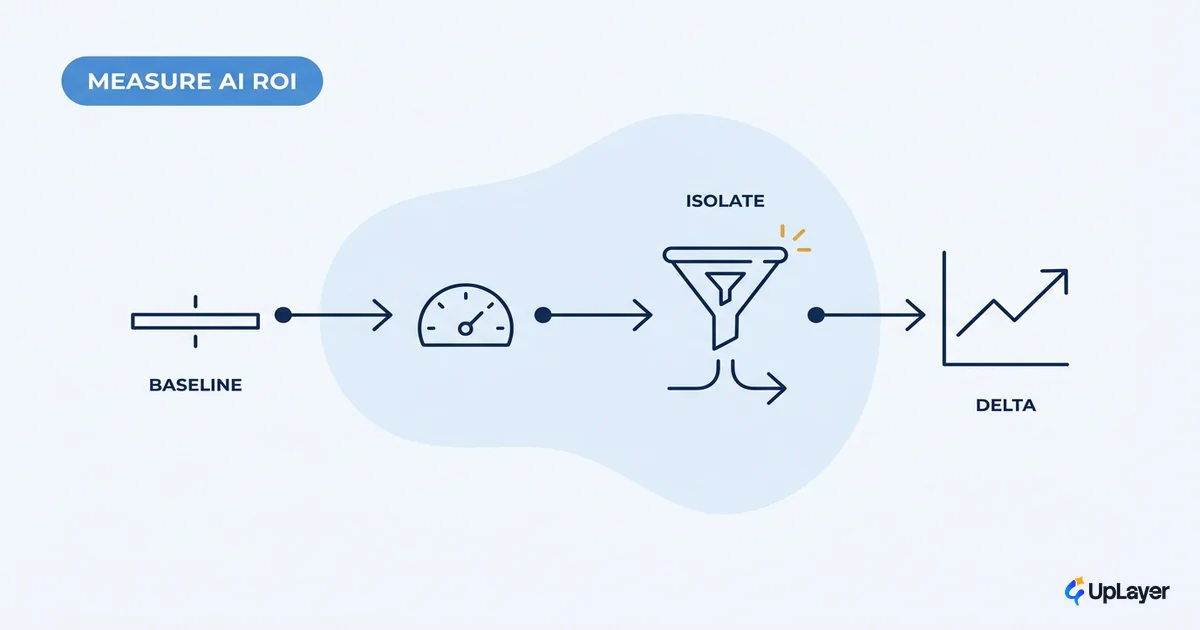
Most teams "measure" AI ROI like this: a metric drifted up around the time the AI shipped, so the AI gets the credit. That is not measurement. That is a story with a number stapled to it.
Knowing how to measure AI ROI means knowing how to defend the claim that the AI, and not the season, the pricing change, or the marketing push, moved the number. The math is the easy part. Honest attribution is the part everyone skips. This piece gives you the five-step loop and the formula to run it across any AI initiative, not just one feature.
If you want the deep version for a single build, we cover how to measure the ROI of a single AI feature end to end in the cornerstone. This post is the general method you reuse every time.
What ROI actually means for an AI initiative
ROI for AI is the metric delta you can defend as caused by the AI, valued in dollars, minus what it cost to build and run. The load-bearing word is "caused." A number that changed is not the same as a number the AI changed.
This distinction is why so much AI work quietly dies. Gartner predicts at least 30% of generative AI projects will be abandoned after proof of concept by the end of 2025, citing unclear business value as one of the top reasons. When nobody can prove the value, the budget walks.
The macro picture says the same thing. AI shipping keeps rising across the economy even as proof of payoff lags, with the Federal Reserve tracking how adoption keeps climbing across US firms and workers. Adoption is not the bottleneck. Measurement is.
BCG surveyed 1,000 executives across 59 countries and found 74% of companies have yet to show tangible value from their use of AI. Only 26% had moved past proofs of concept into measured returns. The leaders that did averaged 1.5x higher revenue growth.
So measuring AI ROI is not a finance formality you run at the end. It is the thing that decides whether the feature survives its first board review.
How to measure AI ROI: the five-step process
What is the process to measure AI ROI? It is a loop, run per initiative, in this order. Skip a step and the final number is a guess wearing a dollar sign.
- Baseline. Record the target metric before the AI exists, for the users who will touch it.
- Instrument. Add the events that let you see usage and outcome, not just clicks.
- Ship. Release to a measurable slice, ideally a holdout or staged rollout.
- Isolate the variable. Separate the AI's effect from everything else that moved.
- Read the delta. Convert the defensible change into dollars, net of cost.
| Step | Output | Most common failure |
|---|---|---|
| Baseline | Pre-AI metric value + window | No baseline, so any later number is unanchored |
| Instrument | Usage and outcome events | Tracking clicks, not whether the task got done |
| Ship | A measurable release (holdout / staged) | 100% rollout with nothing to compare against |
| Isolate | The AI-attributable share of the change | Crediting the AI for a seasonal or pricing swing |
| Read the delta | Dollar value, net of build + run cost | Counting gross benefit, ignoring run cost |
Each step has one job. The middle three are mechanics. The first and fourth are where honesty lives.
How do I set a baseline to measure AI ROI
The baseline is the whole game. You cannot read a delta against nothing.
Measure the target metric for a representative window before the feature exists, and segment to the users who will actually touch the AI. If the AI is a support copilot, your baseline is resolution time for support tickets, not the whole product. If it is an onboarding assistant, your baseline is activation for new accounts, not your install base. A blended company-wide number washes out the signal you are trying to detect.
Pick a window long enough to absorb your normal weekly and seasonal noise. One quiet week is not a baseline. We go deeper on windows, segments, and seasonality in set a baseline before shipping AI, because this is where most ROI math is quietly broken before a line of model code runs.
WARNING
No baseline, no ROI. If you did not record the metric before the AI shipped, you cannot measure how to move a metric you never benchmarked. The honest answer at that point is "we do not know," and the honest fix is to ship the next thing with a baseline in place.
How to attribute a metric change to an AI feature
Attribution is the step that separates real measurement from wishful thinking. Here you decide how much of the change the AI actually earned.
Rank your methods by rigor and use the most rigorous one your traffic allows:
ATTRIBUTION DECISION RULE

1. Can you randomize exposure?
   -> Holdout / A-B test. Gold standard. Use it.

2. Enough comparable users but can't randomize?
   -> Matched cohorts (AI-exposed vs similar non-exposed).

3. Neither, but a clean before/after?
   -> Pre-post with controls. Adjust for known confounders.
      Treat the result as directional, not proof.

4. None of the above?
   -> You cannot attribute yet. Say so. Do not claim ROI.

ALWAYS list confounders before reading the delta:
seasonality, pricing change, a marketing push,
a competitor outage, an unrelated product release.
This is not optional rigor for its own sake. The NIST AI Risk Management Framework builds a dedicated measure function into its core and is explicit that human judgment should be employed when deciding which metrics and thresholds count. Attribution is a judgment call you make on purpose, with the confounders named out loud, not a number a dashboard hands you.
The AI ROI metrics and the formula that ties them together
The formula is simple once attribution is honest. The inputs are where the work was.
AI ROI = (Attributed metric value - Total cost) / Total cost

Attributed metric value =
    (post-AI metric - baseline metric)
    x  share attributable to the AI   (from your method above)
    x  dollar value per unit of the metric

Total cost = build cost + run cost (model, infra, monitoring, maintenance)
The metrics that matter are the ones your buyer already tracks, translated into dollars. Cost-savings framing alone undersells SaaS AI, where the money is usually in retention and expansion.
| Metric you already track | What the AI moves | Dollar translation |
|---|---|---|
| Retention / churn | Fewer cancels from a feature that earns trust | Saved accounts × average contract value |
| Activation | More new users reach first value | Incremental activated × their expected LTV |
| Conversion | Trial-to-paid lift from in-product help | Extra conversions × plan price |
| Expansion | Upsell driven by a copilot or assistant | Incremental seats / tier × revenue per unit |
A calculator helps only if you feed it honest baseline and attribution numbers. We walk through inputs and traps in the AI ROI metrics that actually matter and in our take on an AI ROI calculator. Until you have a real shipped result, frame every figure as projected, the way we label a Concept Demo: "designed to move," never "achieved."
What an honest AI ROI read looks like
An honest read carries its own uncertainty. State the attributed delta, the method you used, and the confounders you could not fully rule out. A single point estimate with no method behind it is a marketing claim, not a measurement.
It also includes the verdict to kill. If the attributed delta is inside the noise after a fair window, the feature did not move a metric, and the right call is to retire it and reallocate the spend. That decision is a feature of the method, not a failure of it. We cover the traps in measuring AI ROI without fooling yourself.
Run this loop on every initiative and "how to measure AI ROI" stops being a debate and becomes a habit: baseline, instrument, ship, isolate, read the delta, decide. The teams that build this muscle are the ones who keep their AI budget, because they can prove what it bought.
TIP
Want this run on your product, with the highest-ROI opportunity scored against a metric you already track? How the AX Audit works.