Measuring AI ROI without fooling yourself
Measuring AI ROI honestly means catching the traps that inflate the number: vanity metrics, missing baselines, and broken attribution. Here is how.
 Shahriar P. ShuvoAI ROI & Strategy8 min read
The most dangerous AI ROI number is the impressive one nobody can defend. It looks great on a slide, it survives the demo, and then a finance lead asks one question about how it was calculated and the whole thing folds. Measuring AI ROI honestly is less about finding a bigger number and more about producing one that holds up when someone hostile reads it.
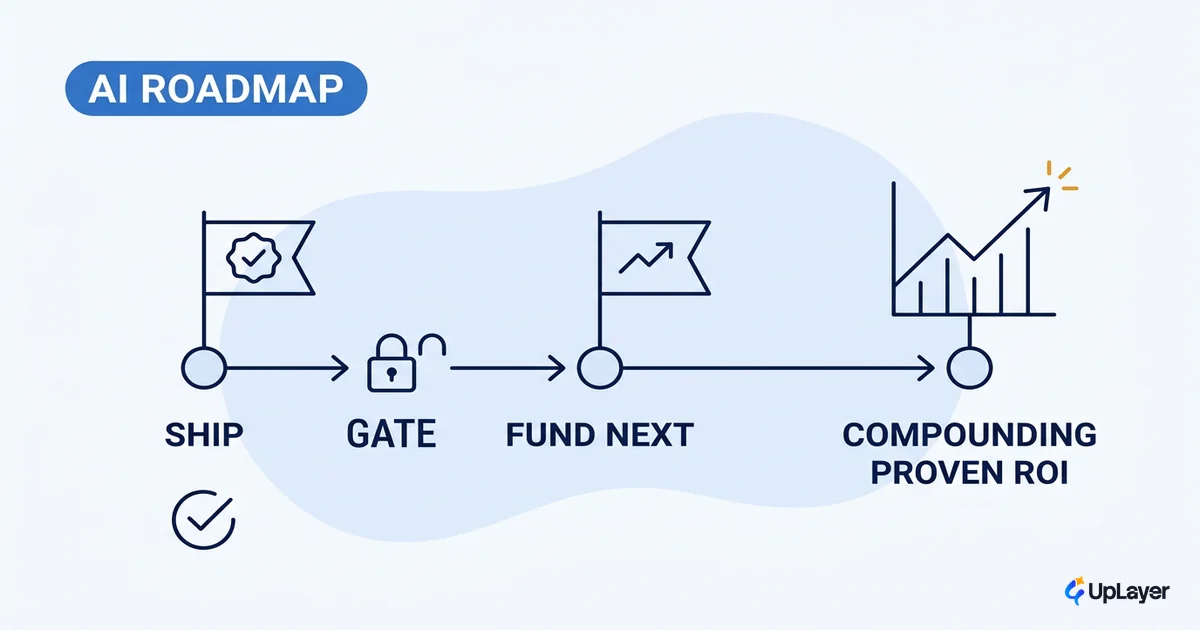
This is the trap most teams walk into. They reach for the figure that justifies the spend instead of the figure they can stand behind. The good news is that the ways AI ROI numbers get inflated are predictable. There are four of them, and once you can name them you can instrument around each one. The work starts where the cornerstone leaves off: tie one AI feature to one metric you already track, then make sure the delta you report is real.
Why is measuring AI ROI so hard?
It is hard because the inputs are entangled and the timeline is long. AI rarely runs alone. A human reviews the output, a workflow routes it, an existing feature already moved the metric a little, so attributing the result to "the AI" is a judgment call dressed up as a measurement. The timeline makes it worse. Deloitte's 2025 survey of 1,854 executives found that most teams reach satisfactory returns on a typical AI use case in two to four years, and that payback runs two to four years, not the seven to twelve months people expect from a normal technology investment. Only six per cent saw payback inside a year.
So if your AI ROI report shows a fast, clean, enormous return, the base rate says check it before you circulate it. Difficulty here is structural, not a sign you are bad at spreadsheets. The fix is not a better formula. It is honest instrumentation that survives the entanglement and the wait.
The four traps that inflate AI ROI numbers
Most common mistakes when measuring AI ROI come down to four failure modes. Each one produces a number that reads well and breaks under questioning. The table is the short version; the sections after it go deeper on the two that catch the most people.
| Trap | What it looks like | Why the number breaks | The fix |
|---|---|---|---|
| Vanity metrics | "The AI handled 50,000 tickets this month" | Activity is not value. The tickets may still need the same human review. | Report the outcome delta (resolution time, cost per ticket), not the volume. |
| Missing baseline | "Conversion is 4.1% with the AI on" | No before-number, so the gain is unprovable. | Capture the pre-ship baseline; without it there is no delta to claim. |
| Broken attribution | "Revenue is up since we launched the model" | A pricing change, a season, or another release moved it too. | Use a holdout or staggered rollout so one variable is attributable. |
| Reinvestment paradox | "We saved 200 hours a month" | The hours got absorbed into new work, never booked as savings. | Track whether the freed capacity reached the P&L or just moved. |
These are not exotic. Each ai roi metrics mistake is the path of least resistance, which is exactly why undisciplined reporting lands there by default.
WARNING
Activity counts are the easiest number to produce and the easiest to inflate. "Documents processed," "queries answered," and "hours of work touched" all rise the moment you ship, whether or not anything got better. If a metric goes up simply because the feature exists, it is not measuring ROI.
Vanity metrics vs metrics that move the business
A vanity metric is any number that climbs because the AI is busy, not because the business is better off. The distinction matters because, as TechRadar Pro put it, a reliance on vanity metrics gives organizations a skewed view of success while surface-level results untethered to business objectives give no true indication of value. The number looks like proof. It is not.
Klarna is the cautionary tale. Its support AI reportedly emulated the work of 853 full-time agents and saved around $60m, a headline that sounded like a finished ROI case. Months later the company reversed course and started rehiring humans, because cutting people out of the loop too fast hurt the experience the metric never captured. The activity figure was real. The value story it implied was not.
The honest move is to map every AI ROI claim to a metric the business already watches:
- Retention or churn, not "users who clicked the AI feature."
- Activation or time-to-value, not "onboarding messages the assistant sent."
- Cost per resolved case, not "cases the bot touched."
- Expansion or conversion, not "suggestions generated."
If the candidate metric would not appear in a board deck on its own, it is probably a vanity metric wearing an ROI costume.
How to measure AI ROI so the number holds up
Honest measurement needs three things in place before you report anything: a baseline, a counterfactual, and a single attributable variable. Skip any one and the number becomes a story. The full procedure has its own piece, so for the end-to-end version follow the step-by-step measurement process; the point here is the instrumentation that keeps the result defensible.
Start by capturing the before-number. You cannot claim a delta you never measured, so set a baseline before you ship the feature, not after. Then isolate the variable. The cleanest way to de-risk attribution is a holdout group or a staggered rollout, so the metric moves for the cohort with the AI and not the one without it. That is how you separate the model's effect from the pricing change, the seasonal lift, and the other release that shipped the same week.
Honest AI ROI = (Value_treatment - Value_control) - Fully_loaded_cost
                 ------------------------------------------------------
                                 Fully_loaded_cost

Value_treatment = metric for the cohort WITH the AI feature
Value_control   = same metric for the comparable cohort WITHOUT it
Fully_loaded_cost = model + inference + build + maintenance + human-in-the-loop review

# The control term is what makes it honest. Without it you are
# measuring "before vs after," which credits the AI for everything
# that happened in the world during the test window.
The subtraction of the control group is the whole game. A before-versus-after comparison hands the AI credit for every other thing that changed. A treatment-versus-control comparison hands it credit only for what it actually caused. The fully loaded cost matters just as much: leaving out human review or maintenance is how a break-even feature gets reported as a win.
How to avoid false AI ROI numbers in your report
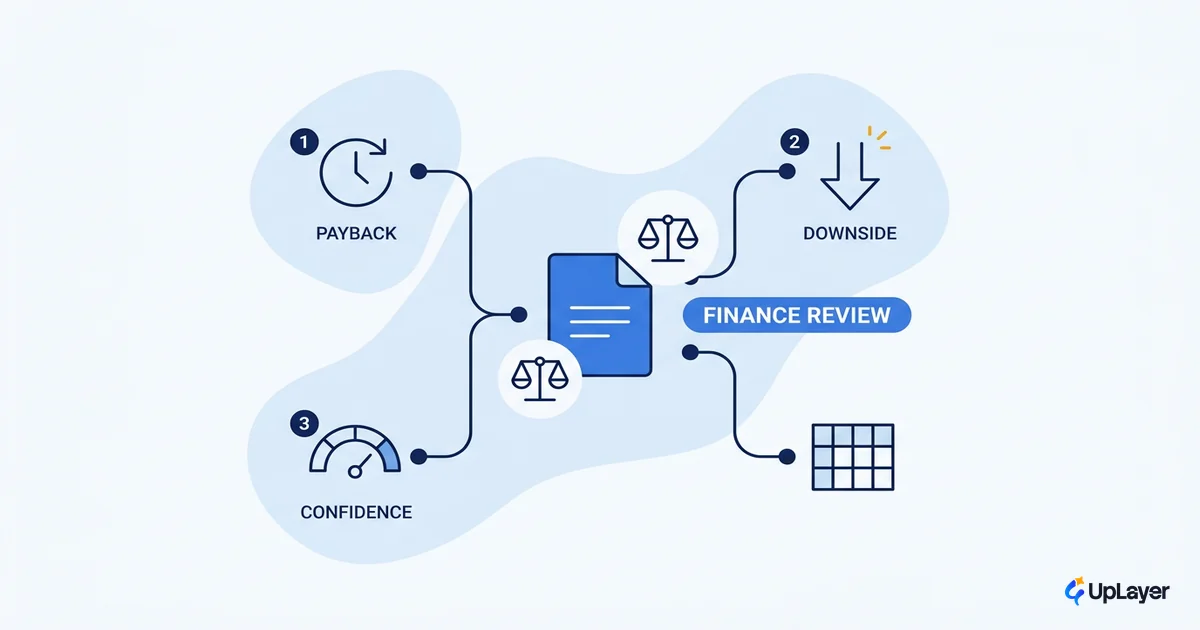
Run a short, hostile checklist before any AI ROI report leaves your hands. Read your own number the way a skeptical CFO would.
- Is there a baseline? If the before-number was never captured, you have a current-state metric, not a delta.
- Is there a control? If everyone got the feature, you cannot rule out the rest of the world moving the metric.
- Are the costs fully loaded? Model, inference, build, maintenance, and the human-in-the-loop time all count.
- Did the savings reach the P&L? Freed hours that got reabsorbed into new work are real but are not booked ROI.
- Would the metric survive on a board slide alone? If it only makes sense with a paragraph of context, it is probably a vanity metric.
This discipline is not bureaucratic caution. Gartner predicted that at least 30% of generative AI projects would be abandoned after proof of concept by the end of 2025, with unclear business value among the named causes. A number that cannot defend itself does not just embarrass you in a meeting. It gets the whole initiative cut.
IMPORTANT
If you cannot prove direct attribution, say so. A conservative projected ROI you can defend beats an inflated one you cannot. Finance trusts the team that discloses the uncertainty far more than the team that hides it.
What honest measurement looks like in practice
Picture a Concept Demo for a B2B SaaS support assistant. You would not lead with "the assistant answered 40,000 tickets." You would hold a control cohort, capture the pre-ship resolution time and cost per case, ship to the treatment cohort, and after a clean window report the projected ROI as the cost-per-case delta minus the fully loaded cost, with the attribution method stated in plain language. No invented client, no rounded-up miracle, just a number with its work shown. That is the version a board approves and a finance team re-runs without finding a hole.
Measuring AI ROI honestly is a competitive advantage precisely because so few teams do it. When your number survives scrutiny, you earn the budget for the next feature and the trust to move faster on it. The traps that inflate AI ROI are predictable, the instrumentation that defuses them is cheap, and the payoff is a report you never have to walk back.
TIP
Want a number you can defend in front of finance? How the AX Audit works. We find the AI opportunity, project the ROI with the baseline and counterfactual in place, and hand you a figure that holds up under scrutiny.