How to protect ROI on AI investments
Most AI spend leaks because nobody tied it to a metric. Here is how to structure ROI on AI investments so the return is provable, not hoped for.
 Shahriar P. ShuvoAI ROI & Strategy7 min read
The return on most AI investments was never lost. It was never made provable. That is the uncomfortable truth behind the ROI on AI investments most teams can't show their board: the spend got approved against a feeling, the feature shipped, and no one had agreed beforehand which number it was supposed to move. So when the question comes, "what did the AI get us," there is no honest answer.
This is not a talent problem or a model problem. It is a measurement-design problem, and it is fixable before you write a line of code. What follows is the structure we use to tie spend to a metric so the return is provable by construction, not discovered by luck.
Why AI investments fail to return
AI investments fail to return because the money was committed against a vibe instead of a baseline. No agreed metric, no owner, no kill criteria. The feature becomes its own justification.
The data is blunt about how common this is. Gartner projects that at least 30% of generative AI projects get abandoned after proof of concept, citing poor data quality, escalating costs, and unclear business value, against deployment bills that run from $5 million to $20 million. Boston Consulting Group, surveying 1,000 executives, found that 74% of companies have yet to show tangible value from their use of AI. And MIT's Project NANDA research, reported by Fortune, found that for 95% of companies the pilots stall, delivering little to no measurable impact on P&L.
Read those three numbers together and the pattern is not "AI doesn't work." It is "nobody set up the conditions to prove whether it worked."
The leak is structural. If you don't name the metric before the build, the return is unprovable the day you ship, no matter how good the feature is. It is also why so many AI pilots stall before they show ROI: the proof was never designed in.
What roi of ai actually measures
The roi of ai is the change in a business number you already track, divided by what it cost to move it. Not model accuracy. Not tokens. Not how many people clicked the sparkle icon once.
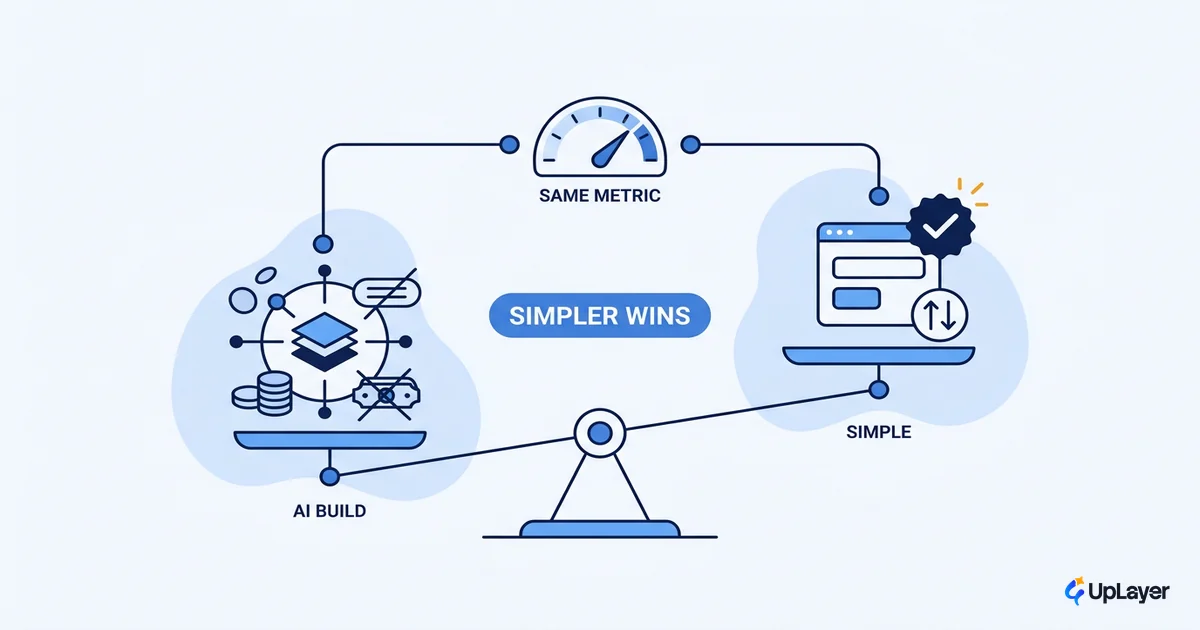
This is where most spend goes quiet. Teams measure the AI, not the outcome. A feature can feel productive and move nothing. A study covered by CIO that measured developer output and found no significant gains from AI coding assistants, despite developers reporting they felt faster, is the whole problem in one example: perceived value is not measured value. The only way to tell them apart is to pick the number first and measure the ROI of an AI feature against a real baseline.
| What teams count | What actually proves ROI |
|---|---|
| Feature usage / clicks | Lift in a metric you already track |
| Model accuracy | Retention, activation, conversion, expansion |
| "Users love it" anecdotes | Before-and-after against a baseline cohort |
| Time saved (self-reported) | Time saved (measured), tied to cost or revenue |
If removing the AI would not change the number you reported to the board, the AI was never the cause. That is the test, and most features fail it quietly. The work of an honest roi of ai calculation is choosing one number the feature is accountable for and instrumenting it before launch, so the comparison is real and not reconstructed after the fact. Pick the metric your buyers and your board already argue about. A new metric invented to flatter the feature convinces no one, and it should not.
Tie the spend to a metric before you build
Here is the mechanism that protects ROI on AI investments: every funded idea carries a projected roi before any code exists. You write down the baseline, the lift you expect, the cost, and the guardrail, and you refuse to fund anything that can't fill in all four. This is the core of any honest ai cost benefit analysis.
AI investment guard (fill before funding)
-----------------------------------------
metric            = the number you already track (e.g. 90-day retention)
baseline          = current value, measured, with the cohort defined
projected_lift    = the change you expect, with assumptions shown
cost              = build + run + maintenance over 12 months
guardrail         = reliability bar + the kill trigger if lift < X by day N

projected_roi     = (projected_lift_in_$ - cost) / cost
fund_decision     = projected_roi clears the bar AND every field is filled
The discipline is the empty field. If you cannot state the baseline, you don't have a measurement plan, you have a hope. So set a baseline before you ship, define the cohort, and only then commit the budget. Projected roi with the assumptions visible is a number a CFO can argue with. A demo is not.
How to de-risk an AI investment
To de-risk an AI investment, you put controls on it the same way you would any other bet with an uncertain payoff. Five of them carry most of the weight.
- One metric, named up front. Not three. One number this feature owns, chosen because the team already tracks it.
- A measured baseline. The current value and the cohort, recorded before launch, so the lift is undeniable.
- Kill criteria. The threshold and date at which you stop. Pre-committed, so sunk cost can't override it.
- Reliability guardrails. Anti-hallucination checks and human-in-the-loop on high-trust actions, so a wrong answer doesn't cost you more than the feature earns.
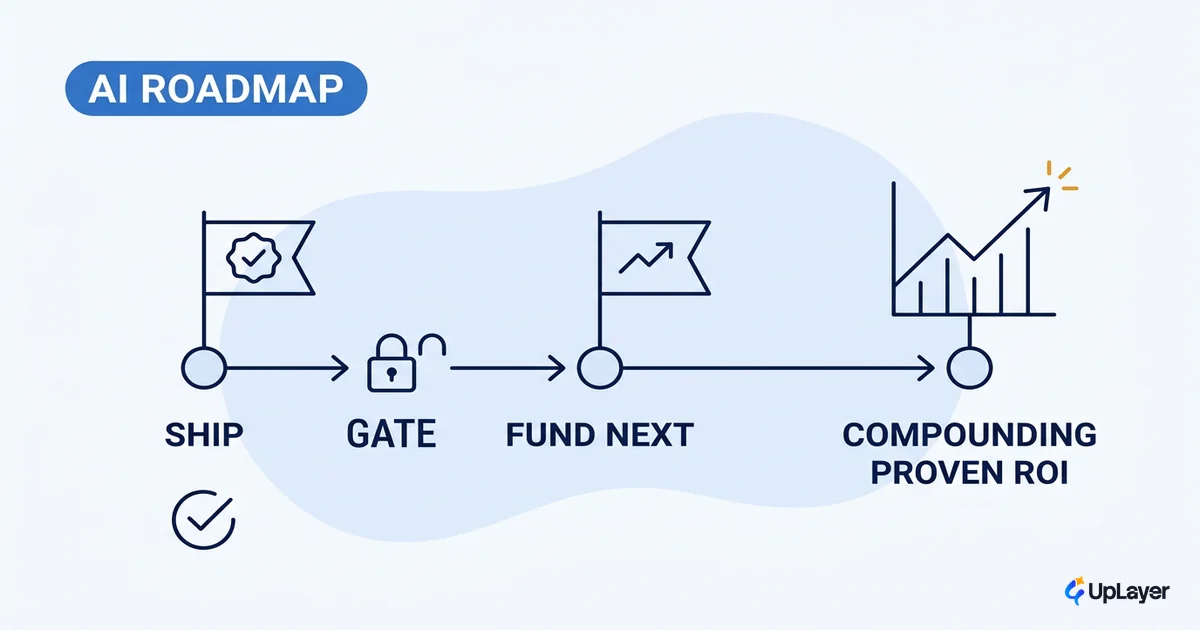
- Staged spend. Fund the proof, not the platform. Release the next tranche only when the metric moves.
WARNING
The most expensive leak is the one that feels like progress. A feature that ships, gets used, and demos well will pass every review except the one that matters: did the number move. If you skipped the baseline, you can't run that review, and the spend is unprovable forever.
These controls are not bureaucracy. They are what turns an act of faith into a decision you can defend.
The AI business case that survives review
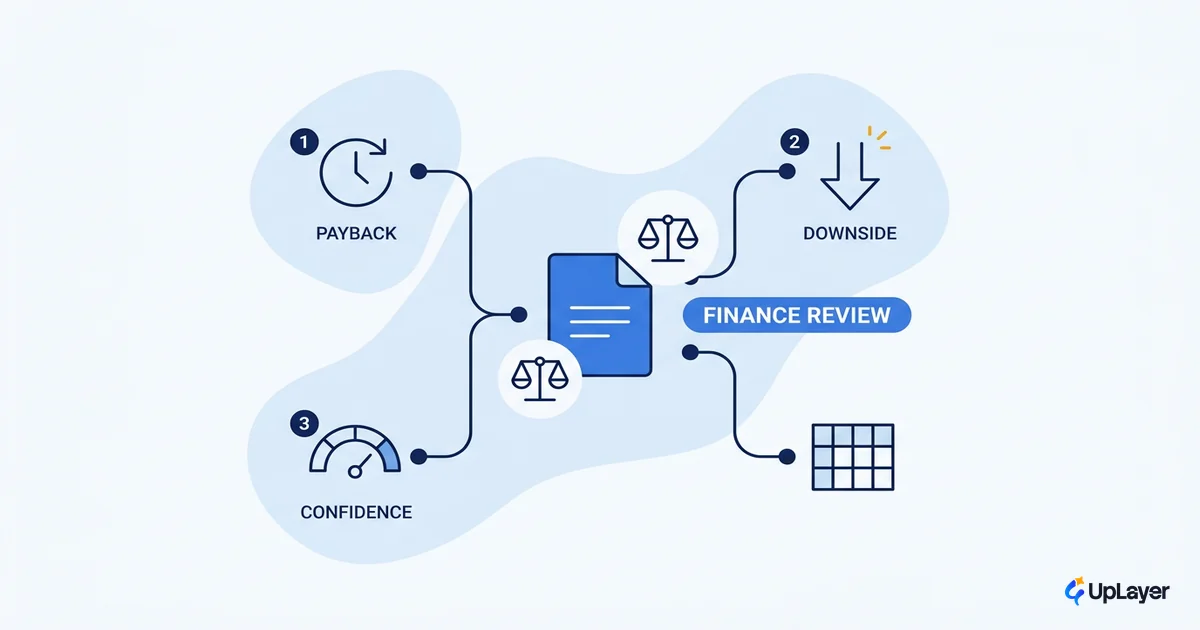
An ai business case survives review when it reads like a finance document, not a product pitch. It names the metric, shows the baseline, projects the lift with assumptions, states the cost, and pre-commits the kill criteria. Finance can't veto a number they helped set.
Write the AI business case that survives review before the build, not after. The version assembled to justify spend that already happened never convinces anyone, because everyone in the room knows the metric was chosen to flatter the result. The order matters: metric, then baseline, then budget.
A case that can't name the number it will move is not a business case. It is a request for permission to find out.
How do I protect ROI on AI investments
You protect it by making the return provable before you commit the money. Run the same short checklist on every idea, and walk away from any that can't pass it.
- Name the single metric the feature owns.
- Measure and record the baseline and the cohort.
- Project the lift with assumptions shown, not asserted.
- Cost it over 12 months, build plus run.
- Pre-commit the kill trigger.
When we run this in an AX Audit, the output is a ranked map of opportunities by projected roi, each tied to a baseline metric, plus a working Concept Demo of the top one. Metrics are framed as designed-to-move and projected, never claimed as achieved, because honest proof is the only kind worth funding against.
The teams that show real ROI on AI investments are not the ones that spent the most or shipped the fastest. They are the ones that decided, before any budget moved, exactly which number would prove it worked, and refused to build anything that couldn't be tied to one. Protect the metric and the return protects itself.
TIP
Want a ranked, baseline-tied projection of where AI pays off in your product, with the features to skip named outright? How the AX Audit works.