AI assistant for B2B SaaS without breaking trust
An AI assistant for B2B SaaS lives or dies on trust. Here are the data boundaries, audit trails, and reliability guardrails that decide whether it gets adopted.
 Shahriar P. ShuvoAI Copilots & Assistants8 min read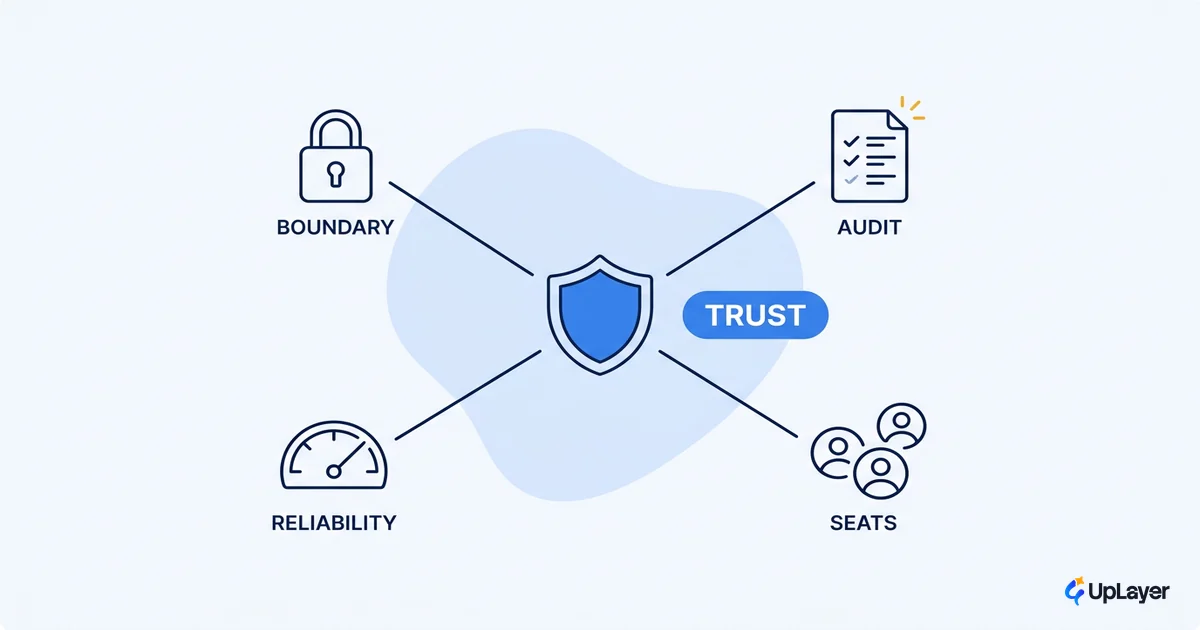
In B2B, the thing that kills an AI assistant is rarely a wrong answer. It is one un-auditable action that scares a security reviewer into disabling the feature for the whole org. An AI assistant for B2B SaaS does not fail in the demo. It fails three weeks later, when an admin can't explain to their compliance team what the assistant touched, so they switch it off and tell their account manager why.
That is the real constraint. Not model quality, not latency, not how clever the prompt is. Trust. The buyer you are shipping to is a governed organization, and they will keep your assistant on exactly as long as they can account for what it does. This piece is the set of trust mechanics that decide adoption: the data boundaries, the audit trails, and the reversible actions that separate a feature that spreads from one that gets quietly killed. Start from designing AI assistants that earn trust, then make the trust concrete with the guardrails below.
Why a B2B AI assistant lives or dies on trust, not model quality
A B2B AI assistant earns its place when the buyer can account for everything it does, and loses it the moment they can't. The model being smart is table stakes. The model being explainable, bounded, and reversible is what survives a security review.
The failure rate here is not a rumor. Gartner projects that at least 30% of generative AI projects will be abandoned after proof of concept by the end of 2025, citing poor data quality, inadequate risk controls, escalating costs, and unclear business value.
"At least 30% of generative AI projects will be abandoned after proof of concept by the end of 2025, due to poor data quality, inadequate risk controls, escalating costs or unclear business value." (Gartner)
Read that list again. Two of the four killers (inadequate risk controls, unclear business value) are trust and ROI problems, not engineering problems. Your assistant can be technically excellent and still land in that 30% because nobody could prove it was safe or that it moved a number.
This is why we treat the assistant as a supportive AI layer, never a core-engine bet. It sits above your product, it helps with a job your users already do, and it is reliable by design. You add AI as a supportive layer so a bad model day degrades the assistant, not the product. The assistant is allowed to be wrong sometimes. It is never allowed to be unaccountable.
What do enterprise buyers expect from an AI assistant
Enterprise buyers expect three things before they trust an AI assistant with real work: clear data boundaries, a complete audit trail, and actions they can reverse. Everything else in the security questionnaire is a variation on those three.
Most assistants ship the opposite. They read broadly, log thinly, and act in ways that are hard to undo. That gap is exactly where adoption stalls. The Stanford HAI 2025 AI Index notes that AI-related incidents are rising while a gap persists between recognizing the risks and acting on them. Your buyer has read that gap into their procurement process. They will assume your assistant is risky until you show them otherwise.
Here is what the cautious buyer expects, against what a typical assistant actually ships:
| Buyer expectation | What most assistants ship | What closes the gap |
|---|---|---|
| Data stays inside my tenant boundary | Reads across data it was never scoped to | Per-tenant scope enforced below the model, not in the prompt |
| I can see exactly what it did | Thin logs, no link from action to user | Append-only audit log: who, what, when, on whose behalf |
| I can undo a bad action | Writes are fire-and-forget | Every write is reversible or staged for human approval |
| A human stays in the loop on risky steps | Full autonomy by default | Human-in-the-loop on anything destructive or external-facing |
| It admits when it is unsure | Confident answers on everything | Visible uncertainty and a path to a human |
Notice that none of these are model features. They are product and design decisions about scope, disclosure, and reversibility. That is the work.
Four guardrails that keep an AI assistant for B2B SaaS trustworthy
An in-app AI assistant stays trustworthy when four reliability guardrails are wired in below the model: scoped data access, an append-only audit trail, reversible-by-default actions, and human-in-the-loop on anything risky. Designing AI assistants for governed buyers is mostly the work of getting these four right.
Treat them as a config you can point a security reviewer at, not a vibe:
assistant_guardrails:
  data_scope:
    boundary: tenant            # never reads across tenants
    sources: [allowlist_only]   # explicit, not "all available context"
    pii: redact_before_model
  audit:
    log: append_only            # immutable
    record: [actor, action, target, timestamp, on_behalf_of]
    retention: matches_product_policy
  actions:
    default: reversible         # or staged for approval
    destructive: require_human_confirmation
    external_facing: require_human_confirmation
  human_in_the_loop:
    trigger: [low_confidence, irreversible, sends_to_third_party]
    fallback: hand_to_human
The audit trail is the one teams skip and the one buyers check first. If an admin cannot reconstruct what the assistant did and on whose behalf, the assistant is not enterprise-ready, no matter how good the answers are.
WARNING
One un-auditable action can disable your assistant org-wide. A single write that an admin can't explain to their compliance team is enough for them to switch the feature off for everyone. Audit and reversibility are not polish. They are the price of staying turned on.
Human oversight is not a temporary scaffold you remove once the model is good. Nielsen Norman Group's read on the post-hype market is that AI's core limitations remain (inconsistency, hallucinations, edge-case failures) alongside the ongoing need for human oversight. Design the human-in-the-loop step as a permanent part of the product, and make it cheap to use, so it does not become the reason people stop reaching for the assistant.
How do B2B users adopt an AI assistant
B2B users adopt an AI assistant in widening circles of trust, not in one switch-flip. They start by letting it read and suggest, watch whether it is right and accountable, then let it act on small reversible things, and only later hand it anything that matters. Adoption is the assistant earning scope.
That sequence is a design constraint, not just an observation. If your assistant demands broad write access on day one, cautious users will never get to day thirty.
- Read and explain. The assistant answers questions and shows its sources. Zero write risk. This is where trust is won or lost.
- Suggest and draft. It proposes an action; the user approves. The human-in-the-loop step is the product, not a speed bump.
- Act on the reversible. It takes small actions the user can undo in one click. Every action lands in the audit log.
- Act on the consequential. Only after the first three have a track record, and only with confirmation on anything destructive.
NOTE
Each ring up the ladder should be earned per customer, not granted globally in a release note. Let admins widen the assistant's scope on their own timeline. The ones who trust it fast will. The cautious ones will not churn over a permission you forced on them.
This is also where you connect adoption to usage you can see. An in-app AI assistant that lives where the work happens gets reached for more than a bolted-on chat window, because the cost of trying it is one click inside a task the user already started.
Designing AI assistants that ship to cautious users
Designing AI assistants for cautious B2B users comes down to safe defaults, honest disclosure, and a visible off-ramp. The assistant should default to the least powerful action that does the job, say plainly what it is about to do and why, and always leave a one-step way back to a human. Supportive AI is restrained on purpose.
The hard call is what not to let the assistant do. We say no to autonomy that the buyer cannot audit, because the revenue from a flashier feature is not worth the account you lose when a security team disables it. That restraint is the product judgment, and it is also what makes the assistant trustworthy enough to spread.
Tie all of it to a number you already track. Pick the metric that proves the assistant works before you build it: retained seats on accounts that turned it on, weekly active users on the assistant, or tickets deflected. Then measure the delta. As a Concept Demo, a scoped, well-audited assistant might be projected to lift weekly active usage on a workflow by a meaningful margin while keeping enterprise seats from churning during a security review. Projected, with the assumptions shown. We do not invent the result. We size it, ship the smallest honest version, and then prove it with the metric that proves it works.
Here is how you ship an AI assistant to cautious users in one line: bound the data, log everything, make every action reversible, keep a human in the loop on anything risky, and tie the whole thing to a metric the buyer already watches. Do that, and an AI assistant for B2B SaaS becomes the rare AI feature that survives procurement and earns more scope every quarter instead of getting switched off. The next move is to put a number on it before you write a line of code.
TIP
Want to know which assistant features will actually move a metric, and which will get disabled in a security review? How the AX Audit works.