How to add AI to your SaaS without betting the company
How to add AI to your SaaS the low-risk way: a five-step playbook to ship a supportive AI layer that moves a metric and survives a future model swap.
 Shahriar P. ShuvoAI for SaaS & Features11 min read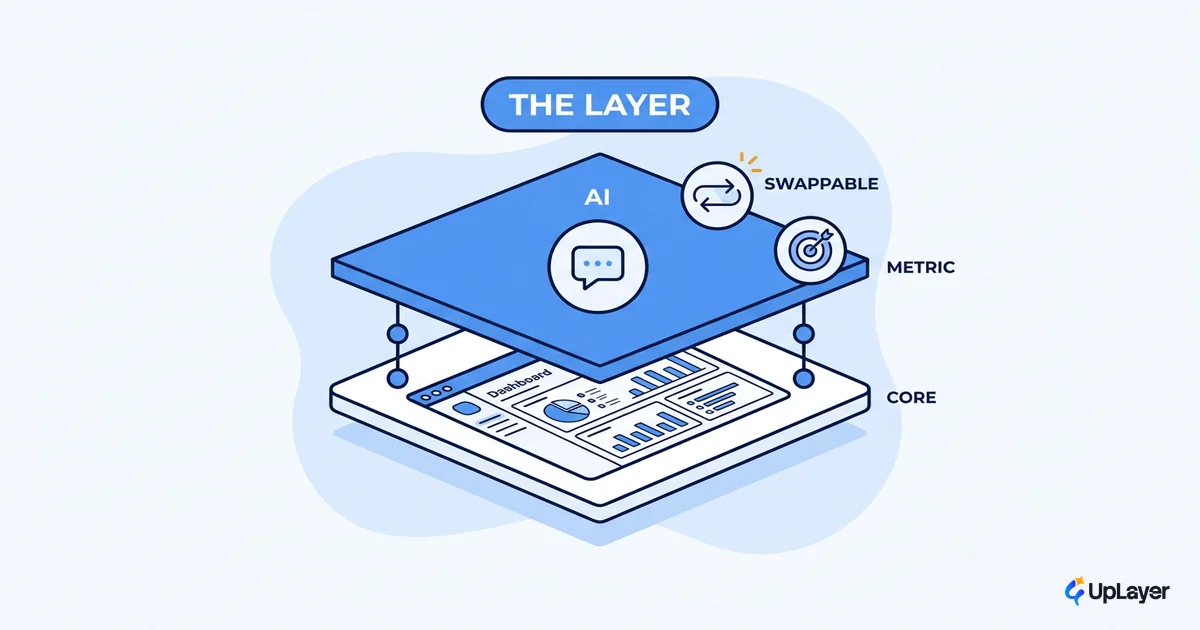
The fastest way to add AI to your SaaS is also the fastest way to regret it. You wire a model into the core path, ship a slick demo, and now a price change, a rate limit, or a quiet deprecation is a product outage instead of a vendor email. The board wanted "AI." What they got is a single point of failure you do not control.
Figuring out how to add AI to your SaaS is not really a build problem. It is a sequence of de-risking decisions, and the order matters more than the model. Get the order right and AI becomes a layer on top of the product you already trust, something you can swap, measure, and turn off. Get it wrong and you have coupled your roadmap to someone else's pricing page.
This is the playbook we use to add AI as a supportive layer: pick one metric, ship above the engine, keep the model swappable, guard reliability, then measure the delta. Before you write a line of integration code, tie it to a metric you already track. That single discipline is what separates a feature that pays off from a chatbot nobody opens.
How to add AI to your SaaS: layer it on, do not rewrite
The lowest-risk way to add AI is to put it above your core engine, never inside it. A supportive layer reads from your product, calls a model, and writes a suggestion, a summary, or a ranked list back to the user. The engine that actually runs your business keeps running with or without it.
That distinction is the whole game. Supportive AI sits above the core engine: copilots, in-product assistants, semantic search, summarization, triage. Core-engine AI replaces the logic your product is built on, like swapping your ranking, pricing, or matching system for a model's output. The first kind degrades gracefully when the model misbehaves. The second kind takes the product down with it.
When AI is a layer, a bad day for the model is a quiet day for the feature, not an incident for the company. You can ship it behind a flag, roll it to 5% of accounts, and pull it without a deploy. That optionality is the reason "layer, not rewrite" is the default answer to how to add AI to your SaaS safely.
WARNING
The moment an AI model sits on your product's critical path, its failure modes become yours. Hallucinations, latency spikes, deprecations, and price hikes all turn into your outage and your support tickets. Keep the model off the path that has to work.
Start from a metric you already track, not the model
Pick the metric before you pick the model. Adding AI to a SaaS product pays off when you sequence it right, and that sequence starts with a number the team already reports: activation, retention, conversion, or expansion. The model is an implementation detail you choose last.
This is where most teams invert the work, and the data backs it up. Across enterprise surveys, the hard part of enterprise AI is proving value, not picking a model; the projects that stall do so on unclear business value and data readiness, not on model access. Starting from "which model" guarantees you optimize the wrong variable.
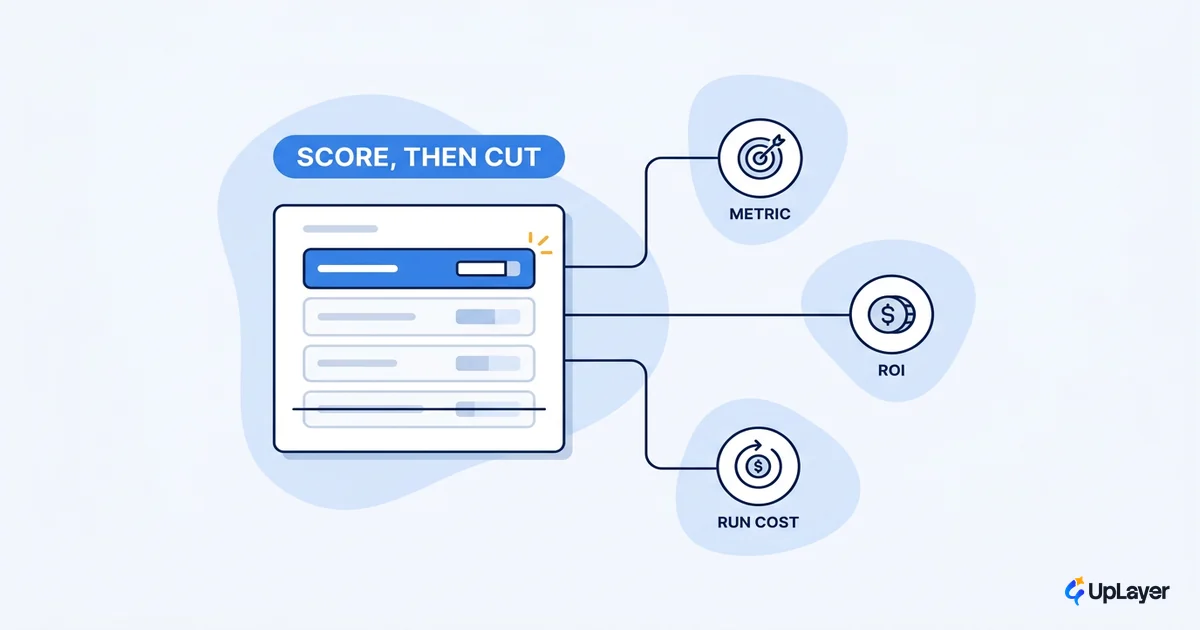
A metric-first saas ai strategy gives you three things a model-first one cannot: a baseline to measure against, a kill criterion if the number does not move, and a sentence finance will accept. Before you commit, decide which AI features to build first by ranking each idea against one metric and one cost. The feature that wins is the one with the clearest projected delta, not the flashiest demo.
| Question | Metric-first (do this) | Model-first (skip this) |
|---|---|---|
| Where do we start? | A number we already report | A model we read about |
| How do we know it worked? | The metric moved | The demo looked good |
| What if it does not? | Kill it, we set a threshold | We keep tuning prompts forever |
| What does finance hear? | "Projected to lift activation 8%" | "We added AI" |
Pick a supportive feature, not a core-engine bet
Once you have the metric, choose a feature that supports the user without owning a decision your business cannot get wrong. The safe set is narrow and boring on purpose: it earns its place by moving the metric, not by replacing your engine.
Use this as the build-it / skip-it line. The left column is a layer. The right column is a bet.
| Build it (supportive layer) | Skip it for now (core-engine bet) |
|---|---|
| Copilot that drafts, you approve | Model that auto-executes irreversible actions |
| Semantic search over your own docs | Replacing your ranking engine with an LLM |
| Summarize long threads or records | Generating your pricing or billing logic |
| Triage and classify inbound | Letting a model decide refunds with no human |
| Suggest next steps in-product | Anything where a wrong answer is unrecoverable |
The skip column is not "never." It is "not first, and not without a human in the loop." If you want the longer version of this map, see the AI features worth adding versus the ones that flop. Every item on the left is a surface change, and an AI powered SaaS is judged at that surface, where the user feels the product get smarter. The point of integrating AI into SaaS this way is that every feature on the left can ship, miss, and get pulled without anyone's quarter blowing up.
Keep the model swappable so a swap never takes you down
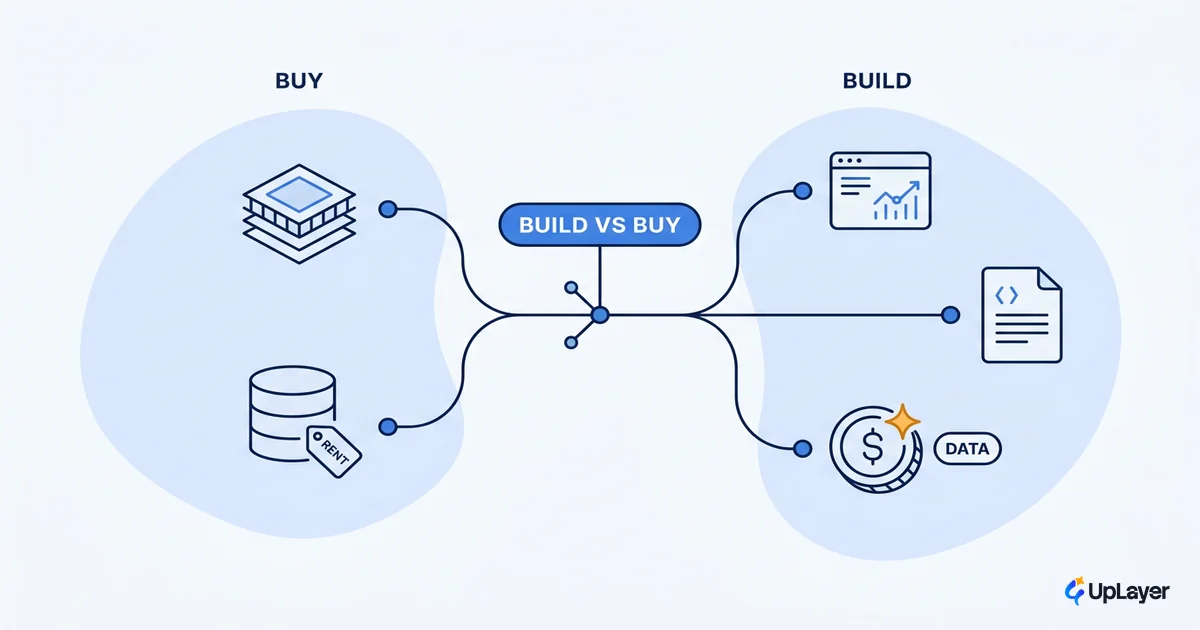
Now the part that actually answers "how do I avoid betting the company on a model?" You make the model a replaceable component. Your product talks to an interface you own, and the provider lives behind it. Swapping GPT for Claude for an open-weight model becomes a config change, not a rewrite.
This is not premature abstraction, it is reading the market correctly. The inference cost for a GPT-3.5-level system dropped more than 280-fold in under two years, and open-weight models have closed most of the quality gap with closed ones. The model you integrate today will be outclassed or undercut within months. Coupling your product to one provider's name in your code is the bet you are trying not to make.
The industry is standardizing this seam for you. Anthropic's Model Context Protocol is an open standard that replaces fragmented integrations with a single protocol, so the connections between your data and whatever model you use become portable instead of bespoke. Build to a stable interface and a model swap stays a Tuesday, not a migration.
A minimal version of the seam looks like this. The product never imports a vendor SDK directly.
// One interface your product depends on. Providers are interchangeable.
interface AIProvider {
  complete(prompt: string, opts?: AIOptions): Promise<AIResult>;
}

// Config decides the model, not your feature code.
const ai = createProvider({
  provider: process.env.AI_PROVIDER,   // "openai" | "anthropic" | "self-hosted"
  model: process.env.AI_MODEL,         // swap without touching the feature
  fallback: "self-hosted",             // degrade, don't go down
  timeoutMs: 4000,                     // the layer fails fast and quietly
});
When the model lives behind that interface, a deprecation notice is a one-line change and a bad provider day falls back instead of failing. The same seam decides how much you let any vendor in, which is its own call: there is a working guide to which SaaS AI tools to buy, wrap, or never depend on for a core flow. That is what it means to de-risk the integration: the product depends on a contract you control, not a vendor you do not.
Build reliability guardrails before you ship
A supportive feature still has to be trustworthy, or it quietly trains users to ignore it. Reliability is not a polish step you add later. It is the difference between a feature that moves a metric and one that erodes trust in the rest of your product. This is where building SaaS with AI becomes engineering rather than a demo: the guardrails, fallbacks, and evals are the work.
Treat the model like software you can test. Evaluations test outputs against criteria you define, and you regression-test every prompt and model change before it reaches users, the same way you would gate a code change behind CI. A prompt tweak that fixes one case and breaks ten others should never reach production, and without evals you will not know it did.
This matters more every quarter. Stanford's index notes that AI-related incidents are rising sharply while standardized reliability evaluations are still rare, which means the teams shipping AI are mostly shipping it untested. Three guardrails keep a supportive layer honest:
- Human-in-the-loop on high-trust actions. The model proposes, a person confirms anything irreversible or customer-facing.
- Abstain over guess. When confidence is low, the feature says "I'm not sure" instead of inventing an answer. A blank is recoverable, a confident wrong answer is not.
- Evals as a gate. A test set of real inputs that every prompt and model change must pass before it ships.
Build these guardrails once and the next feature inherits them. That shared internal layer of evals, routing, and caching is what an AI SaaS platform should give every feature, so each new AI surface ships faster and safer than the last instead of rebuilding the same scaffolding.
NOTE
Guardrails are also how you keep the model swappable. The same eval suite that catches a bad prompt catches a bad provider, so you can switch models and trust the test, not a vibe check.
Ship small, measure the delta, then decide
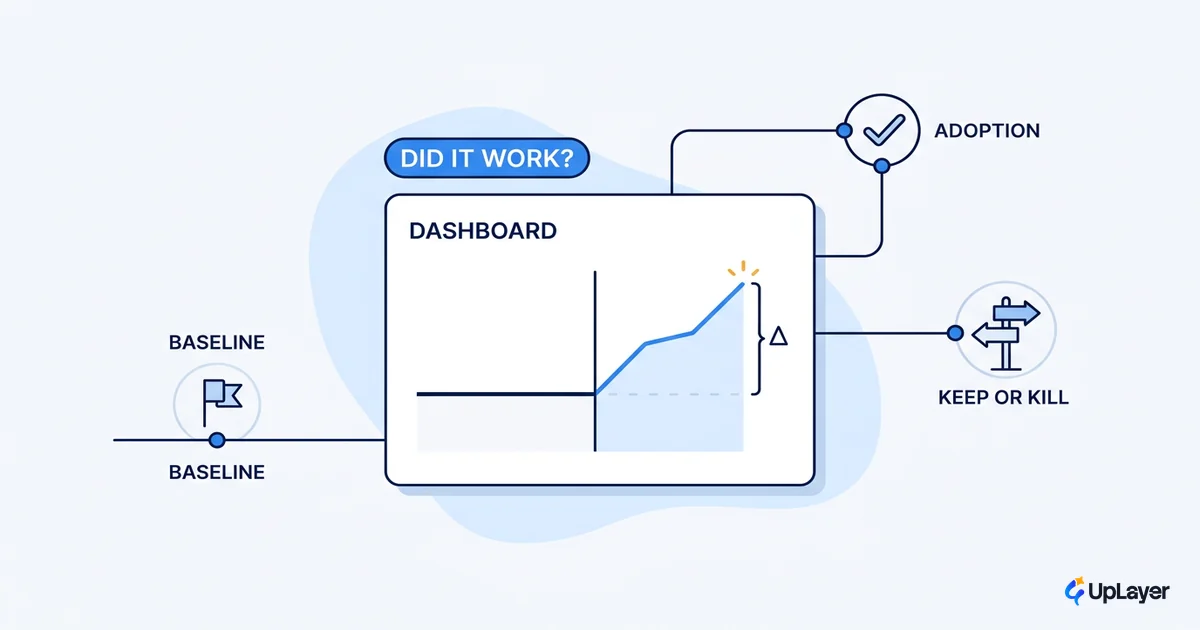
Ship the smallest version that can move the metric, to the smallest set of users that can prove it. A scoped pilot behind a flag beats a company-wide launch, because it gives you a clean before-and-after instead of a vibe.
Then measure the delta against the baseline you set in step two. Give it a real window, instrument the metric, and put a kill criterion in writing before launch. If activation does not move in 30 days, you turn it off. That sounds harsh, and it is the cheapest insurance you will buy.
Here is the full de-risk sequence in one view.
| Step | The decision | How you de-risk it |
|---|---|---|
| 1. Layer | Above the engine, not inside | Failure stays quiet and pull-able |
| 2. Metric | One number you already track | A baseline and a kill criterion |
| 3. Feature | Supportive, not a core bet | A wrong answer is recoverable |
| 4. Swap seam | Model behind an interface | A swap is config, not a rewrite |
| 5. Guardrails | Evals, human-in-the-loop, abstain | Untested changes never ship |
A scoped pilot also keeps the cost of being wrong small. If the feature flops, you have spent one sprint and a flag, not a quarter and a relaunch. If it works, you have a clean number to take to the next funding conversation. Either outcome is cheap, which is the entire reason to ship small first.
We prove this order with Concept Demos before a client commits to a build: a working prototype of the highest-ROI feature, with the metric impact framed as projected, never as an achieved result we did not actually measure. The verdict sometimes is "do not build this one yet," and that is the point. Saying no to a feature that will not move the number is cheaper than shipping it and discovering the same thing in production.
How do I add AI to my SaaS safely?
The safe path is the boring one. You add AI to your SaaS as a supportive layer above the engine, anchored to one metric you already track, with the model behind an interface you own and evals gating every change. Each step is reversible, so no single decision can take the product down.
The lowest-risk way to add AI is to make every part of it optional: optional to the user (it suggests, you approve), optional to the architecture (a layer you can flag off), and optional to the vendor (a model you can swap). If any one of those is load-bearing, you have a bet, not a feature.
To avoid betting the company on a model, never let the model own a decision your business cannot get wrong, and never write a vendor's name into your critical path. Keep the seam standard, keep the human in the loop where trust matters, and keep the metric in front of the model the entire time.
The same discipline answers the question every founder eventually gets from the board: what happens when the model we picked gets deprecated or repriced? If you built a layer behind an interface with an eval suite, the answer is "we swap it and the tests confirm nothing broke." If you wired the model into the core path, the answer is "we have a project." One of those is a sentence. The other is a quarter.
Adding AI well is less about the model and more about the order you make decisions in. Do it as a layer, tie it to a metric, keep it swappable, and the question of how to add AI to your SaaS stops being a gamble and starts being product work you can defend to the board. That is the version of integrating AI into SaaS that survives the next model swap, the next price change, and the next quarter's review.
TIP
Want the metric, the feature, and the projected ROI mapped for your product before you build anything? How the AX Audit works. We find the highest-ROI AI opportunity, prove it on a number you already track, and tell you what not to build.