Build vs buy for AI features in your SaaS
A build vs buy AI features frame for SaaS: own the differentiating layer, rent the commodity model, and never lock a core flow to one vendor.
 Shahriar P. ShuvoAI for SaaS & Features7 min read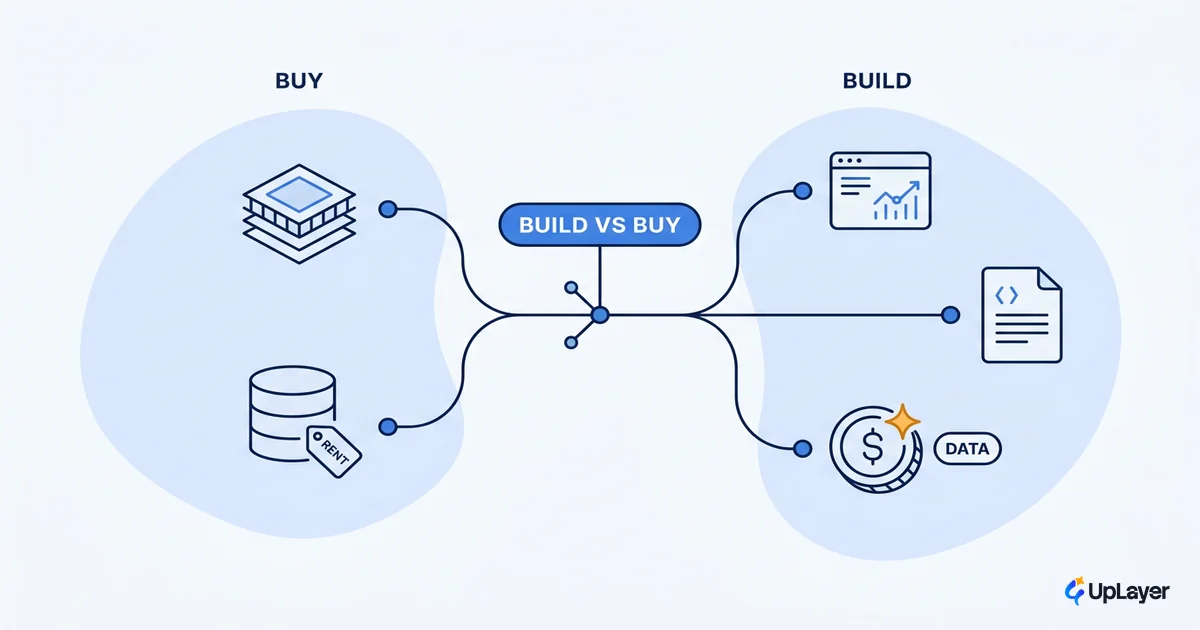
The build vs buy AI features debate almost always collapses into the wrong question. Someone asks "should we train our own model," the room argues for an hour, and the real decision goes untouched. For a post-product-market-fit SaaS, training a model is the one thing you almost certainly should not build. So the binary is broken before you start.
The better frame is layers. An AI feature is not one thing you buy or build. It is a stack: a model, the infrastructure under it, your data, the UX, and the workflow logic that makes the feature feel native to your product. Some of those layers are commodities you rent. One or two of them are the reason a customer keeps paying. The job is to own the layers that differentiate and rent the rest, the same way you already add AI to your SaaS without betting the company on a single vendor or model.
This piece gives you the decision frame, the cost math, and the one rule that keeps a build-vs-buy call from turning into a liability you cannot reverse.
Should you build or buy AI features? Decide by layer, not by feature
The answer to "should you build or buy AI features" is: both, and you decide layer by layer. Buy the commodity layers, build the ones that carry your differentiation, and refuse any setup that ties a core flow to a single vendor.
This matches what actually happens in practice. Companies buy third-party AI where it exists and build in-house where off-the-shelf isn't ready or specific enough, according to Bain's enterprise AI survey, which also found only about 35% of companies have a clearly defined vision for how AI creates business value. The build-vs-buy call is not one verdict. It is a set of smaller calls, most of which point to "buy."
Here is the stack, layer by layer, with the default verdict:
| Layer | What it is | Default | Why |
|---|---|---|---|
| Model | The LLM or ML model itself | Rent | A commodity that re-prices and improves every quarter. Owning it is a tax, not an edge. |
| Infrastructure | Inference, vector store, orchestration | Rent | Undifferentiated plumbing. Off-the-shelf is cheaper and more reliable than your version. |
| Data | Your proprietary product data and context | Own | This is what no competitor can copy. The moat lives here. |
| UX | How the feature surfaces in the workflow | Own | Whether the feature gets used is a design problem, not a model problem. |
| Workflow logic | The product-specific rules around the AI | Own | The glue that makes it feel native. Generic vendors cannot encode your edge cases. |
Read the table top to bottom and the pattern is obvious. The layers you should rent are the ones the "build our own AI" debate fixates on. The layers you should own are the ones it ignores.
The commodity layers: when is buying an AI feature cheaper?
Buying is cheaper whenever the layer is a commodity, which is almost always the model and the infrastructure. The model is the most expensive thing to build and the least valuable thing to own.
The cost math is lopsided. In a16z's read of enterprise AI, one executive estimated that "LLMs are probably a quarter of the cost of building use cases", with development and integration eating the majority of the budget. So even if you could build the model for free, you would still spend most of the money on the layers around it. The model is not where the cost lives, and it is not where the value lives either.
The scale of the commodity confirms it. Menlo Ventures found that the LLM layer commands $3.5 billion of enterprise investment, a shared pool that every product rents from. You do not need to own a slice of that pool. You need an API key and a credit card. The cheap, fast, reliable move is to rent it and spend your engineering on the layers a vendor cannot give you. This is also where most SaaS AI tools earn their keep: as rented commodity parts you wrap, not core flows you depend on.
A simple way to make the call per layer:
Buy when:   commodity AND low switching cost AND not a core flow
Build when: differentiating OR core-flow-critical OR encodes proprietary data

Rough cost:
  build  = model_cost (~25%) + integration + UX + reliability + maintenance
  buy    = vendor_fee + integration + switching_risk

If a layer is commodity, build rarely wins on cost.
If a layer is differentiating, buy rarely wins on value.
NOTE
"Build" for an AI feature rarely means training a model. It means building the data pipeline, the UX, and the workflow logic on top of a rented model. If your build plan starts with "train," stop and check whether you are trying to own a commodity.
What AI features must you own?
You must own the layer that differentiates and any layer that controls a core flow. Everything else is negotiable. The features you must own are the ones where your data, your UX judgment, or a critical path are at stake.
Three things belong to you and only you:
- Your proprietary data and context. The model is generic. Your product data is not. The feature gets its edge from what you feed the model, not from the model itself.
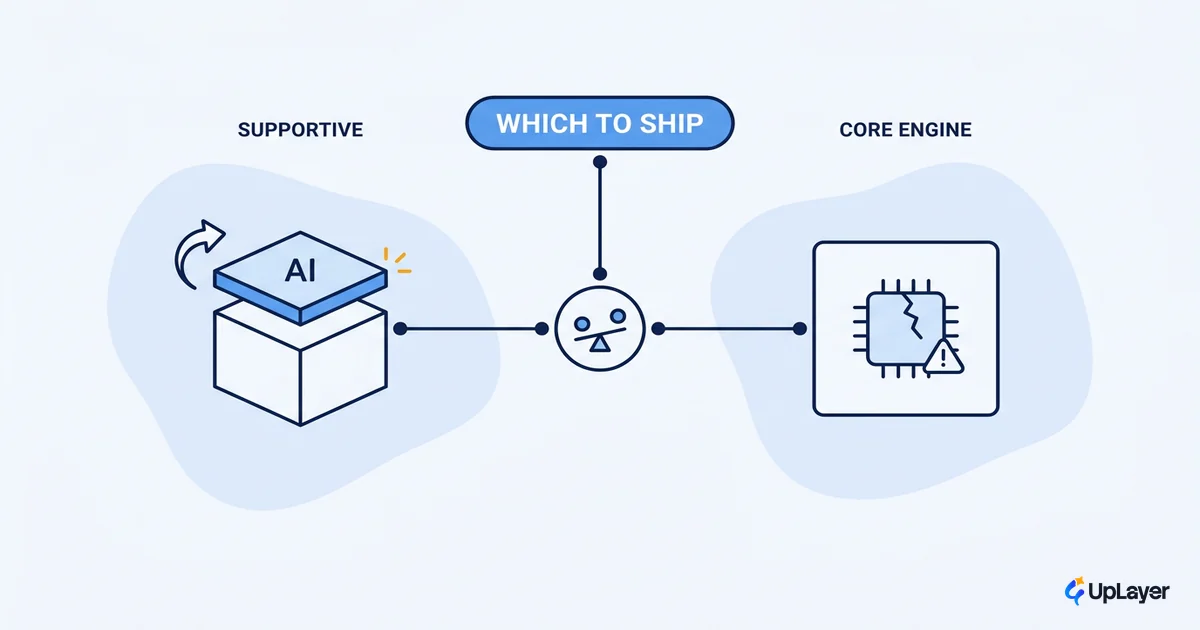
- The UX and the workflow logic. Whether an AI feature gets opened every day or ignored is a design call. A vendor widget bolted onto the side of your product does not know your workflow. Yours can. AI that sits on top as a supportive layer, inside the flow your users already live in, is the part that earns its place.
- The reliability guardrails on a core flow. If a feature touches money, data, or a step a user cannot undo, you own the human-in-the-loop checks and the fallbacks. You cannot outsource the trust.
WARNING
Never lock a core flow to a single vendor. If the feature your customers rely on breaks the moment a vendor changes pricing, deprecates an endpoint, or goes down, you do not own your product anymore. Rent the model, but keep the core flow yours and swappable. That is how you de-risk the whole bet.
Build vs buy AI features as a SaaS AI strategy, not a one-off call
A durable SaaS AI strategy treats the model as interchangeable. You design so that swapping one model for another is a configuration change, not a rewrite. That single property keeps the build-vs-buy decision reversible, which is what makes it safe to move fast.
Enterprises already work this way. They optimize for optionality, designing apps so that switching between models requires little more than an API change, explicitly to reduce dependency on any one provider. A SaaS AI strategy built this way turns build vs buy AI features into a reversible call rather than a one-way door. Carry the same discipline into your product. Abstract the model behind your own interface. Keep prompts and logic in your codebase, not in a vendor's console. Then a better, cheaper model is an upgrade you ship in an afternoon, not a migration you dread.
The cost of skipping this is not abstract. Gartner projected that at least 30% of generative AI projects would be abandoned after proof of concept by the end of 2025, citing escalating costs and unclear business value. A vendor-locked feature with no metric attached is a strong candidate for that pile. Tie every AI feature to a number you already track, retention, activation, conversion, or expansion, and the build-vs-buy call gets easy: build only the layer that moves the number, rent the rest.
TIP
In a Concept Demo, we model the same feature two ways, fully built versus vendor-bought, and project the cost and metric impact of each before a line of production code ships. The output is a ranked verdict, including the parts to rent and the parts to skip.
The good news is that a clean build-vs-buy AI features decision is mostly a subtraction problem. Once you accept that the model is rented and the differentiation lives in your data and UX, the list of things you actually have to build gets short, the budget gets honest, and the feature you ship is one you can swap, fix, and prove. Decide by layer, keep the core flow yours, and the build-vs-buy AI features question stops being a gamble and starts being a plan you can defend to your board. The teams that get this right ship faster precisely because they build less.
TIP
Want the layer-by-layer verdict for your product, with a projected ROI on a metric you already track? How the AX Audit works.