A SaaS AI strategy that survives a model swap
Build a SaaS AI strategy around the metric you want to move and a swappable supportive layer, so a model deprecation becomes a config change, not an outage.
 Shahriar P. ShuvoAI for SaaS & Features7 min read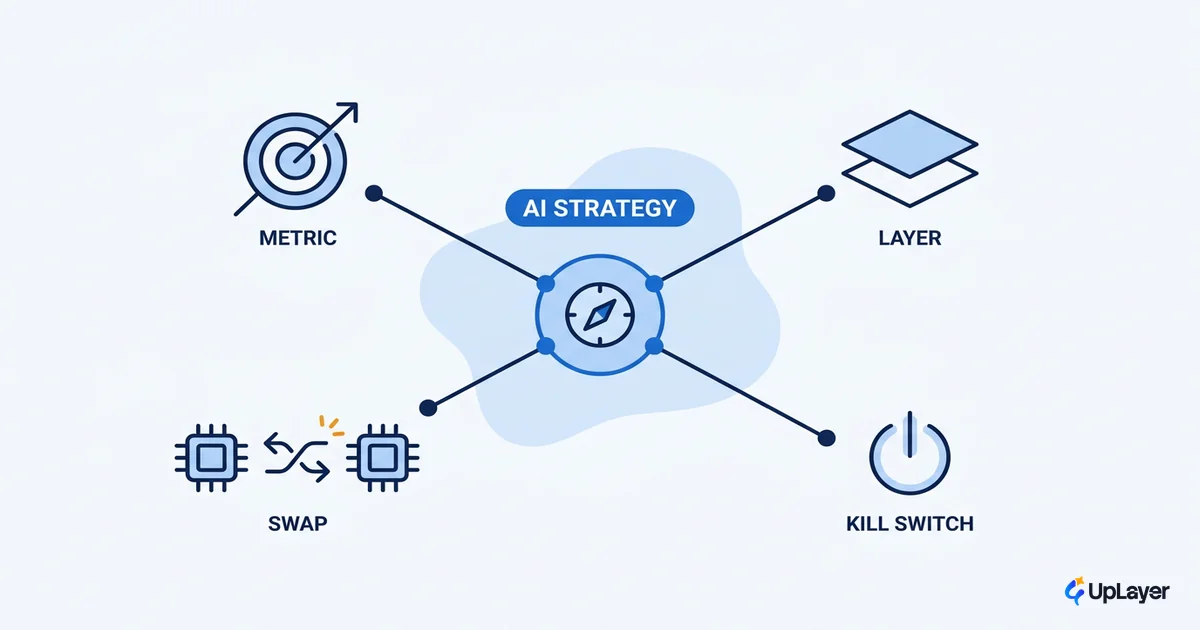
The model named in your AI plan today will be deprecated, probably within a year, on a date the vendor already publishes. Most teams write a SaaS AI strategy as if that never happens. They pick a model, build features on top of it, and quietly bet the roadmap on that one choice holding still.
A durable plan assumes the opposite. It treats the model as the most replaceable part of the system and organizes everything else around a number you already care about. Get that ordering right and a model swap becomes a config change. Get it wrong and every price hike, outage, or retirement turns into a production incident. This is the same de-risk logic behind shipping AI as a layer rather than a rewrite, which is how you add AI without betting the company.
Here is what a strategy like that contains in practice, where each part lands in your product, and what to leave out of the first version.
What a SaaS AI strategy should actually cover
A good plan needs four parts: the metric you want to move, the supportive layer that moves it, the swap plan for when the model changes, and the kill switch for features that do not earn their place. Everything else is decoration.
Skip these and you join the statistics. Gartner projects that at least 30% of generative AI projects get abandoned after the proof of concept, citing poor data quality, weak risk controls, escalating costs, and unclear business value. Notice that none of those failure modes is about the model being bad. They are about the strategy around it being thin.
At least 30% of generative AI projects will be abandoned after proof of concept by the end of 2025, due to poor data quality, inadequate risk controls, escalating costs or unclear business value. (Gartner)
Each part of the strategy answers a specific question, so the document stays honest:
| Strategy part | The question it answers | What it pins down |
|---|---|---|
| The metric | What are we trying to move? | One number you already track |
| The supportive layer | Where does AI sit in the product? | Above the engine, never inside it |
| The swap plan | What happens when the model retires? | A migration that is routine, not heroic |
| The kill switch | When do we stop? | The bar a feature must clear to stay |
Anchor the strategy to a metric, not a model
The fixed point of a SaaS AI strategy is a metric, not a model. Pick one number you already measure, retention or activation or support deflection, and make the strategy accountable to it. The model is an implementation detail underneath that number.
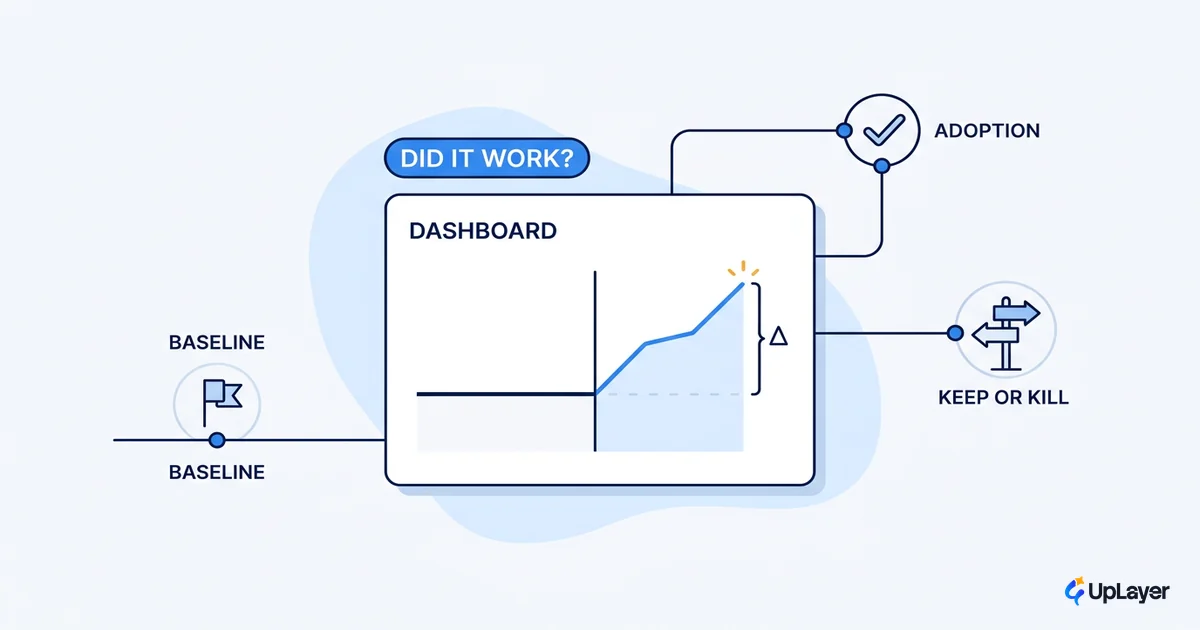
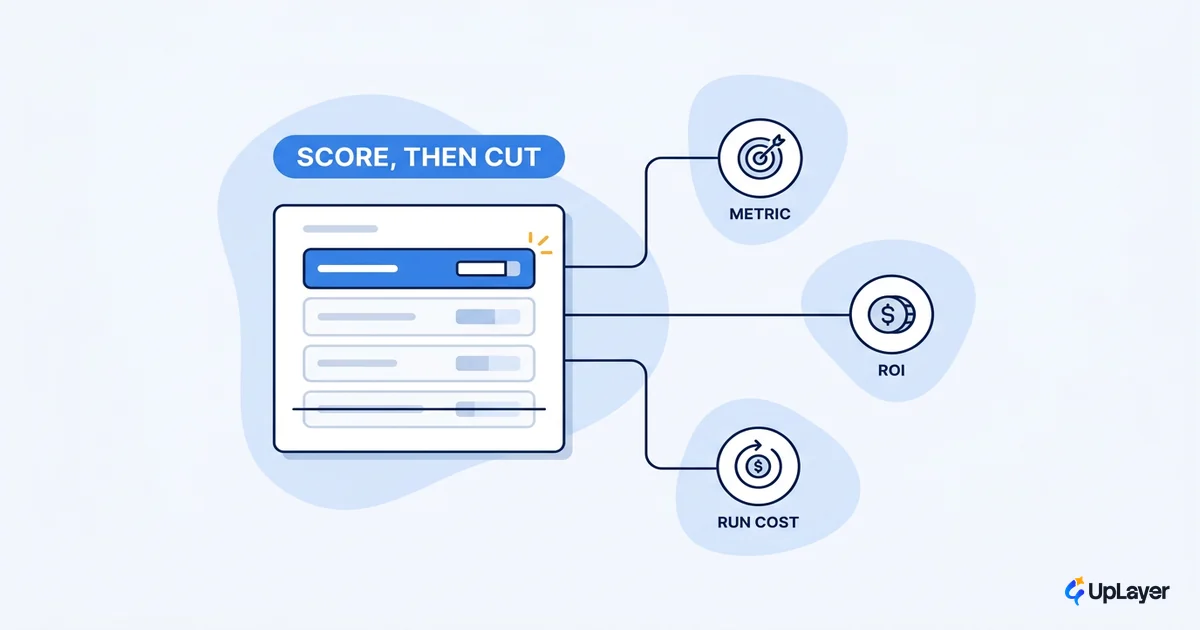
This is also how you avoid building features nobody asked for. When every candidate has to name the metric it moves, the demo-friendly ideas that move nothing fall out on their own. You rank what remains by projected ROI and build from the top. If you want the mechanics of that projection, tie it to a metric you already measure before you write any code.
NOTE
A projected ROI is an estimate, framed as "designed to move" until live data confirms it. In a Concept Demo we model the delta against your current baseline, not against a vendor's benchmark. The number is a forecast you can audit, not a promise.
When the metric is the anchor, swapping the model is a tuning exercise. The question stops being "is this model good" and becomes "does this model move the number we picked." That is a far easier question to answer, and a far cheaper one to re-answer next quarter.
Ship AI as a supportive layer so a swap is a config change
Supportive AI sits above your core engine and reads from it. It never becomes the engine. A copilot, semantic search, summarization, or triage layer can be replaced, retuned, or switched off without touching the system of record underneath. That separation is the entire de-risk move in one sentence, and it is why integrating AI into SaaS as a layer, not a rewrite holds up under pressure.
The reason this matters is scheduling. Vendors retire models on a clock you do not control. OpenAI publishes the dates its models retire, giving at least six months for generally available models and as little as two weeks for previews. Anthropic states plainly that it regularly retires older ones as newer models ship. A deprecation is not an edge case. It is a calendar event.
# The boundary that makes a swap a config change
ai_layer:
  reads_from: [system_of_record]   # one-way: layer reads, never owns
  writes_to: [suggestions, drafts] # human confirms before it counts
  model:
    provider: any                  # the swappable part
    id: current-default            # change this line, not the product
    fallback: second-source-ready  # promote on deprecation or outage
core_engine:
  owns: [billing, auth, source_data]
  depends_on_model: false          # the load-bearing parts never call out
WARNING
The moment a model becomes the load-bearing core of your product, every model change, price hike, or outage is a production incident. Keep the model above the line, not inside the engine. This is the difference between supportive AI and core-engine AI, and supportive AI versus core-engine AI is the call that decides how much a swap costs you later.
How do you future-proof an AI strategy against vendor lock-in
You future-proof an AI strategy by making the model swappable and proving the swap works before you need it. Three moves do most of the work: put an abstraction seam between your product and any single provider, keep a second source warm, and run evals as the regression test for every swap.
That third move is the one teams skip. GenAI features are non-deterministic, so you cannot eyeball whether a new model still behaves. In the Thoughtworks pattern catalog, evals are the regression test that tells you whether a new model still behaves within acceptable boundaries. With an eval suite, swapping a model is a green-or-red decision. Without one, it is a gamble you run in production.
| Lock-in trap | The de-risk move |
|---|---|
| Provider-specific calls scattered across the codebase | One adapter behind which any provider plugs in |
| No way to compare a new model to the old one | An eval suite that scores every candidate |
| Single vendor, no fallback | A second source kept warm and tested |
| Prompts and tuning tied to one model's quirks | Behavior pinned to the metric, not the model |
Plan for the swap on day one and vendor lock-in stops being a strategic risk. It becomes a line in a config file.
What to leave out of the first version
The fastest way to wreck the plan is to put too much in it. Leave these out of version one:
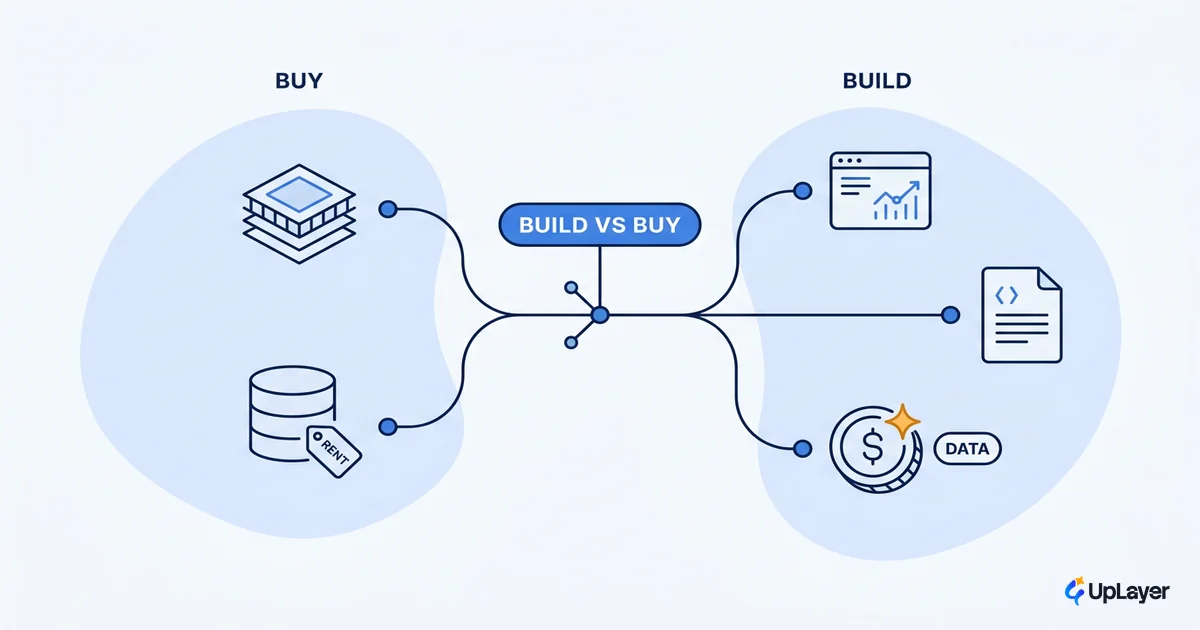
- A custom or fine-tuned model when an off-the-shelf one clears the bar. You can always specialize later.
- Any feature that cannot name the metric it moves. If removing the AI improves the product, that is your answer.
- A platform-wide rollout before a single feature has proven its number.
- Governance theater that produces documents instead of guardrails.
A plan this lean looks unambitious next to the roadmaps full of agents and copilots. It also ships, moves a number, and survives the next deprecation, which is more than most of those roadmaps can claim. A SaaS AI strategy is not built to look advanced. It is built to keep paying off after the model you started with is gone.
TIP
Want a SaaS AI strategy ranked by projected ROI, with the model treated as the swappable part? How the AX Audit works.