AI feature prioritization for your SaaS backlog
A scoring method for AI feature prioritization that ranks your SaaS backlog by projected ROI on a metric you already track, so impact wins over excitement.
 Sohanur RahmanAI for SaaS & Features7 min read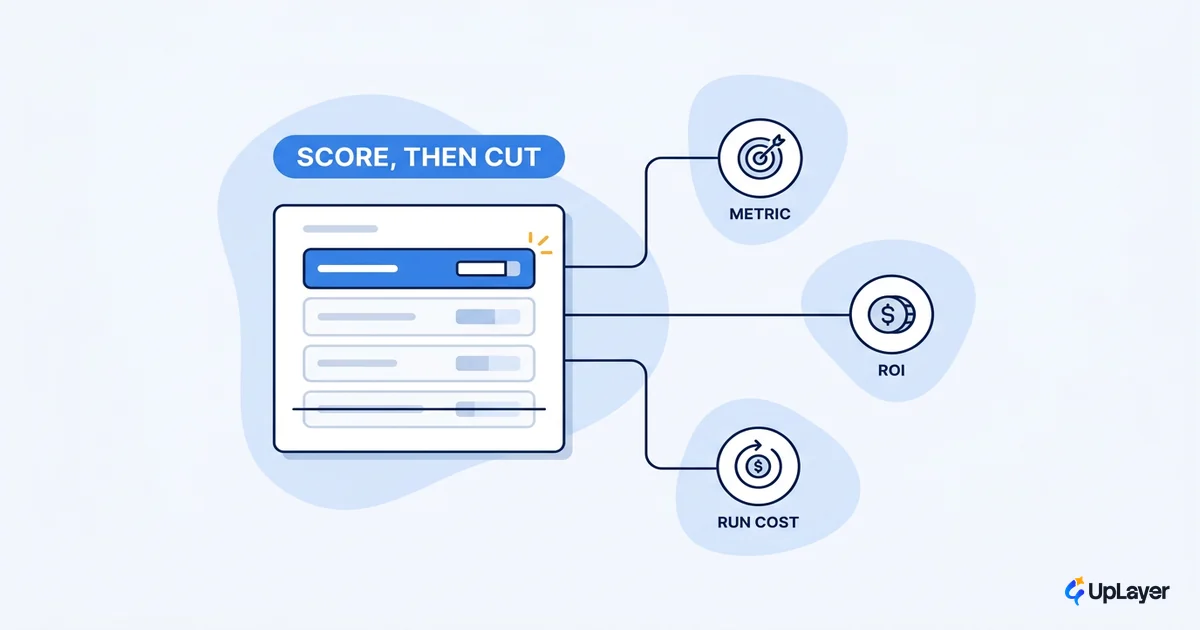
You have ten AI ideas and budget for two. A chat assistant, smart search, auto-summaries, predictive lead scoring, churn alerts, a copilot in the editor. Every one of them has a champion who will argue for it on Friday. The hard part of ai feature prioritization is not finding good ideas. It is making the weak ones lose on arithmetic instead of losing on who argued loudest in the room.
That is the whole job. A backlog of AI features is a backlog of guesses about which one moves a number you care about. Prioritization is the discipline of turning those guesses into a sortable list before you commit a single sprint. This post gives you a scoring method built for a real SaaS feature backlog: how to rank AI ideas by projected ROI on a metric you already track, what cost terms the usual frameworks miss, and which ideas to cut. It pairs with the broader question of how to decide which AI features to build, narrowed here to the part where you actually rank the list.
Why AI feature prioritization breaks the usual roadmap math
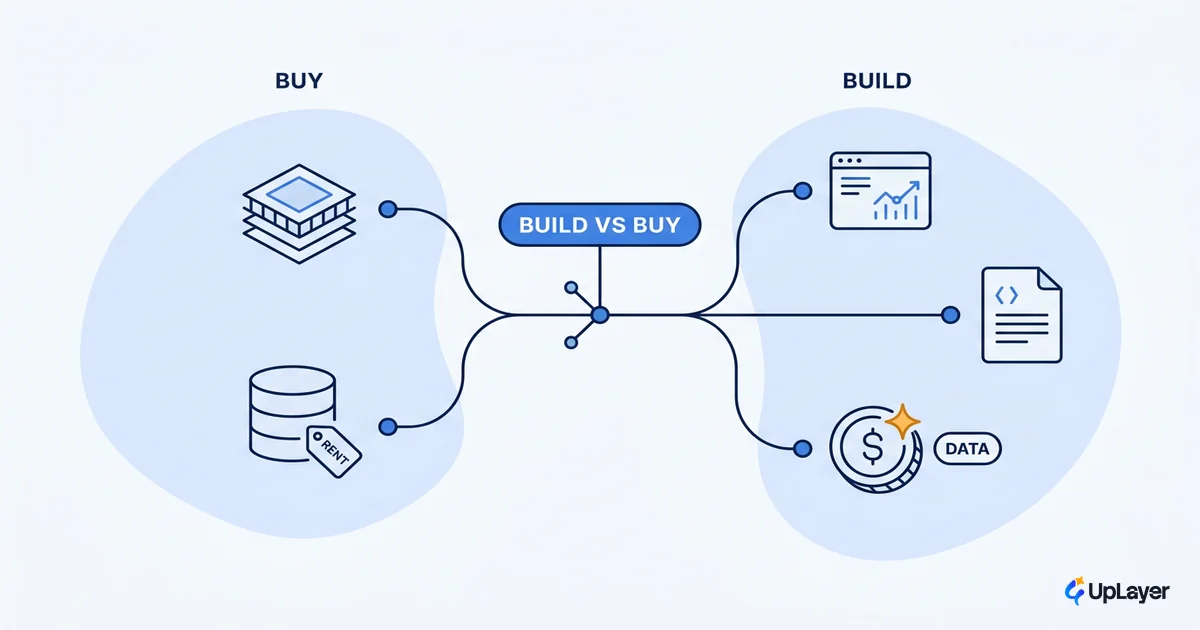
AI features carry costs that a CSV export never does, so scoring them like ordinary features over-ranks the flashy ones. A normal feature has a one-time build cost. An AI feature has a build cost plus a per-call inference bill that never stops, plus evaluation work to keep accuracy honest, plus guardrails so a bad output does not reach a customer. If your scoring model only counts engineering days, it will tell you to ship the demo that wows the room and quietly bleeds margin.
This is why so much shipped AI moves nothing. Gartner projects that at least 30% of generative AI projects are abandoned after proof of concept, most often over unclear business value.
At least 30% of generative AI projects will be abandoned after proof of concept by the end of 2025, due to poor data quality, inadequate risk controls, escalating costs or unclear business value. (Gartner, July 2024)
The lesson is not that AI is risky. It is that a feature with no projected line to a metric is a feature you cannot defend, and the ones you cannot defend are the ones that get killed after the spend. In a B2B account that pressure is sharper, because AI for B2B SaaS lives or dies by a buying committee and a feature that cannot name its number rarely survives procurement. So the score has to start from the metric, not the model. Every AI idea on your backlog should name the one number it is supposed to move: activation, conversion, retention, or expansion. An idea that cannot name its metric is not ready to be scored, and that is already useful signal.
Score every idea before you argue about it
So how do you prioritize AI features without it turning into a popularity contest? You pick a scoring frame and apply it to every idea the same way. The point of a frame is not precision. It is that two ideas get compared on the same axes instead of on enthusiasm. The RICE framework Intercom built for its own roadmap is a good starting point because it forces four honest questions: Reach, Impact, Confidence, and Effort.
Here is the standard RICE definition, in plain terms:
- Reach. How many users does this touch in a set period? Count real accounts, not the whole list.
- Impact. How much does it move a metric per user who hits it? Use a coarse scale (3 for massive, 2 for high, 1 for medium, 0.5 for low, 0.25 for minimal) so you stop pretending you can measure it to two decimals.
- Confidence. How sure are you about reach and impact? Express it as a percentage and let weak evidence drag the score down.
- Effort. For an AI feature, this is not just build months. It is build, plus ongoing inference cost, plus evaluation and guardrail work. Roll the recurring cost in or the cheap-looking idea will win on a lie.
That last adaptation is the whole reason generic prioritization advice fails on AI. This is the same logic as the general method for prioritizing AI features by projected ROI, applied here to a concrete SaaS backlog with the AI cost terms made explicit.
What scoring framework fits AI features?
RICE is one option. It is not the only one, and the right choice depends on how your team already plans. The frameworks below all produce a sortable number. What matters is that you add an AI-specific cost term to whichever you pick.
| Framework | Scores on | Best when | Watch-out for AI |
|---|---|---|---|
| Adapted RICE | Reach × Impact × Confidence ÷ Effort, Effort includes inference & evals | You have many comparable AI ideas | Easy to fake Confidence; demand evidence |
| Value vs Effort (2x2) | Projected metric value > estimated cost | Small backlog, fast triage | The 2x2 hides recurring inference cost |
| Weighted shortest job first | Cost of delay ÷ job size | Scaled teams, dependency-heavy roadmaps | "Job size" must count eval & guardrail work |
For most SaaS teams ranking a handful of AI ideas, adapted RICE anchored to one tracked metric is enough. If you want the same idea framed as a general scoring discipline rather than an AI-specific one, AI feature prioritization without the guesswork covers the abstract case. The version here keeps everything pinned to projected ROI on a metric you can already see in your dashboard.
How do you rank features by ROI?
Convert each score into a projected-ROI estimate, then sort. The arithmetic is deliberately simple. You are not trying to be right to the dollar. You are trying to separate the ideas worth a sprint from the ideas worth a polite no.
projected_value  = reach (users/quarter)
                 × metric_delta_per_user (projected)
                 × value_per_unit_of_metric ($)
                 × confidence (0-1)

projected_cost   = build_cost
                 + (inference_cost_per_call × calls/quarter)
                 + eval_and_guardrail_cost

projected_roi    = (projected_value − projected_cost) / projected_cost
Run it across the backlog and the picture stops being a debate. Here is a Concept Demo on a five-idea SaaS backlog. The numbers are projected, not measured, and no client is implied.
| AI feature idea | Metric it targets | Projected quarterly value | Projected cost | Projected ROI | Rank |
|---|---|---|---|---|---|
| Smart onboarding checklist | Activation | $90k | $25k | 2.6x | 1 |
| Churn-risk alerts for CSMs | Retention | $120k | $48k | 1.5x | 2 |
| In-editor copilot | Expansion | $70k | $55k | 0.3x | 3 |
| Conversational search | Engagement | $30k | $40k | <0 | 4 |
| AI "ask the docs" chatbot | Support deflection | $18k | $35k | <0 | 5 |
The two demos at the top of the room (the copilot and the chatbot) are not the two you build. The onboarding checklist, which nobody pitched with excitement, wins because it moves activation cheaply and reliably. That is what good ai feature prioritization is supposed to do: surprise you. When the ranking matches the loudest voice every time, the framework is not doing any work.
What the score tells you to cut
The most valuable output of the score is the bottom of the list. Two of the five ideas above projected negative ROI. That is not a failure of the exercise. That is the exercise paying for itself, because it let two expensive guesses lose on paper instead of in production.
WARNING
Shipping an AI feature you never scored is not ambition. It is an un-costed bet on inference and eval spend that may never touch a metric. Score it, project the ROI, and let the weak ones lose before they reach a sprint.
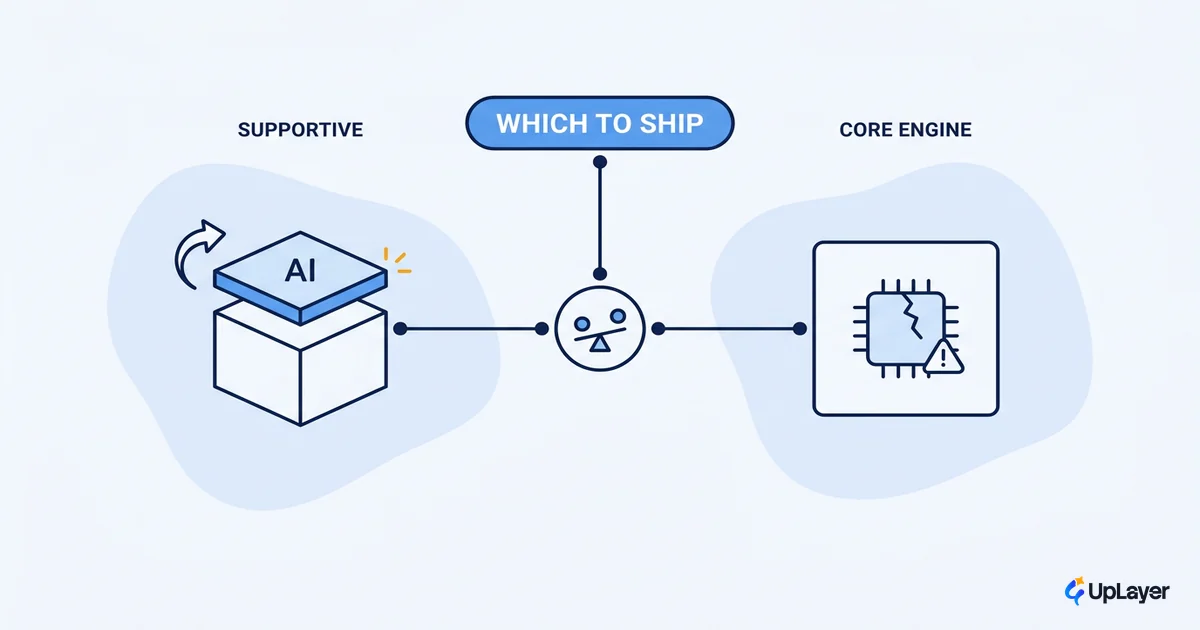
Cutting well is a skill in its own right. Sometimes the honest answer is that a simpler non-AI feature wins on ROI and the AI version was solving for novelty, not for the user. Sometimes an idea looked strong until you costed the guardrails. Knowing which AI features to kill before you ship them protects the budget that the winners need. A backlog where nothing ever gets cut is not a prioritized backlog. It is a wishlist with a deadline.
How do you keep the ranking honest after launch?
Re-score on a cadence, against measured movement instead of projection. A projected ROI is a hypothesis. Once a feature ships, you have real data, and the next round of ranking should use it.
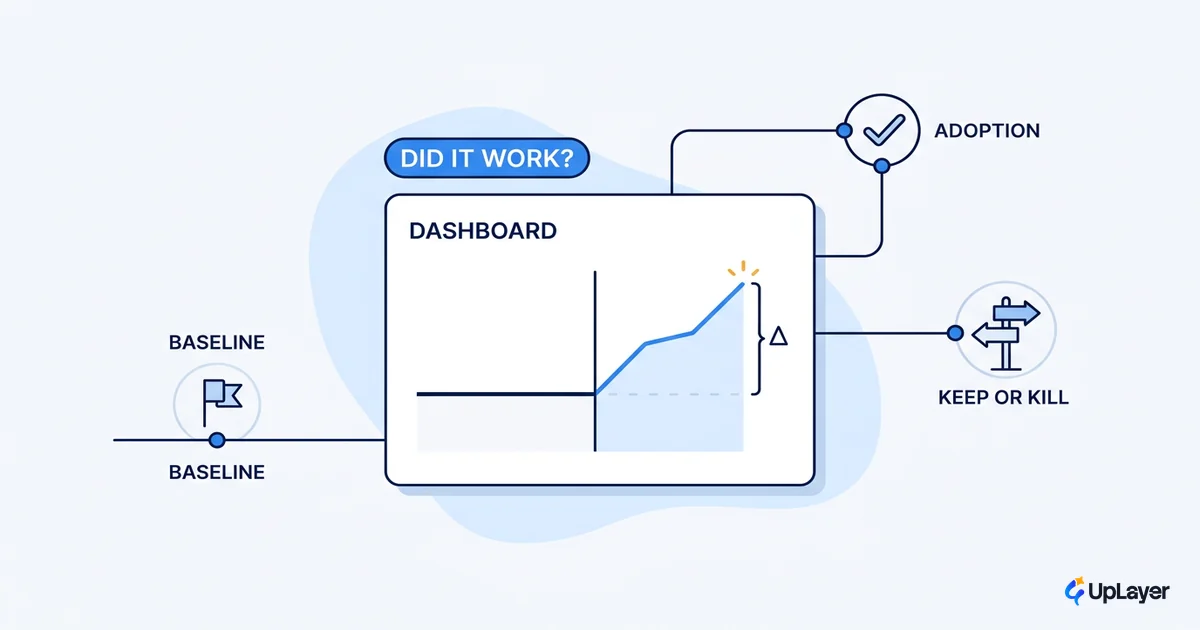
- Ship the top one or two. Instrument the target metric before launch so you have a baseline.
- Measure the delta. After a full cycle, check whether the metric moved. The discipline of how to measure whether the AI feature actually worked turns the projection into a fact.
- Re-rank everything. Feed the measured result back in. Winners that underdelivered drop. Ideas you cut may rise if a cheaper model changed their cost.
This loop is where projected ROI becomes proven ROI. The cornerstone on how to measure the ROI of an AI feature goes deep on the measurement side. The takeaway for prioritization is narrow: a ranking you set once and never revisit will drift from reality within a quarter, because model costs fall, metrics shift, and the ideas you scored on thin confidence either prove out or do not.
A scored backlog is not a permanent verdict. It is the cheapest way to make sure the AI product features you build are the ones that earn their place, and that ai feature prioritization stays a number you can defend rather than an argument you have to win. Run the formula on your own backlog this week and watch which of the best AI features for SaaS, judged by a metric, survive contact with the arithmetic.
TIP
Want a ranked, ROI-projected map of the AI features worth building in your product, with a working concept demo of the top one? How the AX Audit works.