AI for B2B SaaS and where it actually pays off
AI for B2B SaaS lives or dies by a buying committee. Here is where AI pays off, which features survive procurement, and what to kill before you build it.
 Shahriar P. ShuvoAI for SaaS & Features7 min read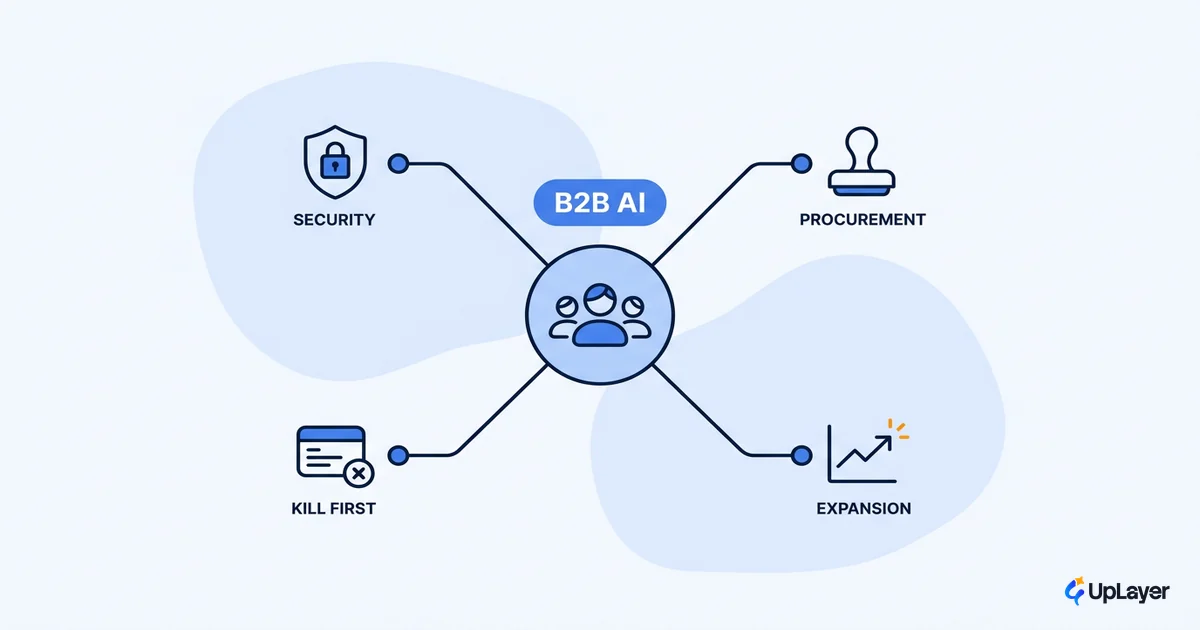
In B2B SaaS the buyer is not a person. It is a committee. So the question that decides whether AI for B2B SaaS pays off is not "is this feature cool," it is "can this feature survive procurement, a security review, and an expansion case." Consumer AI can win on novelty. A B2B AI feature has to win in a room full of people who each have a different reason to say no.
That changes everything about what you should build. The novelty that delights one user is the same novelty that gets flagged in security review and stalls in legal. The features that pay off in B2B are narrower, more measurable, and far less exciting than the demos going around your board chat. We build AI into established products as a layer on top, and the first thing we do is figure out which AI a buying committee will actually accept. If you want the full pillar version of this, start with how to add AI to your SaaS without betting the company on a model.
This piece covers three things: how B2B SaaS AI differs from consumer AI, where AI pays off in a B2B product, and which features to kill before procurement ever sees them.
How is B2B SaaS AI different from consumer AI?
The difference is the buyer. In consumer AI, one person decides and one person uses it. In B2B SaaS, a group decides, and they rarely agree. Gartner found that B2B buying groups are now ranging from five to 16 people across as many as four functions, and that 74% of those teams show unhealthy conflict during the decision.
Buying groups are more diverse than ever, ranging from five to 16 people across as many as four functions. (Gartner, 2025)
That is the whole game. Your AI feature does not get evaluated by the user who loves it. It gets evaluated by the security lead who has to sign off on where the data goes, the procurement owner who has to justify the line item, and the economic buyer who has to see it in next year's expansion number. A consumer feature answers to taste. A B2B feature answers to a committee.
| Consumer AI | AI for B2B SaaS | |
|---|---|---|
| Decision maker | One user | A committee of 5 to 16 |
| Wins on | Novelty, delight, speed | Auditability, trust, a tracked metric |
| Biggest risk | Churn if it is boring | Stalls in security review or procurement |
| Proof that matters | Engagement | Impact on retention, activation, or expansion |
| Failure mode | Quiet uninstall | A committee that remembers the flop |
So the design constraint is not "make it magical." It is "make it explainable to people who were not in the demo." That single shift kills a lot of roadmap ideas, and it should.
Where does AI pay off in B2B SaaS?
AI pays off in B2B SaaS where it moves a metric the committee already tracks. Not a new vanity metric you invent to justify the feature, but the number already on the board deck: retention, activation, conversion, or expansion. If you cannot name which one a feature moves, you do not have a feature, you have a science project.
Expansion is the metric most worth your attention right now. By Benchmarkit's 2025 numbers, a median 40% of new ARR now comes from existing customers through expansion, up five points year over year, and that share climbs past 67% for companies above $100M ARR. Growth in B2B SaaS is increasingly an install-base game, which means an AI feature that drives more usage, more seats, or a higher tier is aimed at the part of the business that is actually growing.
Retention sets the floor under all of it. ChartMogul's retention data shows that net revenue retention only crosses 100% once a company reaches scale: top-quartile NRR is 94% at $1 to 3M ARR, 99% at $3 to 15M, and over 105% at $15 to 30M. Below that line you are leaking, and an AI feature that closes the leak earns its place faster than one that chases a new logo.
Here is the honest mapping of where supportive AI tends to pay off, by the metric it touches:
- Activation: in-product assistants and guided setup that get a new team to first value before they churn in week one.
- Retention: triage, summarization, and anomaly surfacing that remove the boring work users would otherwise leave over.
- Expansion: copilots and analysis that make the product stickier per seat and create a reason to add seats or upgrade tiers.
- Conversion: semantic search and smart onboarding that shorten the trial-to-paid path.
Pick the metric first. The feature follows from the metric, never the other way around.
What AI features fit B2B buyers?
The AI features that fit B2B buyers are the ones that survive a security review. That means supportive AI, not core-engine AI: a supportive AI layer, not a core-engine model you bet the company on. Copilots, assistants, search, summarization, and triage sit on top of the product you already built. They are auditable, they keep a human in the loop where trust matters, and they do not require you to retrain a foundation model on customer data.
This is the difference between an AI powered SaaS that passes procurement and one that gets stuck in it. A committee can approve a feature it can explain, audit, and turn off. It cannot approve a black box.
| Pattern | Passes a B2B security review? | Why |
|---|---|---|
| In-product copilot with citations | Yes | Auditable, sources visible, human stays in control |
| Semantic search over the user's own data | Yes | No model training, clear data boundary |
| Summarization and triage with review step | Yes | Human-in-the-loop on anything consequential |
| Autonomous agent that acts without approval | Usually no | No audit trail, hard to bound, scary in security review |
| Core model trained on pooled customer data | Usually no | Data-handling and IP questions stall the deal |
WARNING
If your AI feature cannot be explained to a security reviewer who was not in the demo, it does not matter how well it performs. In B2B, a feature a committee cannot audit is a feature that does not ship.
The craft is in the guardrails, not the model access. Reliability, human-in-the-loop, and a documented data-handling spec are what move an AI feature from "interesting" to "approved." That is unglamorous work, and it is exactly the work that determines whether AI for B2B SaaS pays off.
The AI features to kill before procurement sees them
Most AI features should die on the whiteboard. Gartner predicts that roughly 30% of generative AI projects get abandoned after the proof of concept, often for unclear business value. In B2B that abandonment is more expensive than the wasted build, because the committee that watched it flop is the same committee you have to sell the next thing to.
So kill features before they cost you that credibility. Before anything reaches procurement, run each idea through a hard filter. If it fails any line, it is not ready, and most are not.
B2B AI feature filter: pass ALL four or kill it

1. METRIC      Does it move a number already on the board deck?
               (retention / activation / conversion / expansion)
2. AUDITABLE   Can a security reviewer trace what it does and turn it off?
3. EXPANSION   Does it strengthen the case for more seats, usage, or tier?
4. OWNER       Is there a named buyer in the committee who wants it?

PASS = build it.   ANY FAIL = kill it or fix it before procurement sees it.
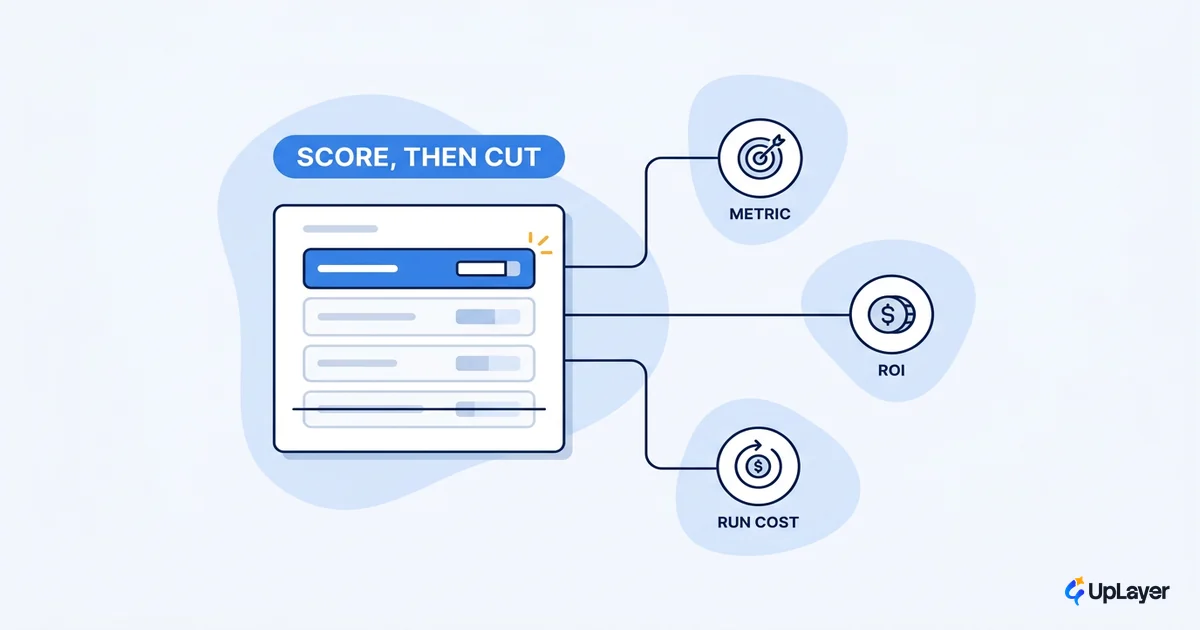
The discipline is to apply this before you build, then rank them by projected ROI so the survivors compete against each other for the next sprint. Killing a plausible feature feels like leaving money on the table. It is the opposite. Every feature you do not build is a security review you do not stall in and a committee you do not burn.
Make the expansion case before AI for B2B SaaS pays off
Make the expansion case before you write a line of code. Take the feature, name the metric, and project the impact with your assumptions shown, the way you would defend it to the economic buyer. A projection a committee can poke holes in beats a demo they cannot tie to a number. That is also how you decide between the AI features worth adding and the ones that only look good in a screenshot.
We build that projection as a Concept Demo: a working prototype of the single highest-ROI opportunity, framed around the metric it is designed to move, never around metrics we claim to have achieved. It gives the committee something concrete to evaluate and gives you a reason to ship or a reason to stop.
The teams that win here are not the ones shipping the most features. They are the ones who said no to the features a committee would have rejected anyway, and spent the saved time making the one survivor undeniable on a metric that already mattered. That is where AI for B2B SaaS pays off: narrower than the hype, tied to a number, and built to survive the room.
TIP
Want to know which AI feature will survive your buyers and move a metric you already track? How the AX Audit works.