What an AI SaaS platform should give every feature
An AI SaaS platform is the shared internal layer of evals, guardrails, model routing, and caching that makes every next AI feature ship faster and safer.
 Anamoul RoufAI for SaaS & Features7 min read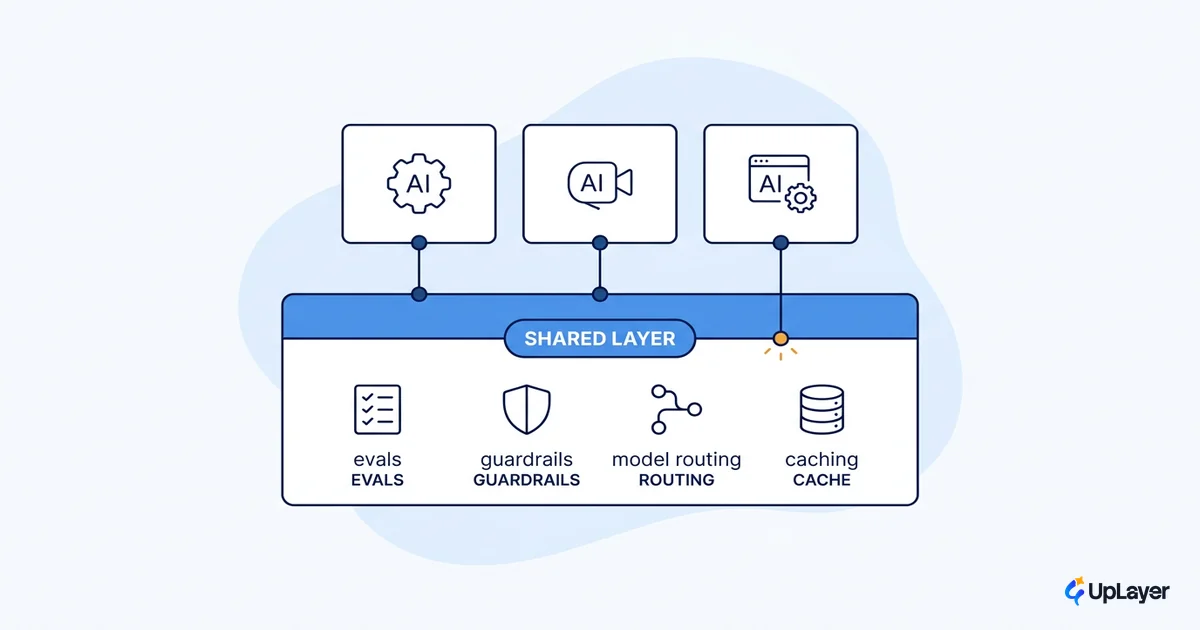
The first AI feature feels like a project. You wire up a prompt, bolt on a model, ship a copilot, and call it done. Then the second feature arrives, and you pay the same bill again: prompt plumbing, an eval suite, a guardrail or two, a model client, a cost cap. By the fifth feature, every team is quietly rebuilding the same scaffolding, badly, in five different corners of the codebase. That tax is the real reason an ai saas platform matters, and it is almost never what the term gets used to mean.
Most people hear the term and picture a product they buy. We mean the opposite: the shared internal layer your own team builds once so each new AI feature ships faster and safer. It is plumbing, not a purchase. Treat it that way and the second feature costs a fraction of the first. Skip it and you re-pay the tax forever. If you are still shipping your first feature, start with how to add AI to your SaaS without betting the company; this piece is about what comes after, when one feature becomes five.
What is an AI SaaS platform, really?
An AI SaaS platform is the reusable layer that sits between your product and the models: prompts, evals, guardrails, model routing, caching, and observability, packaged so every feature inherits them instead of reinventing them. It is shared plumbing, not a product you license.
The reason to name it explicitly is cost discipline. When AI work is scattered feature by feature, the costs and the risks scatter with it, and the business value gets impossible to prove. Those three failure modes, runaway cost, unproven value, and weak controls, are what stall most AI initiatives. IBM frames the antidote bluntly: ROI is a measurement, and AI ROI requires numerical data on business outcomes to calculate, tracked against hard and soft KPIs rather than vibes.
ROI is a measurement, so it requires numerical data on business outcomes to calculate. (IBM, on AI ROI)
A shared layer is how you attack all three failure modes. Costs go down because routing and caching are solved once. Business value gets measured because evals and metric tracking are built in. Risk drops because guardrails are not optional per feature, they are inherited. The platform is the de-risk move dressed up as an architecture decision.
What should an internal ai platform handle?
A useful internal AI layer owns six things, and a feature team should be able to ignore all of them. The same handful of patterns show up in every production system; Eugene Yan catalogs them as the recurring patterns that show up in every production LLM system, spanning evals, retrieval, caching, and guardrails. Your platform is just the place those live so nobody re-implements them.
| Responsibility | What the layer owns | What a feature team should never touch |
|---|---|---|
| Prompt management | Versioned templates, variables, prompt history | Hand-pasted prompt strings in app code |
| Evals | Shared test sets, scoring, regression gates | A bespoke "does it look right" check per feature |
| Reliability guardrails | Input/output validation, refusal rules, PII filters | Ad-hoc if checks that drift between features |
| Model routing | Pick the model per request by cost and difficulty | A single hard-coded model id everywhere |
| Caching & cost control | Response and prompt caching, budgets, rate limits | Uncapped spend nobody notices until the invoice |
| Observability | Traces, token counts, latency, feedback capture | Guessing why a feature got worse last Tuesday |
The point of the table is the right column. A platform earns its name when a product engineer can ship an AI feature without thinking about any of these, because the layer already decided. That is what makes the second feature cheap and the tenth one boring, which is exactly what you want.
Reliability guardrails and evals: the part that earns trust
Evals and reliability guardrails are the half of the platform that keeps you out of the headlines. Guardrails check every input and output against rules you set. Evals score behavior against a fixed test set so you notice regressions before users do. Together they are the most direct way to de-risk an AI feature, because they turn "we think it works" into "we measured it."
This is not optional polish. As Martin Fowler's team puts it, evals keep a non-deterministic system inside sensible boundaries, which is the whole game when the same input can return different output twice. A model with no eval gate is a feature you cannot reason about. A model behind a shared eval gate is one you can ship with a straight face.
The gate itself is simple to express. The platform runs it on every change so no feature merges below the bar:
# eval gate, enforced by the platform on every prompt or model change
eval_gate:
  dataset: support-replies-v3        # 200 labeled examples, shared
  metrics:
    factual_accuracy: ">= 0.95"      # LLM-judge + spot human review
    refusal_when_unsure: ">= 0.90"   # guardrail: say "I don't know"
    pii_leak_rate: "== 0.0"          # hard fail, never ship a leak
  on_fail: block_merge               # regression cannot reach users
This is the supportive-AI posture in code: the model assists, the guardrails and evals keep it honest, and a human stays in the loop where trust is on the line. It is the same reason we argue for supportive AI, not a core-engine bet. You want AI you can fence in, not a model you wager the company on.
Model routing and caching: the part that controls cost
The other half of the platform controls spend, and it is mostly two ideas: route each request to the right-sized model, and cache anything you would otherwise pay for twice. Done in the shared layer, both apply to every feature for free.
Routing means classifying the request and sending it to the cheapest model that can handle it. Anthropic describes this plainly: routing easy questions to a small model and hard ones to a capable one lets you optimize cost and quality at the same time instead of overpaying for the simple 80%. Caching means not re-billing for context the model has already seen. Anthropic reports prompt caching delivering up to 90% lower cost and 85% lower latency on long prompts, which is the difference between an AI feature that pencils out and one that quietly bleeds margin.
TIP
Put routing and caching in the platform, not the feature. A single feature team optimizing its own model spend saves that feature. The shared layer doing it saves every feature, including the three you have not built yet.
For a post-PMF SaaS, this is where AI economics get decided. The model you call and the context you cache move your gross margin on every request, at scale. That is a number your board already watches, which is exactly why it belongs in a deliberate ai saas platform rather than scattered across feature code.
How do you build a reusable ai layer without over-building?
You build the reusable layer on the second feature, not the first. Feature one teaches you what the plumbing actually needs to be. Extract the shared pieces only when a second feature would copy them, and you get a platform shaped by real use instead of a guess.
The order matters more than the ambition:
- Ship feature one end to end. Resist abstracting anything yet.
- Start feature two. The moment you copy a prompt template, an eval set, or a guardrail, stop and extract it into the shared layer.
- Make the layer the default path. Feature three should be unable to call a model without going through it.
- Only then consider a dedicated owner. A platform team for a single feature is a cost with no payoff.
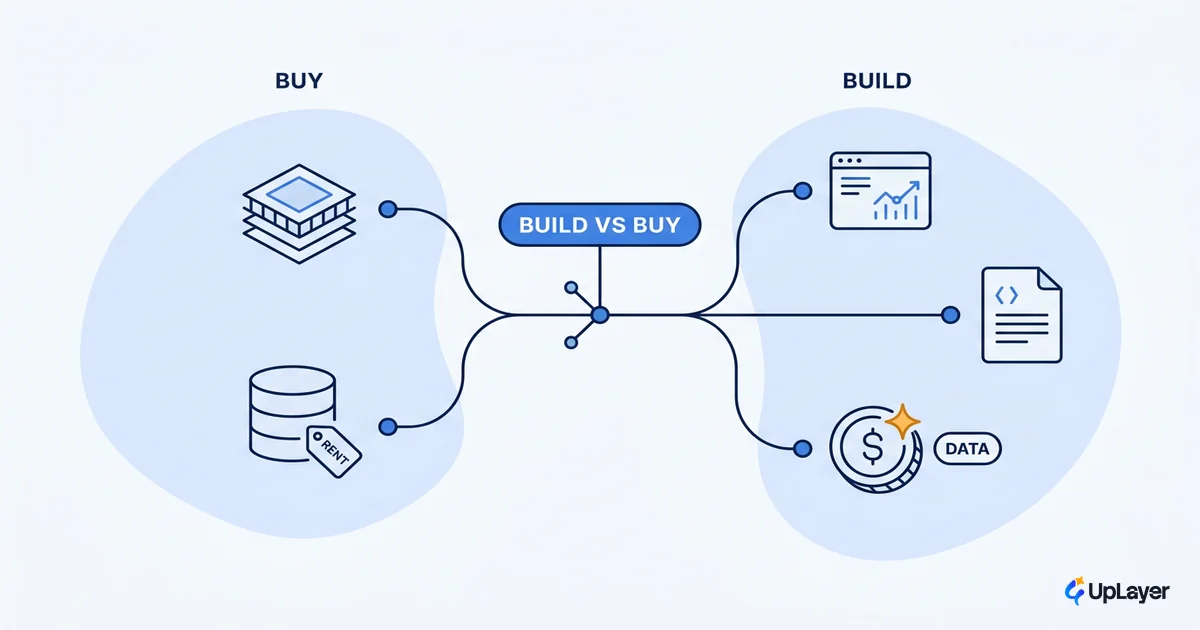
Most of integrating AI into SaaS as a layer is restraint: extract on the second instance, never the first. And the build-versus-buy line runs straight through this layer. Some pieces (a hosted eval tool, a guardrail library, a routing service) are worth buying so you can spend your build budget on the parts that touch your product; see build vs buy for AI features for how we draw that line.
WARNING
The expensive mistake is building the platform before you have two features that need it. Premature plumbing is theater with a roadmap. Build the layer to serve real, shipping features, or you have built a cost center that moves no metric.
What a reusable AI layer actually buys you
A good platform is invisible to the people using it and obvious in the metrics around it: time-to-ship per feature drops, incident rate stays flat as you add features, and cost per request trends down instead of up. Those are the numbers that tell you the layer is earning its keep, and they are numbers a Head of Product can take to a board.
That is the whole case for treating an ai saas platform as shared plumbing rather than a product you buy. The first AI feature proves the idea. The platform is what makes the next ten cheap, safe, and boring to ship, which is the most underrated kind of progress there is. Build the layer once, and every feature after it inherits the reliability guardrails, the routing, and the evals it would otherwise have to reinvent.
TIP
Not sure which AI feature is worth building first, or whether your current one is paying off? How the AX Audit works.