AI powered SaaS, what users feel and what they don't
An AI powered SaaS is judged at the surface, not the backend. Here are the felt moments that make users believe the product got smarter, and what to skip.
 Shahriar P. ShuvoAI for SaaS & Features7 min read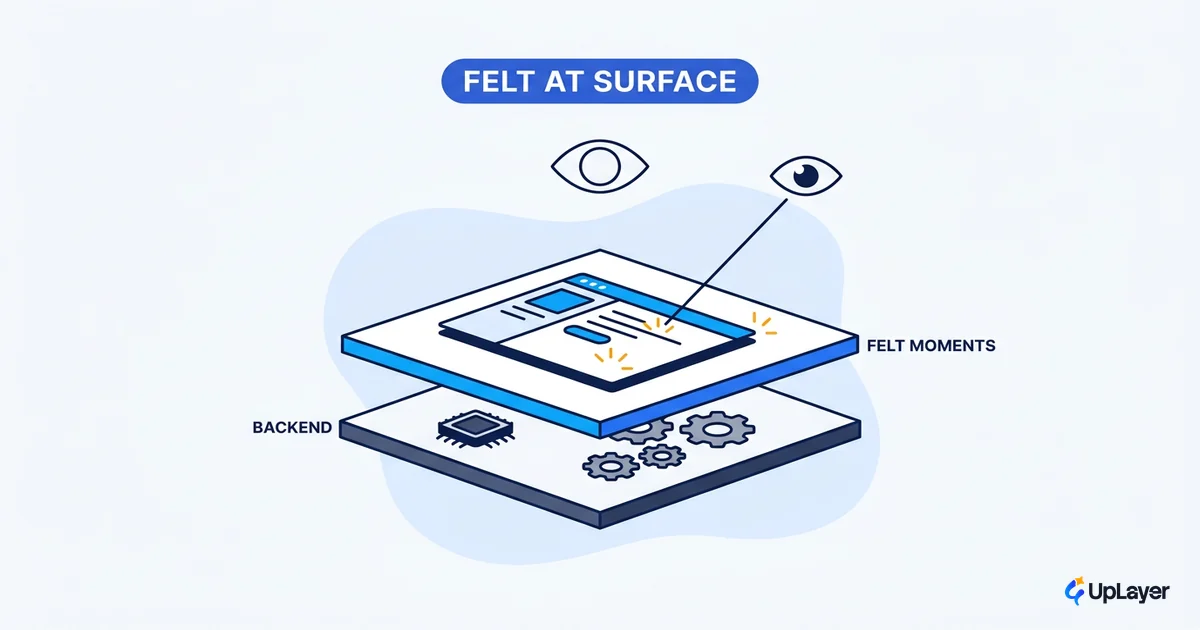
Your users will never know whether you run a foundation model or a regex. They never see the backend. An AI powered SaaS is judged at the surface, in the two or three moments where the product seems to read their mind, and everything else is noise to them. That gap is where most teams waste their AI budget.
The pressure to "be AI powered" usually arrives from a board or a competitor, not from a user. So a team ships a chatbot, a summarizer, and a smart-search box, then waits for the metric to move. It does not move. The features run fine. They just are not felt. The product is now technically AI powered and behaviorally identical to last quarter.
This piece is about the difference between AI that feels intelligent and AI that merely runs. We will name the felt moments that make a product seem smarter, show why most of them never get built, and give you a way to decide which ones are worth your time. If you want the full map of which AI features for SaaS actually earn their place, the cornerstone covers it; this post is about perception.
What makes a SaaS feel AI powered
A SaaS feels AI powered when it removes a decision the user expected to make themselves. That is the whole trick. Not a banner, not a sparkle icon, a moment where the product does the next obvious thing before the user asks.
The mechanism is anticipation at the point of action. A blank field that arrives pre-filled with the right answer. A list that sorts itself by what this user actually needs. A summary at the top of a long thread so nobody has to scroll. None of these announce the model. They just make the work shorter, and the user quietly upgrades their belief about the product.
This matters because perception, not capability, is what your buyer is being graded on. Nielsen Norman Group's research found that people trust AI more when it seems smarter, not more human: competence at the task builds trust, while simulated personality erodes it in factual work. Users do not want a friend in the sidebar. They want the boring decision taken off their plate. An AI powered SaaS wins by being quietly correct, not by being chatty.
The felt moments vs the backend nobody sees
Most of an AI build is invisible to the person you are trying to impress. The pipeline, the evaluation rig, the data plumbing, all real, all necessary, all unfelt. The felt moments are a thin layer of in-product AI sitting on top, and that thin layer is what the keyword "AI powered" is really pointing at.
Here is the split most roundup articles skip.
| Felt moments (the user notices) | Backend work (real, but invisible) |
|---|---|
| A field that arrives pre-filled correctly | Retrieval and ranking that produced the answer |
| A draft reply the user only edits | The model call and prompt orchestration |
| A list reordered to this user's intent | Embeddings, vector store, scoring |
| A one-line summary on a long record | Chunking and summarization pipeline |
| A "this looks wrong, want to fix it?" nudge | Anomaly detection and thresholds |
The error teams make is funding the right column and starving the left. They build a capable system and surface it as a chatbot in the corner that nobody opens. The capability is there. The felt moment never got designed. The product reads as AI powered in the changelog and as unchanged on screen.
NOTE
The user's belief that your product is intelligent is set by the left column. If a felt moment is not on the screen at the point of decision, the backend behind it earns you nothing.
Does AI powered mean better for users?
Not by default, and the data on this is blunt. MIT's NANDA initiative analyzed 300 public AI deployments and found that the vast majority delivers little to no measurable impact on the business, with only about 5% of pilots driving real revenue acceleration. "AI powered" and "better for users" are two different claims, and most teams only ever earn the first.
About 5% of AI pilot programs achieve rapid revenue acceleration; the vast majority stall, delivering little to no measurable impact on P&L. MIT NANDA, The GenAI Divide: State of AI in Business 2025
There is a brighter read on the same coin. When AI features are designed as felt moments rather than bolted-on demos, AI tools post the highest activation rates of any category, around 54.8% versus a 37.5% SaaS average. The capability is not the problem. The surfacing is. A felt moment that shortens the path to first value moves activation; a parked chatbot does not.
WARNING
Most in-product AI ships and moves nothing. "We added AI" is not a result. Pick the one metric you already track, activation, retention, conversion, or expansion, and decide before you build which felt moment is supposed to move it.
So whether an AI SaaS is better for users comes down to a question of design and honesty, not model access. If you cannot name the metric a feature is meant to move, it is theater, and theater is the 95%.
How do you make a SaaS feel AI native without rebuilding it?
You do not need an AI native SaaS rewrite to feel AI native. "AI native" describes how the product feels to use, not whether you started from a blank repo. You get there by adding a supportive layer on top of the engine you already shipped, on the two or three moments that actually gate activation. That is the lowest-risk path, and it is the one we recommend when teams want to add AI to your SaaS without betting the company.
The supportive role is also the one users tolerate best. NN/g's work on AI in interfaces found the assistant pattern, where AI works as a supportive assistant alongside the user instead of taking over the flow, is the role that earns trust and gets used. A copilot that drafts and lets you edit beats an agent that acts and hopes you agree.
Before you build any of it, run the felt-moment test.
FELT-MOMENT TEST  (run per candidate feature)

1. DECISION   What decision is the user making here, by hand, today?
2. MOMENT     Where on the screen does that decision happen?
3. METRIC     Which number does shortening it move? (activation / retention
              / conversion / expansion). Name ONE you already track.
4. WRONGNESS  If the AI is wrong, what does the user lose? Can they undo it?
5. VERDICT    Felt + tied to a metric + safely wrong  ->  build it.
              Anything missing                        ->  skip it.
If a candidate clears all five lines, it is a felt moment worth shipping. If it only clears "the model can do it," it belongs in the backend column and probably nowhere at all.
What an AI powered SaaS should build and what to skip
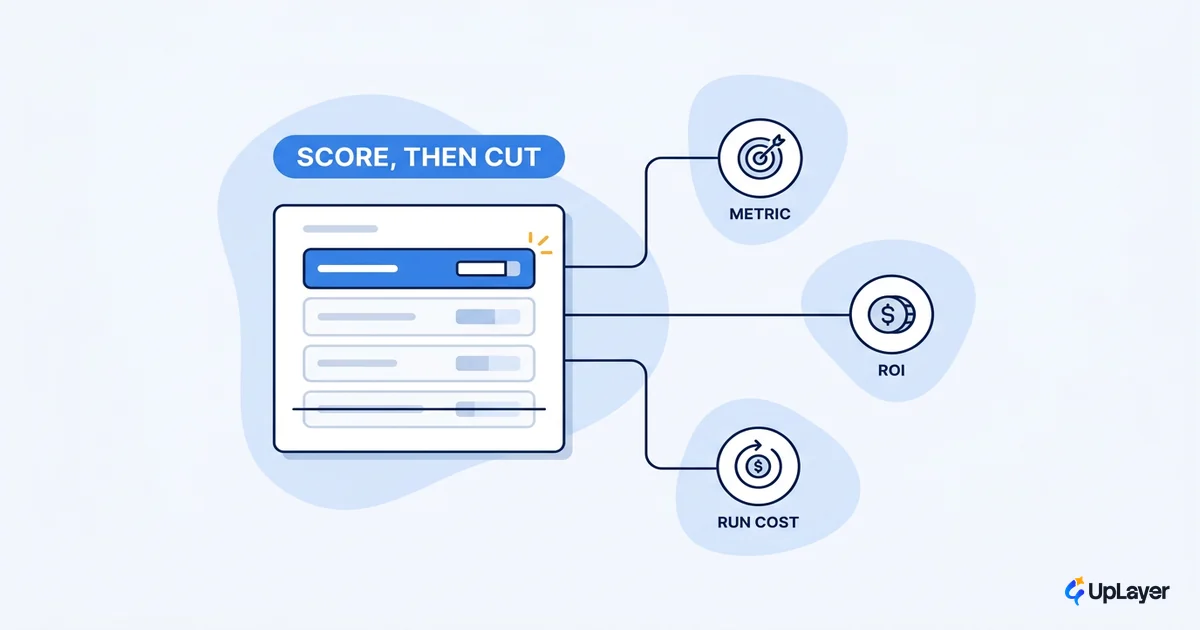
Score every idea, then build the short list. Most teams have five or six AI ideas in a doc; usually two are felt moments tied to a metric and the rest are demos. The discipline is saying no to the demos out loud, which is the part the roundups never do. If you want the full scoring method, we keep it in score each idea against a metric you already track.
| Build it | Skip it |
|---|---|
| Pre-fill that removes a real form step | A chatbot with no job to do |
| Draft-and-edit copilot on a high-effort task | A "summarize" button on a 3-line note |
| Smart default that matches this user's intent | Personality and small talk in the sidebar |
| A nudge that catches a likely mistake | An agent that acts without a clear undo |
The shorter your build list, the more design attention each felt moment gets, and design is what decides whether it gets used. One pre-fill that works beats four AI features that demo.
An AI powered SaaS is not the one with the most models. It is the one where the few moments users actually touch feel like the product thought ahead. Build those, skip the rest, and tie each one to a number you can show a board. Whether your product feels AI powered next quarter is a design and prioritization decision, not a model-licensing one.
TIP
Not sure which felt moments would move your numbers? How the AX Audit works. We rank the AI opportunities in your product by projected ROI and tell you which ones to skip.