When to hire an AI workflow automation agency
Deciding whether to hire an AI workflow automation agency? The honest build-vs-partner signals, what to demand, and when in-house is the smarter call.
 Shahriar P. ShuvoAI Automation7 min read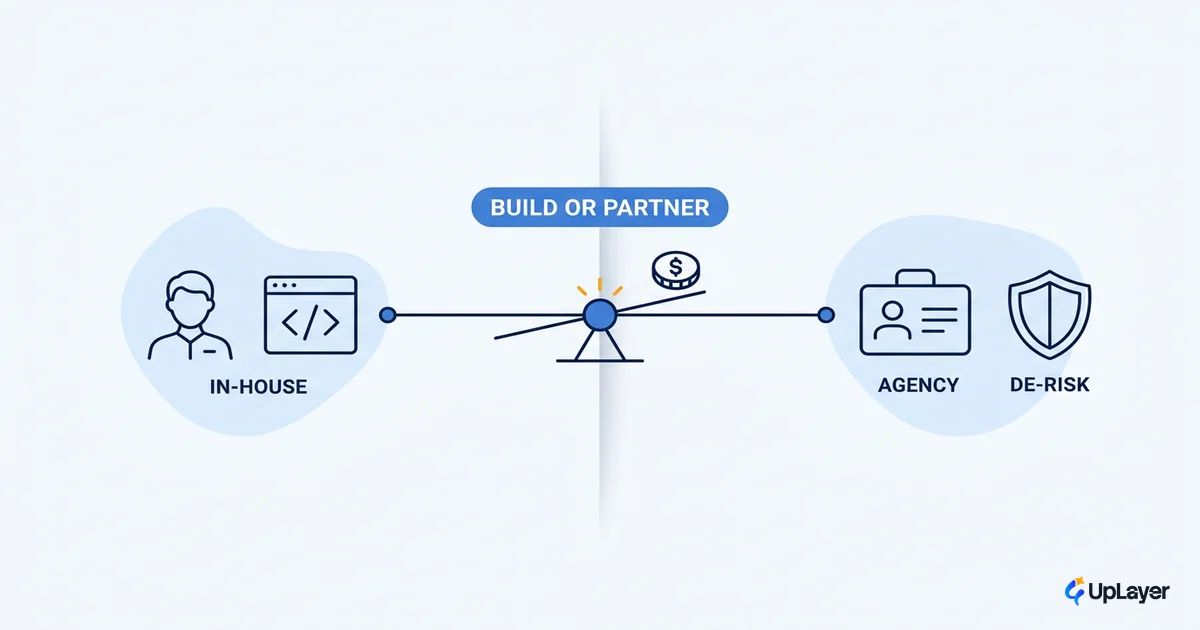
You have two reasonable options on the table. Hire an AI workflow automation agency, or point your own engineers at n8n this sprint and see what sticks. Both feel defensible, and that is exactly why so many teams stall on the decision. The choice you make matters less than the order you make it in.
Here is the uncomfortable starting point. Most of these projects do not pay off, and the model is rarely the reason. The way teams decide is. They settle on a tool before they settle on the payback, hire help to ship a demo instead of to make a decision, and only learn the workflow was a bad candidate after the build is live. Before you bring anyone in, the move is to project the payback before you automate anything, then decide who is best placed to deliver it. This guide is about that decision: the honest signals you need outside help, when your own team is the better bet, and what to demand from an agency if you hire one.
What does an AI automation agency do
A good one does four things in order: finds the single highest-ROI workflow worth automating, proves the payback on a metric you already track, designs the human-in-the-loop experience so people actually trust it, and builds it into your product before handing off. The work is a decision first and a build second.
That distinction is where most of the market gets it wrong. There are agencies that ship bots, and there are agencies that make the ROI call. The first kind takes a workflow you name and automates it. The second kind tells you which workflow to automate, which to leave alone, and what the lift is worth before a line of code ships. Harvard Business Review's review of why most AI projects go off course points at the same root cause: weak problem selection and loose deployment discipline, not weak models. The agency you want is the one obsessed with the decision, not the demo.
| What a good agency does | What a bot shop does |
|---|---|
| Ranks workflows by projected ROI | Automates the workflow you named |
| Ties the build to a metric you report | Ships a feature, calls it done |
| Designs guardrails and human checkpoints | Trusts the model and moves on |
| Tells you what not to build | Builds whatever you'll pay for |
| Hands off with a metric dashboard | Hands off a Zap and an invoice |
If a prospective partner cannot tell you what they would refuse to build, you are talking to a bot shop.
Should you hire an AI automation agency, or build in-house
Hire an agency when speed, reliability, or the ROI decision itself sits beyond your team's current bandwidth. The evidence leans this way more than most founders expect. MIT's GenAI Divide study found that purchased and partnered AI tools succeed about twice as often as internal builds, with partnered solutions working roughly 67% of the time against a far lower internal rate. The same research put the headline failure number at around 95% of enterprise pilots showing no measurable impact on the P&L.
Despite the rush to integrate powerful new models, about 5% of AI pilot programs achieve rapid revenue acceleration; the vast majority stall, delivering little to no measurable impact on P&L.
So the question "should you hire an ai automation agency" is really a question about which path lowers your odds of joining that 95%. These are the five honest signals you need outside help:
- A board or competitor deadline is forcing a ship date your roadmap can't absorb.
- No in-house AI-design muscle. Your team can wire an API but has never designed for model uncertainty.
- You already shipped a flop. An AI feature that demoed well and moved nothing.
- The stakes are high-trust. A wrong automated action damages customer trust or revenue.
- You can't measure impact. No clean baseline, no way to prove the feature paid off.
Two or more of these, and an agency that leads with the ROI decision will usually de-risk the project faster than a from-scratch internal attempt. None of them, and you may not need one at all.
When is in-house automation better than an agency
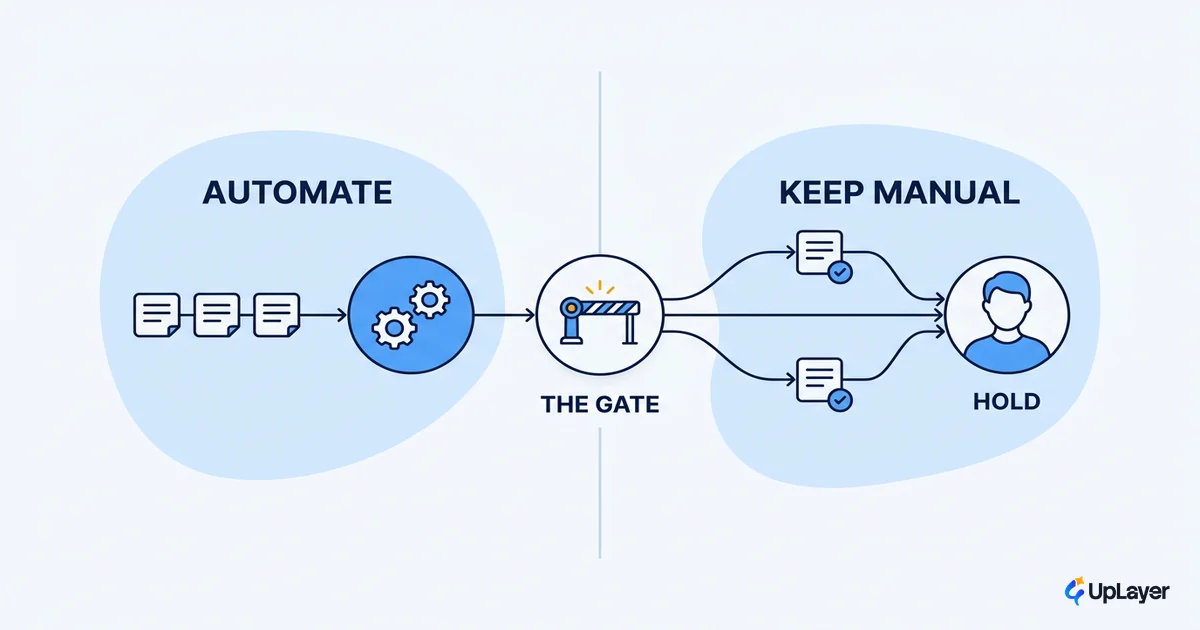
Keep it in-house when the workflow is small, rule-shaped, low-trust, and your data is already clean and reachable. If a junior engineer can map the process on a whiteboard in an hour and the worst failure mode is a re-run, you do not need an agency. You need an afternoon. This is also the moment to decide what not to automate at all before you spend anything, and to pick the right automation tool yourself rather than rent the decision.
The usual blocker is not skill. It is data. IBM's Arvind Krishna noted that only about 1% of enterprise data has reached any AI model so far, even as 92% of companies plan to spend more on AI. If your inputs live in three disconnected tools and a Friday spreadsheet, in-house or agency, you fix that first. Nobody automates their way out of dirty data.
in_house_or_agency = decide({
  KEEP_IN_HOUSE if:
    - workflow is small, rule-shaped, low-trust
    - data is already clean and reachable
    - failure mode is cheap (a re-run, not a refund)
    - your team has shipped reliable automation before
  HIRE_AN_AGENCY if:
    - the ROI decision itself is the hard part
    - reliability/trust failures are expensive
    - you have a deadline your roadmap can't absorb
    - you've shipped an AI feature that moved no metric
})
// if neither side is clearly true, the project isn't scoped yet. scope it.| Fit signal | Keep in-house | Hire an agency |
|---|---|---|
| Workflow shape | Small, rule-based | Cross-team, judgment-heavy |
| Trust stakes | Low, reversible | High, customer-facing |
| Data readiness | Clean, connected | Scattered, needs work |
| ROI clarity | Obvious payback | Needs projecting and defending |
| Track record | Shipped automation before | First serious AI feature |
What to demand from an AI workflow automation agency
If you do hire one, the bar is non-negotiable. A serious AI workflow automation agency should hand you an ROI projection on a metric you already report, a working concept demo of the top opportunity before any full build, a reliability and guardrail plan, a documented data-handling spec, and a guarantee that ties their fee to shipping. Anything less is a pitch, not a partnership.
Reliability is not a checkbox here. Developer trust in AI output is still an open question: Stack Overflow's 2024 survey found only about 43% of developers trust the accuracy of AI output, with roughly a third actively skeptical. An agency that waves that away with "the model handles it" is the wrong agency. The right one designs for the cases where the model is wrong.
WARNING
The fastest way to waste a budget is to hire an agency that skips the ROI step. If the proposal jumps straight to building before anyone has projected the payback on a metric you track, you are buying a demo, not a decision. Make the ROI projection a deliverable, not an afterthought.
Hold any partner to two standards in writing. The 3X Guarantee: the upfront audit finds AI worth at least 3x its fee, or it's free. The Ship-It Guarantee: the final milestone isn't due until the feature is live and working. Both put the risk where it belongs, on the agency.
How an agency should de-risk the build
The honest answer on how to de-risk an AI workflow build: prove it on a concept demo first, gate every high-trust action with a human checkpoint, and measure against a baseline before you call it done. Risk is the reason most of these projects die, so managing it is the actual product. Gartner expects at least 30% of generative AI projects to be abandoned after the proof of concept, and forecasts that over 40% of agentic AI projects will be canceled by 2027, both for the same reasons: escalating cost, unclear value, weak risk controls.
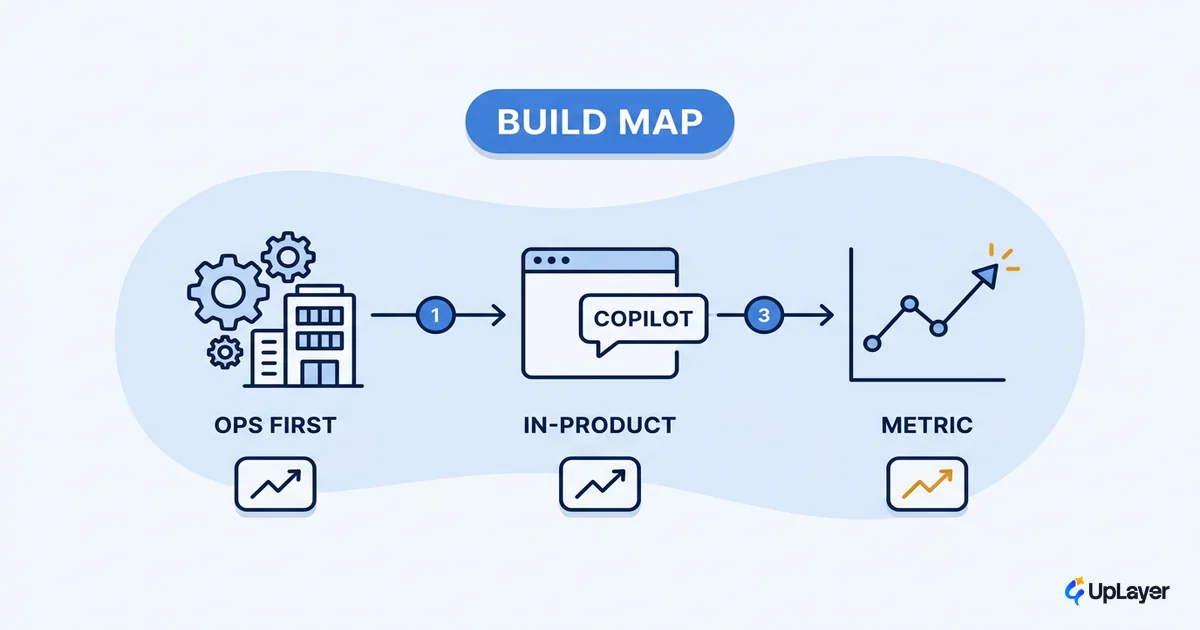
A concept demo is how a good partner sidesteps that fate. It is a prototype built to show the thinking and test the payback before committing to a full build, with metrics framed as projected, never claimed. It is also how you tell ai automation roi from ai automation theater: a demo either moves a number against the baseline or it doesn't, and you find out cheaply. If you want the full sequence an agency should follow inside a product, the build map for AI workflow automation in a SaaS product lays out each gate. The pattern is always the same: small bet, human in the loop, measured outcome.
The real decision behind hiring an AI workflow automation agency was never build versus partner. It was whether the work gets made into an ROI-and-risk decision or rushed into a demo nobody measures. Pick the path, in-house or agency, that forces the projection first, protects trust with guardrails, and proves the payback on a number you already report. Do that, and an AI workflow automation agency becomes a way to de-risk the bet rather than enlarge it.
TIP
Not sure whether your top automation opportunity is worth building at all? How the AX Audit works. We project the payback on a metric you already track, build a concept demo of the #1 opportunity, and tell you what not to build.