RAG for business: when retrieval earns its place
RAG for business sounds like the obvious upgrade for any internal workflow. Here is where retrieval grounding pays back, and where it is plain overkill.
 Anamoul RoufAI Automation7 min read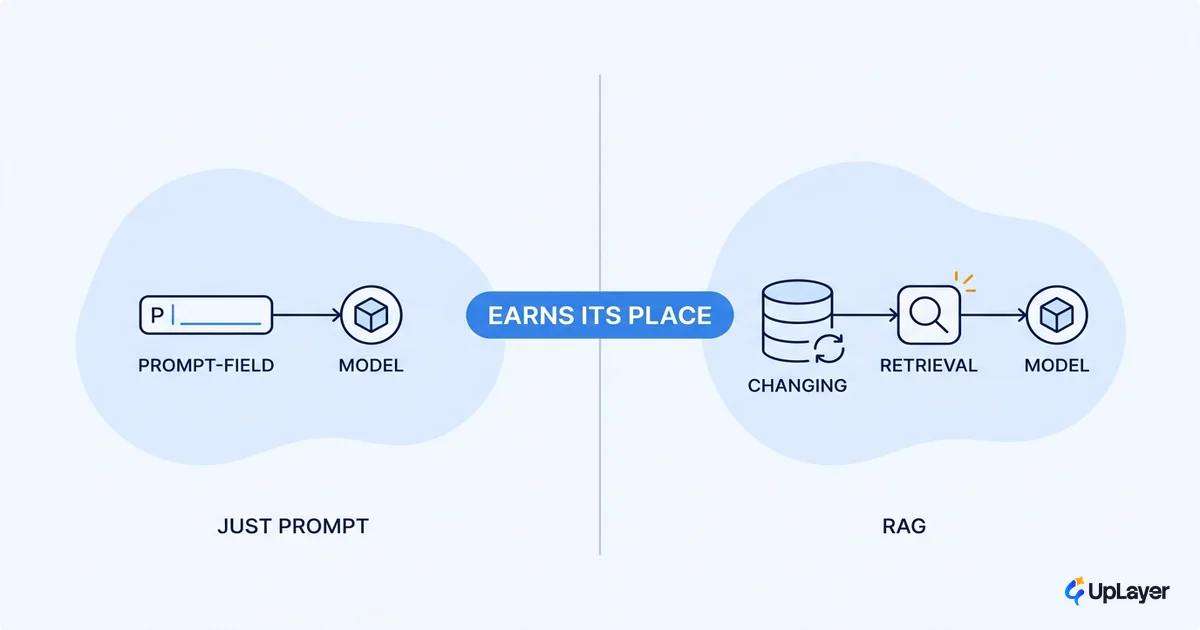
Most teams hear "RAG" and assume it is the obvious upgrade for any internal workflow. So they fund a retrieval pipeline, spend a quarter on chunking and embeddings, and ship something that beats a well-written prompt by almost nothing. The pipeline works. The metric does not move.
RAG for business is not a default. It is a tool that earns its place under specific conditions, and reads as overkill everywhere else. Retrieval grounding pays back when your knowledge is large, changing, and queried often enough that the answer genuinely cannot fit in a prompt. Below that bar, you are paying pipeline tax for a feature your users will not feel. The decision is the same one behind every automation call: tie it to a metric you already track, or do not build it. That is the lens we use when we map what AI workflow automation actually returns, and it is exactly how you should approach retrieval too.
This piece gives you the definition fast, then the part the vendor pages skip: where RAG actually moves a number, and where a prompt would have done the job for free.
What is RAG for business, in one paragraph
Retrieval-augmented generation feeds a language model the relevant slice of your own documents at question time, so the answer is grounded in your data instead of the model's memory. The mechanism is plain: when a user asks something, the system retrieves the most relevant chunks from your knowledge base, injects them into the prompt, and the model writes its answer from that context. IBM describes RAG as grounding the model on external sources of knowledge, with a second benefit that matters for trust: users can see the sources behind an answer and check the claims. The pattern is not new. It was named in a 2020 research paper that paired a model's built-in memory with retrieved, non-parametric memory. For a business, the short version is this: RAG turns a generic model into one that can answer questions about your company, with citations you can audit.
Where RAG actually pays back in internal workflows
RAG earns its place where the same large body of changing knowledge gets queried over and over. That is the pattern. Strip it away and the case for a retrieval pipeline gets thin fast.
The workflows where retrieval grounding reliably moves a metric you already track:
- Support deflection. A grounded assistant answers from your help center and past tickets, and you measure the change in deflection rate and time-to-resolution.
- Internal knowledge search. Engineering, sales, and ops ask questions against runbooks, contracts, and policy docs. The metric is time-to-answer and escalations to a human expert.
- Document Q&A at scale. This is where ai document automation over thousands of contracts, reports, or claims earns the build, because no prompt holds that corpus.
The reason to retrieve rather than retrain is cost. Updating a model's own weights for your domain is expensive and slow; AWS notes RAG is a more cost-effective approach than retraining the model for getting current, company-specific facts into an answer. For most business process automation ai work, that tradeoff is the whole point: you keep the model generic and swap the knowledge underneath it whenever the documents change.
NOTE
Notice what every workflow above has in common: a metric that already exists. If you cannot name the number RAG is supposed to move, that is the signal you are reaching for retrieval before you have a problem that needs it.
When should a business use RAG, and when it is overkill
Use RAG when your knowledge is large, changing, and queried often. Skip it when the knowledge is small, static, or fits in a prompt. That single test settles most of these decisions before any code gets written.
Here is the decision matrix we run with clients:
| Signal in your workflow | Build RAG | Skip it (use a prompt or a lookup) |
|---|---|---|
| Knowledge size | Thousands of docs, won't fit in context | Fits in a single prompt (< a few pages) |
| Change rate | Updates weekly or faster | Static for months |
| Query volume | Asked many times a day | Occasional, one-off |
| Answer source | Must be traceable to a document | Common knowledge, no citation needed |
| Right tool when you skip | RAG earns it | Prompt, FAQ, or a deterministic lookup |
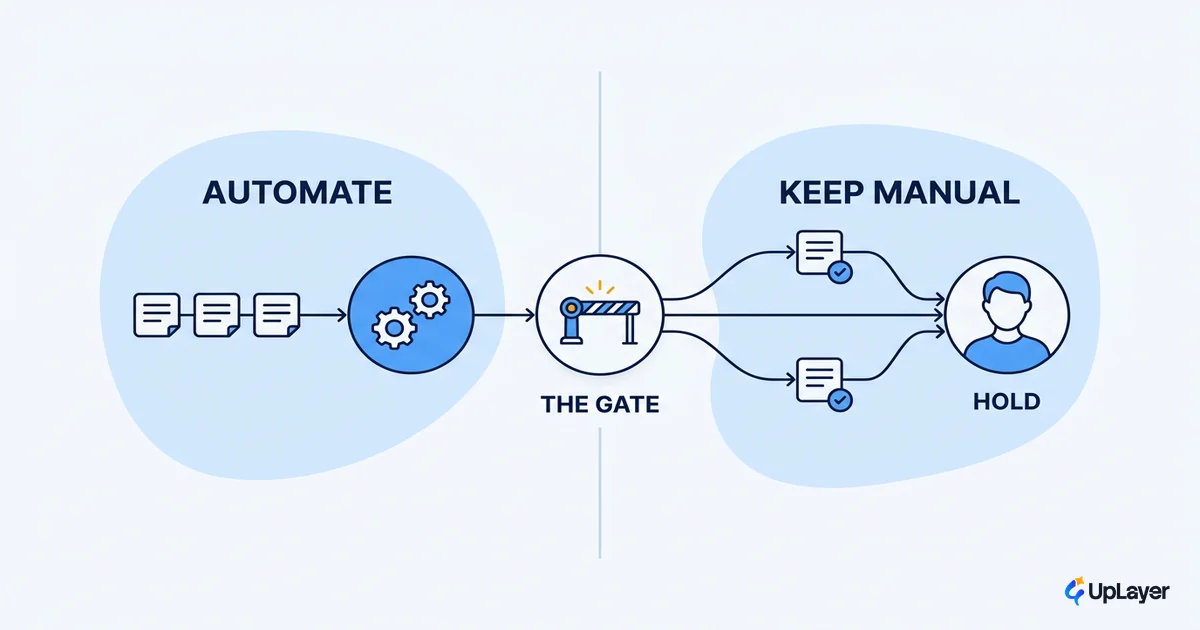
The honest failure mode is building RAG for a knowledge base that three paragraphs of prompt would have covered. You inherit a vector store, a retrieval step, and an eval problem, and you get no measurable lift. Thoughtworks and Martin Fowler are blunt that basic RAG needs extra patterns to overcome its limitations, and that when RAG still is not enough, fine-tuning becomes the better spend. Retrieval is a middle tool, not a universal one. Sometimes the right answer is a plain prompt, and sometimes it is to not automate the step at all, which is a call worth making deliberately. We wrote a whole piece on when not to automate at all for exactly that reason.
How does RAG reduce AI errors, and where it still fails
RAG reduces errors by grounding answers in retrieved source text instead of the model's memory, so the model has the facts in front of it and can cite them. That is real, and it is the main reason teams adopt it. But grounding is only as good as retrieval, and retrieval fails silently.
When the retriever pulls the wrong chunks or misses the right ones, the model writes a confident answer from bad context. Nothing in the output flags that the retrieval was off. This is why retrieval quality, not model choice, is usually the thing that decides whether a RAG system is trustworthy. Anthropic found that improving the retrieval step with contextual embeddings can reduce failed retrievals by 49%, and by 67% with reranking, which tells you how much room a naive pipeline leaves on the table.
Traditional RAG solutions remove context when encoding information, which often results in the system failing to retrieve the relevant information from the knowledge base.
(Anthropic, Introducing Contextual Retrieval)
So grounding alone is not the finish line. You need reliability guardrails around the retrieval step:
# Retrieval-quality gate (run before an answer ships to the user)
groundedness = supported_claims / total_claims   # every claim traceable to a retrieved chunk
retrieval_hit = relevant_chunks_returned / relevant_chunks_expected

PASS  if  groundedness >= 0.95  AND  retrieval_hit >= 0.90
ELSE  ->  return "I don't have a sourced answer" + escalate to a human
The gate matters more than the model. A system that says "I don't have a sourced answer" beats one that invents a fluent, wrong one, because the first protects the metric you are trying to move and the second quietly erodes it.
WARNING
A RAG system with weak retrieval is more dangerous than no RAG at all. It produces fluent, cited, confidently wrong answers. Measure retrieval hit rate and groundedness before you trust deflection numbers, or you will ship trust you have not earned.
RAG as a supportive layer, not a headline feature
The framing that keeps RAG honest is to treat it as a supportive ai layer that sits above your core engine, not as the product's main event. Retrieval grounds the answer and cites its sources; the model stays swappable; your documents stay the source of truth. When the next model ships, you change one layer and the workflow keeps running. That is the same posture we bring to all business process automation: the automation supports the work and stays accountable to a number, instead of becoming a thing the team now has to babysit.
Build RAG when the knowledge is large, changing, and queried enough that a prompt cannot carry it, wrap it in reliability guardrails, and hold it to a metric you already track. Do that, and RAG for business stops being a buzzword you adopted and becomes a layer that quietly pays for itself. Skip those conditions and you have built a pipeline, not a result.
TIP
Not sure whether retrieval would actually move a metric in your product, or whether a prompt would do the job for free? How the AX Audit works.