Business process automation with AI, done right
Business process automation AI fails when you skip the map. Sequence it to de-risk operations, tie every step to a metric, and prove the payback first.
 Shahriar P. ShuvoAI Automation7 min read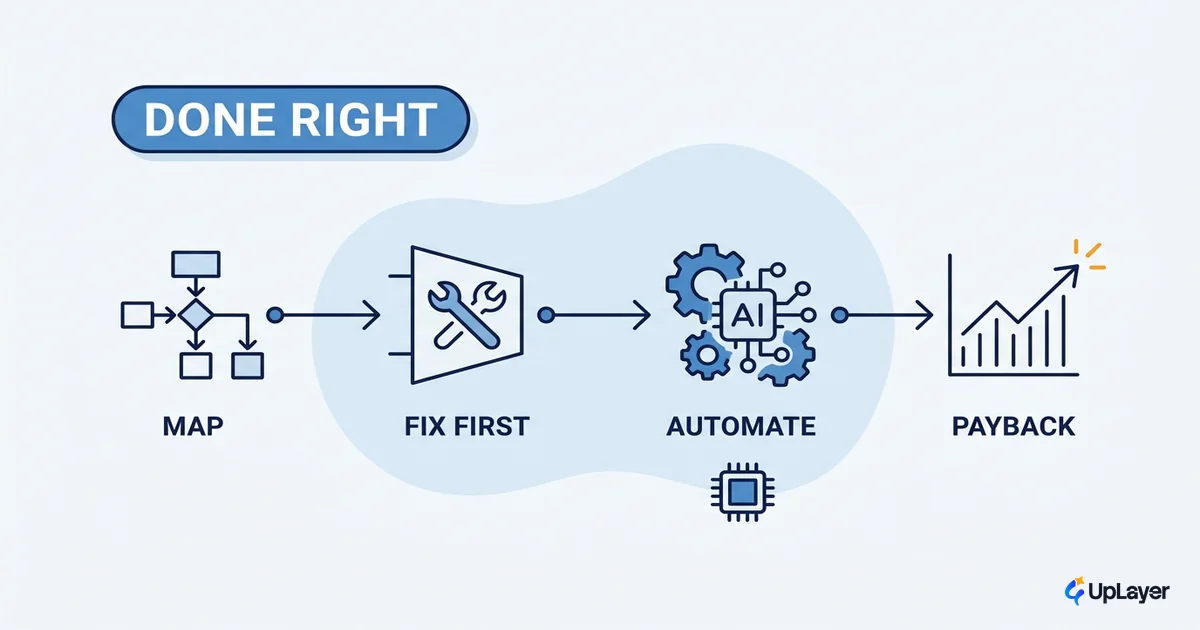
Most teams treat business process automation AI as a tooling decision. Pick a platform, point it at a workflow, ship. That order is exactly why so many of these projects move nothing. The model isn't the hard part. The process underneath it is.
Automation doesn't fix a broken process. It runs the broken process faster, more often, and with less human friction to catch the mistake. If you automate before you map, you don't save the work. You scale the error. The way to avoid that is boring and it works: map the process, score it, pilot it small, and tie it to a number you already report. Get the sequence right and automation lowers your risk instead of raising it. That sequence is what this guide is about, and it starts well before you project, measure, and defend the return before you automate anything.
Most automation projects fail at the map, not the model
The uncomfortable starting point: most of these projects don't pay off, and the model is rarely why. In MIT's GenAI Divide research, most AI pilots stall with no measurable impact on the P&L, with only about 5% of programs reaching real revenue acceleration. That study drew on 150 leader interviews, a 350-person survey, and 300 public deployments. It's not a fluke. It's the base rate.
Despite the rush to integrate powerful new models, about 5% of AI pilot programs achieve rapid revenue acceleration; the vast majority stall, delivering little to no measurable impact on P&L.
Read those failures closely and a pattern shows up. The team picked a process nobody had mapped, automated the version that lived in someone's head, and hardened every undocumented exception into code. The output looked faster. The operation got more brittle. When the process is wrong, business process automation AI makes the wrongness cheaper to repeat, not easier to fix.
So the first move is not a vendor demo. It's a whiteboard. Write down what actually happens, including the messy parts people route around. The map is the asset. The model is a commodity you bolt on afterward.
How do you start business process automation with AI
Start by separating the work into two questions that teams usually blur together: what is the process, and what is the right tool. Answer them in that order. The sequence below keeps the decision honest.
business-process-automation = sequence([
  1. MAP    -> document the real process, exceptions included
  2. SCORE  -> rank candidates by volume, pain, structure, stability
  3. PILOT  -> automate one candidate behind a human checkpoint
  4. MEASURE-> compare the metric you already track, pre vs post
])
# never skip MAP. an unmapped process is an un-automatable process.
Step one has a prerequisite most guides bury: clean, reachable data. The reason so many pilots stall before they prove anything is that the data they need isn't ready. IBM notes that only about 1% of enterprise data has reached AI systems, even as 92% of companies plan to spend more on it. If the inputs to your process live in three disconnected tools and a spreadsheet someone emails on Fridays, fix that first. AI workflow automation built on dirty data inherits every gap.
The starting move, then, is unglamorous. Map one process end to end. Confirm its data is accessible and trustworthy. Only then do you reach for a platform, and you reach for the smallest one that does the job.
Which processes should you automate first
The right first process is high-volume, high-pain, rule-shaped, and stable. Run a candidate through four filters and a fifth gate that the others forget: the metric.
| Filter | Question | Good candidate | Poor candidate |
|---|---|---|---|
| Volume | How often does it run? | Many times a day | A few times a quarter |
| Pain | What does it cost today? | Hours of manual rework | Minor, tolerable |
| Structure | Is it rule-based or judgment-heavy? | Clear, repeatable rules | Nuanced, case-by-case |
| Stability | Will it change next quarter? | Settled, unlikely to shift | Mid-redesign |
| Metric | Does a number you report move? | Ties to cycle time or cost | No metric you track |
The first four filters tell you whether a process can be automated cleanly. The fifth tells you whether it's worth it. A high-volume, structured process that touches no metric you report is a tidy way to spend budget on a result no one notices. For a shortlist already filtered this way, our prioritized shortlist of use cases scored by effort, risk, and projected ROI is a faster on-ramp than starting from a blank page.
Context for the urgency, not the decision: adoption is climbing fast. Gartner projects that 30% of enterprises will automate more than half of their network activities by 2026, up from under 10% in mid-2023. That's a reason to sequence well, not a reason to rush.
When to automate with AI, and when to leave it alone
Knowing when to automate with AI is mostly knowing when not to. Some processes punish automation no matter how good the model is.
WARNING
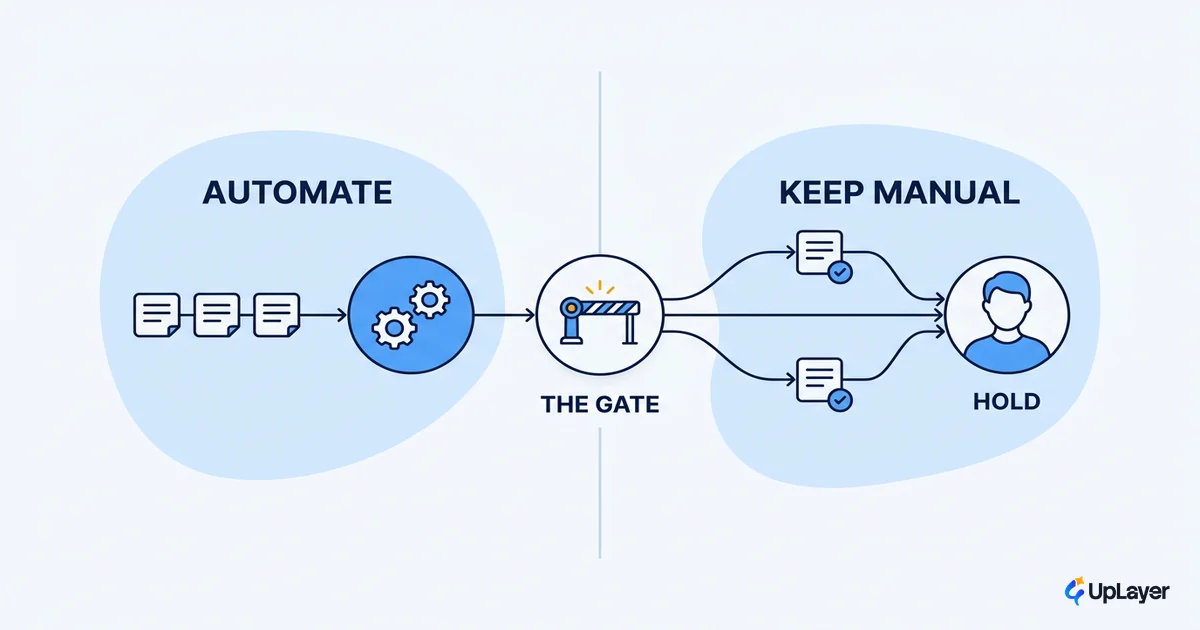
Automating a judgment-heavy, unstable, or high-blast-radius process doesn't remove the risk. It hides it, then multiplies it. The cost of a wrong call now arrives faster and more often, with no human in the loop to catch it.
Leave it alone, or augment a human instead of replacing one, when the process is low-volume (you'll never recoup the build), judgment-heavy (the rules live in expertise, not logic), unstable (you'd automate a thing about to change), or high-stakes (a single bad output damages trust or compliance). In those cases AI assists the person who owns the call. It doesn't take the call. We keep a checklist for when to automate with AI for exactly these edge cases, because the wrong "yes" here is the expensive one.
This is the supportive-AI stance, applied to operations. AI sits as a layer above the work, speeding the clear-cut parts and routing the rest to a human. You ship value without betting an operation on a model's worst day.
How do you de-risk process automation
You de-risk process automation by refusing to scale anything you haven't measured. Confidence is not evidence. MIT Sloan found that most teams claim gains they never actually measure: 58% of data and AI leaders reported exponential productivity gains, while very few were tracking those gains carefully enough to know. Belief is not a baseline.
Four practices turn a risky rollout into a controlled one:
- Shadow-run. The automation runs alongside the manual process for two weeks. You compare outputs, not promises.
- Human-in-the-loop. Every output passes a checkpoint until accuracy earns autonomy. The checkpoint comes off when the data says so.
- Reversible rollout. Ship to one team or one queue first. Keep the manual path warm so you can fall back without drama.
- Measure the delta. Pick the metric before you build. Record it before, record it after, report the difference.
That last one is the whole game. AI workflow automation that can't show a before-and-after on a metric you already track is theater, however clean the demo looked. If you want the broader pattern, we treat AI workflow automation as a supportive layer rather than a replacement for the team, and the de-risking discipline is the same at every scale.
Business process automation AI only ships when the ROI clears
This is where ai automation roi stops being a slogan and becomes a gate. Every automation should clear the test before it gets built, not after. The math is simple enough to defend to a CFO on one line.
projected_roi = (hours_saved_per_month * loaded_cost_per_hour
                 + error_cost_avoided_per_month)
                - (build_cost_amortized + run_cost_per_month)
# if the metric it moves isn't one you already report, the number is fiction.
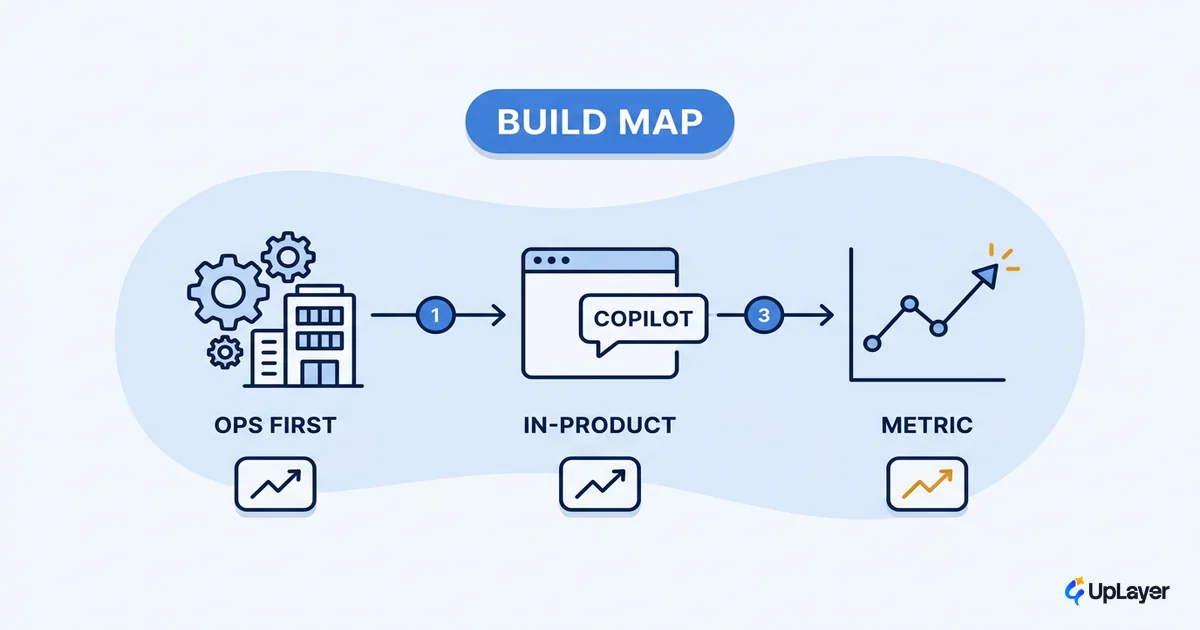
Anchor the projection to a metric the business already watches: support cycle time, invoice processing cost, activation rate, churn. A Concept Demo of the top candidate, with impact framed as projected, turns the argument from "AI is exciting" into "here is the number, here is the source, here is the payback window." That's a decision a finance team can sign off on, and it's the difference between a pilot that scales and one that quietly dies.
Done in this order, business process automation AI stops being a gamble and becomes a sequence of small, measured bets. Map before model, score before build, measure before scale. The teams that win with automation in the next year won't be the ones with the most ambitious AI. They'll be the ones who automated the right process, in the right order, and could prove it moved a number they already cared about.
TIP
Not sure which process clears the gate first, or what it's projected to return? How the AX Audit works.