Agentic AI SaaS without the autonomy hype
Agentic AI SaaS is a cost decision before a capability one. Where autonomy pays off, where a confirmation step protects retention, and what to never ship.
 Sohanur RahmanAI Copilots & Assistants8 min read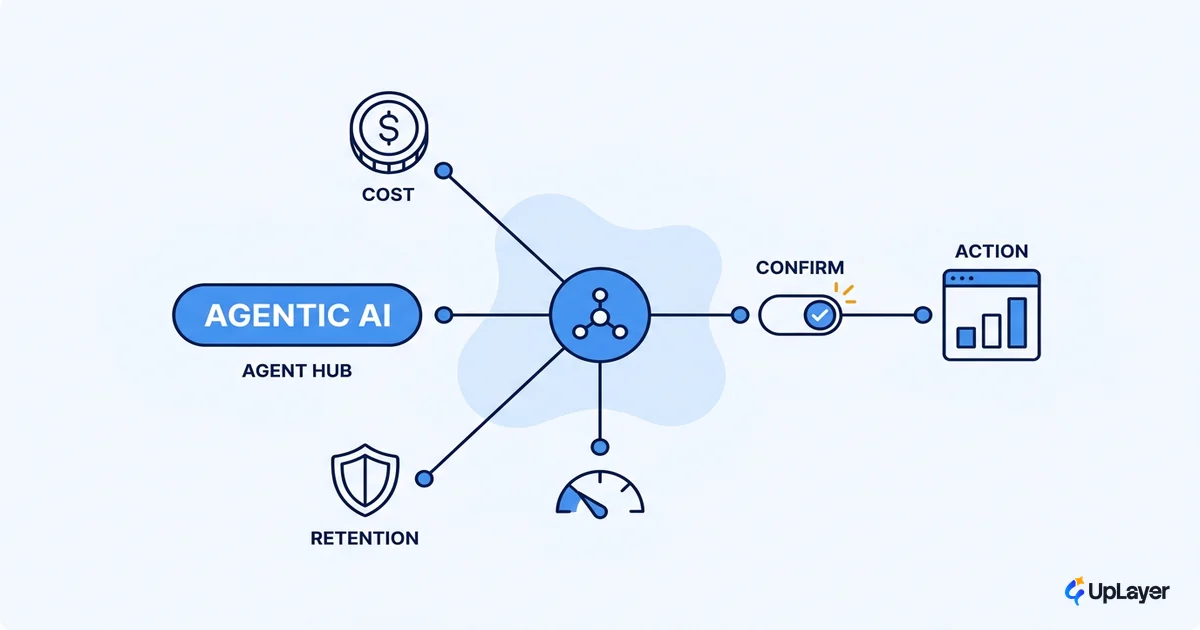
The pressure to ship agentic AI SaaS features usually arrives from two directions at once. The board wants to know what your "agent strategy" is, and a competitor just put the word agentic on their homepage. At the same time, you can picture the failure mode clearly: an autonomous feature takes an action a user did not expect, the user loses trust, and they stop opening the product. Both feelings are rational. They point in opposite directions.
Here is the reframe that resolves it. Agentic AI is a cost decision before it is a capability decision. Autonomy is not a feature you add, it is a tradeoff you accept: more reach in exchange for more cost, more risk, and more ways to be wrong without a human noticing. The question is not whether you can make a feature autonomous. You almost always can. The question is whether the job is worth the autonomy, measured against a number you already track.
This piece gives you the decision, not a framework tutorial. We will cover what autonomy actually changes for your users, how to tell hype from a job that justifies an agent, an autonomy ladder you can apply this week, and where a confirmation step quietly protects retention. It builds on our approach to designing AI assistants for B2B SaaS that earn trust, narrowed to the specific moment you are deciding how much control to hand over.
What does agentic AI actually change for users
Agentic AI changes who acts. A copilot waits for the user and assists; an agent takes the user's goal and acts on its own, returning for judgment only when it chooses to. That shift moves the cost and the risk, not just the capability.
The mechanism is worth being honest about. An agent is a model using tools in a loop, deciding its own next step until it hits a stopping condition. That loop is what makes it useful for open-ended jobs, and it is also what makes it expensive and failure-prone. As Anthropic puts it in their guide to building agents, agentic systems trade latency and cost for better task performance, and the autonomous nature of agents "means higher costs, and the potential for compounding errors." Their actual recommendation is the opposite of the hype: find the simplest solution possible, and only add agentic complexity when a single well-built model call cannot do the job.
For your users, the change is felt as a loss of control. With a copilot, the user is the last decision before anything happens. With an agent, the product becomes the actor and the user becomes the supervisor. That is a great trade when the job is tedious, reversible, and low-stakes. It is a terrible trade when the job touches a customer's data, money, or reputation, because now a model error becomes your product taking a wrong action in your user's name. Supportive AI keeps the human as the decision-maker by default and earns the right to act autonomously one job at a time.
Agentic AI SaaS: separating a real opportunity from hype
Is agentic AI right for my SaaS? For most teams right now, the honest answer is: a little, in a few specific places, and far less than the market implies. The category is loud, and a lot of the noise is rebranding.
Start with the base rate. Gartner predicts that more than 40% of agentic AI projects will be canceled by the end of 2027, citing escalating costs, unclear business value, and inadequate risk controls. The same analysis names the thing you are sensing on competitor websites: "agent washing," the rebranding of existing assistants, chatbots, and RPA as agentic without real agentic capability. Gartner estimates only about 130 of the thousands of self-described agentic AI vendors are real.
Over 40% of agentic AI projects will be canceled by the end of 2027, due to escalating costs, unclear business value or inadequate risk controls. (Gartner, June 2025)
This is not an AI problem, it is a value problem that AI inherited. BCG's research found that only 26% of companies move past proofs of concept to tangible value from AI at all. Adding autonomy to a feature that was never tied to a metric does not fix the value gap, it raises the cost of the gap. So the test for "is agentic AI right for my SaaS" is not a capability checklist. It is a single question: can you name the metric this agent is supposed to move, and is the projected lift worth the autonomy risk. If you cannot, you are not ready to build an agent. You are ready to measure the ROI of an AI feature first.
How autonomous should a SaaS feature be
Autonomy is not on or off. It is a ladder, and most features should sit lower on it than the hype suggests. The right rung is set by two things: how reversible the action is, and how much the metric at risk would suffer from a wrong action.
Use this rule before you build:
autonomy_level = f(reversibility, blast_radius, projected_metric_lift)

if action is irreversible OR blast_radius touches money/data/reputation:
    require explicit human confirmation   # act-with-confirmation, never higher
elif projected_metric_lift <= cost_of_autonomy (compute + error + trust):
    do not build as an agent              # ship a copilot or a single model call
else:
    graduate ONE rung at a time, measure the metric, then decide to climb
The ladder itself:
| Rung | What the feature does | Good fit | Metric to watch |
|---|---|---|---|
| 1. Assist | Answers, drafts, summarizes on request | Anything user-initiated and low-stakes | Activation, time-to-value |
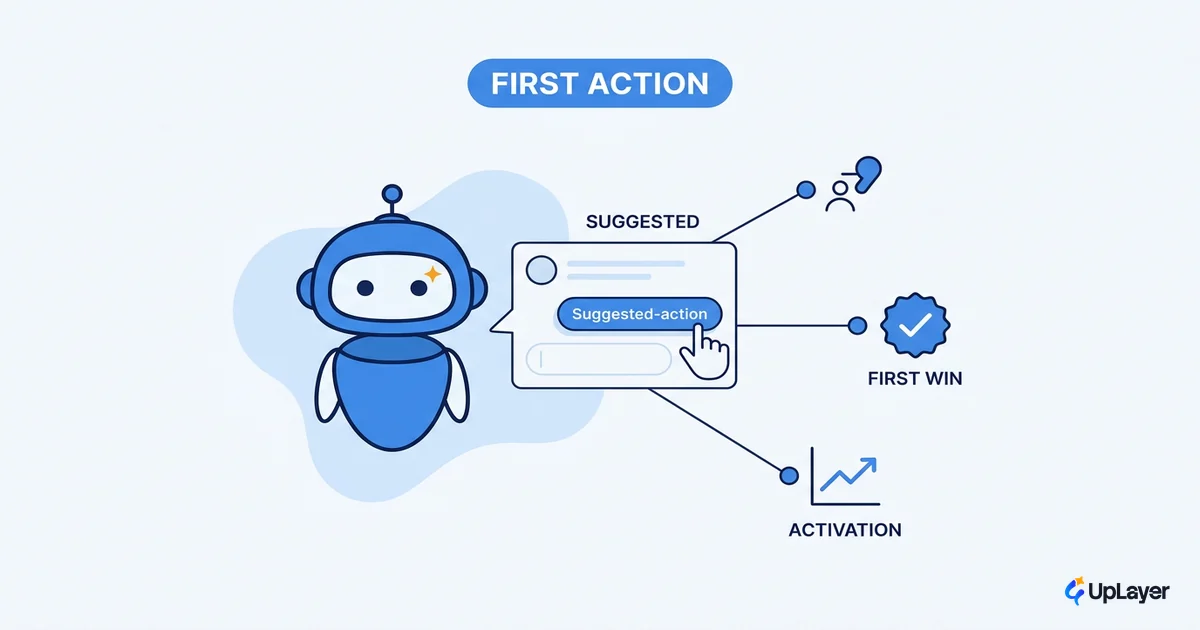
| 2. Suggest | Proposes a next action, user approves | Workflows where the user wants speed but keeps control | Feature adoption |
| 3. Act with confirmation | Prepares the action, waits for one click | Irreversible or sensitive jobs (sends, deletes, payments) | Retention, error rate |
| 4. Act then notify | Acts on reversible jobs, tells the user after | Low blast radius, easily undone, high volume | Task completion, undo rate |
| 5. Fully autonomous | Runs a multi-step job end to end | Tedious, bounded, trusted environments only | Cost per task, escalation rate |
Most B2B SaaS value lives on rungs 2 and 3. Teams reach for rung 5 because it demos well, then discover that a single wrong autonomous action costs more trust than ten correct ones earned. Climb deliberately. The metric tells you when the next rung is justified, and when it is not.
AI agent guardrails and human-in-the-loop as ROI levers
Guardrails are not friction you add to slow a feature down. They are the thing that lets you ship autonomy at all without betting retention on it. A confirmation step, a scope limit, and a clean undo are ROI levers, because the failure they prevent is the one that makes a user quit.
This is also how the people building agents actually recommend doing it. Anthropic's guidance is to have agents pause for human feedback at checkpoints, use stopping conditions like a maximum number of iterations to maintain control, and run behind appropriate guardrails tested in sandboxed environments. The pattern for a product is the same: bound what the agent can touch, keep a human on the decisions that are hard to reverse, and make every autonomous action observable and reversible. Our deeper treatment of guardrails that keep a copilot in bounds covers the implementation; the point here is the economics.
WARNING
Full autonomy as the default is the most expensive mistake in this space. Every rung you climb multiplies cost and the blast radius of a single wrong action. Make autonomy something a feature earns by moving a metric, not the starting point because the word agentic sounds modern.
Human-in-the-loop is not a transition phase you graduate out of. For sensitive jobs it is the design. The human is the guardrail that no model-side check fully replaces, and keeping them there on the right actions is what protects the adoption you are trying to grow.
Where an AI agent for SaaS earns its place (and where to kill it)
An AI agent SaaS feature earns its place on jobs that are tedious, bounded, reversible, and tied to a metric you can move. It should be killed on jobs that are rare, irreversible, or trust-critical, where a copilot does the same work at a fraction of the risk. The deciding factor is always projected ROI against the autonomy cost, not the impressiveness of the demo.
| Build it as an agent | Kill it (ship supportive AI instead) |
|---|---|
| Triaging and routing inbound tickets by rule, with escalation | Auto-closing tickets without a human review of edge cases |
| Drafting and queuing routine follow-ups for one-click send | Auto-sending external messages on a customer's behalf |
| Reconciling and flagging data discrepancies for approval | Auto-correcting financial records with no confirmation |
| Monitoring usage and surfacing at-risk accounts to the CSM | Auto-applying account changes (downgrades, cancellations) |
| Summarizing a long thread and proposing next steps | Acting on the proposal across systems with no checkpoint |
Notice the pattern in the kill column: every one is an irreversible or trust-critical action handed to a model with no human checkpoint. Those are not agentic AI opportunities, they are liabilities wearing the word. We would frame any of these as a Concept Demo first, with the metric movement projected and the assumptions shown, before a line of production code. If the projected lift does not clear the autonomy cost, the right deliverable is an AI agent for SaaS that supports rather than replaces, or no agent at all.
The teams that get the most out of agentic AI SaaS are not the ones who automated the most. They are the ones who treated autonomy as a deliberate ROI call, kept a human on the actions that matter, and let a metric, not a roadmap slide, decide each rung. Build the agent the numbers justify, guard the one the numbers don't, and let the rest stay a copilot.
TIP
Not sure which of your AI ideas justifies autonomy and which should stay a copilot? How the AX Audit works. We rank every opportunity by projected ROI against the autonomy cost, so you ship the agentic AI that pays off and kill the theater.