AI agent guardrails that keep a copilot in bounds
AI agent guardrails decide what your copilot can touch, what needs a human yes, and what you can undo. A product approach for B2B SaaS teams.
 Shahriar P. ShuvoAI Copilots & Assistants7 min read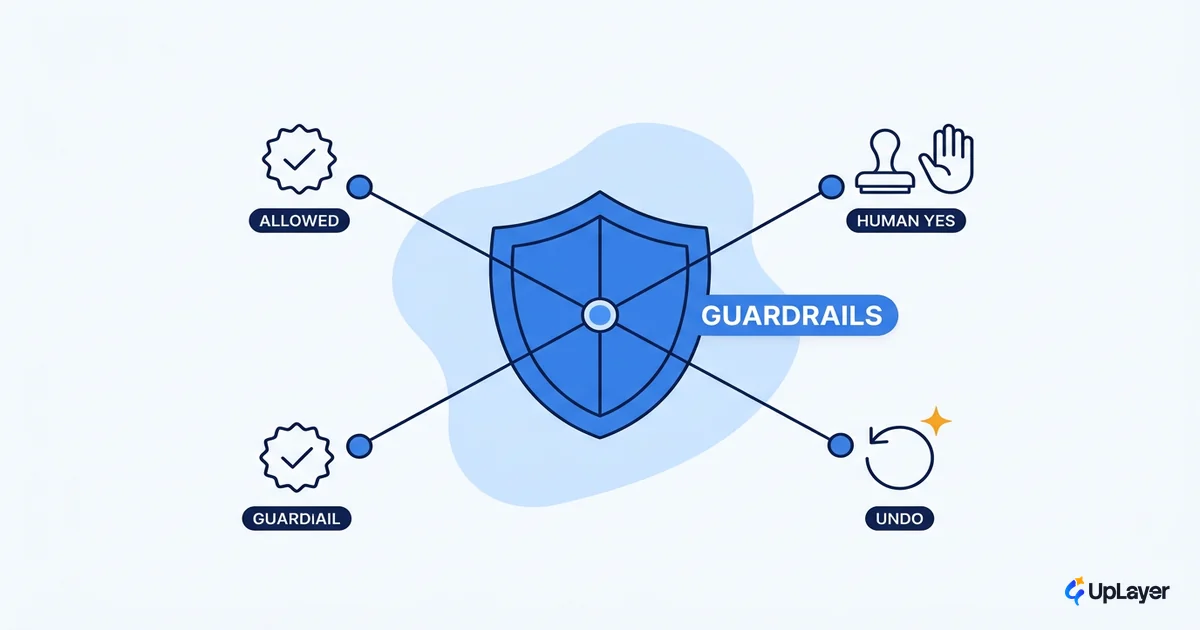
The copilot works in the demo. It answers cleanly, calls the right tool, and the room nods. Then it ships, and three weeks later it confidently issues a refund nobody approved, or overwrites a field on a customer's account, or sends an email to the wrong contact. The model was not broken. It did exactly what an agent is built to do: take an action. The problem was that nothing stood between the action and the customer.
That gap is what ai agent guardrails close. Guardrails are not a content filter you bolt on at the end. They are the set of rules that decide what your agent is allowed to touch, what needs a human to say yes first, and what you can quietly undo when it gets something wrong. The failure that loses trust is almost never a wrong answer. It is a wrong action on real data. This is the same decision that runs through designing an AI assistant your users trust: you scope by what the thing is allowed to do, not by how smart it sounds.
What ai agent guardrails actually are (and what they are not)
Guardrails are a scope-and-permissions surface. They define the blast radius of every action before the agent ever runs.
Most articles treat guardrails as a model-safety SDK: toxicity filters, jailbreak detection, PII redaction. Those matter, but they protect the conversation, not the customer's account. The damage in a B2B product comes from the agent acting on systems it can reach. The security community has a precise name for this. The root causes of an agent doing harm are excessive functionality, permissions, or autonomy, and the listed fixes are to minimize the tools it can call and minimize the permissions each tool holds. Read that as a product instruction, not a security one: the question is which actions the agent owns, and the default answer should be fewer than you assumed.
So guardrails are not:
- A filter that screens text for bad words.
- A one-time compliance review you pass and forget.
- Something the model vendor handles for you.
Guardrails are the permission model, the confirmation points, and the rollback path you design on purpose.
How do you set guardrails for an ai agent
Set them in three layers, in this order: permissions, confirmations, rollback. Each layer assumes the one before it failed.
- Permissions. What can the agent read, and what can it write? Start read-only. Grant write access one action class at a time, and only to the systems the job actually needs.
- Confirmations. Which actions require a human to approve before they execute? This is where you decide how much autonomy the agent gets, and it is a design choice rather than a fallback.
- Rollback. When an action does run and turns out wrong, can you undo it cleanly, and is there an audit trail showing what happened?
The sorting key for all three is the same: the reversibility of the action and the cost of being wrong. A suggestion costs nothing if it is wrong. A deleted record costs a support ticket and some trust. An irreversible financial action costs a customer. You tune the guardrail to the cost, which is the same autonomy-gradient logic behind deciding where an agent fits versus a copilot in the first place.
# pseudo-policy: guardrail by action class
read:*                      -> allow            # observe freely
suggest:*                   -> allow            # draft, never commit
write:reversible            -> allow + log      # auto-undo available
write:irreversible          -> require_human    # confirmation step
write:financial | delete:*  -> require_human + audit_trail
fallback                    -> deny             # default closed
The last line is the one teams skip. Default-deny means a tool the agent was never granted simply cannot fire, even if the model hallucinates a reason to call it.
Reliability guardrails versus safety theater
There is a difference between reliability guardrails that move a metric and filters that only demo well. Reliability guardrails reduce the rate of bad actions reaching a customer, which shows up as fewer support tickets and fewer disabled features. Safety theater is the dashboard of blocked toxic prompts that nobody was sending anyway.
The reason to invest in the real version is that the surrounding risk is growing, not shrinking. Stanford's researchers report that
AI-related incidents are rising sharply, yet standardized responsible-AI evaluations remain rare among major industrial model developers.
That line, from the 2025 AI Index Report, is the case for owning guardrails yourself. You cannot wait for the model vendor to make autonomy safe for your specific product and your specific customer data. The guardrail that earns its place is the one tied to a number you already watch: if it does not lower bad-action rate, support load, or churn risk, it is theater.
WARNING
Shipping an irreversible action with no confirmation step is the single most common way a copilot loses a customer. If the agent can delete, refund, or send on a user's behalf, a human yes belongs in front of it until the data says otherwise.
What stops an ai agent from doing harm: the human-in-the-loop line
What stops an ai agent from doing harm is a human-in-the-loop checkpoint placed exactly where the cost of a wrong action gets high. Not on every action, which trains users to click through blindly, and not on none, which is how the refund went out.
This is standard practice in well-built agents, not a sign of a weak model. Anthropic's own engineering guidance describes agents that pause for human feedback at checkpoints or when they hit a blocker, with explicit stopping conditions to keep the loop under control. The confirmation step is the feature, not an apology for the AI.
Place the human-in-the-loop line by asking three questions of each action:
- Can the user see what is about to happen before it happens?
- If it runs and is wrong, can it be reversed without a support ticket?
- Is there a record of who, or what, did it?
In a B2B setting those questions get sharper, because the wrong action touches another company's data. The discipline of reversible actions and audit trails in B2B is what separates an assistant teams keep enabled from one that gets switched off after the first incident.
How do you limit what an ai assistant can do in agentic ai saas
You limit what an ai assistant can do by mapping every action to an action class, then attaching a guardrail to the class rather than to the individual feature. This keeps ai assistant design honest as the surface grows: a new tool inherits the rule for its class instead of being waved through.
| Action class | Reversibility | Cost if wrong | Guardrail |
|---|---|---|---|
| Read / retrieve | n/a | None | Allow, scope to tenant |
| Suggest / draft | Full (nothing commits) | Low | Allow, user commits |
| Reversible write | Undoable | Medium | Allow, log + offer undo |
| Irreversible write | None | High | Require human approval |
| Financial / delete | None | Severe | Approval + audit trail, default deny |
In an agentic ai saas product the temptation is to grant the agent broad write access so it feels powerful in a demo. The durable version does the opposite: it scopes the agent to bounded jobs the product already does manually, which is the same filter for deciding which jobs actually justify autonomy. Most jobs sit in the top three rows. Very few belong in the bottom two without a person in the loop.
Guardrails that earn their place
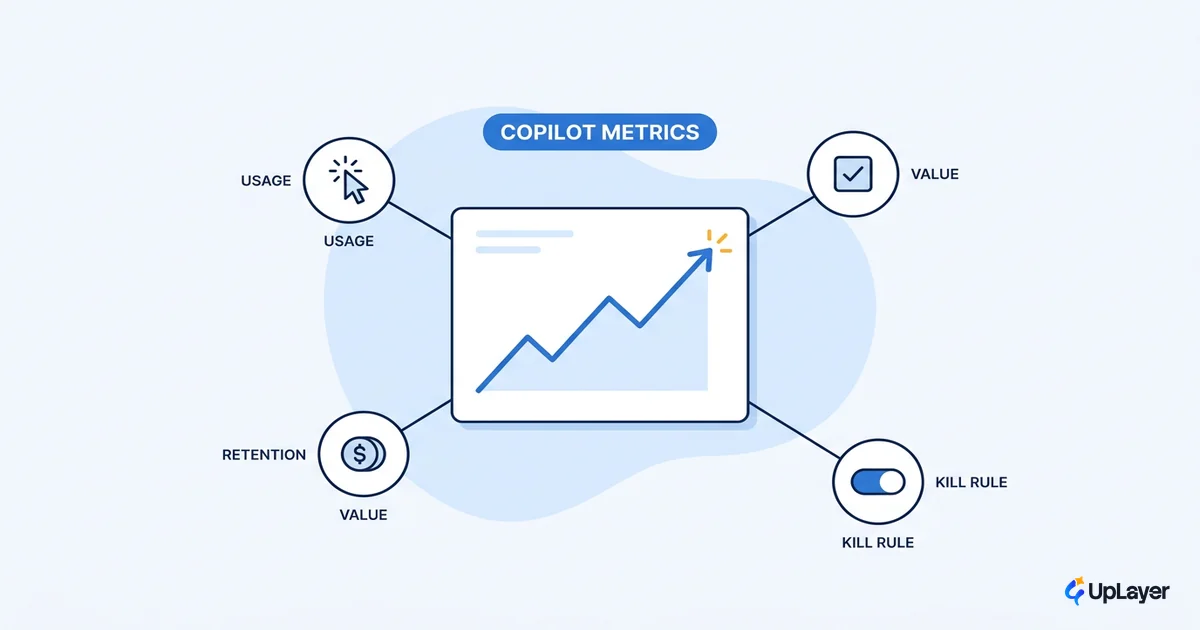
Guardrails are not a tax on shipping AI. They are how you ship autonomy without betting the product on it. Treated as a product investment, they pay back in the metric you already track: support tickets that never get opened, features that stay enabled, accounts that do not churn after a bad action. The discipline of measuring that payback, rather than declaring the system safe, is exactly the posture behind a structured process for managing AI risk, which frames risk as something you govern, measure, and manage over time, not certify once.
The teams that win the next year of agentic features will not be the ones that shipped the most autonomy. They will be the ones whose ai agent guardrails let them ship a little autonomy, prove it moved a number, and earn the right to ship a little more. Permissions, confirmations, and rollback are not the brakes on that. They are the steering.
TIP
Want to know which AI feature is worth building, and what guardrails it needs to ship safely? How the AX Audit works.