AI adoption strategies that move a metric
A short, opinionated menu of AI adoption strategies, each mapped to a metric you already track, with clear notes on when to use each play and when to skip it.
 Shahriar P. ShuvoAI Adoption & Trust8 min read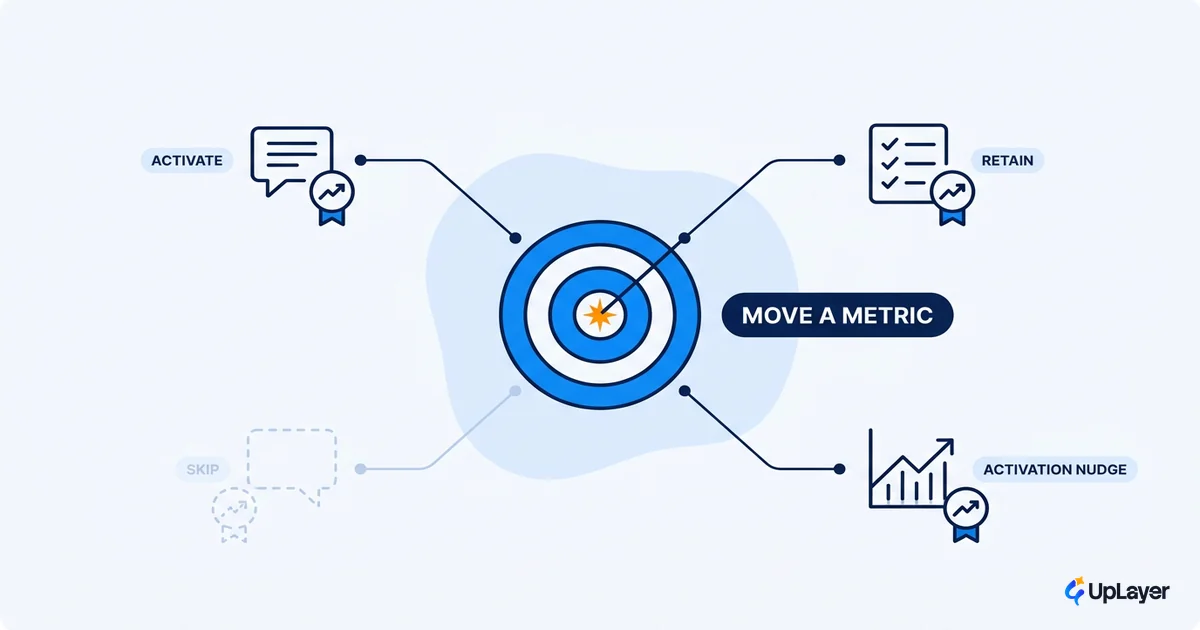
Most AI adoption strategies are employee-rollout decks in disguise. Run a training, send the announcement, watch the usage chart tick up, declare adoption. The chart moves. The business does not.
You ship AI inside a product, to paying users who can leave. That is a different problem. The AI adoption strategies that matter for you are the ones that get a feature used enough, and trusted enough, to bend a number you already report to your board: activation, retention, conversion, or expansion. Everything else is motion. We treat adoption as a throughline you earn over time, not a launch event, which we cover in depth in how to increase AI adoption in your product.
This is a menu, not a manifesto. Below are the plays worth choosing among, each tied to a metric, with an honest note on when to skip it.
Why most AI adoption strategies move nothing
The category problem is simple. Adoption advice optimizes for usage, and usage is not value. A feature can be opened daily and still change nothing you care about.
The data backs this up. In Stanford HAI's index, organizations are starting to see financial impact from AI, but it is thin: among those reporting gains, the most common revenue gain from AI sits below 5%, and most cost savings land under 10%. Usage climbed faster than value did.
Of organizations reporting revenue gains from AI in a business function, the most common increase is less than 5%. Cost savings most often come in under 10%. Adoption rose; impact stayed small. (Stanford HAI, 2025 AI Index Report)
Meanwhile the raw adoption numbers keep going up. By the US Federal Reserve's count, about 18 percent of US firms had adopted AI by the end of 2025, with work-related generative AI use near 41 percent of the workforce. Plenty of adoption. Far less proof that any of it paid.
So here is the test every play on this list has to pass. A real adoption strategy ties to a metric you already track, projects the move before you build, and gets killed if it only moves a vanity number like "AI engagement." Driving AI adoption is not the goal. Driving a metric through AI adoption is.
What are the best AI adoption strategies (the short list)
The best plays are the few you can attach to a number, run on one feature, and measure. There is no universal winner. There is the right play for your metric and your trust ceiling.
Here is the menu. Each row is a play, the metric it tends to move, when to reach for it, and when to leave it alone.
| Play | Metric it moves | Use it when | Skip it when |
|---|---|---|---|
| Reliability-first (ship guardrails before features) | Retention, trust | Users have been burned by a flaky AI feature | The feature is low-stakes and errors are cheap |
| Narrow wedge (one job, done well) | Activation | A broad assistant is going unused | The job is too small to matter to anyone |
| In-context surfacing (the AI meets the user mid-task) | Activation, conversion | Adoption stalls because nobody finds the feature | Discovery is already fine and trust is the blocker |
| Trust signals (sources, confidence, easy undo) | Retention, expansion | Output is correct but users still hesitate | Users do not yet trust the output at all |
| Human-in-the-loop (AI drafts, person approves) | Retention, expansion | A wrong action would damage a customer relationship | Stakes are low and the loop just adds friction |
| Measured rollout (cohort, baseline, compare) | Whichever you chose | You need proof the feature, not the season, moved the number | You have no baseline to compare against yet |
A few of these are tempting and wrong for most teams. A broad, do-everything assistant feels like the ambitious play and usually goes unused. Start narrow. One job your users already do, made faster and more reliable, beats a copilot that promises everything and earns trust on nothing.
What strategy drives AI feature adoption for your metric
Adoption follows the metric, so pick the play by the number you are trying to move, not by what demos best. Supportive AI earns its place by helping a user finish a job they already had, which is why the play that fits the metric almost always wins over the play that looks impressive.
Here is the decision logic as a simple rule set.
# Pick the adoption play by the metric, not the demo
metric = your_primary_number   # activation | retention | conversion | expansion

if metric == "activation":
    play = "narrow wedge + in-context surfacing"
    # get one valuable job done inside the first session

elif metric == "retention":
    play = "reliability-first + trust signals"
    # users stay when the feature is dependable, not flashy

elif metric == "conversion":
    play = "in-context surfacing at the decision point"
    # the AI shows up where the user is choosing

elif metric == "expansion":
    play = "human-in-the-loop + trust signals"
    # higher-stakes value the buyer will pay more for

always:
    baseline_first()        # no baseline, no proof
    rollout = "measured cohort"
    kill_if(moves_only_vanity_metric)
The pattern holds across these. Activation strategies win by getting one useful job done early. Retention strategies win on dependability. The fastest way to pick the right play is to name the metric out loud first, then map it. For which numbers are worth tracking in the first place, see the AI adoption metrics worth tracking.
Reliability and trust are the strategy, not the garnish
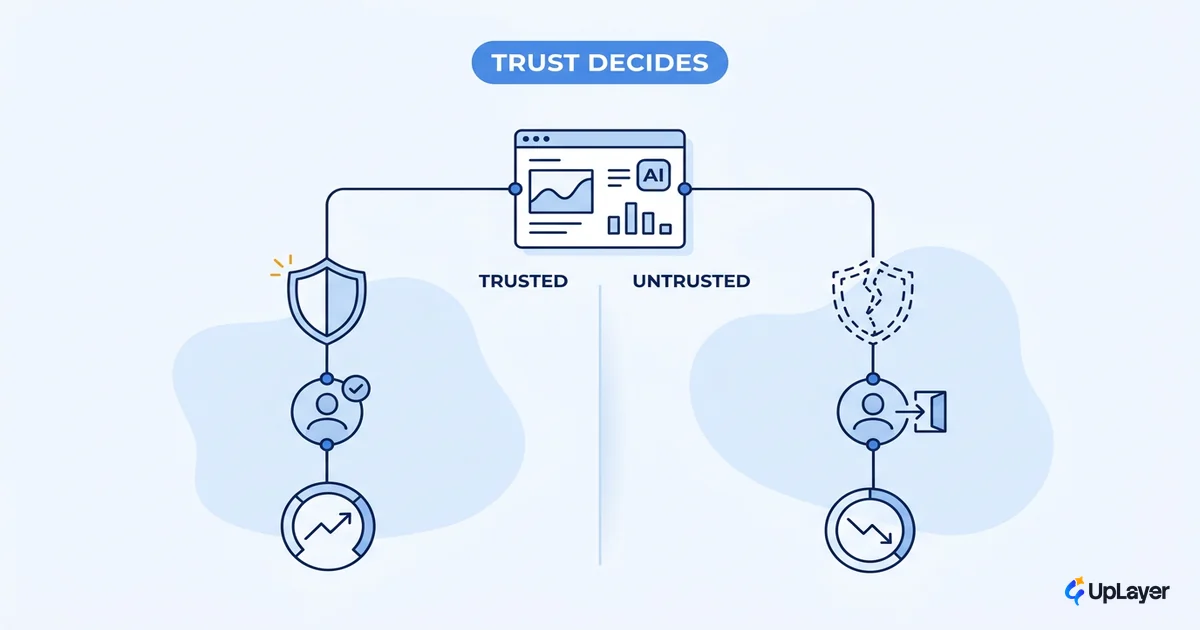
Adoption is downstream of trust, and trust is lower than most teams assume. Pew Research found just 11% of the public is more excited than concerned about AI in daily life, against 47% of AI experts. Your users arrive skeptical. A feature that is wrong once, visibly, can lose them for good.
That is why reliability is not a polish step you add at the end. NIST's risk framework puts it plainly: valid and reliable is the base condition for trustworthy AI, the foundation every other property (safe, secure, explainable, fair) sits on top of. Get the base wrong and no amount of onboarding rescues the rollout.
WARNING
Shipping an AI feature before its guardrails is the fastest way to kill adoption. The first hallucination a user sees resets their trust to zero, and a measured rollout will show you the damage in the retention curve, not the launch metrics. Build the reliability layer first.
There is a gap here that works against you. Organizations name the risks (inaccuracy, compliance, security) far more readily than they mitigate them. Knowing the risk is not managing it. The teams that win adoption close that gap with reliability guardrails and human-in-the-loop checks where a wrong action would cost a customer. We go deeper on earning that confidence in how to build user trust in AI features.
How do you create an AI adoption strategy from this menu
Turning the menu into a plan is short work, and short is the point. You are choosing one play for one metric, not writing a manifesto.
- Baseline the metric. Measure activation, retention, conversion, or expansion today. No baseline, no proof later.
- Pick one play. Use the metric-to-play map above. One feature, one number.
- Project the move. State the expected lift and the assumptions behind it, in writing, before you build.
- Ship the smallest reliable version. Guardrails first. Narrow scope. In-context placement.
- Roll out measured. Use a cohort against your baseline so you can tell the feature moved the number, not the calendar.
- Keep or kill. If it moved the metric, expand it. If it only moved a vanity number, cut it without sentiment.
That is the difference between this post and the document-level work. This is the survey of plays you choose among. Authoring the full plan, with the narrative and the stakeholder sign-off, is its own task, and we cover it in how to write an AI adoption strategy. Read the menu here, then write the document there.
The best AI adoption strategies are not the longest lists. They are the two or three plays you can tie to a number you already report, plus the discipline to skip the rest. Pick the play that moves your metric, ship it reliably, prove the move, and let that one win earn the next one. That is an AI adoption strategy worth running.
TIP
Not sure which adoption play moves your metric, or whether the feature is worth building at all? How the AX Audit works. We rank your AI opportunities by projected impact on a number you already track, and tell you which ones to skip.