How to build user trust in AI features
Building trust in AI is an interface problem, not a model problem. Three concrete moves that make an AI feature feel safe to rely on, tied to a metric you track.
 Anamoul RoufAI Adoption & Trust7 min read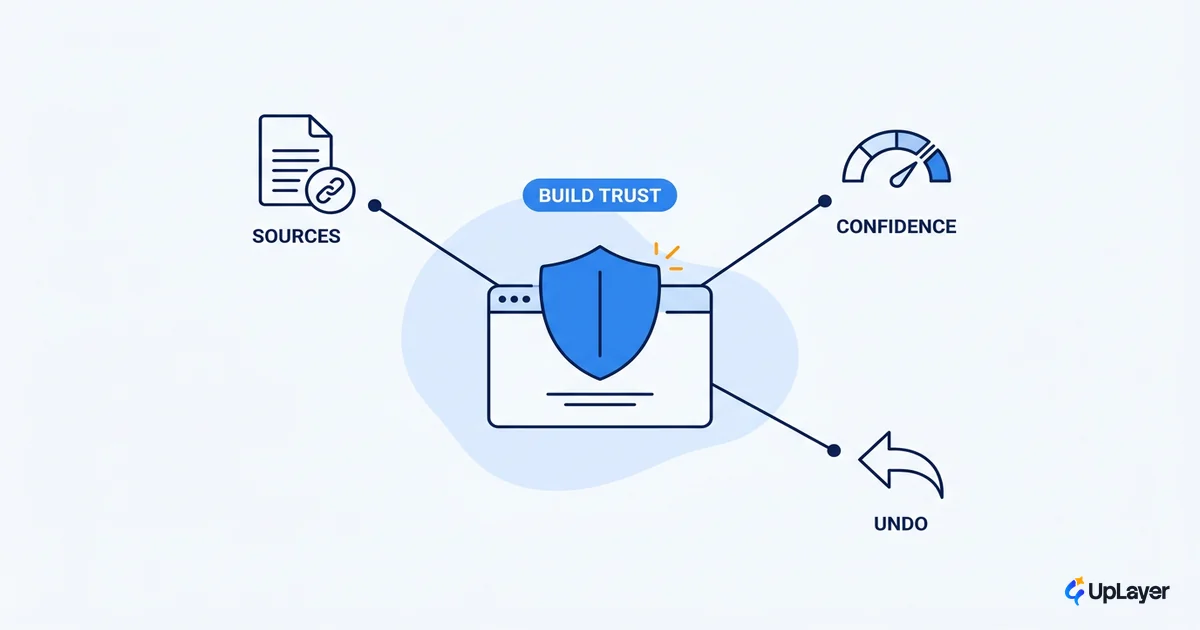
The AI feature shipped. The demo landed. And users still route around it. They skim the suggestion, ignore the summary, and go do the thing by hand the way they always have. That gap between "we built it" and "people rely on it" is a trust problem, and building trust in AI is the work that closes it.
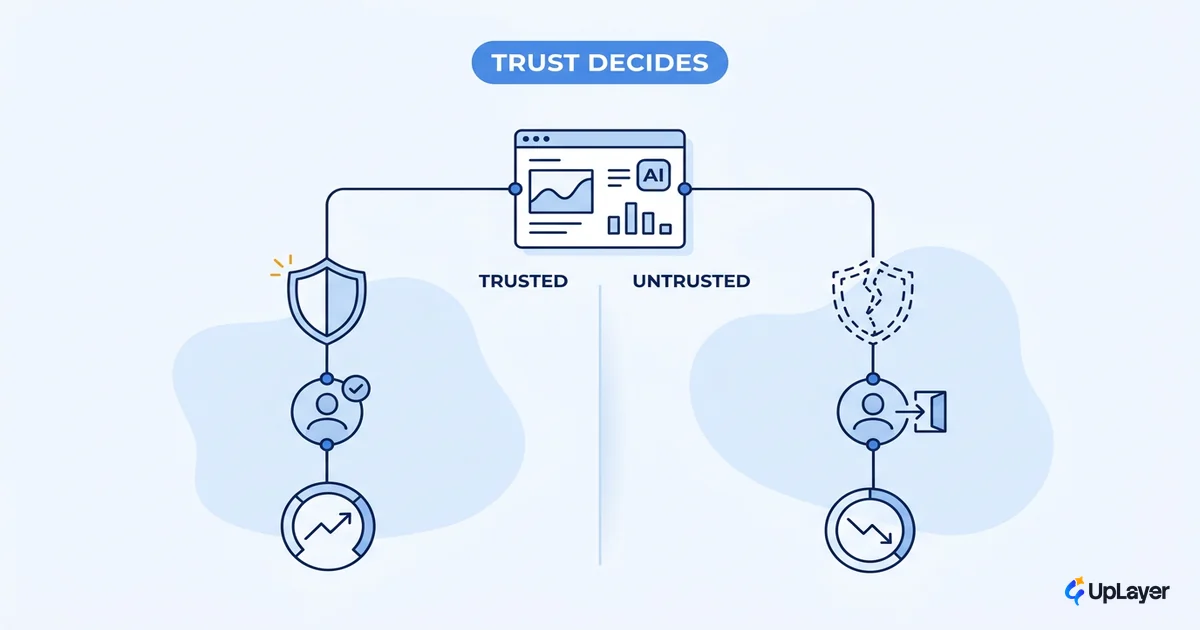
Here is the contrarian part. You do not earn that trust by making the model better. You earn it by changing what the interface shows and what it lets the user do. A trustworthy feature and an untrustworthy one can sit on the exact same model. The difference is design. This is the same lens behind increasing adoption of an AI feature: adoption and trust move together, and both come from product decisions you control.
This piece covers why users withhold trust, why the goal is calibrated trust rather than maximum trust, the three moves that make a feature feel safe to rely on, and how to tie all of it to a number you already track.
Why users don't trust your AI feature
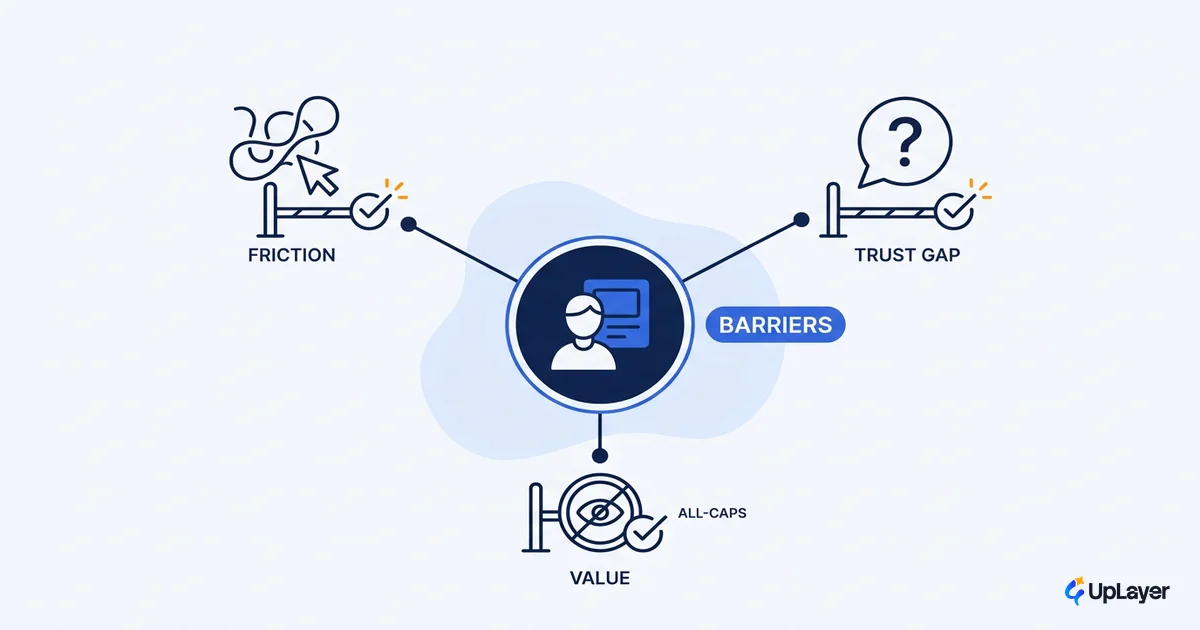
Distrust is the default, and it is rational. Most users do not trust the companies shipping AI, let alone the features. In Pew Research's 2025 study, most users do not trust the companies shipping it: 59% of the public have little or no confidence in U.S. companies to develop and use AI responsibly, and the public is more likely to think AI will harm them (43%) than benefit them (24%). The same posture shows up globally. A study of more than 48,000 people across 47 countries found that adoption is rising but trust remains the critical challenge.
Your users carry that baseline into your product. They have seen a confident chatbot invent a refund policy and a summary quietly drop the one line that mattered. So when your feature produces an output, the honest user reaction is not "great," it is "is this right, and how would I even check?"
Ai user trust is not a feeling you persuade people into. It is a track record they build by watching the feature behave. Your job is to make that track record easy to observe and cheap to verify.
Building trust in AI means calibration, not maximization
The goal is not maximum trust. It is calibrated trust: the user relies on the feature when the model is right and checks it when the model is wrong.
This matters because over-trust is as expensive as under-trust. A user who blindly accepts every output will ship the one hallucination that costs a customer. A user who distrusts everything gets no value and churns. Both are failures. Trustworthy AI aims for the middle: confidence that tracks reality, which comes down to a handful of product decisions rather than an ethics statement.
That middle is hard precisely because skepticism is the resting state. For years the default posture toward AI is caution, not enthusiasm, with far more people concerned than excited about it in daily life. You are not building trust from neutral. You are building it from a deficit, which means every output is either a small deposit or a withdrawal.
So stop trying to make users trust the feature more. Make the feature easier to trust correctly. The three moves below do exactly that.
The three moves that make an AI feature trustworthy
A trustworthy AI feature shows its work, states its confidence in plain terms, and lets the user correct it. Those three moves do most of the work, and none of them require a better model. The models keep getting cheaper and more capable every year, as Stanford's the models keep getting cheaper and more capable AI Index documents, yet trust has not kept pace. That gap is the interface, not the model.
| Move | What it means | What it replaces |
|---|---|---|
| Show the work | Surface the source, row, or signals the output came from | A black box that says "trust me" |
| State confidence honestly | Translate certainty into an action: ready, draft, or withheld | A bare percentage, or false confidence |
| Let users correct | One-click edit, reject, or undo on every output | A dead-end output the user can't fix |
Show the work. Surface what the output is based on. For a generated answer, that means inline citations to the source document, row, or ticket the model used. For a classification or score, it means the top signals that drove the result. Ai transparency is not a disclaimer at the bottom of the screen. It is the user being able to trace any single output back to its inputs in one click. When verification is fast, it stops being friction and becomes a trust deposit.
State confidence honestly, and in context. A bare "37% confidence" tells a user nothing. Translate the number into an action. A high-confidence result is presented as ready to use. A low-confidence result is presented as a draft that needs a human look. A result the model cannot ground is withheld rather than guessed. The discipline to stop the model from guessing when it can't ground an answer builds more trust than a confident wrong answer ever will.
Let users correct the model. Every output needs a fast, obvious path to edit, reject, or undo. Give it a human-in-the-loop path to correct it and two things happen. The user feels in control, which lowers the stakes of trying the feature at all. And every correction becomes a signal you can learn from. A feature the user can fix is a feature the user will use.
Here is the part most teams skip. The confidence-to-action mapping should be explicit, not vibes:
confidence_to_action:
  high:   render result, ready to use, one-click accept
  medium: render result, labeled "draft, review before use"
  low:    render result, labeled "low confidence, check sources"
  ungrounded:
          withhold result, offer 2-4 scoped options instead
          # a silent wrong guess is the most expensive output you can ship
WARNING
A confident wrong answer destroys more trust than withholding ever could. When the model can't ground an output, the honest move is to say so and offer scoped choices, not to guess and hope. One silent mistake can cost weeks of earned trust.
How do you earn user trust in an AI feature over time
Trust is an account, not a switch. You earn it in deposits and lose it in withdrawals, and the balance is what decides whether users rely on the feature next week.
Three things keep the balance positive. Consistency: the feature behaves the same way today as it did yesterday, so users can form a reliable mental model. Graceful failure: when the model is unsure, the feature says so instead of bluffing, which turns a potential withdrawal into a small deposit. No silent changes: when you swap a model or tune a prompt, the behavior users depend on should not shift underneath them without warning.
What makes an AI feature feel trustworthy over time is not a single brilliant output. It is the absence of nasty surprises. A feature that is right 85% of the time and honest about the other 15% earns more user trust in ai features than one that is right 95% of the time and hides its misses, because the second one teaches users they cannot tell which outputs to check.
Tie trust to a metric you already track
Trust is not a vibe you report on. It shows up in numbers you already watch.
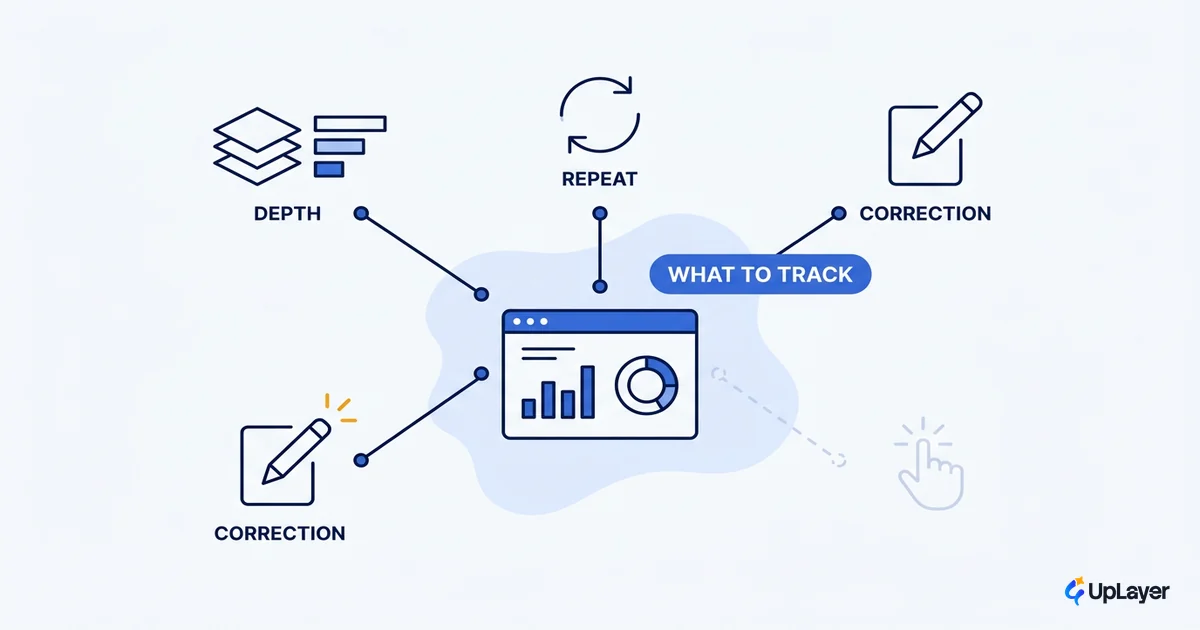
Distrust looks like low feature activation, ignored suggestions, abandoned AI flows, and quiet churn around the feature. So pick one of those metrics, ship one trust move, and measure the delta. That is the whole method, and it is the same ROI discipline as everything else: tie it to a number you already track, then prove the move paid off. Trust is the first gate in the wider AI adoption framework, so closing it is also how you unlock the usefulness and habit stages that follow.
| Distrust signal | Metric it lives in | Trust move to test |
|---|---|---|
| Users ignore AI suggestions | Suggestion acceptance rate | Add inline citations (show the work) |
| Users abandon the AI flow | Feature activation / completion | Add confidence labels and withholding |
| Users undo AI actions a lot | Undo / revert rate | Add a clear correct-and-confirm step |
| Users avoid the feature entirely | Feature retention (week 2+) | Ship graceful failure, kill silent guesses |
NOTE
In a Concept Demo, we instrument the feature before the trust work and after. Designed to move suggestion acceptance and week-2 retention, the projected delta from adding grounding and honest confidence labels is the number we report. Projected, not promised, until it ships and the data lands.
The point of measuring is honesty. If a trust move does not move the metric, it was theater, and you cut it. If it does, you have a number that justifies the next one.
Building trust in AI is not a governance slide or a one-time campaign. It is a set of interface decisions you make on every output, then verify against a metric you already track. Show the work, tell the truth about confidence, and let users fix what the model gets wrong. Do that consistently and trust stops being the thing blocking adoption and starts being the thing driving it.
TIP
Want to know which trust move will move a real metric in your product, before you build it? How the AX Audit works.