Preventing AI hallucinations in production features
Preventing AI hallucinations in production takes grounding, retrieval, constrained outputs, and human checkpoints. The build patterns that keep features honest.
 Shahriar P. ShuvoAI Adoption & Trust8 min read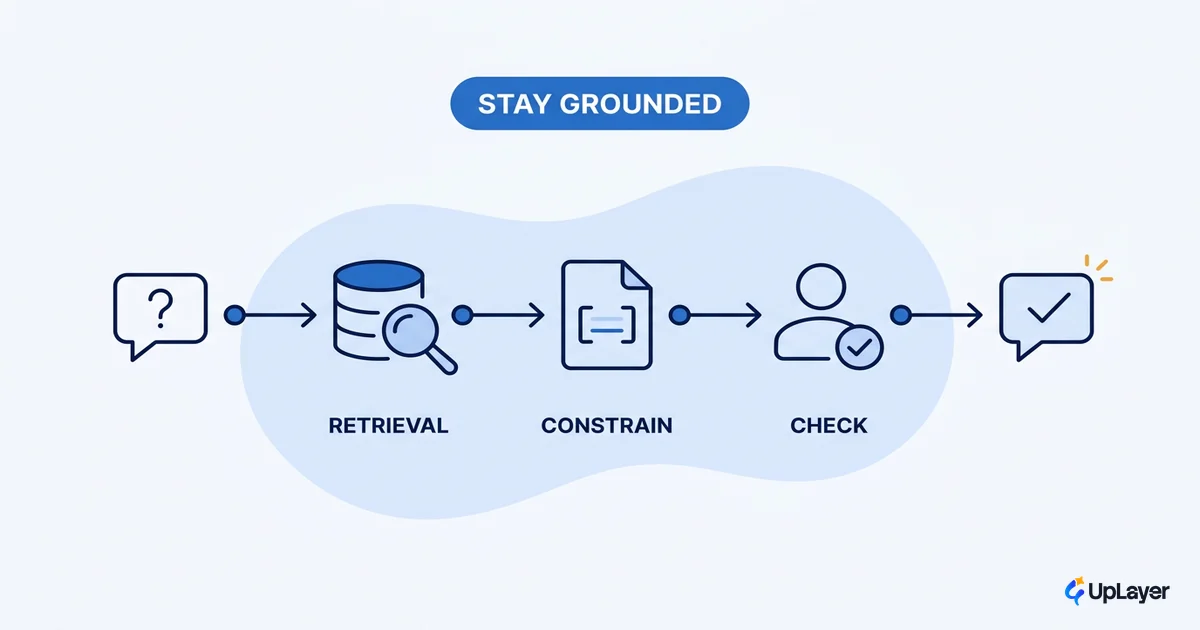
A hallucination is not a rare edge case you patch later. It is the default behavior of a language model that has run out of grounded context and keeps generating anyway. The model does not know it is wrong, which is exactly why preventing AI hallucinations has to be a property of the feature you ship, not a disclaimer you bolt on after launch.
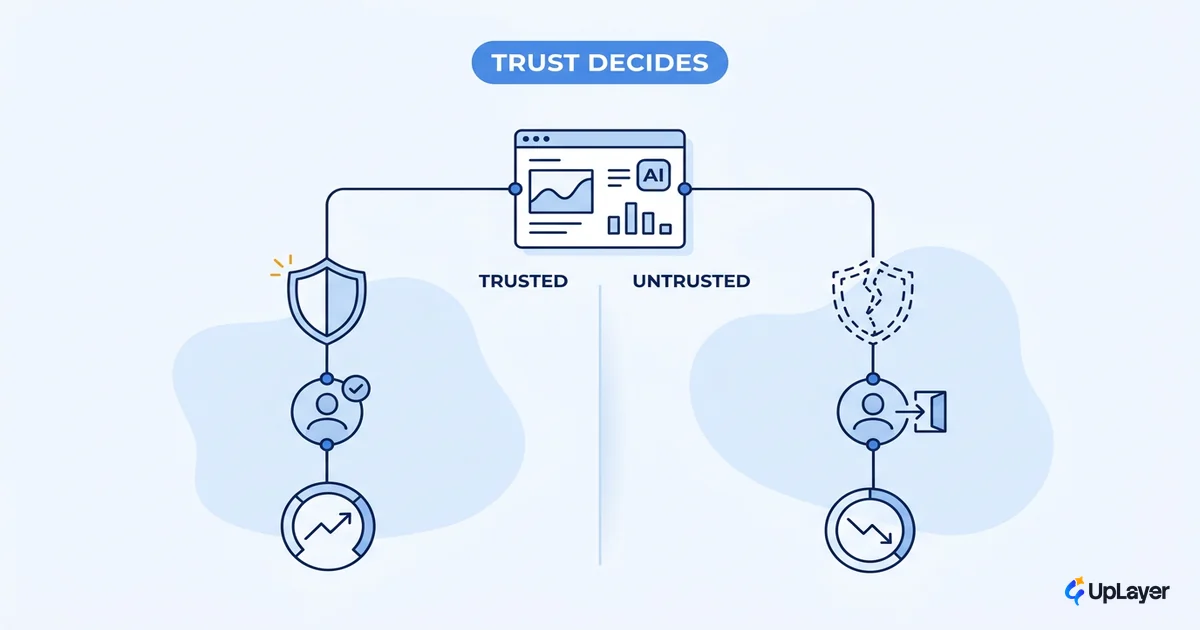
The cost is rarely the wrong answer itself. It is the second wrong answer. The first time your AI feature confidently invents something in front of a paying user, that user stops trusting the feature, then stops using it, then tells their team not to rely on it. That shows up on your dashboard as flat activation and quiet churn on exactly the accounts that tried the new thing. Reliability here is not a virtue. It is an adoption lever, and it is one of the clearest paths to increasing AI adoption in your SaaS product.
This is the build-level version of the problem. We cover four patterns that actually move the hallucination rate in a shipped feature: grounding answers in real data, retrieval the model cannot skip, constrained outputs that fail loud instead of guessing, and human checkpoints placed where a wrong answer costs the most. None of them require a better model.
Why preventing AI hallucinations is an adoption problem, not a model problem
Most teams treat hallucination as something the next model version will fix. It will not, because the failure is structural. A language model predicts plausible tokens, and plausible is not the same as true. When the prompt lacks the fact, the model fills the gap with something that reads correctly and is invented. For the full mechanism behind that, our explainer on what an AI hallucination is and why it happens covers why models fabricate at all.
The reason this matters to a Head of Product is reach. Fabrications do not stay in a sandbox. A public database now tracks more than 1,300 court filings tripped up by AI-invented citations, lawyers sanctioned for trusting output they never checked. Your production feature is one ungrounded answer away from the same class of failure, just with a customer instead of a judge on the other end.
So the goal of preventing AI hallucinations is not a perfect model. It is a feature whose failure modes are visible, bounded, and recoverable, so trust survives the inevitable miss. The four patterns below are ordered by how much reliability they buy per unit of engineering effort.
How do you stop an AI feature from making things up?
You stop an AI feature from making things up by removing its incentive to guess. That means three moves in order: give it the facts (grounding), force it to use them (retrieval it cannot skip), and make "I don't know" a valid, structured output (constrained generation plus a confidence gate). A model that is allowed to abstain hallucinates far less than one that must always answer.
The rate is real and measurable. Vectara keeps a hallucination rate measured model by model on a public leaderboard, scored on the narrow task of summarizing a document the model was handed. Even there, on text the model can see, the best systems are not at zero. Push them onto your messier production data and you live closer to the hard end of that distribution than the easy one.
Here is the practical hierarchy, ranked by reliability gained against build cost.
| Technique | What it does | Reliability gain | Build cost | Best for |
|---|---|---|---|---|
| Grounding / retrieval (RAG) | Injects real source documents into the prompt so the model answers from facts, not memory | High | Medium | Any feature answering from your own data |
| Constrained outputs | Forces structured responses (JSON, enums, schema) so the model cannot free-form a wrong claim | Medium to high | Low to medium | Extraction, classification, form-filling |
| Confidence gating / abstention | Lets the feature say "not enough information" instead of guessing | High on trust, medium on coverage | Low | High-stakes answers users act on |
| Human-in-the-loop checkpoint | Routes low-confidence or high-impact outputs to a person before they ship | Highest on trust | Medium (UX + ops) | Irreversible or compliance-bound actions |
| Citations / source links | Shows the user where each claim came from, so a wrong answer is catchable | Medium (catches, does not prevent) | Low | Anything users need to verify |
Grounding sits at the top for a reason. It is the single largest lever most teams have not pulled correctly, so it gets its own section.
Grounding AI responses: the highest-leverage guardrail
Grounding AI responses means the model answers from documents you supply at request time, not from its training weights. Retrieval-augmented generation (RAG) is the mechanism: fetch the relevant passages from your own knowledge base, put them in the prompt, and instruct the model to answer only from that context. This is the most reliable way to reduce LLM hallucinations in a feature that answers from your own data.
The effect is well established. The original retrieval-augmented generation research found that RAG models generate more specific, diverse, and factual language than a model answering from parametric memory alone. Grounded context beats recalled context, and that gap is your reliability budget.
Done wrong, though, RAG creates a false sense of safety.
WARNING
RAG is not a panacea. Stanford HAI tested purpose-built legal AI tools and found they still hallucinated more than 17% of the time, and one crossed 34%, because the retriever surfaced the wrong passage and the model trusted it anyway. If your chunking is poor or the model is allowed to fill in when retrieval returns nothing, you have moved the hallucination, not removed it.
Three rules keep grounding honest:
- Make the model cite the retrieved passage for every claim, so an ungrounded sentence is visibly missing a source.
- Return "no answer" when retrieval confidence is below threshold, instead of answering from parametric memory.
- Test retrieval and generation separately, because a feature can have a perfect model and a broken retriever, and the user only sees the combined failure.
How to reduce hallucinations in a production LLM feature with constrained outputs
You reduce hallucinations in a production LLM feature by narrowing what the model is allowed to say. A free-text answer has infinite room to invent. A constrained output (a JSON schema, an enum, a typed field, a value that has to appear in the retrieved source) has almost none. If the model must return one of five categories, it cannot invent a sixth. If it must extract a date that exists in the document, it cannot manufacture one that does not.
This pairs with confidence gating, and the pairing is the point. Most hallucinations are high-confidence by construction, so raw model probability is a weak signal on its own. Better gates combine signals and then abstain when they fail.
# Confidence gate (pseudo-config): fail loud, not silently wrong
answer = model(query, context=retrieved_passages)

gate:
  retrieval_score   >= 0.75      # did we actually find relevant source?
  schema_valid      == true      # does the output match the required shape?
  cites_source      == true      # is every claim tied to a passage?
  second_model_agree == true     # cheap verifier confirms (optional)

if all(gate):  return answer
else:          return abstain("I couldn't find that in your data")
A feature that says "I couldn't find that in your data" keeps trust. A feature that guesses loses it. Making that abstention feel like competence rather than failure is a design problem as much as an engineering one, which is the core of designing for AI uncertainty without losing trust.
Where to place a human-in-the-loop checkpoint
A human-in-the-loop checkpoint routes outputs to a person before they reach the user or trigger an action. It is the most reliable of the AI reliability guardrails and the most expensive, so the skill in how to prevent AI hallucinations here is placing it precisely, not everywhere.
The rule is impact-weighted. Insert a human checkpoint where a wrong answer is irreversible, costly, or compliance-bound, and let everything else flow through the automated gates above. A summarized support thread can ship unreviewed because a miss is cheap and the user can correct it. A generated contract clause, a financial figure, or an action that moves money should pass a person, because a confident error there is unrecoverable.
This is not a permanent tax. Full autonomy is still a multi-year horizon. Gartner doesn't expect agents to autonomously resolve even 80% of routine cases until 2029, so today a human in the loop is the responsible default, not a limitation. You remove checkpoints as confidence data accumulates, rather than starting without them. For the design detail, see our guide to human-in-the-loop AI design.
| Feature type | Wrong-answer cost | Recommended checkpoint |
|---|---|---|
| Internal summary / draft | Low, easily corrected | Automated gates only; user edits |
| Customer-facing answer | Medium, trust erosion | Citations plus abstention; spot-review |
| Financial / legal / medical claim | High, possibly irreversible | Mandatory human review before send |
| Action that changes state (refund, deploy) | High, hard to undo | Human approval, then log for audit |
Tie the guardrails to a metric you already track
The mistake that kills reliability work is treating it as an engineering chore with no business owner. The patterns above should map to a number a founder already watches.
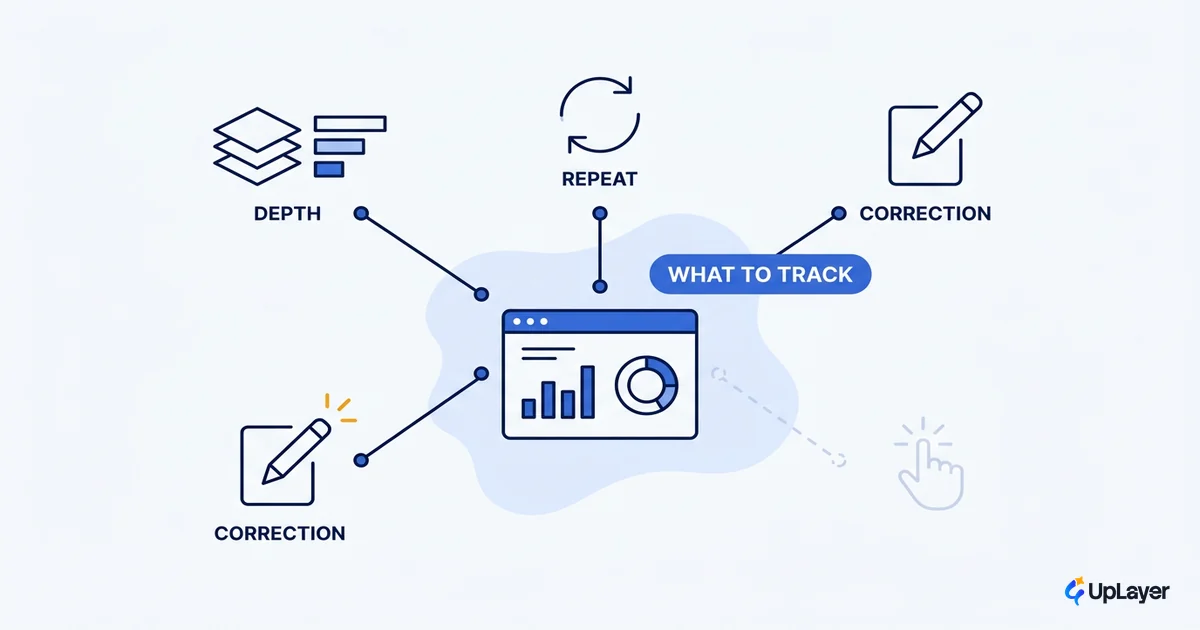
The chain is direct: grounding and gating reduce wrong answers, fewer wrong answers protect trust, and protected trust shows up as sustained activation and retention on AI-touched accounts. So instrument it. Track the feature's abstention rate, the share of answers carrying a citation, the human-override rate at each checkpoint, and the activation and retention of accounts that used the feature versus those that did not. When reliability improves, those curves move, and you have an ROI story instead of a vibe. The full method for attaching a feature to a dollar figure is in how to measure the ROI of an AI feature.
In a Concept Demo, we design the gate and the dashboard together: every abstention and override is logged against the metric it protects, so reliability is projected to move activation, not just reduce error counts.
What techniques prevent AI hallucinations
The techniques that prevent AI hallucinations, in order of leverage, are: ground every answer in retrieved source data, force the model to cite that source, constrain the output to a validated structure, gate low-confidence answers into an honest abstention, and route high-impact outputs through a human before they ship. All of them are decisions you make at build time, not capabilities you wait on a model vendor to deliver.
The reframe that matters is this: a hallucination is not a bug to be eliminated, it is a failure mode to be bounded. Models will keep generating plausible-but-false text when context runs out, because that is what they do. The work of preventing AI hallucinations is making sure that when they do, the wrong answer is caught, labeled, or stopped before a paying user acts on it. That is what keeps the trust curve, and the retention curve, intact.
TIP
Shipping an AI feature and unsure whether your reliability guardrails sit where they actually protect adoption and revenue? How the AX Audit works. We find AI worth at least 3x the fee, or it is free.