What is an AI hallucination and why it happens
An AI hallucination is when a model states something false with confidence. Here is why it happens and how to size the risk for your SaaS product.
 Anamoul RoufAI Adoption & Trust7 min read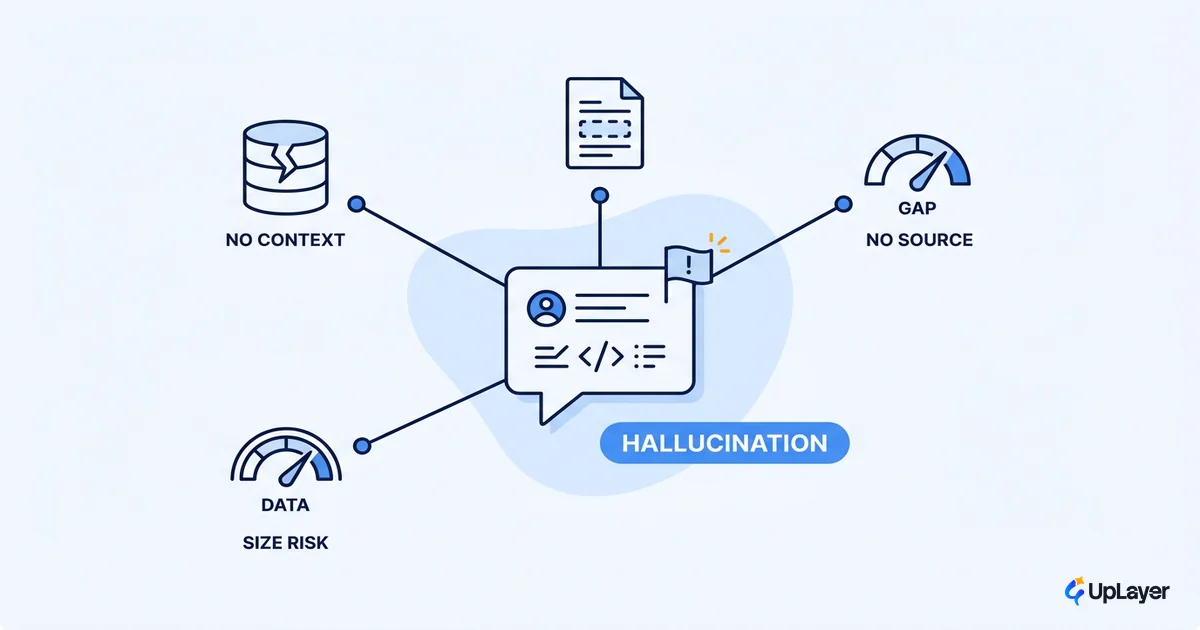
The fear is specific. You ship an AI feature, a user asks it a reasonable question, and it answers with total confidence. The answer is wrong. The user believes it, acts on it, and now your product has quietly cost them something. That failure has a name: an AI hallucination, a moment where the model states something false as if it were fact.
Most coverage treats this as a model defect you either tolerate or wait for vendors to fix. We think that framing is backwards. A hallucination is a reliability problem you design around, not a flaw you have to accept. The model's error rate is never going to hit zero, but where that error reaches a user, and what sits between the two, is a product decision you own.
This piece defines the thing plainly, explains why it happens, and gives you a way to size the risk against a metric you already track.
What is an AI hallucination, in plain terms
An AI hallucination is output that is plausible, confident, and false. The model is not lying, because lying implies it knows the truth and chooses otherwise. It is generating the most statistically likely next words, and sometimes the most likely words are not the true ones.
IBM's working definition is that the model "perceives patterns or objects that are nonexistent", producing output that is nonsensical or inaccurate. The dangerous part is not that the answer is wrong. Software has always produced wrong answers. The dangerous part is the confidence. A hallucination arrives in the same calm, fluent tone as a correct answer, so a user has no native signal to distrust it.
That confidence is exactly why hallucinations erode trust faster than ordinary bugs, and trust is the metric underneath adoption. If you want the broader picture of how trust drives usage, start with our guide on how to increase AI adoption in your SaaS product. For now, hold one distinction: there is a difference between an AI that is sometimes wrong and an AI that is confidently wrong. The second one is the reliability risk.
Why does AI make things up
Hallucination is not a glitch bolted onto an otherwise truthful machine. It falls out of how these models are built.
A large language model predicts the next token. During training it learns to produce fluent, likely text, not verified text. So when it hits a question where the likely answer and the true answer diverge, fluency wins. OpenAI's research puts it directly: hallucinations are "plausible but false statements", and models produce them because standard training and evaluation reward guessing over admitting uncertainty. A model that says "I don't know" scores worse on the benchmarks than one that guesses and is sometimes right, so the training process quietly teaches it to guess.
Like students facing hard exam questions, large language models sometimes guess when uncertain, producing plausible yet incorrect statements instead of admitting uncertainty. Kalai et al., Why Language Models Hallucinate
The same paper argues hallucinations "originate simply as errors in binary classification" and arise from natural statistical pressure in the training pipeline. The useful takeaway for a product team is this: this is structural, not a bug awaiting a patch. You are not waiting for a model release that ends hallucination. You are designing a product that stays reliable while the model occasionally gets it wrong.
What causes an AI to hallucinate, by source
The causes cluster into a few sources, and each one maps to a lever you control at the product layer.
| Source | What goes wrong | The design lever you own |
|---|---|---|
| Training data | Gaps, bias, or stale facts in what the model learned | Ground answers in your own current data instead of model memory |
| Model behavior | Overfitting, high complexity, next-token guessing under uncertainty | Constrain scope; ask for sources; prefer extract-and-cite over free generation |
| Prompt & retrieval | Vague prompts, missing context, weak retrieval | Tighten prompts; retrieve the right documents before the model answers |
| Evaluation | No measurement, so you never see the rate | Track a hallucination rate before and after each change |
IBM attributes much of the model-behavior column to overfitting, training-data bias, and high model complexity. Notice that three of the four levers live in your product, not in the model weights. That is the whole point.
AI hallucination examples that cost real money
The clearest LLM hallucination example on record is legal. Two lawyers used ChatGPT for case research, and it invented six nonexistent cases that they filed in court. The model produced fake names, fake citations, and fake quotes, all in convincing legal prose. A judge fined the lawyers and their firm $5,000 and the story became a cautionary headline.
A US judge fined two lawyers and a law firm $5,000 after fake citations generated by ChatGPT were submitted in a court filing. The chatbot had invented six cases in a brief against the airline Avianca.
The dollar fine is the small cost. The real cost is the trust collapse: every future output from that tool now gets second-guessed. In a SaaS product, that shows up as users quietly abandoning the feature, then doubting the product around it.
Hallucination is also measurable, and it varies sharply by model. Vectara's leaderboard scores how often models introduce unsupported claims when summarizing a source document, and the spread between the best and worst is wide enough to matter for a buying decision. That measurability is good news. Anything you can measure, you can set a threshold on and design against.
Are AI hallucinations a real risk for my product
Usually yes, but the size of the risk is not constant. It is a function of two things: how exposed the output is, and how high the stakes are when it is wrong.
Hallucination risk = exposure x stakes

exposure = how directly model output reaches the user
           (drafted-and-reviewed  <  shown-as-an-answer  <  acted-on-automatically)

stakes   = cost of one wrong-but-confident answer
           (cosmetic  <  misleading  <  financial / legal / safety)

High exposure x high stakes  = do not ship without guardrails and a human in the loop.
Low exposure  x low stakes   = ship, measure, iterate.
A summarizer that drafts text a user reviews before sending is low exposure. A copilot that auto-executes a billing change is high exposure with high stakes, and that is where a single hallucination becomes a real liability. IBM's healthcare example, a model flagging a benign lesion as malignant, sits in the top-right corner of that grid.
WARNING
The expensive mistake is not using a model that hallucinates. Every model does. The expensive mistake is wiring a high-stakes action straight to model output with no human-in-the-loop on high-trust actions. That is the configuration that ships an embarrassment.
So the honest answer to "is this a real risk for my product" is: only where you let it be. Map your AI features onto exposure and stakes, and most of the risk concentrates in a small number of high-stakes paths you can guard specifically.
How to design around an AI hallucination
This is where AI reliability stops being a model property and becomes a design discipline. The patterns are well understood, and none of them require training your own model.
- Ground the answer. Retrieve relevant, current documents and have the model answer from them, with citations, instead of from memory. This is the single highest-leverage move and the core of preventing AI hallucinations in production.
- Constrain the job. A model asked to extract and cite hallucinates far less than one asked to generate freely. Narrow the task to narrow the failure surface.
- Signal uncertainty. Show sources, surface confidence, and let "I don't have a reliable answer" be a valid, well-designed response rather than a dead end.
- Put a human in the loop on any high-stakes action, so the model proposes and a person approves.
- Set AI guardrails and measure. Define an acceptable hallucination rate, instrument it, and watch it move when you change prompts, retrieval, or model.
Done together, these turn an unreliable model into a reliable feature. That is the supportive-AI layer thesis in one sentence: the model sits on top of your product, guarded and grounded, never wired straight to a consequential action.
An AI hallucination is not a verdict on whether you should build with AI. It is a design constraint, and a well-understood one. The teams that win the trust race in 2026 are not the ones with the lowest-hallucinating model. They are the ones who treat reliability as a product decision, size the risk honestly, and guard the few paths that actually matter. Do that, and a hallucination becomes a managed edge case instead of the thing that quietly kills adoption.
TIP
Want to know which AI feature is worth building and how to make it reliable enough to trust? How the AX Audit works.