Reducing churn with AI features users trust
Reducing churn with AI works only when the feature is reliable enough to trust. Here is the trust-to-retention mechanism, and the AI that backfires.
 Shahriar P. ShuvoAI Adoption & Trust7 min read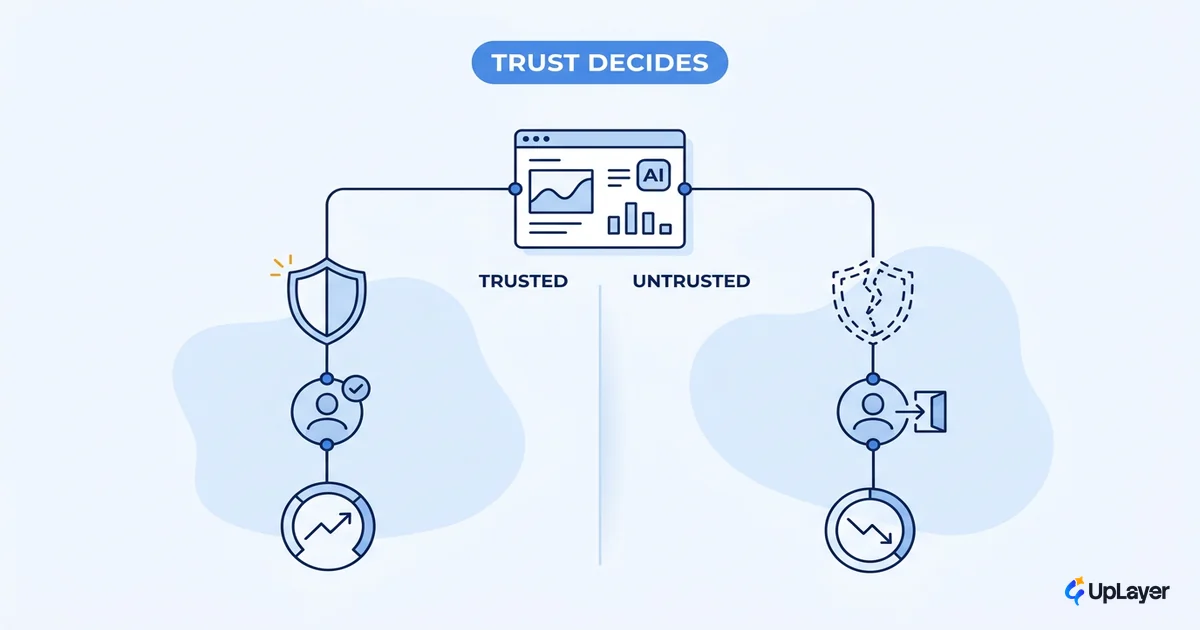
AI does not reduce churn. A trusted AI feature does, and an untrusted one speeds churn up. Same surface, opposite sign. Reducing churn with AI is real, but it runs through one variable most teams never check: whether users actually rely on the feature, or quietly route around it and start shopping for a replacement.
Most retention guides skip that variable. They assume any AI feature is retention-positive, ship it, and move on. This piece takes the other position. We will walk the mechanism that turns an AI feature into a retention lever, the case where the same feature becomes a churn accelerant, and a method for projecting the effect on churn before you build, so the work ladders to a number your team already tracks. It starts upstream with increasing AI adoption, because a feature nobody adopts cannot move retention in either direction.
Does AI actually reduce churn, or just predict it?
Most "AI for retention" tooling predicts churn. It scores at-risk accounts and surfaces a health signal. That is useful, but prediction is not reduction. A model that flags an account as likely to leave changes nothing on its own; a human or a workflow still has to act, and the customer never touches the model.
Reducing churn with AI means the feature itself changes user behavior: it removes friction at a moment that matters, the user comes to rely on it, and leaving your product now costs them something it did not before. That only happens when the feature is reliable enough to trust. When it is not, the AI becomes one more reason to leave. This is why so much AI work never reaches that point. Gartner projects that at least 30% of generative AI projects will be abandoned after proof of concept by the end of 2025, citing poor data quality, escalating costs, and unclear business value. A feature that never ties to a retention number is a feature that gets cut before it can move one.
So the honest answer to "do AI features reduce churn" is conditional: yes, when they are adopted and trusted; no, and often the reverse, when they are not.
Reducing churn with AI: the trust-to-retention mechanism
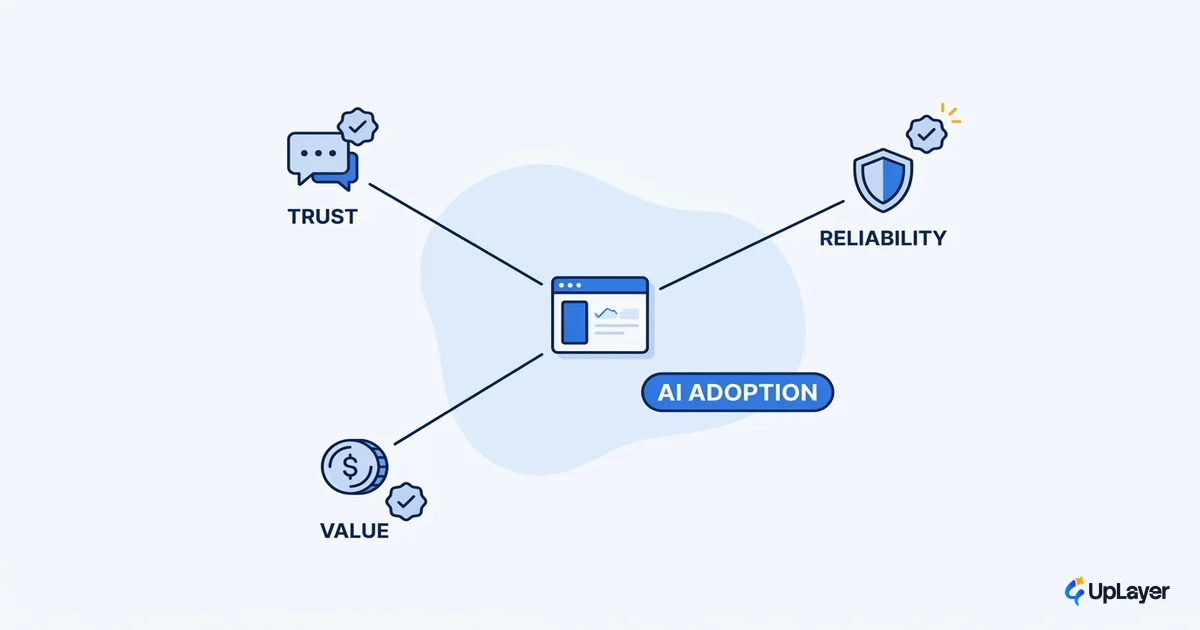
So how can AI reduce customer churn in practice? Here is the mechanism in one line: adoption builds trust, trust builds reliance, reliance raises the cost of switching, and a higher switching cost is lower churn. AI churn reduction is the end of that chain, not the start of it.
Walk it forward. A user tries the AI feature. If it is accurate and predictable, they use it again. Repeated reliable use is how trust forms, and trust is what converts a "nice feature" into a "feature I now depend on." Once a user has wired your AI into their daily workflow, the competitor who lacks it is no longer a lateral move; switching means giving up something that works. That is the AI retention effect, and it is entirely downstream of trust.
Trust is also the scarce input. A global study of over 48,000 people across 47 countries, led by the University of Melbourne with KPMG, found that while two-thirds already use AI regularly, less than half are willing to trust it.
Across 47 countries, 66% of people use AI with some regularity, but only 46% are willing to trust it. Usage is not the constraint. Trust is.
That gap is the whole game. Closing it is a design problem, not a model problem, which is why building user trust in AI features is the work that actually moves the retention number. Get it right and the feature retains. Get it wrong and you have built the opposite.
When an AI feature increases churn instead
The same feature that lowers churn when trusted raises it when it is not. An AI assistant that confidently returns a wrong answer, fails silently, or strands the user with no human fallback does not feel neutral. It feels like the product got less reliable, and reliability is the thing users stay for. Stanford's 2025 AI Index notes that AI-related incidents are rising sharply while standardized reliability evaluations remain rare, so the failure modes that erode trust are getting more common, not less.
This is where AI user trust stops being soft language and becomes a churn variable. The table below is the same surface viewed from both ends of the trust gap.
| Same AI feature | Trusted version (supportive AI) | Untrusted version (churn accelerant) |
|---|---|---|
| When it is unsure | Says so, shows confidence, offers a path | Answers anyway, sounds certain |
| When it fails | Hands off to a human-in-the-loop fallback | Dead end, user is stuck |
| Effect on workflow | Becomes a dependency | Becomes a workaround |
| Effect on churn | Switching cost goes up | "Was this worth it?" goes up |
| What it needs | Measured AI reliability and guardrails | Shipped on vibes |
WARNING
Shipping an AI feature without measuring whether it lowered or raised churn is not a neutral bet. If users do not trust it, you have not added a retention feature. You have added a reason to leave, and you will read it as "AI did not work" instead of "we did not make it trustworthy."
Supportive AI is the design stance that keeps the sign positive: the AI sits above your core product as a layer that helps, defers when it is unsure, and never becomes a single point of failure. That is the difference between AI churn reduction and AI-driven churn.
How to use AI to improve retention in SaaS without betting the roadmap
You do not need a model overhaul to start reducing churn with AI. You need to attach one AI feature to one churn-linked moment and prove the delta. Here is the method to use AI to improve retention in SaaS without gambling a quarter on it.
- Pick the moment, not the model. Find the point in the journey where accounts actually leave: a stalled onboarding, a support dead end, a repetitive task that drives downgrades. That moment is your target.
- Set the baseline. Measure current churn rate at that moment before you build anything. No baseline, no proof.
- Project the delta. Estimate how many at-risk users the feature retains, and turn it into a churn-point movement you can defend.
- Add the guardrails first. Confidence signals, human fallback, and reliability checks are not polish. They are what keeps the sign positive.
- Measure against the baseline. Compare real churn at that moment after launch. If it did not move, you learned that cheaply instead of expensively.
The projection is a number, not a story. A simple model keeps it honest:
projected_retained_users = at_risk_users_at_moment × adoption_rate × trust_rate × effectiveness

projected_churn_delta = projected_retained_users / total_account_base

Example (Concept Demo, projected, not a measured client result):
  at_risk_users_at_moment = 1,200 / quarter
  adoption_rate           = 0.45   # they actually use the feature
  trust_rate              = 0.60   # they rely on it when it matters
  effectiveness           = 0.35   # it resolves the churn trigger
  retained ≈ 1,200 × 0.45 × 0.60 × 0.35 ≈ 113 users / quarter
Notice that trust_rate sits in the middle of the equation. Halve it and the retained number halves with it. This is the same discipline behind learning to measure the ROI of an AI feature: one feature, one metric you already track, one measured delta. Reducing churn is just ROI expressed as retention.
What not to build: AI retention features that backfire
The fastest way to raise churn is to ship an AI retention feature that users cannot trust. These are the patterns that backfire, framed as projected risk, not measured client outcomes:
- The confident hallucinator. A copilot that answers everything, including the things it does not know. Every wrong answer that sounds right spends trust you cannot easily earn back.
- The silent agent. Automation that acts without telling the user what it did or letting them undo it. The first surprise is the last straw.
- The dead-end bot. A support assistant with no human fallback. It converts a solvable problem into a cancellation.
- The vanity feature. AI bolted on for the changelog, attached to no churn-linked moment and measured against nothing. It moves no number and adds surface area to break.
Cutting these is not caution, it is supportive AI in practice. The feature you do not build cannot churn a user.
Reducing churn with AI is, in the end, a trust problem wearing a retention problem's clothes. Build the feature your users come to rely on, give it the guardrails that keep it reliable, and measure the churn delta at the moment that matters. Do that and AI becomes a retention lever you can defend with a number rather than a narrative.
TIP
Want to know which AI feature would move your churn number, and by how much, before you build it? How the AX Audit works.