How to increase AI adoption in your SaaS product
How to increase AI adoption in your SaaS: earn user trust, prove usefulness in one session, then measure repeat usage against a metric you already track.
 Shahriar P. ShuvoAI Adoption & Trust11 min read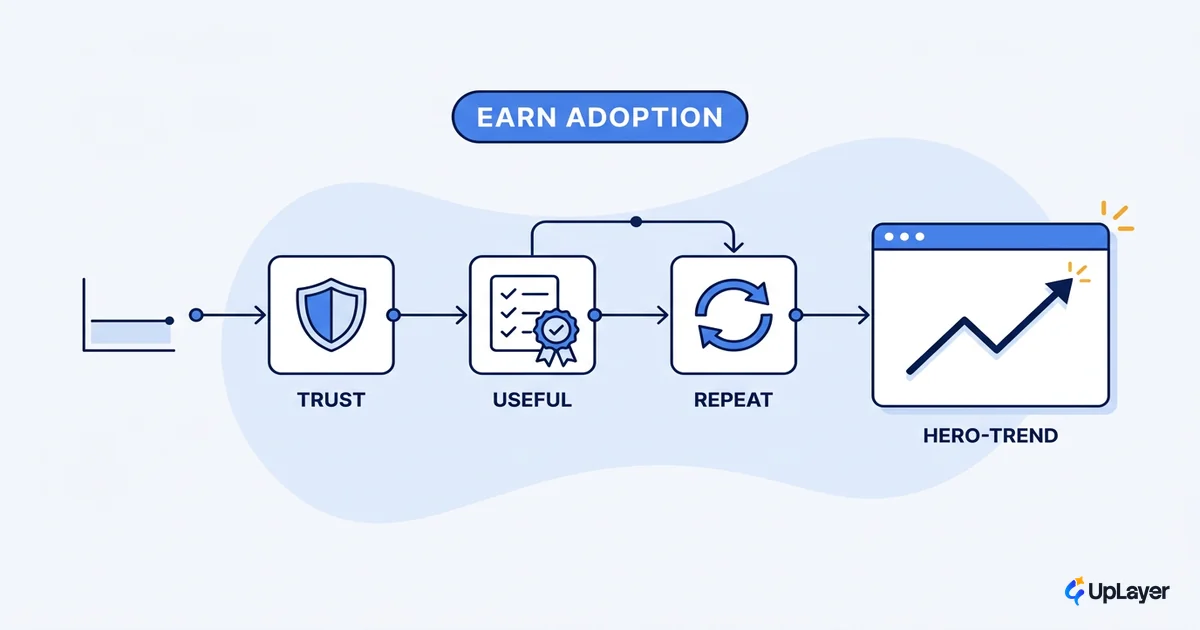
Shipping an AI feature is not adoption. The feature is live, the demo went well, and three weeks later the usage chart is a flat line near the floor. That gap, between available and used, is where most AI budgets quietly die, and learning how to increase AI adoption starts with naming it honestly.
Adoption is the count of users who reach for the feature again next week because it earned the click the first time. It is not opens, it is not beta signups, and it is not the board feeling reassured that you "did AI." If you want the feature to pay off, you have to tie it to a metric you already track (retention, activation, conversion, expansion) and then move that number on purpose.
This is the pillar for everything we publish on adoption and trust, and the argument runs in one line: adoption is earned trust over time, not a launch event. Make the feature reliable, make it useful, then measure the move. The rest of this page is how.
Why do users ignore AI features
Most AI features fail on adoption, not on technology. The model works. The feature dies in the space between "we put it in the UI" and "people use it on purpose," and that space is wider than most teams expect.
Start with the macro picture, because it reframes the problem. About 41% of the US workforce now uses generative AI for work, per the Federal Reserve's April 2026 tracking, and roughly one in six people worldwide now use generative AI according to Microsoft's AI Economy Institute. Access is spreading fast. Habit and value are not.
The value gap is the part that should worry a product team. BCG's 2025 study found that 60% of companies are seeing hardly any material value from AI despite real investment, with only 5% generating value at scale. The averages also hide wide swings once you break AI adoption down by industry, where a healthcare buyer and a developer-facing tool sit at opposite ends of the trust curve. Gartner has gone further on the project side, predicting that at least 30% of generative AI projects get abandoned after the proof of concept for reasons like unclear business value and weak risk controls. Those same causes are the AI adoption challenges that stall a feature inside your product, each with a fix a product team can actually ship.
Only 5% of firms are generating AI value at scale. 60% see hardly any material value despite substantial spend. (BCG, 2025)
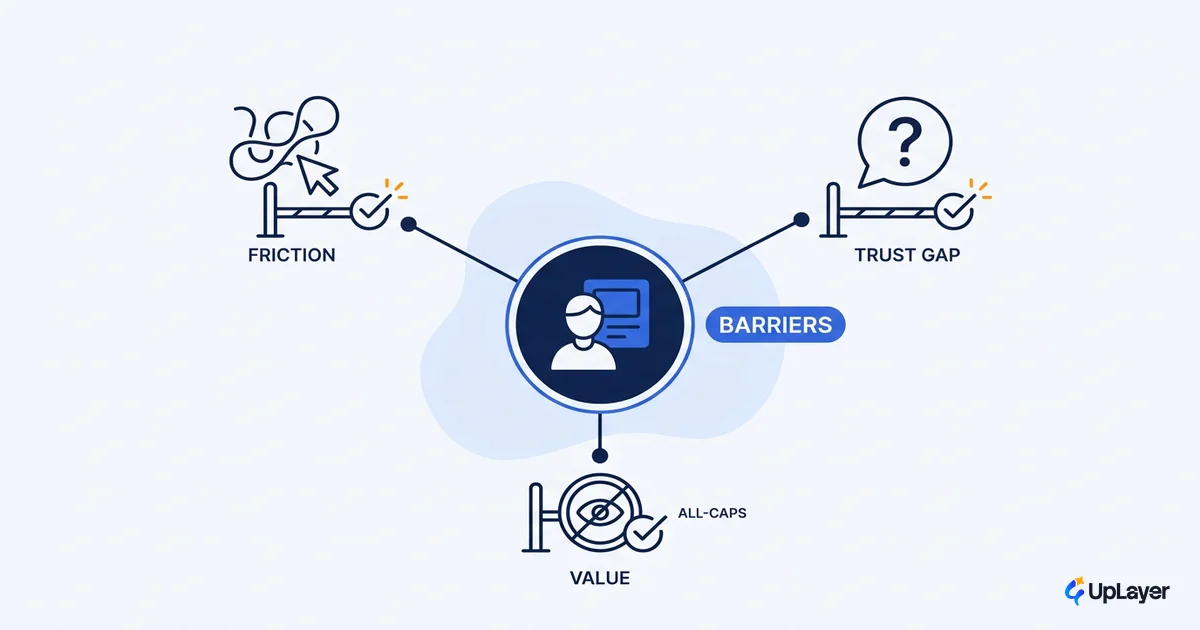
None of that is a model failure. It is an adoption failure, and inside your product it shows up the same way every time: a high first-try rate, a near-zero return rate. People are curious enough to click once. They are not convinced enough to come back. Most of the reasons sit on the user's side of the screen, which is why the real barriers to AI adoption are interface friction, the trust gap, and value the user cannot feel, not the model. We map those failure modes in detail in why most AI features ship and move nothing, but the short version is that a feature nobody trusts is a feature nobody adopts, no matter how good the demo looked.
Adoption is earned trust over time, not a launch event
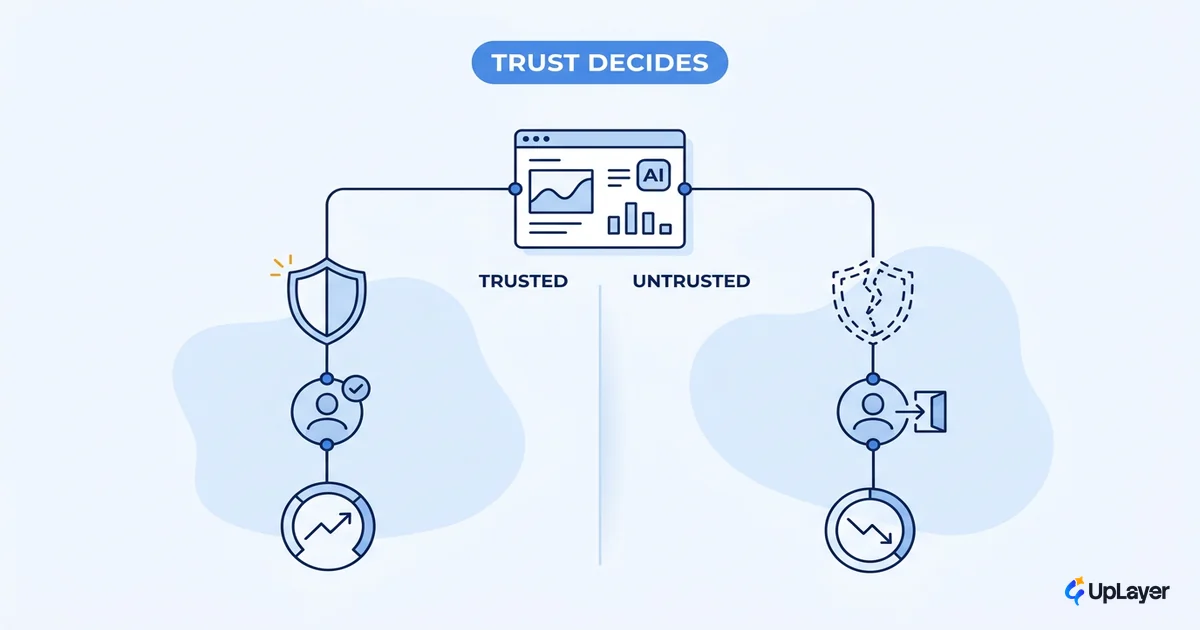
People will use a tool and distrust it at the same time, and that tension is the central fact of AI user trust. The global numbers make it concrete: 66% of people use AI regularly but only 46% are willing to trust it, in the KPMG and University of Melbourne 2025 study of more than 48,000 people across 47 countries. The same study found 83% expect AI to deliver benefits. Expectation is high. Trust is the bottleneck.
A feature your user does not trust gets opened once, judged, and abandoned. That is why treating adoption as a launch event is the wrong model. You do not "launch and drive adoption" the way you would a marketing campaign. You earn one repeat use, then another, by being right when it counts and honest when you are not sure.
This is the work behind how to build user trust in AI features: trust is not a banner that says "powered by AI," it is the accumulated memory of the feature not embarrassing the user. Every interaction either adds to that memory or spends it. Adoption is just what earned trust looks like on a usage chart.
The first driver of AI adoption is reliability, not novelty
Reliability is the price of entry, because trust is destroyed faster than it is built. The same KPMG study found that 66% rely on AI output without checking it, and 56% have made work mistakes because of it. Read that twice. Users are leaning on AI they have not verified, getting burned, and that burn is what kills the second visit.
This is the part teams underspend on. They polish the prompt and the panel, then ship a feature that hallucinates on the third query. A confident wrong answer is worse than no answer, because it spends trust the user may never extend again. Driving AI adoption is therefore a reliability problem before it is a growth problem.
Three things make a supportive AI feature reliable enough to adopt:
- Guardrails on the output. Constrain what the feature can claim, ground it in the user's own data, and refuse rather than guess when grounding is thin. If the term itself is new to you, start with what guardrails in AI actually are, then read the patterns in AI guardrails.
- Human-in-the-loop where the stakes are real. Let the user confirm, edit, or reject before an action commits. This is not a crutch for weak AI, it is how human-in-the-loop design keeps the user in control of consequences they care about.
- Visible uncertainty. Show sources, show confidence, and make "I'm not sure" a designed state rather than a silent guess. Honesty about limits is what separates a tool people trust from one they audit.
Reliability is also an ROI lever, not just a trust lever. A feature that works 95% of the time and fails loudly keeps its users. One that works 99% of the time and fails silently loses them to a single bad surprise. Build for the failure case, because that is the moment adoption is won or lost.
The second driver is usefulness the user can feel in one session
A user adopts an AI feature when it saves them a step they actually care about, in the first session, without a tutorial. Usefulness is not a roadmap claim. It is a felt moment. If the user cannot say what the feature did for them after one use, they will not return for a second.
This is where supportive AI becomes a design problem, not a marketing problem. The features that get used share a shape. They sit inside an existing workflow, they reduce an effort the user was already spending, and they produce something the user would have made anyway, faster. The features that flop tend to be standalone chat boxes bolted onto a sidebar, asking the user to invent a use case the product never suggested.
Two design moves do most of the work:
- Anchor the feature to a job the user already has open. A "summarize this" button on the document beats a chat assistant that opens with "how can I help?" The document is the context, and the user's intent is already obvious.
- Make the first success cheap. Nudge a new user toward one high-value action in the first session instead of presenting the full surface area and hoping they explore. One clear win beats ten possible ones.
The principle: supportive AI earns adoption by removing friction the user can name, not by adding capability the user has to discover. In-product AI earns its place on the screen the same way every other good feature does, by being the fastest path to a result the user already wanted.
A framework for driving AI adoption: the four gates
Every adopted AI feature clears four gates, in order. Skip one and the feature stalls there, no matter how strong the others are. We call this the Adoption Gates model. It maps each driver to the question the user is silently asking, the symptom you see when the gate is closed, and the lever that opens it.
| Gate | The user's question | What you see when it's closed | The lever that opens it |
|---|---|---|---|
| 1. Trust | "Will this embarrass me?" | High first-try rate, near-zero return rate | Guardrails, grounding, visible uncertainty, human-in-the-loop |
| 2. Usefulness | "Did this save me a step I care about?" | Users try once, leave no feedback, never come back | Anchor to an open job, deliver a felt win in session one |
| 3. Habit | "Is this where I now go for this task?" | Sporadic use, no week-over-week retention of the feature | In-context entry points, smart defaults, light nudges at the moment of need |
| 4. Proof | "Is this worth my team paying for?" | Usage exists but no one can tie it to a business metric | Instrument the feature against retention, activation, or conversion |
The order is not arbitrary. Trust gates usefulness, because nobody leans on a feature they expect to be wrong. Usefulness gates habit, because nobody builds a routine around a tool that did not help. Habit gates proof, because a feature used twice cannot move a metric. Most teams build for usefulness and assume the rest follows. The teams that win on AI adoption start at trust and instrument for proof from day one.
That last gate is where you measure adoption rather than guess at it. The cleanest signal is repeat usage, expressed as a rate you can watch week over week:
Repeat usage rate = (users who used the feature again within 14 days)
                    / (users who tried it at least once)

Adoption signal:
  high first-try + low repeat  -> shipped and ignored (trust or usefulness gate closed)
  high first-try + high repeat -> habit forming (instrument for proof next)
This is the spine of the full AI adoption framework, where each gate becomes a concrete checklist. The point of the model is diagnosis. When a feature stalls, you can name which gate is closed instead of restarting from zero.
How do you get users to actually use an AI feature?
You get users to actually use an AI feature by making the first use safe, obvious, and worth repeating, then by removing the reasons they would fall back to the old way. Adoption is not a persuasion problem you solve with a tooltip tour. It is a trust-and-usefulness problem you solve in the design.
In practice that is four moves, in order, and they map directly to how to drive adoption of an AI feature in SaaS:
- Make it reliable, so the first try does not burn trust.
- Put it where the relevant task already lives, so the user does not go looking.
- Deliver one felt win before asking for any commitment.
- Measure repeat usage, not opens, so you know whether the habit is forming.
Nudges and onboarding help at the margin. They cannot rescue a feature that fails the trust gate. You cannot tooltip your way out of a feature people do not believe.
This is also why "do AI because the board asked" produces features nobody uses. Pressure to ship AI is not a reason a user will adopt it. The user adopts because the feature is reliable and useful to them, which is a harder and more honest bar than "we launched something." It is also why the right move is sometimes to not build the feature at all, and to say so.
How to increase AI adoption: the metrics that prove it's working
The metric that proves AI adoption is not "feature opens." It is the rate at which users return to the feature and the lift it produces in a number you were already tracking. Total queries and beta signups measure curiosity. Adoption lives in repeat behavior.
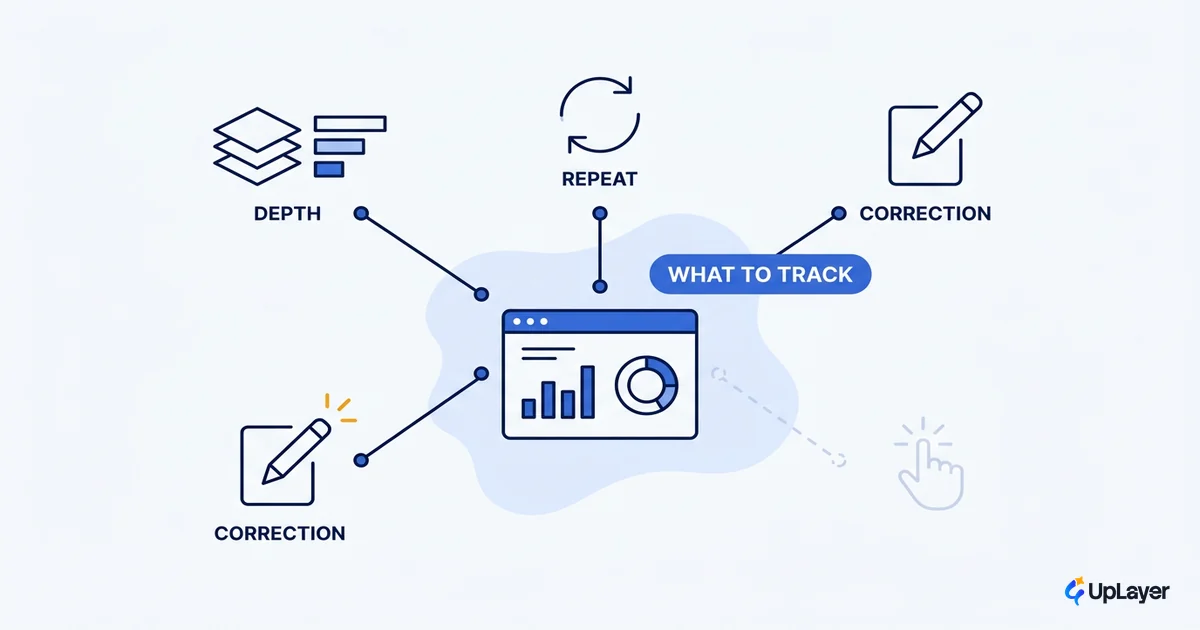
Track these AI adoption metrics, in roughly this priority:
- Repeat usage rate. Of users who tried the feature once, what share used it again within 7 or 14 days? This is the single cleanest signal that the feature passed the trust and usefulness gates.
- Feature-attributed retention or activation. Compare retention or activation for users who adopted the feature against a matched cohort that did not. If adopters do not retain better, the feature is busy, not valuable.
- Task completion rate. Of users who start the AI-assisted task, what share finish it without falling back to the manual path? Mid-task abandonment usually means a trust or reliability failure.
- Correction and override rate. How often do users edit, undo, or reject the output? A small rate signals trust, a high rate signals the feature is making work, not saving it.
- Time-to-first-value. How long from first exposure to first useful result? The longer this is, the more users drop before the feature can earn its place.
WARNING
If you only instrument "opens," every adoption chart is a story you are telling yourself. Capture the baseline of your target metric before you ship, then watch the delta against a matched cohort. A number without a before is not proof.
The discipline that separates adoption from theater is setting that baseline first, so the post-launch numbers mean something. The full menu of signals lives in the AI adoption metrics worth tracking, but the priority order above is enough to know within two weeks whether a feature is forming a habit or quietly dying.
Knowing how to increase AI adoption is not a growth hack layered on after launch. It is the consequence of building a feature users can trust and use without being taught, then measuring the one number that proves the habit is real. Reliability earns the first repeat use, usefulness earns the habit, and instrumentation turns the habit into proof you can take to the board. That is how you move from being one of the many teams that "did AI" to the small share that can show it was worth the spend.
TIP
Want to know which AI feature in your product is most likely to clear all four gates, and what it would move on a metric you already track? How the AX Audit works. In 14 days we map your highest-ROI opportunity, project the impact, and build a working concept demo. Under the 3X Guarantee, the audit finds AI worth 3x the fee or it's free.