What are guardrails in AI and why they matter
What are guardrails in AI? A plain-language guide to the types of AI guardrails, how they keep features reliable, and which ones your product really needs.
 Shahriar P. ShuvoAI Adoption & Trust8 min read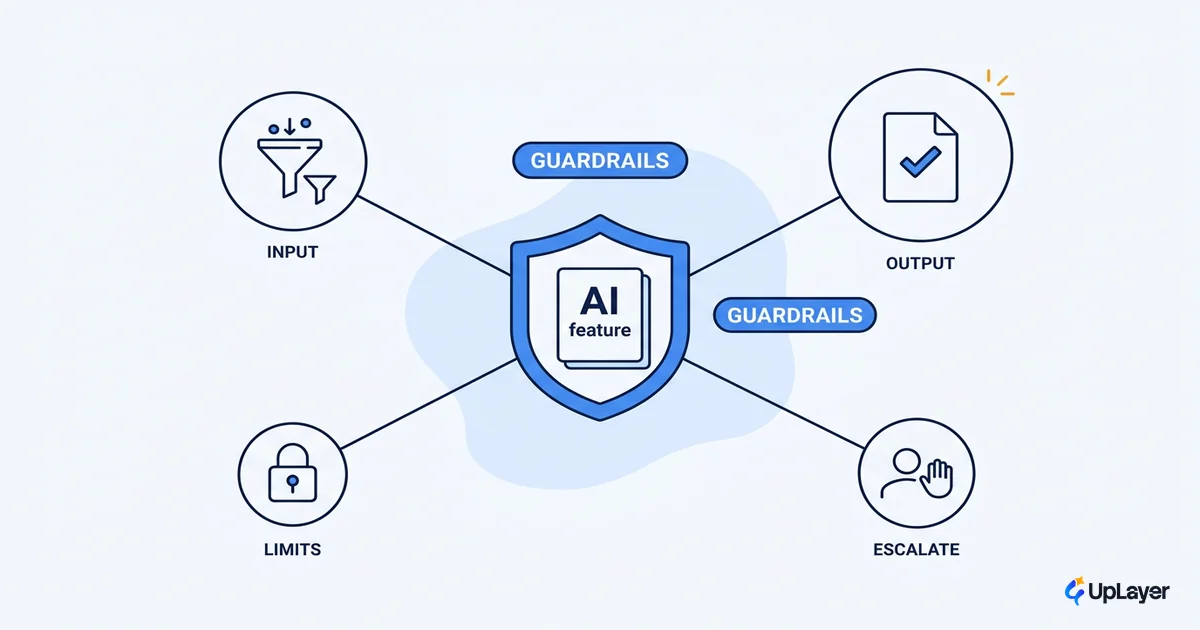
Most teams get guardrails wrong in one of two directions. They ship an AI feature with nothing around it and find out the hard way when it leaks a customer's data or answers a question it had no business answering. Or they bolt on every guardrail a vendor sells and ship something so slow and over-blocked that users stop trusting it for the opposite reason. So when you ask what are guardrails in AI, the honest answer is not "a checklist you maximize." It is a layer you size to the cost of a bad output.
This piece gives you the plain definition, the main types of AI guardrails that actually exist, and a way to decide which ones your specific feature needs. The goal is not maximum safety. It is the right amount of safety for what the feature can break.
What are guardrails in AI, in plain terms
Guardrails in AI are the safeguards that sit around a model and keep its inputs and outputs inside boundaries you define. IBM describes them as the safeguards that keep AI systems operating safely, responsibly and within defined boundaries, spanning policies, technical controls, and monitoring. The useful mental model is a highway barrier: it does not slow the car down, it just keeps it from veering off the road.
The key word is around. A guardrail is not the model and it is not your core product logic. It is a separate check that runs before the prompt reaches the model, or after the response comes back, deciding whether to allow, block, rewrite, or escalate. That separation is what makes guardrails a supportive layer rather than a rewrite of your engine. It is the same principle behind shipping AI as a layer on top of the product you already built, which is the foundation of any real plan to increase AI adoption in your product without betting the company on a model.
Guardrails matter because the buyer's real currency here is trust. A single bad output in front of a paying customer costs more than the feature earns in a month. Guardrails are how you bound that downside.
What does AI guardrails mean for a product team
For a product team, "guardrails" means the operational controls that make an AI feature safe to put in front of real users. It is the layer between governance intent and shipped behavior. You can read more on the same idea in our companion piece on AI guardrails explained for product teams, which goes deeper on implementation.
Governance frameworks set the frame; guardrails do the work. The US standards body NIST organizes trustworthy-AI risk into four functions: govern, map, measure, and manage. Guardrails live mostly in manage: they are the concrete mechanism that enforces a policy once the feature is live. So when a stakeholder asks what does AI guardrails mean in practice, the answer is the running code that catches the failures your risk map predicted.
This framing keeps guardrails tied to a metric you already track. You are not adding safety for its own sake. You are protecting retention, support load, and the trust that makes users keep the feature on.
What are the main types of AI guardrails
There is no single guardrail. There are categories, and most features need two or three of them, not all of them. The cleanest split is by where the rail runs and what it catches.
The two foundational types are input and output rails. As Martin Fowler describes the pattern, you use an input guardrail and an output guardrail: one screens the user's prompt before it reaches the model, the other scans the response before it reaches the user. Input rails matter because prompt injection is not a fringe risk. In the OWASP Top 10 for LLM applications, prompt injection sits at number one.
| Guardrail type | What it catches | Where it runs | Typical cost |
|---|---|---|---|
| Input rail | Prompt injection, jailbreaks, off-topic or abusive prompts | Before the model | Low to medium |
| Output rail | Hallucinated, unsafe, or off-brand responses | After the model | Medium |
| Topical / relevance rail | Questions outside the feature's job | Before or after | Low |
| Content filtering | Hate, violence, self-harm, sexual content | Input and output | Low |
| PII / data rail | Leaked emails, account numbers, secrets | Output | Medium |
| Human-in-the-loop | High-stakes actions that need a person to confirm | Before the action commits | High (latency) |
AI content filtering is the most commodity layer of the stack. Managed services make it close to free to start. Microsoft's managed content filtering services include prompt-injection shields, harm-category detection, and groundedness checks. You do not need to build a classifier from scratch to catch the obvious failures.
NOTE
Topical rails are the most underused guardrail. A support copilot that politely refuses to answer legal or medical questions avoids a whole class of liability that no content filter would have caught, because the output was not unsafe. It was just out of scope.
How guardrails make an AI feature reliable
A guardrail is how you make non-deterministic output behave predictably enough to ship. That is the link between guardrails and AI reliability: the model will sometimes produce the wrong thing, and the rail is the part of the system that promises this class of wrong thing will not reach the user. You cannot make a language model deterministic, but you can bound its blast radius. We cover how to put a number on that in how to measure AI reliability.
In practice a reliable feature is a small stack of rails composed in order, not one giant filter. A pseudo-config makes the shape concrete.
# Rail stack for a customer support copilot
input_rails:
  - jailbreak_and_injection_check   # block "ignore previous instructions"
  - topical_check                   # stay on support topics only
output_rails:
  - pii_redaction                   # strip emails, account numbers
  - groundedness_check              # answer must cite a help-doc source
  - content_safety                  # hate / violence / self-harm
fallback:
  on_block: "Hand off to a human agent with the original message."
Each line is a decision you can defend to a metric. The groundedness check protects answer quality, which protects trust. The handoff protects the user experience when a rail fires, so a blocked response feels like care rather than a dead end.
Do all AI features need guardrails
No. And pretending otherwise is how teams ship slow, over-blocked features. The right question is not "is this feature safe enough," it is "what is the worst thing a single bad output can do here." Size the guardrails to that blast radius.
A feature that drafts a tweet for a user to review before posting has almost no blast radius. The human is the guardrail. A feature that auto-replies to customers, moves money, or changes a configuration has a large one, and skipping rails there is genuinely reckless. That is the real lesson behind the real cost of shipping AI without guardrails: the cost is not uniform, so the protection should not be either. For the high-stakes middle ground, human-in-the-loop AI design is often the highest-leverage rail you can add.
According to IBM's 2025 Cost of a Data Breach Report, almost every AI-related breach, 97% of them, occurred in an environment without proper access controls. The absence of a basic guardrail, not a sophisticated attack, was the common factor.
WARNING
Over-blocking is also a failure. A guardrail that rejects one in five legitimate requests trains users to stop relying on the feature, which costs you the same retention you were trying to protect. Tune thresholds against real traffic, not worst-case imagination.
How to pick the guardrails your feature actually needs
The practical AI guardrails meaning for your team is whatever catches your worst failure, so work backward from that failure, not forward from a vendor catalog. The framework is short on purpose.
- Name the worst output. Write the single most damaging thing this feature could say or do. Be specific.
- Find the rail that catches it. Match that failure to one row in the table above. Usually it is one or two rows, not six.
- Add only those rails. Start there. Content filtering is cheap insurance, so it almost always makes the cut. OpenAI ships a free moderation endpoint that classifies harmful text and images, so there is little excuse to skip the baseline.
- Measure the false-positive rate. A rail you cannot tune is a rail that will quietly erode trust.
This is also where an outside read pays off. A quick audit can tell you which of your AI ideas carry real blast radius and which are safe to ship lean, so you spend your guardrail budget where it moves a metric.
Guardrails are not a tax you pay to look responsible. They are the layer that lets a supportive AI feature stay reliable in front of real users without rewriting your core engine. So the next time someone asks what are guardrails in AI, the better answer is a question back: what is the worst this feature can do, and which one rail catches it? Size from there, and you ship something users actually keep.
TIP
Not sure which of your AI features carry real risk and which are safe to ship lean? How the AX Audit works.