The real cost of shipping AI without guardrails
Shipping AI without guardrails taxes churn, support load, and trust. Here is the real cost of ungoverned AI and the minimum guardrails that prevent it.
 Shahriar P. ShuvoAI Adoption & Trust7 min read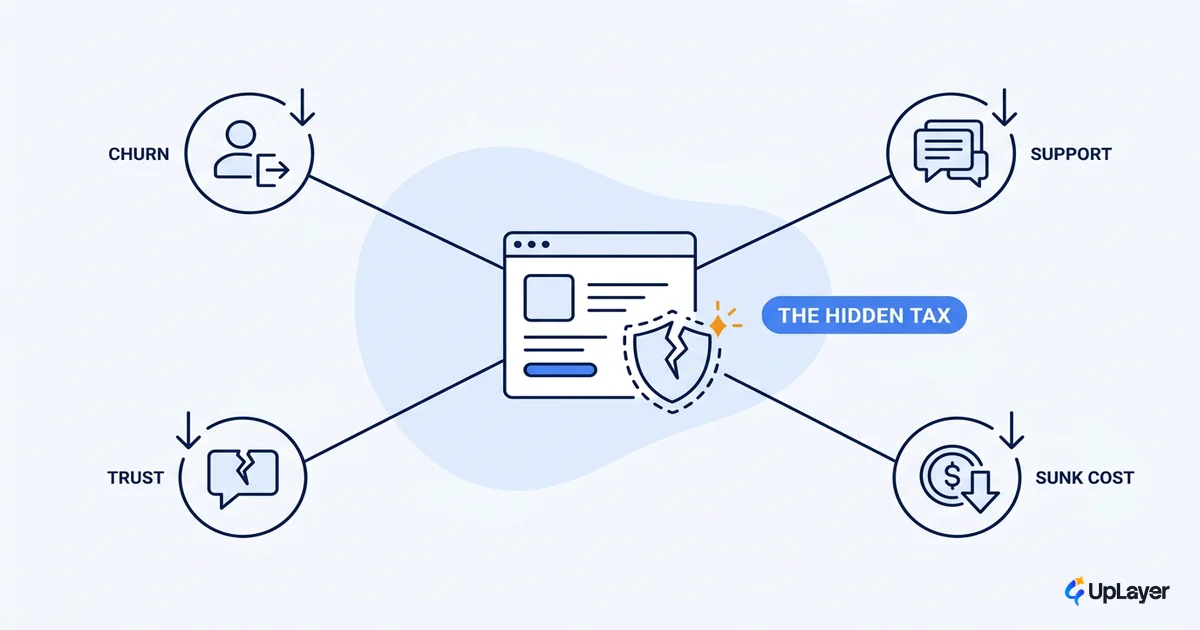
Shipping AI without guardrails feels like a win for about a week. The feature went live, the demo looked sharp, and the board got its update. Then the quiet tax starts. A confident wrong answer here, a support ticket there, a user who tried it once and never came back. None of it shows up as a single failure you can point to. It shows up in the numbers you already watch.
Most teams price the build and ignore the blast radius. They budget for the model and the UI, then treat reliability as something to add later. But the cost of ungoverned AI is rarely the model. It is the churn you eat, the support load you absorb, and the trust you do not get back. If you are still increasing AI adoption by adding features, the guardrails are not the optional part. They are the part that decides whether the feature moves a metric up or down.
What "shipping AI without guardrails" actually means
Ungoverned AI is any feature where there is nothing between the model's output and your user. The model generates, the user sees it, and you find out it was wrong when someone complains. There is no confidence check, no human in the loop on anything that matters, no fallback when the model is unsure, and no log to tell you how often it fails.
This is different from what AI guardrails actually are, which is the technical machinery (input filters, output validation, scope limits, human review). The point here is the consequence, not the taxonomy. An ungoverned feature is one you cannot reason about. You do not know its failure rate, so you cannot tie it to a metric, so you cannot tell whether it is helping or quietly hurting.
What happens when you ship AI without guardrails
The honest answer to what happens when you ship AI without guardrails is that most of these features do not survive contact with real usage. Gartner projects that at least 30% of generative AI projects will be abandoned after proof of concept by the end of 2025, citing poor data quality, inadequate risk controls, escalating costs, and unclear business value. Inadequate risk controls is the polite phrase for no guardrails.
The risks of AI without guardrails are not exotic. They are the ordinary ways a probabilistic system disappoints a human who expected a correct answer. The model hallucinates a policy that does not exist. It answers confidently in a domain it should have refused. It exposes data it should have redacted. Each of these is survivable in isolation. The problem is what they cost in aggregate, measured against numbers you report every month.
The four costs you actually pay
Ungoverned AI does not send you a bill. It taxes four things you already track. Naming them turns an abstract risk into a line item you can defend a guardrails budget against.
| What breaks | The AI reliability failure | The metric it taxes | Minimum guardrail that prevents it |
|---|---|---|---|
| A confident wrong answer | Hallucination with no confidence check | Trust, then churn | Confidence threshold + "I'm not sure" fallback |
| A flood of "the AI is wrong" tickets | No output validation or scope limit | Support cost, team load | Output validation, narrow scope |
| A leaked or non-compliant response | No PII redaction or access control | Trust, legal exposure | Redaction, access controls, logging |
| A quietly killed project | No eval, no metric, no proof it works | Sunk build cost | Logging and evaluation from day one |
That last row is the expensive one. IBM's 2025 breach research found that 97% of organizations reporting an AI-related security incident lacked proper AI access controls, and 63% had no AI governance policy at all. Ungoverned features are not just more likely to fail. They are more likely to fail in a way that costs real money and is hard to clean up.
The failures themselves are trending the wrong direction. According to Stanford's AI Index, the number of reported AI incidents rose to 233 in 2024, a record high and a 56.4% increase over the prior year. As more teams ship AI faster than they govern it, the base rate of public failure climbs. You do not want your feature in next year's count.
Why ungoverned AI breaks trust faster than it earns it
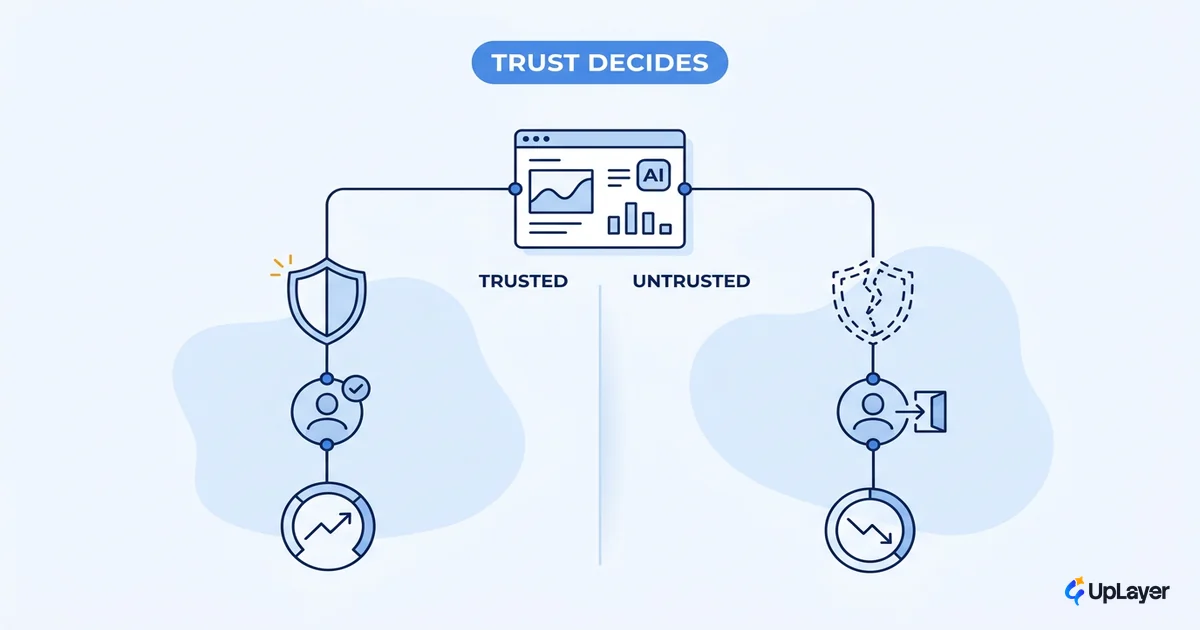
This is the core of what are the dangers of ungoverned AI: trust is asymmetric. A user needs many good answers to start relying on a feature, and a single confident wrong one to stop. You earn trust slowly and lose it instantly, and the lost trust does not stay contained to the AI feature. It spreads to the product around it.
Salesforce's consumer research found that advances in AI make it more important for companies to be trustworthy, with trust and consistent experience cited as drivers of long-term loyalty. The flip side is that breaking that trust is a direct path to switching.
The teams that survive this treat reliability as a feature, not a patch. That is the whole point of learning to build user trust in AI features before you scale them. An AI feature that is right 95% of the time and honest about the other 5% will out-retain one that is right 98% of the time and confidently wrong about the rest. Honesty about uncertainty is itself a guardrail.
The minimum guardrails that prevent it
You do not need a governance committee to ship responsibly. You need a short list of controls that catch the failures most likely to tax your metrics. This is the minimum set we put on every supportive AI feature before it goes live. It is closer to a pre-flight checklist than a compliance program.
MINIMUM GUARDRAILS CHECKLIST (ship none without these)

1. CONFIDENCE THRESHOLD
   - Below threshold -> say "I'm not sure" or hand off. Never guess.

2. HUMAN-IN-THE-LOOP on high-trust actions
   - Anything irreversible or money-touching needs a human approve step.

3. SCOPE LIMITS
   - Refuse out-of-domain questions. Narrow beats broad-and-wrong.

4. OUTPUT VALIDATION + PII REDACTION
   - Check format, strip sensitive data before the user sees it.

5. LOGGING + EVALUATION from day one
   - Track failure rate against a metric. No log = no proof = no defense.

6. GRACEFUL FALLBACK
   - When the model fails, route to the known-good path, not a dead end.
Five of these six are cheap. They are a day of engineering, not a quarter. The work of preventing hallucinations in production and the discipline of measuring AI reliability start from exactly this list. The expensive one is the last failure mode, the one where you skipped logging and now cannot prove the feature works or fails, so it gets cut in the next planning cycle with no data to defend it.
WARNING
The most expensive guardrail is the one you skip because the feature "works in the demo." Demos do not have edge cases. Production is nothing but edge cases. Ship the checklist, or plan to ship the feature twice.
Is it risky to launch an AI feature without guardrails?
Yes, and the risk is rarely a dramatic blowup. It is a slow regression in a metric you care about, plus the odds that the whole project gets quietly killed. Gartner projects that over 40% of agentic AI projects will be canceled by the end of 2027, again pointing to escalating costs, unclear business value, and inadequate risk controls. A feature with no guardrails has no way to prove its value, which makes it the first thing cut when budgets tighten.
Reframe guardrails as what they are: the cheapest insurance you can buy against a metric regression. The minimum set costs a few days. A trust failure that bumps churn costs a quarter of recovery, if you recover at all. The math is not close.
The teams that win with AI in 2026 are not the ones shipping the most features. They are the ones shipping features they can stand behind, where reliability is designed in and proven against a number. Treat guardrails as part of the product, not paperwork bolted on after launch, and shipping AI without guardrails stops being a tempting shortcut and starts looking like the obvious mistake it is.
TIP
Not sure which AI feature is worth building, and worth governing properly? How the AX Audit works. We map the highest-ROI opportunity, project its impact on a metric you already track, and hand you the reliability guardrails it needs to ship.