Human-in-the-loop AI design for SaaS products
Human in the loop ai is a design choice, not a default. Learn when to keep a human reviewing AI output, when to remove them, and how to do it.
 Anamoul RoufAI Adoption & Trust7 min read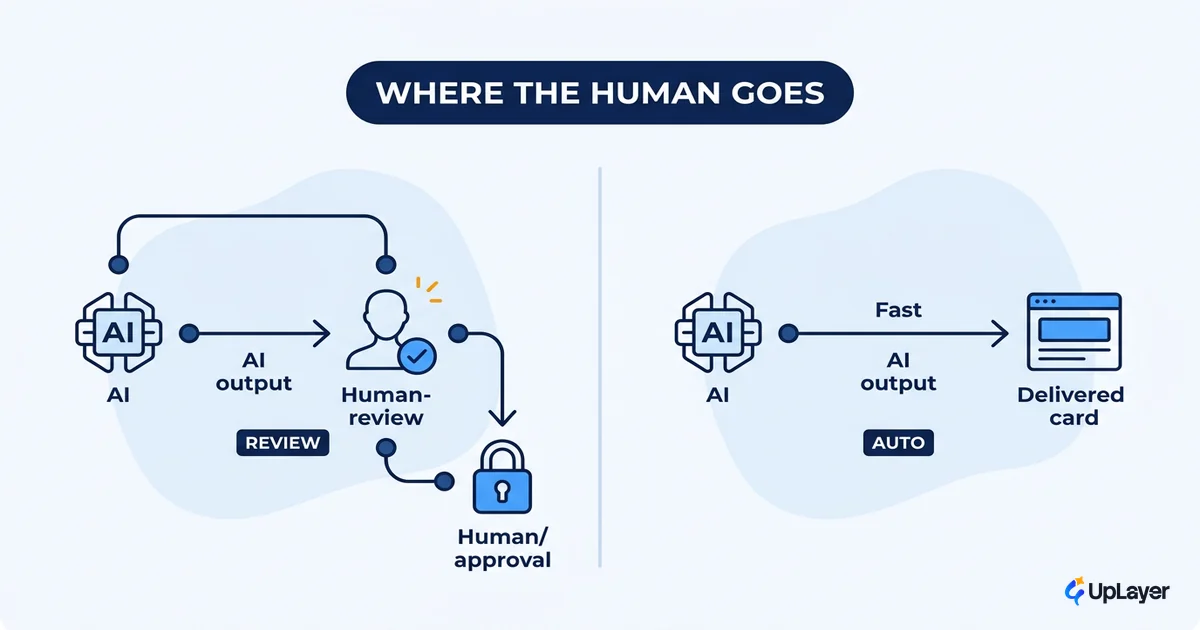
Most teams bolt a human onto every AI output the moment they get nervous. A reviewer approves each summary, each suggested reply, each draft. The feature was supposed to save time, and now it waits on a person. The speed that justified building it is gone.
Human in the loop ai is a design choice, not a safety blanket you drape over everything. The real question is never whether to keep a person involved. It's which outputs actually deserve one. Some need a careful second set of eyes. Most do not, and forcing review on them quietly kills the feature. This is the supportive-AI view: the model does the work, the human covers the cases where being wrong is expensive, and you decide that split on purpose. It sits underneath any serious effort at increasing AI adoption in your product, because adoption follows trust, and trust follows good judgment about where oversight belongs.
This piece gives you the definition, a rule for when the human stays, a clear look at what review costs, and a pattern for building checkpoints that catch errors without slowing the feature to a crawl.
What is human-in-the-loop AI, in plain terms
Human-in-the-loop AI is any design where a person reviews, corrects, or approves a model's output before, during, or after it acts. The human is a checkpoint in the workflow, not a spectator next to it.
There are two versions, and conflating them causes most of the confusion. Design-time loops happen while you build the model: labeling data, ranking responses, tuning. Run-time loops happen in production, when a person signs off on what the model produced for a real user. This article is about the run-time kind, because that's the one a SaaS owner controls and pays for every day.
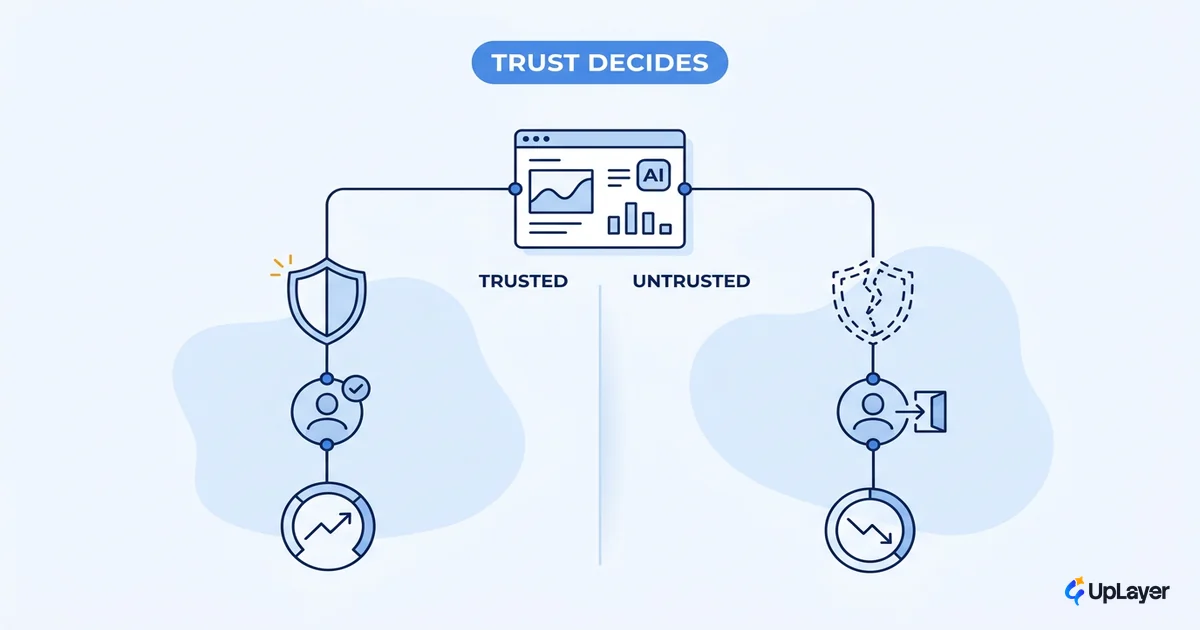
It matters because users arrive skeptical. Pew Research found that more concerned than excited about AI in daily life describes 38% of Americans, against just 15% who lean the other way. A visible, well-placed human review step is one of the most direct ways to build user trust in AI features. The catch is that "well-placed" is doing all the work in that sentence.
NOTE
Human-in-the-loop design is not the same as "a human checks everything." It's choosing the small set of outputs where a human's judgment is worth the wait, and letting the model run clean everywhere else.
When should an AI feature keep a human in the loop
Keep a human in the loop when the cost of being wrong is high, the action is hard to reverse, and the model's confidence is low. Remove the human when output is cheap, reversible, and the model is reliably right. The decision is the product of three factors, not any one of them alone.
Score each AI output against stakes, reversibility, and confidence. A mislabeled support ticket is low stakes and trivially reversible, so it ships without review. An AI that auto-issues refunds is high stakes and hard to claw back, so it routes to a person. The point is to spend your oversight budget where a mistake actually hurts, the same discipline behind deciding which features deserve to exist at all.
| AI output | Stakes | Reversible? | Keep a human? |
|---|---|---|---|
| Suggested reply draft (user edits before sending) | Low | Yes | No, ship it |
| Auto-categorize a support ticket | Low | Yes | No, sample only |
| Summarize a long document | Medium | Yes | No, flag low confidence |
| Draft a contract clause | High | Yes (before send) | Yes, review before send |
| Auto-issue a refund > $200 | High | No | Yes, approve first |
| Auto-suspend a user account | High | Hard | Yes, two approvers |
The rows that say "yes" share a trait: a wrong answer reaches the user and is expensive to undo. That's also where a review step lets you catch a hallucination before it reaches the user, which is the entire reason the loop earns its friction. Everywhere else, the human is overhead dressed up as caution.
Where the human slows you down, and should come out
Oversight is not free. Every review step adds latency, adds a queue, and adds a person who gets tired and rubber-stamps after the fortieth approval. Reviewer fatigue is real, and a checkpoint that everyone clicks through without reading is worse than no checkpoint, because it manufactures false confidence.
AI oversight should be proportional to risk. That's not just product sense, it's the spirit of the law. The EU AI Act requires that high-risk systems be designed so a person can effectively oversee them, and it reserves the heaviest control, verification by two separate people, for the highest-stakes cases like biometric identification. The framework calibrates oversight to consequence. Your product should too. Applying contract-grade review to a playlist recommendation is not safety, it's waste.
WARNING
If you review everything, you ship nothing. A loop on every output turns an AI feature back into a manual process with extra steps, and users feel the lag long before they feel the safety.
The honest test: would a reasonable user rather have this output 5 seconds faster, or 0.5% more accurate? For most low-stakes outputs, speed wins by a wide margin, and the human should come out of the loop.
How to design human review into an AI workflow
Design the review step as a targeted checkpoint, not a blanket gate. There are four patterns, and good products mix them by output type rather than picking one for the whole feature.
Checkpoint patterns (choose per output, not per feature)

1. GATE          → human approves before output acts.
                   Use for: high stakes, irreversible.
2. SAMPLE        → review a random 1-5% for quality drift.
                   Use for: high volume, low stakes.
3. ESCALATE      → auto-ship if confidence >= threshold,
                   else route to a human.
                   Use for: variable confidence, medium stakes.
4. POST-HOC      → output ships now, human audits later,
                   flags feed back into the model.
                   Use for: reversible, learning loop.
The escalate pattern is the workhorse for SaaS. The model handles the clear cases on its own and asks for help only when it's unsure, so ai with human review stays cheap on average. This is also where the NIST AI Risk Management Framework is useful: it treats oversight as a governed, measurable control through its Govern, Map, Measure, and Manage functions, which means you can audit whether your checkpoints actually fire, instead of assuming they do.
IMPORTANT
Log every checkpoint decision: what the model produced, what the human did, and why. That log is your evidence that the loop works, and your training data for shrinking it later.
When should an AI feature have no human at all
Drop the human entirely when the output is fully reversible, cheap, and the model clears a confidence bar you've measured. Autocomplete, search ranking, tag suggestions, and draft text the user edits anyway are all fine to ship unsupervised. The user is the loop. They accept, edit, or ignore, and that's enough oversight for a low-stakes call.
The mistake is treating "no formal review step" as "no safety." You still need guardrails, confidence thresholds, and fallbacks. You've just decided a dedicated human reviewer isn't the right one for this output. Supportive AI means the model carries the routine load and the human is reserved for the cases that genuinely need a person.
Is human in the loop ai worth the friction? Measure it
Tie the loop to a metric you already track, then check whether it helps or just slows you down. Human in the loop ai earns its place only when the value the review step protects is larger than the cost it adds.
loop_value = (errors_caught × cost_per_error)
           − (reviews × minutes_per_review × loaded_cost_per_minute)
           − conversion_loss_from_added_latency

Keep the loop while loop_value > 0.
Tighten the confidence threshold until it stops being true.
If a checkpoint catches almost nothing, it's friction wearing a safety badge, and you can raise the auto-ship threshold or remove it. If it catches expensive errors often, it's paying for itself and you keep it. Either way you're deciding with a number, not a fear. The same instinct applies to how you measure AI reliability: watch the rate of bad outputs that reach users, and let it tell you where the human is still earning their seat.
Here's the uncomfortable backdrop. MIT Sloan and BCG found that only 10% of companies see significant financial benefit from AI, and the ones that do are the ones where humans and machines learn from each other on purpose. A well-designed loop is how you join that 10%: the human's corrections become signal, the model improves, and the checkpoint gradually narrows. As a Concept Demo, a support-triage feature with an escalate-on-low-confidence loop is designed to auto-resolve roughly 70% of tickets and route the rest, with projected reviewer load dropping as the model learns from each escalation.
Human in the loop ai works when you treat the human as a precision instrument, aimed only at the outputs where being wrong is costly, and removed from everywhere else. Get that split right and oversight stops being a tax on speed and starts being the reason users trust what your product ships.
TIP
Not sure which AI outputs in your product need a human and which are just paying a tax on speed? How the AX Audit works.