An AI adoption framework for product teams
An AI adoption framework that ships: five stages from first AI feature to dependable layer, each gate cleared by a metric you already track.
 Sohanur RahmanAI Adoption & Trust7 min read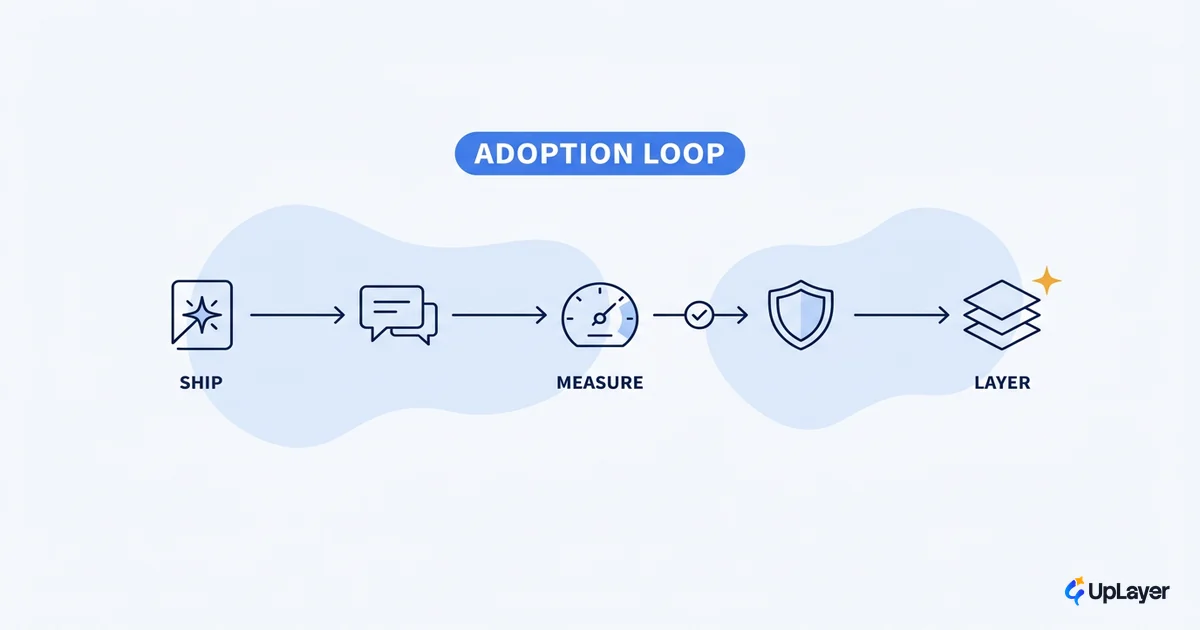
A framework's real job is to tell you when to stop, not just how to start. Most adoption frameworks only know how to go forward. They walk a team from pilot to scale and quietly assume the feature deserves to survive the trip.
That assumption is where the money goes. A team ships an AI feature, the launch goes fine, and then "adoption" turns into a vibe nobody can defend in a board meeting. An ai adoption framework should fix exactly that: a sequence of gates that moves one AI feature from first ship to dependable layer, where every gate is cleared by a number you already track. No metric, no advance. This piece lays out the five stages, the metric attached to each, and the one branch every other framework leaves out.
What an AI adoption framework actually is (and isn't)
An ai adoption framework is a sequenced set of gates that carry a single AI feature from first ship to dependable layer, with a metric controlling each gate. It is not a maturity-model poster.
The distinction matters. The thing most blogs sell you is an ai adoption model: a grid that grades your whole organization on governance, talent, and culture. That has its place for a CIO. It does almost nothing for a product team that needs to decide whether this feature, in front of these users, is ready to widen. The org-level model measures readiness. The product-level framework measures movement.
The stakes are no longer about whether you adopt. 78% of organizations reported using AI in 2024, up from 55% the year before, per Stanford HAI's AI Index. Nearly everyone ships AI now. The differentiator is the rollout, and the rollout is where things die.
At least 30% of generative AI projects will be abandoned after proof of concept by the end of 2025, Gartner predicts, because of poor data quality, weak risk controls, escalating costs, or unclear business value.
Read that list of causes again. Three of the four are not technical. They are decisions a framework is supposed to force early. A good ai adoption process is the thing standing between a promising pilot and that 30%. If you want the broader playbook for getting a feature used once it ships, our cornerstone on how to increase AI adoption in your product sits underneath everything here.
What are the stages of an AI adoption framework
There are five stages, and they form a loop, not a ladder. A ladder only goes up. This loop has a gate at every step that can send you back or end the feature.
| Stage | What happens | Gate metric | What kills it |
|---|---|---|---|
| 1. Frame | Tie the feature to one metric you already track | The metric is named and baselined | No metric you can point to |
| 2. Pilot | Ship to a thin slice of real users | Projected delta shows in the slice | Slice moves nothing |
| 3. Trust gate | Prove the feature is dependable enough to widen | Reliability >= your set threshold | Users don't trust the output |
| 4. Widen | Roll out to the full base, watch the metric hold | Metric holds at scale, not just in the slice | Gains vanish when volume rises |
| 5. Hold | Keep it dependable, decide what comes next | Metric stays above baseline over time | Drift erodes the gain quietly |
This is the ai rollout framework spine. Each row is a checkpoint, and each checkpoint is binary: the metric cleared the bar or it didn't. Written as a loop, it reads like this:
for each ai_feature:
    frame   -> name one tracked metric, baseline it
    pilot   -> ship to ~5% of users, measure the delta
    if delta <= 0:        kill(feature)        # the branch others skip
    trust   -> measure reliability vs threshold
    if reliability < threshold:  return to pilot
    widen   -> roll out, confirm the metric holds at scale
    hold    -> monitor for drift, then return to frame for the next one
The stages are deliberately boring. Boring is the point. A framework you can argue with at a standup beats a poster on a wall.
Attach a metric to every stage
A stage without a number is theater. This is the rule that separates an ai adoption framework from a slide.
Every gate above points at a metric your team already reports: activation, task completion, retention, support deflection, expansion. You are not inventing new instrumentation for the AI feature. You are borrowing a number leadership already trusts and asking the feature to move it. That borrowing is what makes the result defensible. When someone asks whether the feature worked, you point at a line that already existed and show the delta.
WARNING
A stage with no metric is a vibe, not a gate. If you can't name the number a stage has to move, you can't tell when the feature has passed it, and you can't tell when to kill it. Define the metric before the model.
Pick the metric in the Frame stage and never swap it midstream. Swapping metrics to find one that looks good is how a feature that moved nothing gets reported as a win. For the full menu of what to instrument, see the AI adoption metrics worth tracking. The short version: one metric per feature, chosen before launch, owned by a named person.
The trust gate: where most rollouts should slow down
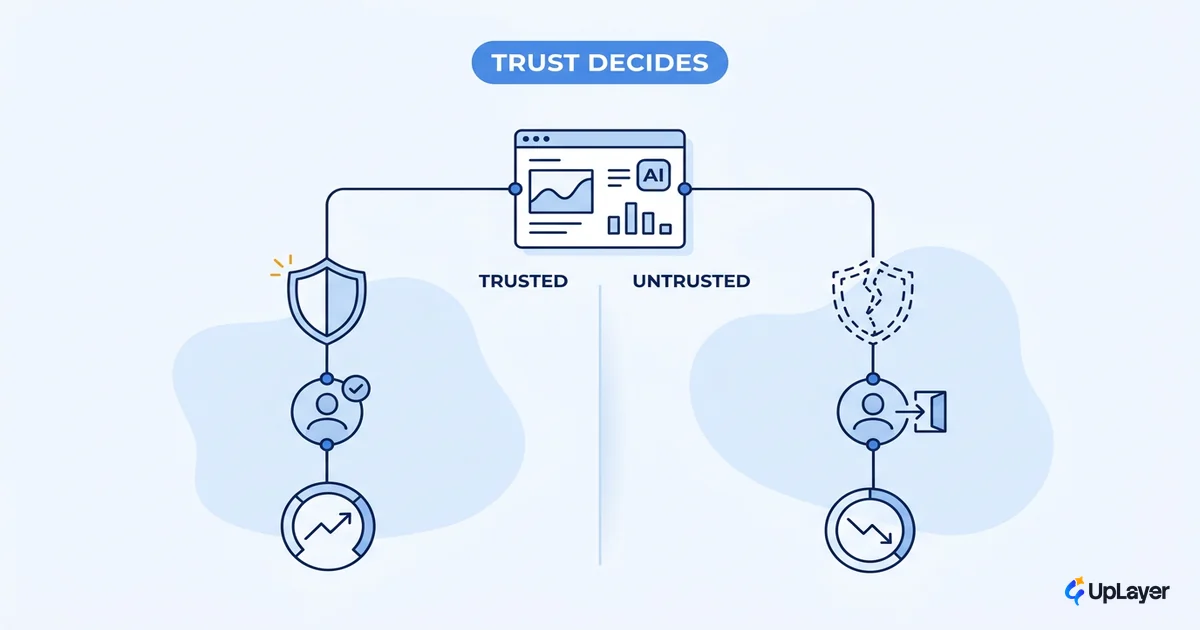
The trust gate is the stage competitors leave out, and it's the one that decides whether the whole ai adoption process survives contact with real users.
Here is the failure mode. A pilot looks great, so the team widens immediately. Then volume rises, edge cases multiply, the model produces a confident wrong answer in front of a paying customer, and trust collapses faster than it built. You don't widen a feature users don't trust. The trust gate is a hard stop between pilot and widen that asks one question: is this dependable enough to put in front of everyone?
Answering it takes two things. First, a human-in-the-loop checkpoint on the outputs that carry the most risk, so a wrong answer gets caught before it ships to a user. Second, a way to measure the feature's reliability as a number, not a feeling, so the gate has a threshold instead of a gut check.
For the scaffolding underneath the gate, the NIST AI Risk Management Framework is the neutral standard. It defines four functions to manage AI risk in practice: govern, map, measure, and manage. You don't need to adopt all of it. You need the spirit of "measure" before "manage at scale," which is exactly what the trust gate enforces.
IMPORTANT
The trust gate is the most expensive stage to skip. A feature that fails here in the pilot costs a sprint. The same feature failing after a full rollout costs the trust of your entire base, and that does not come back on the next release.
How do you structure AI adoption in a SaaS product
Structure it as a supportive layer above your core engine, one feature at a time, with a founder or PM owning the metric. That sentence is the whole answer; the rest is detail.
In a SaaS product the framework has a specific shape. The AI feature sits above the system of record, not inside it, so a stalled rollout or a model swap never takes the product down. You move one feature through all five stages before starting the next, because parallel AI bets dilute the one thing you need, which is a clean read on whether each feature moved its metric.
This is where most teams stall. Challenges in scaling AI are the recurring theme in Deloitte's State of AI in the Enterprise research, drawn from thousands of leaders. Piloting is easy. Holding a gain at full volume is the hard part, and it's the part the Widen and Hold stages exist to protect. For the broader set of plays that get a feature past the stall, see the adoption strategies that move a metric.
The SaaS-specific checklist:
- One feature in flight at a time, fully sequenced.
- The AI layer is replaceable without touching the core engine.
- One named owner per feature, accountable for one metric.
- A reliability threshold set before the pilot, not negotiated after.
What a good AI adoption framework refuses to do
A good framework can end a feature. That's the whole test. What is a good framework for ai adoption, in one line? One that has a kill condition at every stage and uses it.
Look back at the table. Every row has a "what kills it" column. That column is not decoration. It's the part that makes the framework honest. A framework that can only move features forward isn't a framework, it's a ratchet, and a ratchet is how the 30% of abandoned projects got built in the first place. They were never allowed to die early and cheap, so they died late and expensive.
Saying no to a feature that won't move its metric is not a failure of the process. It is the process working. The teams that ship dependable AI are not the ones that ship the most features. They are the ones that kill the weak ones at the Pilot gate and pour that saved time into the one feature that's actually moving a number.
NOTE
The cheapest feature you'll ever ship is the one you kill at stage two. The most expensive is the one you scale because no stage was allowed to stop it.
Run the loop on one feature, watch the metric, and let the gates do their job. A working ai adoption framework is less about the stages you climb and more about the ones you're willing to walk back down, which is the difference between a product team that compounds trust and one that just accumulates AI features nobody uses.
TIP
Want the metric, the projection, and a working concept demo before you commit a build? How the AX Audit works.