What is trustworthy AI and how to design for it
Trustworthy AI is not an ethics page. It is four product decisions a SaaS team can ship: reliability, transparency, recoverability, and a human in the loop.
 Shahriar P. ShuvoAI Adoption & Trust7 min read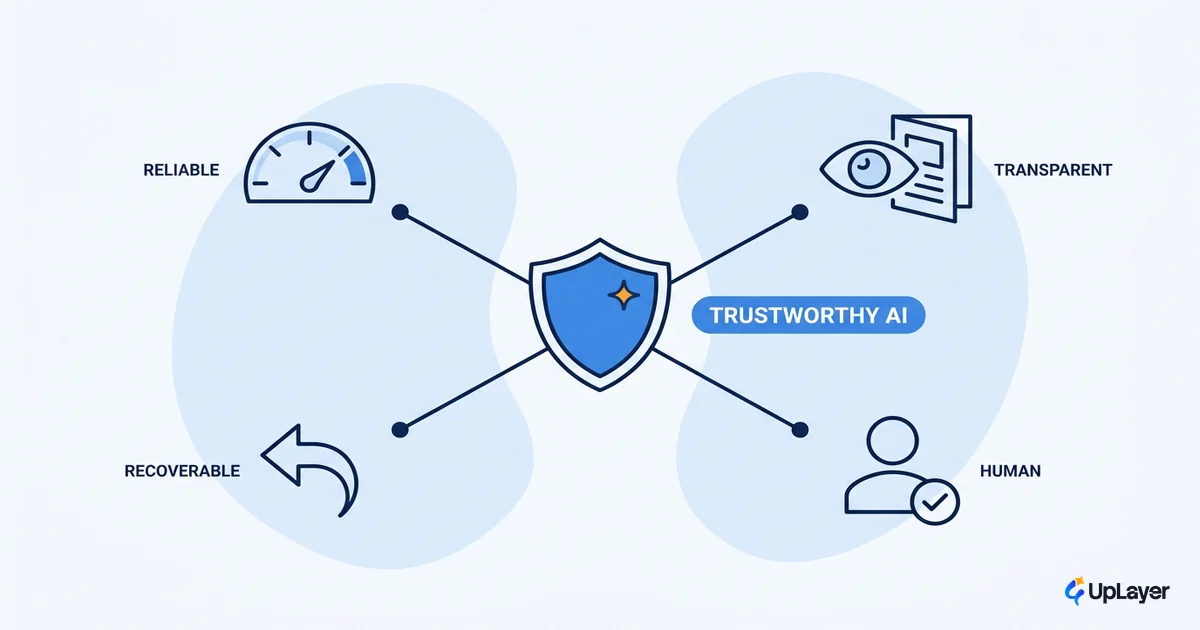
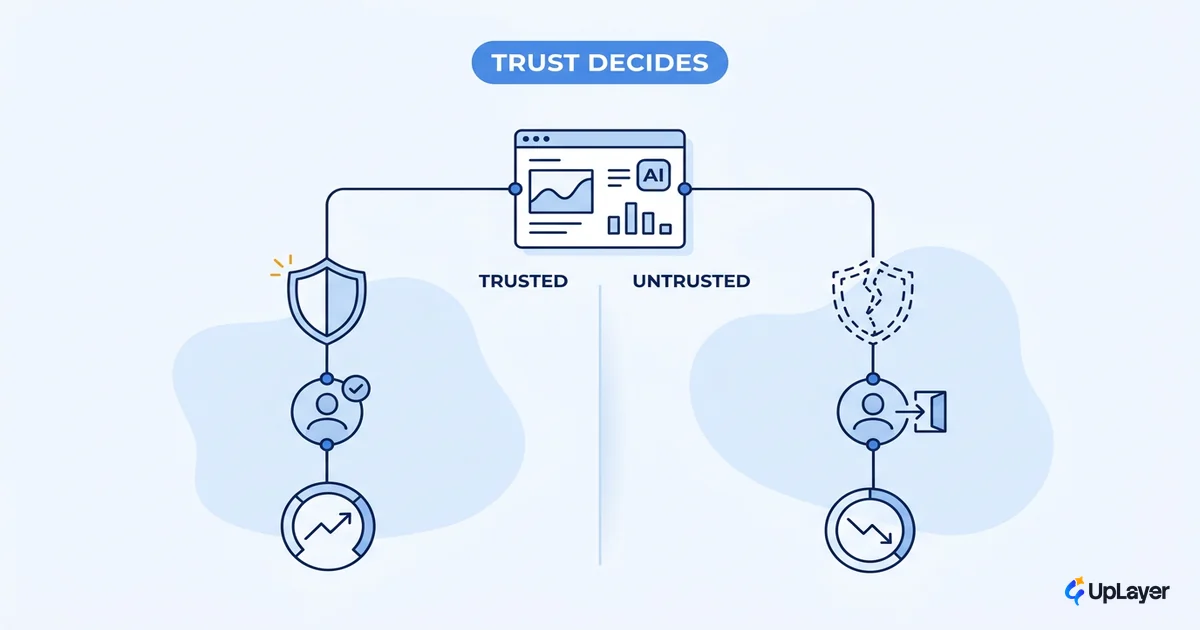
Trustworthy AI is not an ethics statement you publish. It is a set of product decisions your users feel in the first three interactions. Most teams treat trust as a values page and a disclaimer, then wonder why the AI feature gets clicked once and abandoned. Your users are not reading your principles. They are deciding, fast, whether the feature is safe to rely on.
This post turns the abstract principle lists into four properties you can actually build this quarter: reliability you measured, transparency the user can see, recoverability for the wrong answer, and a human who stays on the consequential decisions. Trust is not a soft virtue here. It is the precondition for adoption, and adoption is a metric you already track. If you want the feature to move that number, start by reading how to increase AI adoption and treat everything below as the layer underneath it.
What is trustworthy AI, in product terms
In product terms, it is AI a user is willing to rely on because they have evidence it will behave as expected and a way to recover when it does not. That is the definition that matters inside a product. The user is not grading your model. They are deciding whether to act on its output.
The formal frameworks agree on the shape. The U.S. NIST AI Risk Management Framework lists the characteristics of trustworthy AI systems as valid and reliable, safe, secure and resilient, accountable and transparent, explainable and interpretable, privacy-enhanced, and fair with harmful bias managed. NIST is explicit that "valid and reliable" is the base condition, the one everything else sits on. That is the part most product teams skip, because it requires a number they measured rather than a claim they wrote.
For a SaaS team, the taxonomy is correct but the altitude is wrong. You do not ship "accountability." You ship a feature where the user can see what it did, trust the result enough to act, and undo it when it misfires. So we compress the principles into four properties you can put on a ticket.
What makes AI trustworthy: four properties you can ship
What makes AI trustworthy in a shipped product is not the length of your governance doc. It is whether four things are true in the interface. Each maps to a metric you already track, and each has a version of "trust theater" you should skip.
| Property | What the user feels | Metric it moves | What not to build |
|---|---|---|---|
| Reliability | "This is usually right" | Activation, task success | A leaderboard score with no in-product measurement |
| Transparency | "I can see what it did" | Retention, support deflection | A wall of legalese no one reads |
| Recoverability | "I can undo a bad answer" | Retention, churn | A confident output with no escape hatch |
| Human in the loop | "A person owns the risky call" | Trust, conversion | Full automation on consequential decisions |
Reliability comes first because it is the base. You cannot earn trust on a feature whose accuracy you have never measured against a real task. This is the same discipline as treating AI reliability as something you measure, not assert. Transparency is the cheapest trust you can buy: show the source, the confidence, or the steps, so the user can calibrate. Recoverability is the one teams forget, and it is the one that protects retention when the model is wrong, which it will be. Keeping a person on the consequential calls is how you cap downside without capping speed.
If you want the user-facing playbook for these signals, the companion piece on how to build user trust in AI features goes deeper on the interface patterns.
Trust-readiness score (per AI feature)

  reliability   = measured task-success rate on real inputs   (0-1)
  transparency  = can the user see source / confidence?       (0 or 1)
  recoverability= can the user undo or correct the output?    (0 or 1)
  oversight     = is a human on the consequential decision?   (0 or 1)

  ship_ready = (reliability >= target) AND transparency AND recoverability
               AND (oversight OR decision_is_low_stakes)

# If any term is 0 on a high-stakes decision, you are shipping trust theater.What are the principles of trustworthy AI
The principles are well documented. The work is mapping them onto the four properties so they become decisions instead of slogans. The EU's Ethics Guidelines for Trustworthy AI set out seven requirements, and the one that translates most directly to product is human agency and oversight, which the guidelines say can be achieved through human-in-the-loop, human-on-the-loop, and human-in-command approaches. That is not a compliance footnote. It is a design choice about where a person sits relative to the model.
Here is the mapping that responsible AI design comes down to in practice:
- Reliability carries NIST's "valid and reliable" and the EU's "technical robustness and safety." Decision: define the target accuracy on a real task before you build, then measure against it.
- Transparency carries the EU's transparency requirement, where humans must be aware they are interacting with AI and informed of its limitations. Decision: surface source, confidence, or reasoning in the interface, not in the terms of service.
- Recoverability carries "safe" and "secure and resilient." Decision: every AI action a user can take, a user can reverse.
- Human in the loop carries human agency and oversight. Decision: pick the oversight model per decision, and use human-in-the-loop AI design wherever the cost of a wrong answer is high.
These are the ai trust principles a SaaS team can act on without a governance board. They turn the values page into a checklist on a feature ticket.
WARNING
Trust theater is the failure mode. A confident output with no confidence signal, a disclaimer instead of an undo, a model leaderboard instead of an in-product accuracy number. Users see through all three. The principles only build trust when they change the interface, not the marketing.
How do you build trustworthy AI into a product
How do you build trustworthy AI into a product without stalling the roadmap? You build it one feature at a time, against the metric that feature is supposed to move. The sequence is short and you can start it this week.
- Pick one feature and one metric. Not "make the product trustworthy." Pick the AI feature, name the metric it should move (activation, retention, support deflection), and write down the target.
- Measure reliability on real inputs. Run the feature against representative data and record the task-success rate. This number is your floor. If you cannot produce it, you are not ready to claim the feature is reliable.
- Expose what the user needs to calibrate. Source, confidence, or the steps taken. This is the cheapest trust signal and the one that most affects ai user trust.
- Add the escape hatch. Make the output reversible or correctable. Recoverability is what keeps a wrong answer from becoming a churn event.
- Place the human. On low-stakes decisions, monitor. On consequential ones, require a human in the loop before the action commits.
The reason this matters is that adoption and trust are not the same curve, and the gap is wide. KPMG's 2025 global study found that only 46% of people globally are willing to trust AI systems, even as usage climbs. YouGov's late-2025 polling reached the same conclusion from the other direction: adoption is rising while trust is not, with 35% of U.S. adults using AI weekly but exposure failing to convert into confidence.
Adoption alone is not enough. The trust gap is the conversion problem hiding inside your AI feature.
That gap is your opportunity. The teams that close it ship the four properties; the ones that do not ship a values page.
What trustworthy AI is not (skip this work)
It is not the work most teams default to. It is not a published set of principles, a model leaderboard screenshot in the pitch deck, or a blanket disclaimer at the bottom of the screen. Those are signals about you, not evidence for the user. They cost effort and move no metric.
In a Concept Demo, the difference shows up fast. Two versions of the same AI feature, one with a confidence signal and a one-click undo, one with neither. The projected lift on activation and retention comes from the second set of decisions, not from the wording of a trust statement. We do not invent the number for you. We measure the projected delta against the metric you already track, then build only the version that earns its place.
The principles are not in dispute. The product decisions are where teams lose. Build reliability you measured, transparency the user can see, recoverability for the wrong answer, and a human on the calls that carry risk, and trustworthy AI stops being an abstract goal and becomes a feature that moves a number. That is the only kind of trust that survives contact with a real user.
TIP
Want to know which AI feature is worth making trustworthy first, and what it could move? How the AX Audit works.