AI chatbot for SaaS that does more than answer FAQs
An AI chatbot for SaaS that only deflects tickets hits a ceiling. Here is the line between a chatbot, a copilot, and an assistant that moves a metric.
 Sohanur RahmanAI Copilots & Assistants7 min read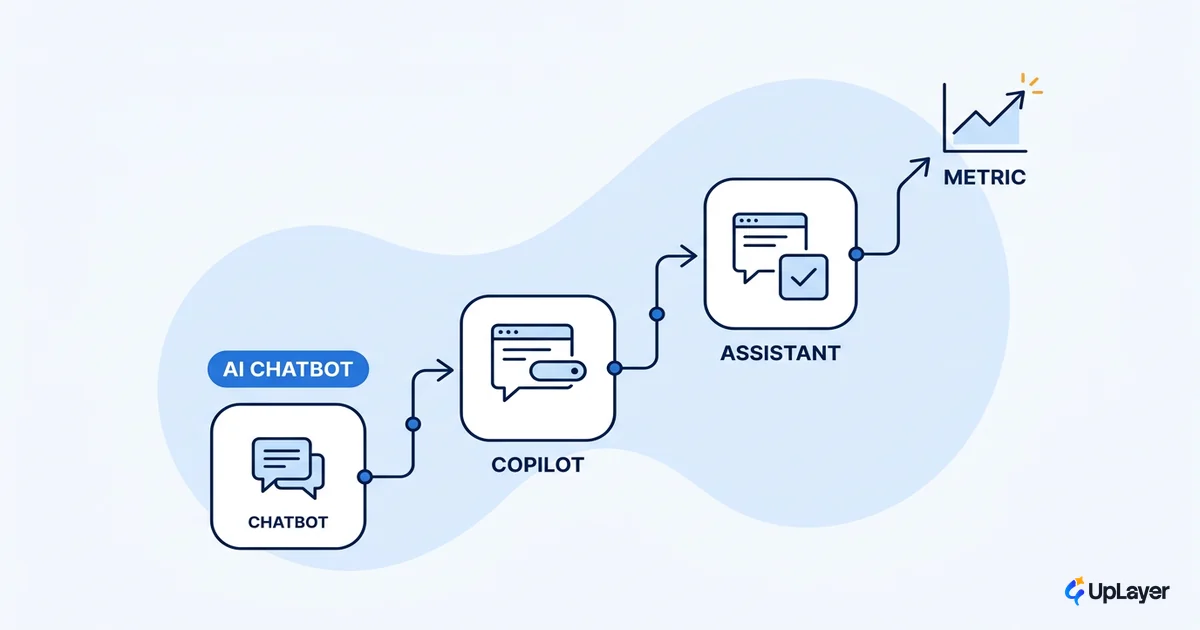
Most teams ship an AI chatbot, watch it deflect a handful of support tickets, and then quietly wonder why no metric the board tracks ever moved. That is the trap. An AI chatbot for SaaS that only answers FAQs is solving a support problem, not a product one, and the two pay off very differently.
The chatbot itself is rarely the issue. The ceiling is. A bot that lives in a help widget and quotes your docs back to users can lower ticket volume, but it almost never touches activation, retention, or expansion. Those are the numbers that decide whether an AI feature earned its place. The interesting question is not "should we have a chatbot," it is "what should it graduate into, and when."
This piece draws the line between a chatbot, a copilot, and an assistant, then gives you a test for when to cross it. It is part of our work on designing the assistant your users trust, and it leads with the same belief: build the AI surface that moves a number, and skip the one that just demos well.
A SaaS chatbot that only answers FAQs hits a ceiling fast
Deflection is real, and it is worth having. The standard metric the support-bot industry optimizes for is automation rate, which Intercom defines as the share of conversations resolved without a human teammate needing to step in. A good FAQ bot pushes that number up, trims response times, and frees your team.
The ceiling is what that number does not include. Ticket deflection is a cost story. It rarely shows up in activation, feature adoption, or net revenue retention, because the bot sits beside the product instead of inside it. You can run a 70% automation rate and still have users who never reach the moment your product becomes indispensable.
For a $1M to $20M ARR B2B SaaS, that gap matters. The board pressure to "do AI" is really pressure to move a growth metric. A chatbot answering questions in a sidebar is the safest, lowest-ceiling way to spend that budget. It is also the most common reason a team burns $20k to $50k on AI and has nothing to point to a quarter later.
How is an AI chatbot different from a copilot?
The words get used interchangeably, which is exactly why so many teams build the wrong thing. The useful distinction is not the model behind it. It is where the surface lives, what it is allowed to touch, and the metric it is built to move.
| Surface | Where it lives | What it does | What it touches | Metric it moves |
|---|---|---|---|---|
| Chatbot | Support widget, beside the app | Answers questions, deflects tickets | Knowledge base, docs | Ticket volume, response time |
| Product copilot | Inside the feature surface | Suggests, drafts, explains in context | Read access to user data | Activation, feature adoption |
| In-app assistant | Inside the workflow | Suggests and acts on the user's behalf | Read and scoped write access | Retention, expansion, time-to-value |
A chatbot is reactive and external. A product copilot is contextual and suggestive, living where the work happens and helping the user move faster without taking the wheel. An assistant goes one step further and can act, inside guardrails. This is also where the copilot-versus-agent decision starts, and it is worth reading when a product copilot beats an agent before you commit to autonomy you do not need.
None of these is "better." They sit on a ladder of capability and risk. The job is to know which rung your product actually needs.
When does a chatbot become an assistant?
A chatbot answers. An assistant acts inside the workflow. The graduation point is not a model upgrade, it is a design and trust decision, and three signals tell you it is time.
- Users keep asking the bot to do, not just to know. When the top intents shift from "how do I export this" to "export this for me," the demand has moved from information to action.
- The valuable action lives one click away from the answer. If your bot explains a workflow and the user then has to go perform it manually, you are leaving the metric on the table. That is the moment to consider an in-app AI assistant that closes the loop.
- The action maps to a metric you already track. Drafting a report, configuring a setting, or completing onboarding are actions tied to activation and retention. Answering a trivia question is not.
When those line up, you are no longer building a chatbot. You are building an AI assistant for B2B SaaS, and the design bar rises with it. The bot now needs context, permissions, and a way to fail safely. That is the real cost of graduating, and it is why the decision should be deliberate rather than a feature you bolt on because a competitor did.
Should a SaaS chatbot take actions?
Sometimes. Not by default. The pull toward action is strong right now, and the data is loud about it.
IMPORTANT
Gartner predicts that agentic AI will autonomously resolve 80% of common customer service issues without human intervention by 2029, driving a projected 30% reduction in operational costs.
That number is a forecast about support, not a mandate for your product. The right response is not "make the bot autonomous." It is "decide which actions are safe to delegate, and gate the rest." Letting a bot take an action is a trust transaction. Get it wrong once on a destructive or irreversible step, and users stop trusting every suggestion it makes after.
We use an action ladder. Each rung adds capability and demands more guardrails. Most SaaS products should live in the middle, not the top.
Action ladder (climb only as trust is earned)

  0  READ-ONLY      answer, explain, surface info        no risk
  1  SUGGEST        propose the next step, user decides   low risk
  2  DRAFT          prepare the action, user reviews      low risk
  3  CONFIRM        execute on explicit confirmation      medium risk
  4  EXECUTE        act autonomously, log + undo          high risk

Trust gate to move up a rung:
  - is the action reversible?            if no -> stay at CONFIRM
  - does it touch money, data, or auth?  if yes -> human-in-the-loop
  - can the user audit what happened?    if no -> do not ship it
This is the heart of supportive AI. The assistant acts where it is safe, asks where it is not, and never bets the user's trust on an unsupervised step. Human-in-the-loop is not a limitation to apologize for. It is the design choice that lets you ship action at all.
WARNING
Autonomy is the most expensive feature to get wrong. An assistant that executes an irreversible action without confirmation can erase months of earned trust in a single interaction. Start at SUGGEST or DRAFT, and earn each rung up.
What this means for your roadmap (the ROI verdict)
Here is the part most roundup posts will not tell you: most B2B SaaS products do not need an autonomous agent. They need a scoped assistant tied to one metric, and a chatbot for everything else.
Nielsen Norman Group's research on conversational interfaces found that bots work best as linear flows with a limited number of branches, and that the experience breaks the moment users step outside the script. Ambition is not what makes a bot useful. Scope is. The teams that win narrow the assistant to a job the product already needs done, then make that one path excellent.
So the verdict on your roadmap looks like this:
- Keep the chatbot for deflection. It is cheap, low-risk, and it does its job in the support layer.
- Graduate one workflow into an assistant. Pick the action closest to your activation or retention metric and build the loop end to end.
- Skip the autonomous agent until a scoped assistant has proven the metric moves. That is the feature most likely to flop and the easiest to defer.
NOTE
Concept Demo framing: in our prototypes, a scoped onboarding assistant that completes the first key action for a new user is designed to move activation, with projected lift modeled against the team's existing funnel rather than claimed from a live deployment.
The point of an AI chatbot for SaaS is not to win an AI checkbox. It is to find the one place where answering should become acting, prove that action moves a metric you already track, and build only that. Get the line right between a chatbot, a copilot, and an assistant, and you ship the version of an AI chatbot for SaaS that actually pays for itself instead of demoing well and moving nothing.
TIP
Not sure whether your chatbot should graduate, or which workflow to scope first? How the AX Audit works.