When a product copilot beats an agent for your SaaS
A product copilot beats an agent when trust, adoption, and support load matter more than autonomy. A field guide and a decision table for your SaaS feature.
 Shahriar P. ShuvoAI Copilots & Assistants8 min read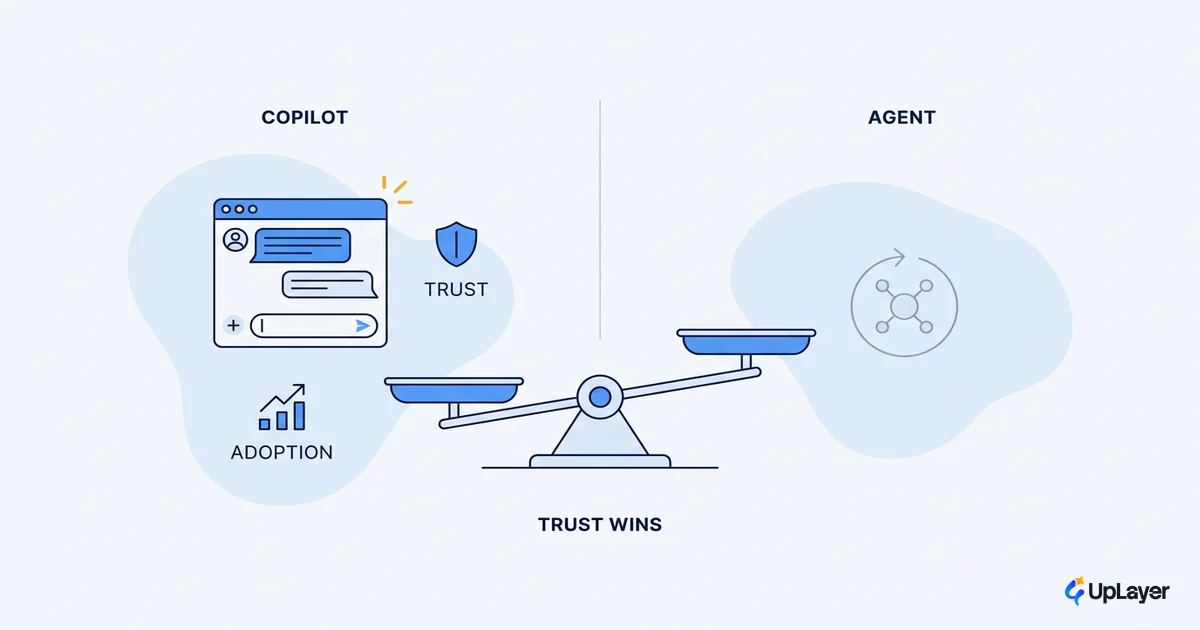
The default assumption in 2026 is that an agent is the upgrade and a product copilot is the training-wheels version. That assumption is canceling projects and burning budgets. A copilot, which drafts and suggests while a human stays in control, often beats an autonomous agent on the only measures that pay your bills: adoption, trust, and the support load you create when the AI is wrong.
The data is not subtle. Over 40% of agentic AI projects will be canceled by the end of 2027, Gartner predicts, because of escalating costs, unclear business value, or inadequate risk controls. The agent is not the safe default. It is the riskier bet wearing the more impressive label.
This is a field guide. We define both, give you the cases where a copilot wins clearly, and hand you a decision table you can run against your own feature this week.
Copilot vs agent: the one distinction that decides everything
A copilot assists a human who stays in control, suggesting and drafting while the person makes every decision. An agent acts autonomously toward a goal, planning and executing steps with little or no human input per step. Everything else is detail. The line that matters is who is accountable for the action the moment it happens.
That single difference cascades into everything you care about as a product team.
| Dimension | Copilot | Autonomous agent |
|---|---|---|
| Who decides | Human, every step | The system, per step |
| Failure cost | Caught before action | Discovered after action |
| Trust required to adopt | Lower | Much higher |
| Support load when wrong | A confused user | A cleaned-up mess |
| Governance needed | Light | Heavy |
| Best fit | Consequential, ambiguous work | High-volume, low-stakes, well-defined work |
A copilot is a form of supportive AI. It sits on top of the work the user is already doing and makes them faster without taking the wheel. That positioning is why it tends to clear the adoption bar autonomous systems keep missing. For the broader version of this decision framed around your stack, read copilot vs agent: which does your SaaS actually need.
Why pick a copilot over an agent: four cases where it wins
A copilot wins whenever the cost of a wrong autonomous action is higher than the cost of asking a human to confirm. Here are the four cases where that is reliably true.
When the action is consequential and hard to reverse
If a mistake spends money, contacts a customer, deletes data, or changes a record of truth, keep the human in the loop. A copilot drafts the email, proposes the refund, suggests the database change, and a person approves it. This is not a fringe view. Even in the most AI-forward companies, Microsoft's research finds that agents handle routine work end-to-end but still require oversight only for high-stakes or nuanced decisions. The few seconds of human review are cheaper than one autonomous error reaching a customer.
When trust has not been earned yet
New AI features start with a trust deficit, not a surplus. Adoption is rising fast across the market: Stanford's AI Index reports that 78% of organizations used AI in 2024, up from 55% the year before. But raw usage is not trust, and governance maturity has lagged that climb badly. A copilot lets users build confidence one confirmed suggestion at a time, which is exactly how trust compounds. An agent that acts without asking starts from a worse position and has to earn the same trust with the cost of being wrong already paid.
When support load is the real cost
Every autonomous action that goes wrong becomes a support ticket, a refund, or a churn risk. This is where the agentic-AI failure economics bite. The same Gartner analysis that projects the 40% cancellation rate ties those failures to escalating costs and inadequate risk controls, which is the polite phrasing for "it acted, it was wrong, and someone had to clean it up." A copilot converts most of those would-be incidents into a user who simply ignored a suggestion. That is a non-event instead of a ticket. When your support team is the constraint, the copilot is the cheaper architecture by a wide margin.
When the task is ambiguous or high-judgment
Agents do well on narrow, well-defined, high-volume tasks where success is unambiguous. They do badly when the right answer depends on context the model does not have, which is most B2B work. A good ai assistant for b2b saas leans into that reality. It surfaces options, shows its reasoning, and lets the domain expert apply the judgment the model cannot. We go deeper on this in designing AI assistants that earn trust.
When should you not build an AI agent
You should not build an agent when you cannot yet measure its task success rate, when a wrong action is expensive to reverse, or when you lack the governance to monitor it in production. Those three conditions describe most SaaS features in 2026.
There is also a quality problem in the market you are benchmarking against. Gartner calls out agent washing, the rebranding of chatbots and RPA as agents, and estimates only about 130 of the thousands of agentic vendors are real. The same January 2025 poll it ran found only 19% of organizations had made significant agentic-AI investments, while 31% were waiting or unsure. The label is inflated. Your decision should ignore the label and follow the cost of being wrong.
CAUTION
"Build an agent" sounds like ambition. Often it is unmeasured risk wearing a roadmap. If you cannot name the metric the agent moves and the cost of its worst wrong action, you are not ready to build one.
When you do decide an agent earns its place, fence it in with the right guardrails before it touches anything irreversible.
What does a product copilot do that an agent should not
A copilot owns the draft-and-suggest layer. It writes, proposes, ranks, and explains, then hands the decision to a person. An agent should never own the irreversible commit (the send, the charge, the delete, the write to a system of record) without a human gate. That is the whole boundary. Cross it only when you have the data to prove the action is safe to automate.
You can encode the rule. Score the feature, then route it.
def route_feature(f):
    # higher score = stronger case for a copilot, human-gated
    score = 0
    if f.action_is_irreversible:        score += 2   # send, charge, delete
    if not f.can_measure_success_rate:  score += 2   # no eval, no autonomy
    if f.task_is_ambiguous:             score += 1   # judgment beats automation
    if not f.has_production_governance: score += 1   # no monitor, no agent

    if score >= 3:
        return "copilot: human approves every consequential action"
    return "agent candidate: gate it, monitor it, graduate it later"
The copilot is not the lesser product. It is the version that ships, gets used, and earns the evidence you need to decide what to automate next.
A decision table you can run this week
The choice between a copilot and an agent is not philosophical. Score your feature against five questions and the answer falls out.
| Question | If yes, lean copilot | If yes, lean agent |
|---|---|---|
| Is a wrong action expensive or irreversible? | Yes | — |
| Can you measure task success rate today? | — | Yes |
| Is the task ambiguous or judgment-heavy? | Yes | — |
| Is it high-volume, repetitive, low-stakes? | — | Yes |
| Do you have production monitoring and governance? | — | Yes |
Three or more copilot answers means ship the copilot first. You can always graduate a proven copilot into a more autonomous agent once you have the reliability data and the governance to back it.
IMPORTANT
Doing it in this order is good de-risking, not timidity. Ship the human-gated version, watch the metric, and let real task-success data decide what earns autonomy. That is the logic behind building a product copilot that moves a metric, not a demo.
Autonomy is a milestone you reach, not a default you start from. For most B2B SaaS in 2026, a product copilot beats an agent because trust, adoption, and support load are the numbers that actually move your retention, and the copilot is the shape that earns all three before you bet a sprint on more. Start with the metric, keep the human on the consequential calls, and graduate to autonomy only when the evidence is in.
TIP
Not sure whether your next feature should be a copilot, an agent, or neither? How the AX Audit works. In 14 days we map the highest-value AI opportunity in your product, project its return on a metric you already track, and build a working concept demo of the right shape before you commit a sprint. The 3X Guarantee: we find AI worth at least three times the fee, or the audit is free.