Copilot vs agent: which does your SaaS need
Copilot vs agent comes down to one question: who approves the action, the user or the AI? A decision framework for SaaS teams on scope, cost, and risk.
 Sohanur RahmanAI Copilots & Assistants8 min read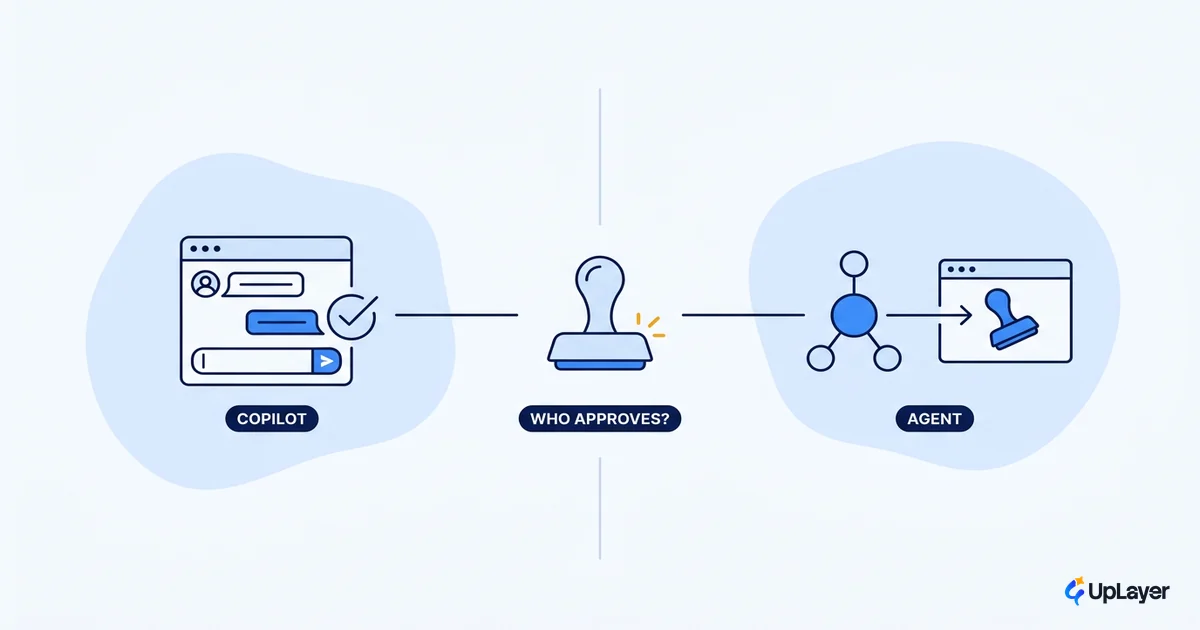
The pressure to "do AI" is being read by most product teams as pressure to ship an autonomous agent. So the roadmap fills with agents, the demos look impressive, and six months later half of them are quietly switched off. The copilot vs agent decision is the one that determines whether that happens to you, and most teams make it backwards. They pick autonomy first and look for a job to give it, when the honest path runs the other way.
There is one question that resolves most cases: who approves the action, the user or the AI? If a human approves before anything happens, you are building a copilot. If the AI decides and acts on its own, you are building an agent. That single line of accountability changes the scope, the cost, and the risk of everything downstream. This piece gives you the definition that matters, the moment a copilot is the right call, the real cost and risk trade-off, and a four-question test you can run against any feature on your roadmap. The deeper version of how these features should feel to a user lives in our guide to designing AI assistants for B2B SaaS that earn trust.
What is the difference between a copilot and an agent?
A copilot suggests and a human approves. An agent decides and acts on its own. Everything else (the model, the framework, the UI) is detail. The load-bearing difference is where the approval step sits.
This maps cleanly onto how the people building these systems describe them. In its engineering guidance on the topic, Anthropic separates workflows, where the model follows predefined paths a human laid out, from agents, where the model dynamically directs its own process. Their conclusion is worth holding onto: the most successful implementations use simple, composable patterns rather than the most autonomous architecture available. Autonomy is not a maturity level you graduate to. It is a design choice you make only when the work demands it.
A product copilot keeps the human in the loop on the decision that matters. An agent removes them from it. If you want the AI agent vs copilot distinction in more depth across patterns, the AI agent vs copilot breakdown for product teams goes one layer deeper. For the decision in front of you, this is enough:
| Copilot | Agent | |
|---|---|---|
| Who approves the action | The user | The AI |
| Primary mode | Suggests, drafts, recommends | Decides and executes |
| Human role | In the loop on every action | Out of the loop, in the loop on exceptions |
| Failure mode | Bad suggestion the user can reject | Wrong action already taken |
When does a copilot beat an agent?
A copilot beats an agent whenever a human needs to own the outcome, the cost of a wrong action is high or hard to reverse, the volume is low to moderate, and trust is the thing your adoption depends on. That covers most features in most B2B SaaS products. This is supportive AI: it makes a capable person faster without ever taking the wheel, it ships in weeks instead of quarters, and when it is wrong the user simply declines the suggestion and moves on.
The case for starting here is partly about where the rest of the market actually is. Adoption of AI is close to universal now.
78% of organizations reported using AI in 2024, up from 55% the year before, according to Stanford HAI's 2025 AI Index.
Near-universal adoption with very few clean wins tells you the bottleneck is not access to models. It is judgment about what to build. A copilot is the pattern that lets you ship a real AI feature, learn how your users actually behave around it, and earn the trust you will need before you ever ask them to let the software act unsupervised. Supportive AI is not the timid choice. It is the one that keeps you in the market long enough to make the bold one.
The copilot vs agent cost and risk trade-off
State the trade-off plainly and the decision gets easier. An agent costs more to build, far more to govern, and it fails louder. A copilot's worst day is a suggestion the user rejects. An agent's worst day is an action it already took, on real data, that someone now has to find and undo.
The market is already pricing this in. Over 40% of agentic AI projects will be canceled by the end of 2027, Gartner forecasts, citing escalating costs, unclear business value, and inadequate risk controls. The same analysis flags "agent washing," where vendors rebrand existing assistants and chatbots as agents without the substance, which is exactly how a team ends up paying agent prices for copilot capability. Building agentic AI for SaaS is not free optionality. It is a standing tax on engineering, governance, and trust.
Here is the trade-off as a table, then as a rule you can keep.
| Dimension | Copilot | Agent |
|---|---|---|
| Build time | Weeks | Months, plus integration work |
| Failure cost | Rejected suggestion | Executed wrong action |
| Governance load | Light (human is the control) | Heavy (audit, rollback, monitoring) |
| Reversibility | High (nothing happened yet) | Often low (action is done) |
| Trust impact | Builds it | Spends it fast if wrong |
Decision rule:
  approver == user   ->  build a copilot   (supportive AI, ships in weeks)
  approver == AI     ->  build an agent ONLY IF all of:
                           - work is high-volume and rule-defined
                           - wrong actions are bounded and reversible
                           - you already run audit + rollback + monitoring
                         else -> build the copilot, revisit on evidence
The point of writing it as code is that the rule is genuinely this mechanical. The agent branch has three preconditions and an else, and the else is the copilot. Most features land in the else.
Should my SaaS build a copilot or an agent?
Your SaaS should build a copilot when a human needs to own the outcome, and an agent only when the work is high-volume, rule-defined, reversible, and backed by governance you already have. Run this four-question test on any feature before you commit to a pattern.
| Question | If yes, lean | Why |
|---|---|---|
| Does a human need to own the outcome (legal, financial, brand, safety)? | Copilot | Accountability cannot be handed to a model |
| Is the task repetitive, rule-defined, and run hundreds of times a day? | Agent | Volume justifies the build; rules bound the risk |
| Is a wrong action hard or impossible to reverse? | Copilot | The approval step is your rollback |
| Do you already run mature audit, monitoring, and rollback? | Agent (cautiously) | Most teams shipping agents do not |
If you answered "copilot" to the first, third, or fourth question, that part of the feature is a copilot. Reserve agentic autonomy for the slice of work that clears all four bars.
The most useful move is to stop treating this as one choice for the whole product. The strongest 2026 builds split it by component. The judgment-heavy, human-facing layer gets a copilot. A narrow, high-volume execution layer underneath can get an agent, wrapped in the guardrails that keep it in bounds. A support tool, for example, gives the human a copilot that drafts replies while a back-office agent tags and routes the trivial tickets that never needed a person. If you want the longer version of that argument, when a product copilot beats an agent walks through it case by case.
WARNING
Define the metric and name the approver before you pick the model. A feature with no metric it should move and no clear human owner is not ready to be either a copilot or an agent. It is theater with a roadmap slot.
Decide against the metric, not the trend
Copilot vs agent is settled by one question, who approves the action, and answered for most SaaS features by the copilot. A copilot keeps a human accountable, ships in weeks, fails safely, and protects the trust your adoption runs on. An agent earns its heavier build and standing risk only when the work is high-volume, rule-defined, reversible, and governed. The teams getting this right are not the ones betting on autonomy. They are the ones who shipped supportive AI first, tied it to a number they already track, and graduated to autonomy only where the evidence justified it. Decide against the metric, not the trend, and the copilot vs agent question stops being a gamble and becomes a calculation.
TIP
Deciding which AI pattern your product actually needs, tied to the metric it should move? How the AX Audit works. We find AI worth at least 3x the fee, or the audit is free.