AI copilot for SaaS, from idea to a feature that ships
An AI copilot for SaaS earns its place when it does one job well enough to move a metric you already track. Here is the scoping path that gets it to ship.
 Shahriar P. ShuvoAI Copilots & Assistants7 min read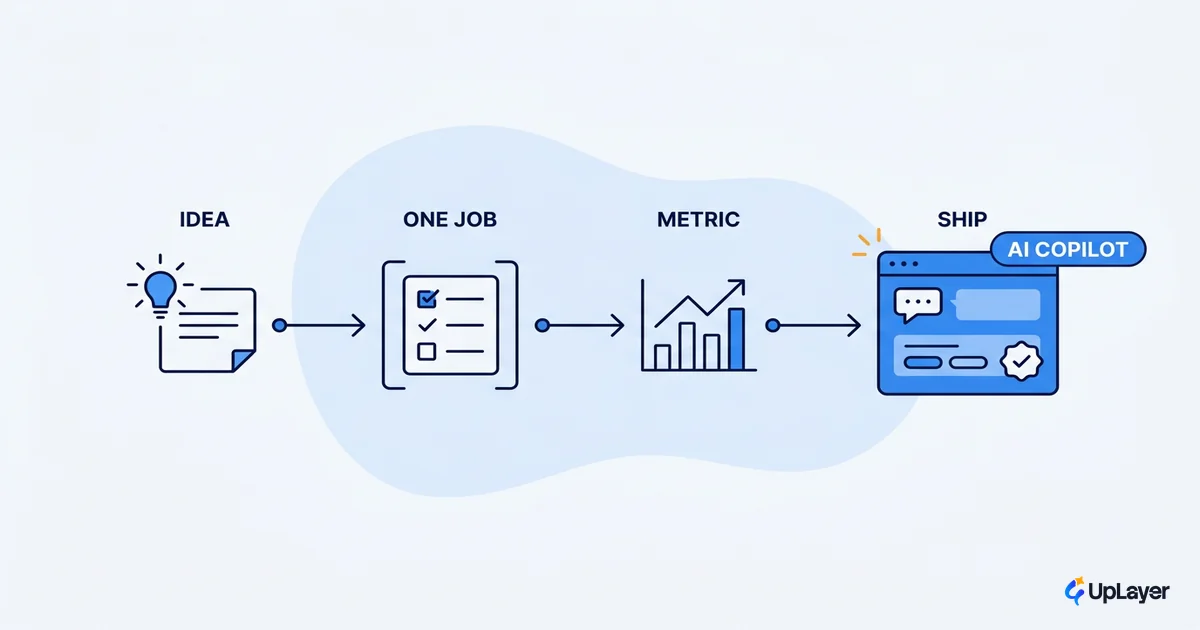
Most teams start an AI copilot for SaaS with the wrong sentence. It sounds like "we should have a copilot," and it ends with a chat box bolted to the corner of the app that promises to answer anything and earns the trust of no one. It demos well in the all-hands. It ships. It moves nothing.
The copilots that survive do the opposite. They pick one job, do it reliably, and move a number the team was already watching. Breadth is the trap. A narrow copilot that drafts the thing your users dread, or explains the data they keep misreading, beats a broad assistant that does fifty things at 60% quality. The path from idea to a feature that ships runs through scope, not stack.
This is the scoping path we use to take a copilot from a vague mandate to an AI assistant your users actually trust. Start from the metric. Pick the one job. Prove it before you build it.
Why an AI copilot for SaaS gets abandoned
The honest reason an AI copilot for SaaS fails is rarely the model. It's the absence of a job and a number. The feature was scoped to "be helpful," which is unfalsifiable, so nobody can say whether it worked, so it quietly gets deprioritized.
The data backs the pattern. Gartner expects at least 30% of generative AI projects to be abandoned after proof of concept by the end of 2025, citing poor data quality, escalating costs, and unclear business value. Distinguished VP Analyst Rita Sallam put it plainly: teams "are struggling to prove and realize value."
"After last year's hype, executives are impatient to see returns on GenAI investments, yet organizations are struggling to prove and realize value." (Rita Sallam, Gartner)
Unclear business value is a scoping failure wearing a budget costume. The fix is upstream of any engineering decision. Before you choose a framework, name the metric the copilot is supposed to move: activation, time-to-first-value, ticket deflection, expansion, retention. If you can't name it, you're not ready to build, and that is a good thing to learn for the price of a planning meeting instead of a quarter.
WARNING
The broad assistant is the most expensive version to build and the easiest to abandon. "Answers anything" means "is accountable for nothing." Scope down until the copilot owns exactly one job tied to one metric.
Where do you start with a SaaS copilot
You start with the metric, then the workflow, then the model. In that order. The metric tells you whether the feature earned its place; the workflow tells you where users already spend effort you can remove; the model is the last and least interesting decision.
Look for a workflow your users repeat. Repetition is the signal: the report they rebuild every Monday, the data they export and re-explain, the onboarding step where new accounts stall. A copilot that compresses a repeated, painful workflow has a built-in metric and a built-in audience. A copilot that invents a new behavior has neither.
This is also where you decide you want a copilot at all, rather than something that acts on its own. A copilot suggests and the human commits; an agent commits on its own. For high-trust SaaS work, suggestion is usually the safer first step. We walk through that fork in detail in when a product copilot is the right call versus an autonomous agent.
What should a SaaS copilot do first
The first job should be the one with the highest metric upside and the lowest trust risk. Retrieve-and-explain (answer questions over the user's own data) and draft-and-review (produce a first pass a human edits) are the two safest opening moves. Both keep a human in the loop, both have an obvious before-and-after, and both fail gracefully.
Narrow and useful is what gets a copilot kept. In a controlled GitHub experiment, developers given a focused copilot finished the task 55% faster (1 hour 11 minutes versus 2 hours 4 minutes) and at a higher completion rate. The point isn't the percentage; it's that a tightly scoped copilot on one job produces a delta you can actually measure. Microsoft's own research on early Copilot users found that 77% of early Copilot users didn't want to give it up, with users reporting they were 29% faster on the tasks it touched. Retention of the feature follows usefulness on a real job, not breadth.
Here's how the candidate first jobs compare. Score yours the same way before you build.
| Candidate first job | Metric it can move | Trust risk | Good first copilot? |
|---|---|---|---|
| Retrieve-and-explain over user data | Time-to-answer, activation | Low (cites sources) | Yes |
| Draft-and-review (email, report, summary) | Time-to-first-value | Low (human edits) | Yes |
| Triage and route (tag, prioritize) | Ticket deflection, response time | Medium | Often |
| Configure-on-command (change settings) | Onboarding completion | High (acts on state) | Later |
| "Ask me anything" assistant | None specific | High & diffuse | No |
NOTE
The two safest opening jobs share a shape: the AI proposes, the human disposes. Keep that loop until the metric proves the copilot is right often enough to earn more autonomy.
How do you add an ai copilot to a saas product
Adding a copilot is a sequence, not a sprint to a chat UI. The order protects you from shipping something you can't evaluate. This is the difference between building AI copilots that get used and ones that get abandoned: every step is gated by the metric, and the product copilot ships behind a flag so you can measure the lift against a real baseline.
COPILOT SCOPING FRAMEWORK
1. METRIC      Name the one number this copilot must move.
               (activation | time-to-value | deflection | retention)
2. JOB         Pick one repeated workflow that drives that metric.
               One job. Not a category of jobs.
3. LOOP        Design the propose -> review -> commit loop.
               Human stays in the loop on anything that changes state.
4. GUARDRAILS  Add reliability: cite sources, constrain scope,
               fail to a safe default, log every action.
5. SHIP        Release behind a flag to a cohort. Keep a control.
6. MEASURE     Compare the cohort's metric to the control.
               Kept if it moves. Killed if it doesn't.
Notice that the model choice never appears as its own step. It lives inside step 4, as an implementation detail of the loop and the guardrails. A SaaS copilot is a product decision first and a model decision a distant second. Once the job is fixed, the interaction layer still has real choices to make, and the LLM copilot design choices that shape the experience are where a scoped copilot either feels native or feels bolted on. We cover the practical side of building AI copilots that move a metric rather than a demo in its own piece, but the gate is always the same: does the cohort's number move.
Proving it before you build: the concept demo
You don't need the full build to know whether a copilot will earn its place. A Concept Demo does it first: a working prototype of the one job, on real-shaped data, that shows the loop and lets you project the metric move before committing the engineering. Projected, not achieved. The honest version of proof.
This is also where the supportive-AI thesis matters. A good AI assistant for B2B SaaS sits as a layer on top of the product you already built. It reads, drafts, explains, and suggests above the core engine, with reliability guardrails and a human on the commit. It is never the engine itself, never a model you bet the company on. That placement is what keeps a copilot from becoming a liability the day a model changes.
IMPORTANT
What not to build: the omniscient assistant, the copilot with no metric, and the agent that acts on production state before a narrower version has earned trust. Cut these in scoping, not in retro.
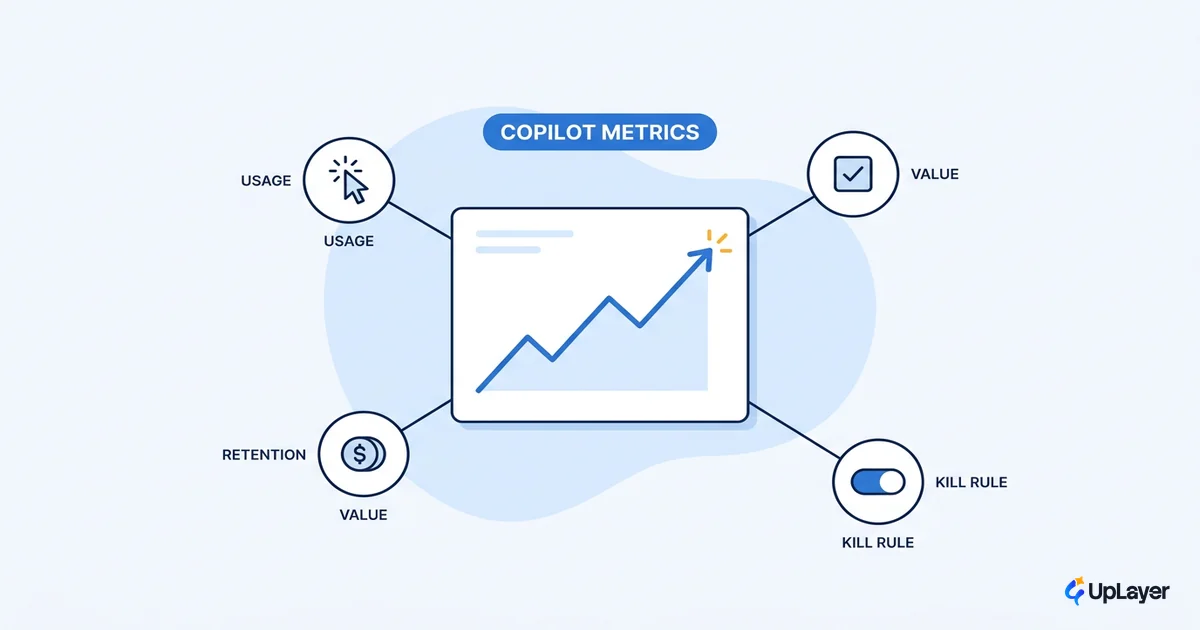
Once a Concept Demo projects a real move, the build is a known quantity, and so is the way you'll judge it. The same number that justified the copilot is the number you track after launch, using the metrics that prove a copilot works.
A copilot that ships is a copilot scoped to a job and a number. Start an AI copilot for SaaS from the metric you already track, give it one job it can do reliably, prove the move with a concept demo, and let the cohort data decide whether it lives. Breadth can come later, after the narrow version has earned the trust to expand. That is how an AI copilot for SaaS goes from a vague mandate to a feature that ships and keeps paying.
TIP
Want to know which copilot job will move a metric in your product, before you build anything? How the AX Audit works.