Choosing AI product features that move a number
A prioritization lens for AI product features: project the metric movement before you write the spec, and kill the ones that can't show one.
 Shahriar P. ShuvoAI for SaaS & Features7 min read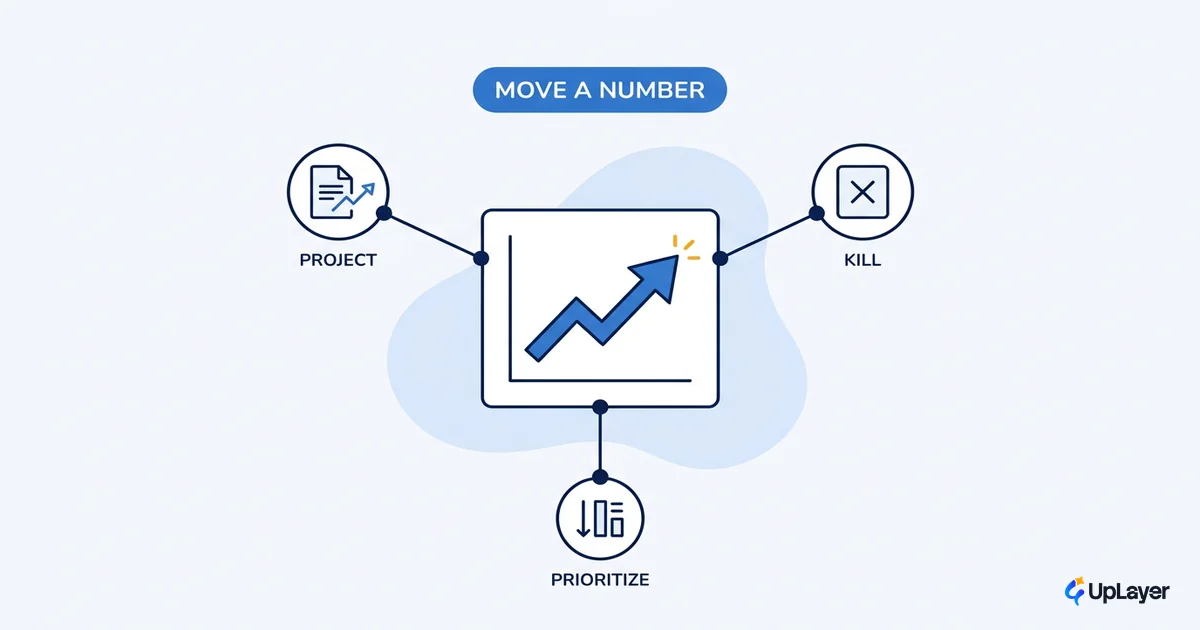
Most AI product features ship and move nothing. They demo well in the all-hands, they get a launch post, and three months later no metric on the dashboard has budged. The hard part was never the model. It's choosing which feature to build, and that choice usually gets made on demo appeal instead of on a number you already care about.
We start from the other end. Pick the feature by the metric it's projected to move (churn, activation, conversion, expansion), project that movement before you write the spec, and kill anything that can't show one. That discipline is unglamorous and it's the whole game. If you're still deciding which AI features for SaaS are worth adding, this is the lens to run them through first.
Most AI product features ship and move nothing, and that's a choosing problem
The failure rate is a selection failure, not a model failure. The models are good enough. The features that flop flopped because nobody projected what number they were supposed to move before the build started.
The data is blunt. In MIT's GenAI Divide study, only about 5% of enterprise AI pilots hit real revenue acceleration while the vast majority stall and deliver no measurable impact on the P&L. Gartner expects at least 30% of generative AI projects to be abandoned after proof of concept, in part because of unclear business value.
Only about 5% of enterprise AI pilots achieve rapid revenue acceleration. The rest stall with little to no measurable P&L impact. (MIT NANDA, The GenAI Divide, 2025)
If you've already spent $20k to $50k on a chatbot nobody opens, you know this number from the inside. The fix isn't a better model. It's a better question asked earlier: what does this feature move, and by how much. That question belongs at the very front, when you are still generating candidates, which is why the best AI SaaS ideas start from a metric, not a demo.
What makes an ai product feature worth building?
An ai product feature is worth building only when you can name the metric it moves and project the movement before you spec it. That's the bar. Everything else is taste.
Three tests decide it:
- It maps to a metric you already track. Not a new vanity metric invented to justify the feature. Churn, activation rate, trial-to-paid conversion, net expansion. A number your board already sees.
- There's a believable mechanism. You can draw the chain from feature to a specific user behavior change to the metric. If the chain has a hand-wave in the middle, the projection is fiction.
- The projected lift beats the boring alternative. A faster onboarding email or a better empty state often moves the same metric for a tenth of the cost. The AI version has to win on projected impact, not on novelty.
The best ai features for saas tend to be the supportive ones (a copilot, in-product search, summarization, triage) that sit as a layer on top of work users already do. They have short, legible chains to a metric. The ones that flop are usually the ones chasing a capability rather than a behavior.
| Feature pattern | Earns its place when | Skip it when |
|---|---|---|
| In-product copilot | It removes a repeated manual step tied to activation or retention | It's a chat box bolted on with no job to do |
| Semantic / AI search | Findability is a measured drag on activation or expansion | Search already works and nobody complains |
| Summarization / triage | It collapses a slow workflow users do weekly | The summary saves 10 seconds nobody was losing |
| Predictive scoring | The score changes a decision someone actually makes | The score is shown but never acted on |
| Generative content gen | Output volume is the bottleneck to a tracked metric | It produces drafts that always get rewritten |
How do you tie a feature to a metric?
You tie a feature to a metric by writing the chain down and putting numbers on it. Feature to behavior to metric, with every assumption visible. If you can't fill in the blanks, you've found a feature to cut, not a spec to write.
Here's the projection shape we use to estimate projected roi before any code exists.
projected_metric_lift =
    reach            # % of active users who hit this feature
  x adoption         # % of those who actually use it (be pessimistic)
  x behavior_delta   # change in the target behavior per adopter
  x metric_sensitivity  # how that behavior maps to the metric

projected_value =
    projected_metric_lift
  x value_per_unit_of_metric   # $ per retained account, per activation, etc.

# Worked example (Concept Demo, projected, not a real client):
#   reach            = 60% of active users see the copilot
#   adoption         = 25% use it in week one (deliberately conservative)
#   behavior_delta   = +1 completed key action in onboarding
#   metric_sensitivity = that action lifts 30-day activation ~8 pts for the cohort
#   => projected activation lift, then x value_per_activated_account = projected ROI
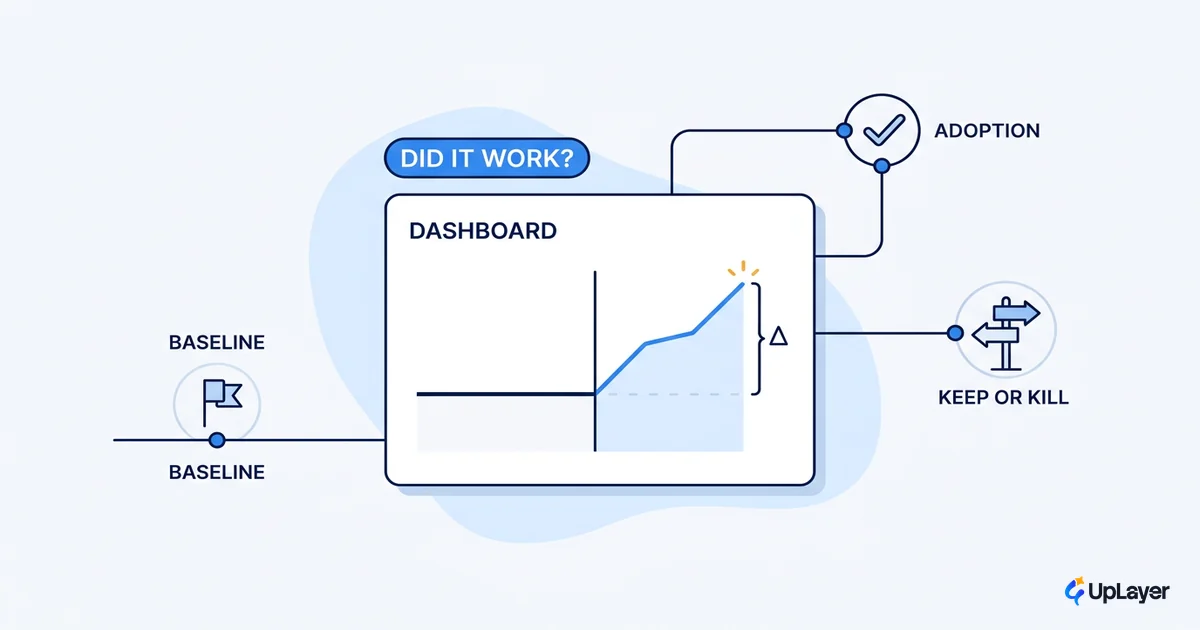
The point of writing it this way is that it forces a pessimistic adoption number into the math early, where ai feature adoption is usually the assumption that quietly kills the case. A feature that needs 80% adoption to pay back is a feature that won't pay back. When the build ships, you measure whether the AI feature actually worked against the same chain, so the projection and the post-launch read use one model, not two.
NOTE
Show the assumptions, not just the answer. A projection with visible inputs can be argued with and corrected. A single confident number with no math behind it is the thing that gets a feature shipped and then quietly buried.
How do you choose ai product features when several look good?
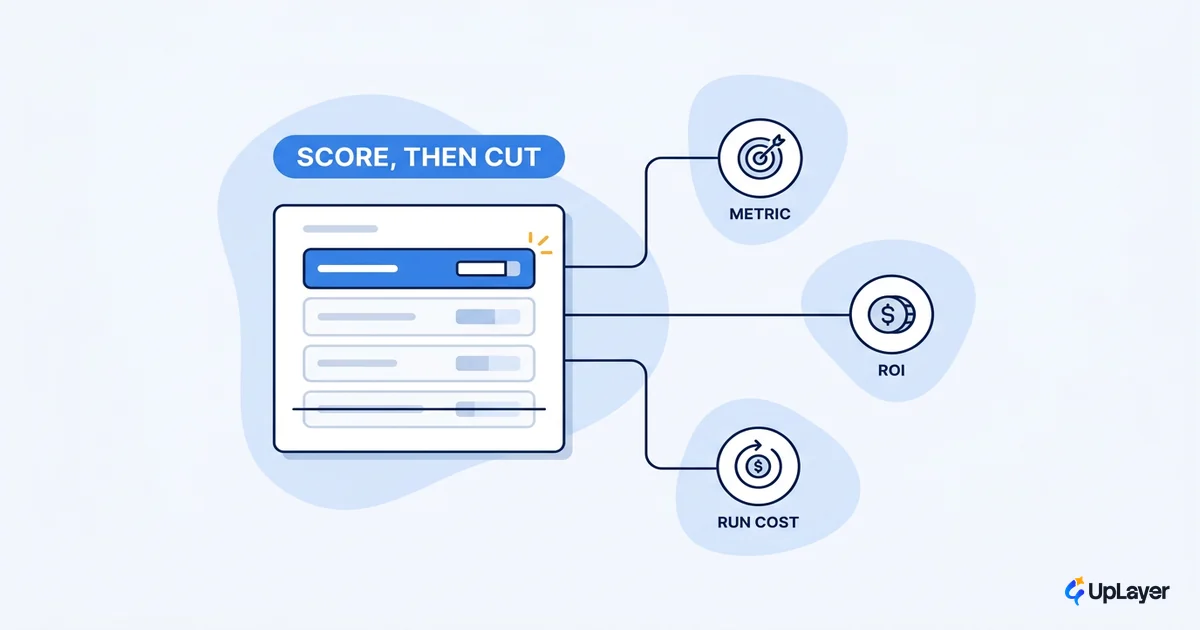
You choose ai product features by scoring them on projected impact against cost and confidence, then enforcing a hard floor: no projected number, no spec. The scoring keeps you honest when three features all "feel" important.
A lightweight pass we run on a candidate list:
score = (projected_metric_value x confidence) / build_cost

where:
  projected_metric_value = projected_value from the chain above
  confidence             = 0.1 to 1.0, how much you trust the assumptions
  build_cost             = design + eng + ongoing reliability work

reliability_gate: if a wrong/hallucinated output damages trust on a
high-stakes action, the feature must clear a guardrail bar before it
scores at all. Trust failures cap adoption, which caps every metric.
Run every candidate through it, rank by score, and draw a line. Below the line is not a backlog, it's a kill list. Being willing to kill the AI features that should not ship is the part most teams skip, and it's where the leverage is. This is the same muscle as choosing to prioritize AI features by projected ROI rather than by who argued loudest in the planning meeting.
WARNING
If a feature can't show a projected number on a metric you already track, it doesn't get a spec. Not a smaller spec. No spec. This is the rule that prevents the chatbot-nobody-opens outcome, and it's the rule the data keeps validating.
The cost of skipping this is documented. Gartner expects over 40% of agentic AI projects to be canceled by end of 2027 over escalating costs and unclear business value, and BCG found that only about a quarter of companies move beyond proofs of concept to real value. The teams in the other three-quarters mostly didn't lack models. They lacked a way to say no.
Reliability is part of the projected roi, not a tax on it
A feature that hallucinates loses the adoption that creates the metric movement. So reliability isn't a separate workstream you bolt on later. It's inside the projection, because adoption is inside the projection.
Guardrails, human-in-the-loop on high-trust actions, and honest confidence signals are what let users keep using the thing past week two. That sustained use is the only reason the projected number lands. Treat reliability as a multiplier on adoption, not a line item you cut to ship faster. Cut it and you cut the metric you were building for.
The teams that get value from AI aren't building more ai product features. They're choosing fewer, projecting each one against a number they already track, and proving the lift before they scale it. Build the two that move a metric and skip the eight that move a demo, and your roadmap starts paying for itself instead of just shipping.
TIP
Want the projection done on your actual metrics before you build? How the AX Audit works.