Picking an AI workflow automation platform
How to choose an AI workflow automation platform without lock-in: a real comparison framework, the exit-cost test, and when point tools win.
 Shahriar P. ShuvoAI Automation7 min read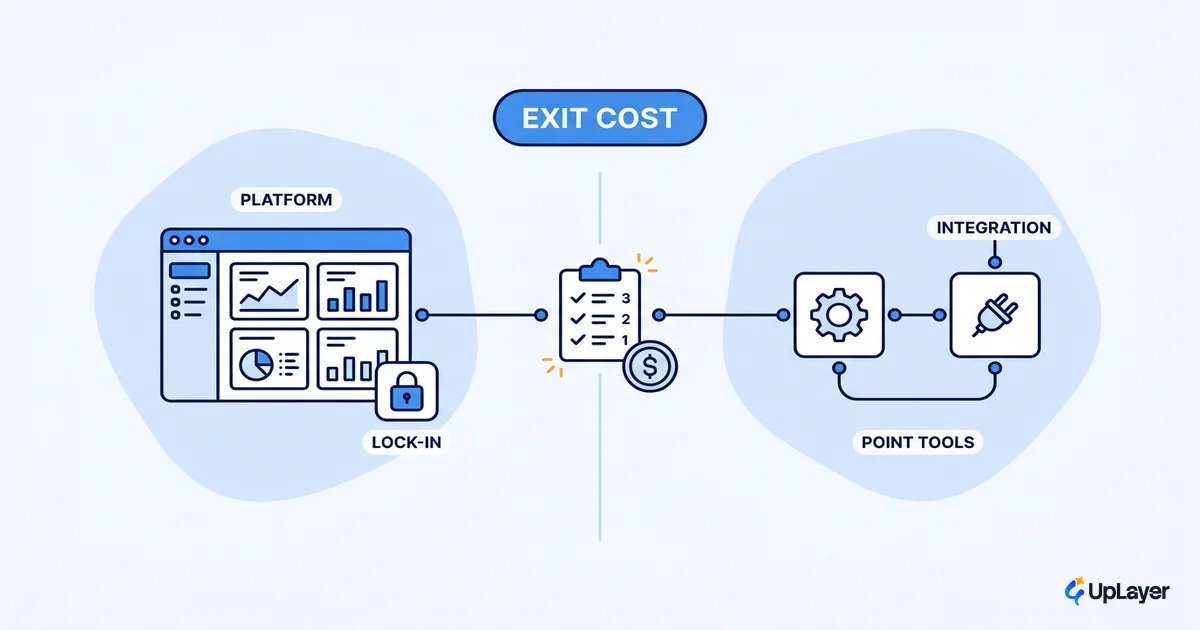
The demo always wins the room. Someone drags three boxes onto a canvas, an AI step summarizes a ticket, a Slack message fires, and the deal closes in your head before the trial ends. Eighteen months later the renewal owns you, your workflows live in a format only that vendor reads, and moving costs more than staying. That is the real risk in choosing an AI workflow automation platform: not the price on the invoice, but the price of leaving.
So price the exit before you price the seats. A platform is a bet on switching costs. The question is not which tool has the most integrations. It is whether this commitment proves AI moves a metric you already track, and what it costs you to walk away if it does not. If you are still deciding whether automation pays for your team at all, start with AI workflow automation ROI for SaaS teams and come back here once the business case holds.
This piece gives you a comparison framework instead of a feature grid: what actually makes a good platform, how to compare true cost, the exit-cost test that de-risks the decision, and the cases where point tools or no tool at all beat buying a platform.
What makes a good AI workflow automation platform
A good AI workflow automation platform earns its place on three axes: value, portability, and reliability. Most buyers grade only the first, and only on demo day.
Value means it moves a metric you already report on, not a vanity number the vendor invented. Portability means you can leave with your workflows, your data, and your logic intact. Reliability means guardrails and human-in-the-loop where a wrong answer costs trust. Score a platform on all three before a single seat is purchased.
The hype tax is real here. Gartner predicts more than 40% of agentic AI projects will be canceled by the end of 2027, driven by escalating costs, unclear business value, and weak risk controls. The same analysis names "agent washing": vendors rebranding ordinary RPA, chatbots, and assistants as agents. Half of what gets sold as AI powered workflow automation is deterministic plumbing with a chat box stapled on. That is fine if you need plumbing. It is a problem if you paid an AI premium for it.
Use a weighted scorecard so the loud features do not drown out the load-bearing ones.
| Criterion | Weight | What good looks like | What to discount |
|---|---|---|---|
| Metric impact | 30% | Ties to retention, activation, or cost-to-serve | "Hours saved" with no baseline |
| Portability | 25% | Exports workflows and data in open formats | Logic locked in a proprietary canvas |
| Reliability | 20% | Guardrails, evals, human-in-the-loop | "It just works" with no failure plan |
| Real AI vs. RPA | 15% | Genuine model reasoning where it helps | Agent-washed rule engine |
| Total cost to scale | 10% | Predictable as workflows grow | Per-run pricing that punishes success |
NOTE
Weights are a starting point, not gospel. If you are in a regulated space, reliability and portability outrank everything. Re-weight for your buyer, then score every shortlisted tool against the same rubric so the comparison is honest.
How do you compare automation platforms on true cost
You compare automation platforms on total cost, not sticker price. Total cost is run cost plus integration cost plus the exit cost most buyers never price at all.
Sticker price is seats, tasks, or runs. It is the smallest number in the deal. Integration cost is the engineering time to wire the platform into your stack and keep it wired as both sides change. Exit cost is what you pay to rebuild everything somewhere else when the renewal turns hostile or the vendor pivots. Compare the right AI workflow automation tools on all three, because the cheapest sticker often hides the steepest exit.
The scaling tax is where budgets quietly break. Deloitte's Global Intelligent Automation survey finds that fragmented processes are what stall automation programs before they scale. A platform that demos beautifully on one clean workflow can collapse under ten messy real ones, and the cost of forcing your fragmented reality into its model shows up nowhere on the pricing page.
True cost of an AI workflow automation platform (annual)

  total = license
        + (integration_eng_weeks   x loaded_weekly_rate)
        + (maintenance_eng_weeks   x loaded_weekly_rate)
        + run_or_task_overage
        + (exit_eng_weeks x loaded_weekly_rate) / expected_years_on_platform

# Exit cost is divided across the years you expect to stay.
# A 2-year platform with a 6-week exit carries 3 exit-weeks per year.
# If that line dwarfs the license, you are buying lock-in, not leverage.
Run the formula before the second sales call. If exit cost is the largest term, the vendor is selling you switching costs dressed as features.
The exit-cost test that de-risks the choice
The exit-cost test is one question asked three ways. Can you export your workflows, your data, and your business logic in a form a different tool can actually use? If any of the three is trapped, the platform owns you, and that is what you have to de-risk before you sign.
Workflow export is easy to fake. A vendor will happily hand you a JSON dump that no other system can read. Data export is usually fine until you read the contract's fine print on format and cadence. Logic is where lock-in really lives, and it is worst in no-code tools where the rules exist only as boxes and arrows on a canvas you cannot run anywhere else.
WARNING
No code AI workflow automation is the fastest way to ship and the fastest way to get stuck. The same drag-and-drop that lets a non-engineer build a flow in an afternoon hides your logic in a proprietary editor. Before you commit, confirm you can export the full logic, not just a screenshot of it. Our guide to no code AI workflow automation covers where it pays off and where it traps you.
Make the test concrete. Pick your single most valuable workflow, ask the vendor for a full export, and have an engineer estimate the weeks to rebuild it on a neutral stack. That number is your exit cost. A platform worth buying makes that number small on purpose, because confident vendors compete on value, not on hostages.
When should you pick a platform over point tools
You pick a platform over point tools when you have three or more connected workflows that share data, identity, and governance. Below that line, point tools almost always win.
A point tool does one sharp job and gets out of the way. It is cheaper, easier to leave, and easier to reason about. A platform earns its place only when the cost of stitching point tools together, and governing them, exceeds the cost of the platform itself. AI powered workflow automation does not change that math; it just raises the stakes on both sides.
| Situation | Pick |
|---|---|
| One high-value job, clear inputs and outputs | Point tool |
| Three or more workflows sharing data and access rules | Platform |
| You cannot yet name the metric it should move | Buy neither yet |
| Heavy compliance, audit, and human-in-the-loop needs | Platform with strong guardrails |
| A proof of concept you might kill in a quarter | Point tool or a thin custom build |
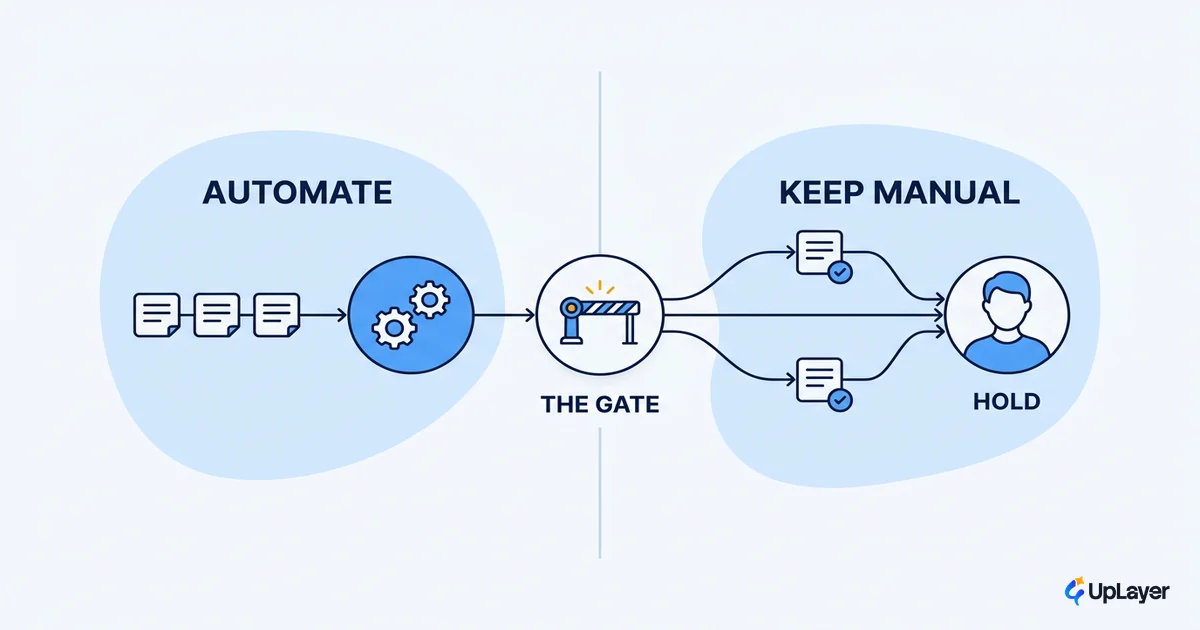
The honest answer is sometimes "buy neither yet." If you cannot name the metric the automation should move, no platform will find it for you, and a smaller commitment will teach you more for less. We made that case in full in when not to automate with AI, because the most expensive automation is the one you scale before you have proof it works.
TIP
Before committing to a platform, run a Concept Demo on your single highest-value workflow. Build it thin, instrument the metric, and watch a real number for two weeks. A working demo on one workflow tells you more about fit than a vendor's entire integration list.
Tie the platform choice back to a metric you already track
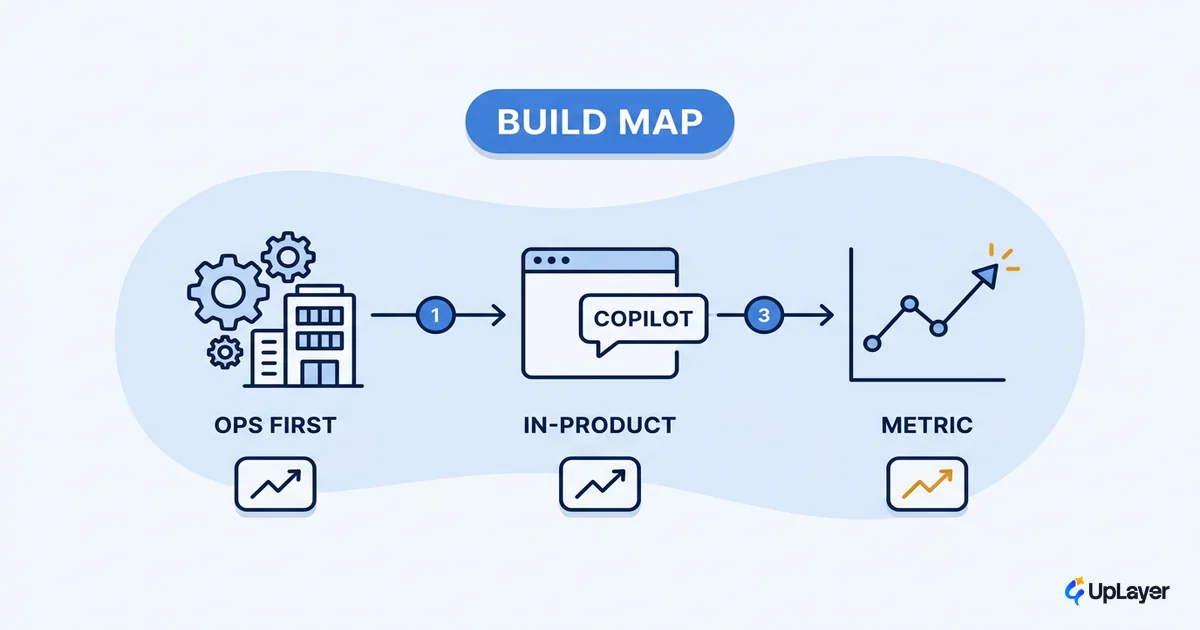
Every platform decision should resolve to one metric you already report on. Not "hours saved." A number your board sees: gross retention, activation rate, cost-to-serve, expansion. If the platform cannot be traced to one of those, it is a cost center wearing an AI badge.
The gap between teams that do this and teams that do not is widening. BCG's 2025 analysis finds the roughly 60% of companies that lag capture almost none of the value, while the leaders reinvest returns and pull further ahead. The difference is rarely the tool. It is whether the work was tied to a number from the start.
So run a small projected model before you buy. Suppose support automation is the workflow and the metric is cost-to-serve. If your team handles 8,000 tickets a month at a loaded cost of $6 each, and a well-designed assistant deflects a projected 25%, that is 2,000 tickets and $12,000 a month. Set that against the platform's true cost, including the exit term. If the projection does not clear the cost with room to spare, the answer is no, and saying no is the cheapest decision you will make all year.
Picking an AI workflow automation platform is a procurement decision dressed as a technology one. Price the exit, weight the scorecard, prove the metric on one workflow, and the choice gets quiet and obvious. The teams that get locked in are the ones who graded the demo. The teams that scale are the ones who graded the math, which is the whole point of treating an AI workflow automation platform as an ROI decision rather than a feature shootout.
TIP
Want a number before you commit to any platform? How the AX Audit works. We find the single highest-ROI AI opportunity in your product, project the impact on a metric you already track, and tell you what not to build, backed by our 3X Guarantee.