Choosing an AI agent framework as a product call
How to choose an ai agent framework by product constraints (control, observability, cost) instead of GitHub stars, written for the team that owns the roadmap.
 Sohanur RahmanAI Copilots & Assistants7 min read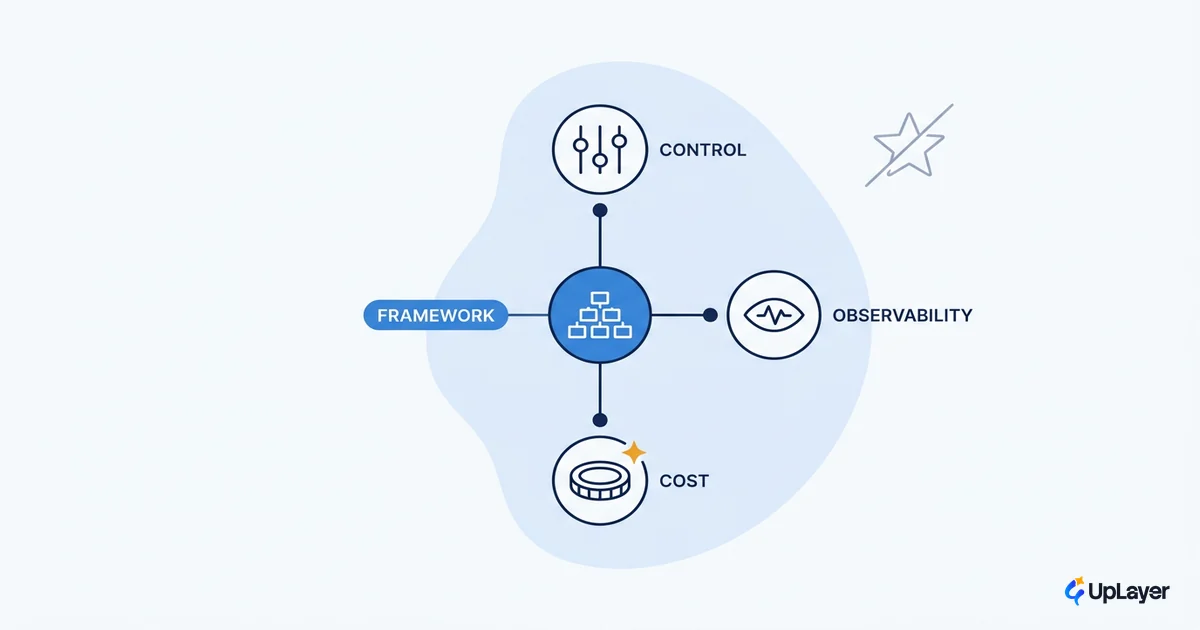
The choice of an ai agent framework is the least interesting decision in your AI feature, and the one that gets the most airtime. Your engineers will benchmark LangGraph against CrewAI against the OpenAI Agents SDK, count GitHub stars, and bring you a recommendation. None of that tells you whether the feature will move a number you already track.
We think the framework is a product call, not an engineering popularity contest. The question that matters is not "which library is best." It is "which constraints decide this for our product, and who owns the bill when an agent loops 40 times on a customer's request." If you own the roadmap, those constraints are yours to set before any code gets written. This piece gives you the four that count and a way to weigh them, drawn from how we design AI assistants for B2B SaaS that earn trust.
The ai agent framework is a product decision, not a GitHub-stars contest
Pick by constraints, not by stars. The framework rarely reaches the user, but the cost, latency, and failure behavior it shapes reach the user every session. That is where the decision actually lives.
Start with the sobering context. Gartner predicts more than 40% of agentic AI projects will be canceled by 2027, driven by escalating costs, unclear business value, and inadequate risk controls. Notice what is missing from that list: nobody's project dies because they chose the wrong agent library. They die because the thing cost too much and proved too little.
So the framework question is downstream of four product constraints. Hold the roadmap, and these are your levers:
- Control. How much of the agent's behavior can you pin down, inspect, and override versus how much you hand to the model.
- Observability. Whether you can see, replay, and debug what the agent did when a customer complains.
- Cost to serve. The unit economics per session, which compound directly against your margin.
- Blast radius. What an agent can touch when it is wrong, and how fast you can stop it.
Frameworks differ on how much of each they hand you by default. That is the real comparison, not the feature matrix.
How do you choose an ai agent framework
Score the candidates against your constraints, not their changelogs. Here is the buyer-facing tradeoff, framed for the person approving the work rather than writing it.
| Option | Control | Observability | Cost to serve | Best when |
|---|---|---|---|---|
| LangGraph | High. Low-level control, durable execution, and human-in-the-loop | Strong via LangSmith tracing | Higher build effort, predictable runtime | You need stateful, long-running, auditable flows |
| OpenAI Agents SDK | Medium. Few abstractions: agents, handoffs, guardrails | Built-in tracing | Tied to one provider's pricing | You want a fast, lightweight start and accept vendor coupling |
| CrewAI | Medium. Role-based multi-agent orchestration | Decent, framework-managed | Multi-agent calls multiply token cost | A genuine multi-agent workflow earns its complexity |
| No framework (thin workflow) | Highest. You own every step | Whatever you instrument | Lowest, fully in your control | The task is a few deterministic steps with one model call |
That last row is not a joke. Anthropic, after working with dozens of teams, reports that the most successful agent builds use simple, composable patterns rather than complex frameworks. For a supportive in-product feature, "no framework" is often the correct answer, and the cheapest to maintain.
When you ask how do you choose an ai agent framework, run it as a scorecard. Weight the four constraints by what your product cannot afford to get wrong, score each candidate, and let the numbers decide. If two options tie, pick the one your team can debug at 2am.
What an ai agent saas team should actually weigh
Tie every constraint to a metric you already report. An ai agent saas feature that cannot be traced to retention, activation, conversion, or cost per resolved request is a science project, not a product.
The barrier teams hit is not capability. It is reliability. In LangChain's survey of more than 1,300 professionals, performance quality is the top barrier to putting agents in production, more than twice as significant as cost. Translation: the model can usually do the task in a demo. Making it do the task correctly, every time, for a paying customer is the hard part, and that is a product and design problem more than a framework one.
So what should a product team weigh in a framework? Weigh the things that show up on your dashboard. The clearest one is unit cost, because an agent's economics compound per session:
cost_per_resolved_session =
    (avg_model_calls_per_session * avg_tokens_per_call * price_per_token)
    + tool_and_infra_cost_per_session

contribution_margin_per_session =
    revenue_or_value_per_session - cost_per_resolved_session

# A framework that triples avg_model_calls_per_session to look
# "more agentic" can quietly erase the margin on the feature.
Run that math before you pick. A multi-agent framework that fans out to five sub-agents may be elegant and still unaffordable at your volume. The framework that wins is the one that hits your quality bar at a cost per session your margin can carry.
Does the ai agent framework affect the user experience
Rarely in the way buyers fear, and often in a way they ignore. The user does not see "LangGraph" or "CrewAI." They see latency, accuracy, and how gracefully the thing recovers when it is wrong. Those are shaped by your framework choice even though the brand never appears in the UI.
So when someone asks does the ai agent framework affect the user experience, the honest answer is: the label does not, the behavior does. A framework that makes streaming, interrupts, and human handoff easy produces a calmer experience. One that buries failures produces a frustrating one. This is the heart of building agentic ai saas that supports the user without the autonomy hype: the experience is a design decision the framework either helps or fights.
WARNING
Beware "agent washing." Gartner notes that many vendors rebrand assistants, RPA, and chatbots as agents without substance. Picking the most autonomous-sounding framework does not make your feature better. It usually just widens the blast radius and the bill.
There is also churn risk in the choice itself. Frameworks deprecate. Microsoft's AutoGen is now in maintenance mode, with users pointed at a successor. Betting your UX on a fast-moving library means accepting that migration is a when, not an if. Favor options whose primitives you could rebuild yourself if you had to.
Reliability guardrails are the real deliverable
The framework is plumbing. The reliability guardrails are the product. What keeps a copilot trustworthy is not which graph library you used, it is the constraints around it: input and output validation, human-in-the-loop on high-trust actions, evaluation against real cases, and observability you can replay.
These outlast any framework decision. Whether you build on LangGraph or on a hundred lines of your own code, you still need AI agent guardrails that keep a copilot in bounds. Strong frameworks help here, LangGraph's durable execution and tracing exist for exactly this, but no framework hands you reliability for free. You design it, and you measure it against the metric the feature is supposed to move.
This is why we say the framework debate is a distraction from the work that matters. Spend the planning energy on guardrails, evaluation, and the metric. The library is an implementation detail you can swap.
When the right answer is no framework at all
Sometimes the best ai agent framework is none. Many supportive features, summarize this, triage that, answer from these docs, are a few deterministic steps with a single model call. Wrapping them in an autonomous agent platform adds cost, latency, and failure modes you then have to guard against.
Before you adopt anything, decide what kind of feature you are building. Our take on how to build an ai agent, the product decision first and on whether you need a copilot or an agent at all both start in the same place: most SaaS features need a tight, auditable workflow, not full autonomy. If a thin pipeline hits your quality bar at a lower cost per session, that is the answer. Choosing not to build the agentic version is a legitimate, often correct, product decision.
The teams that win the next year will treat the ai agent framework as a constraint-driven, reversible choice, scored against a metric and a cost they already track, rather than a flag they plant on the most-starred repo. Pick for control, observability, and cost to serve, design the guardrails as the real deliverable, and keep the option of no framework on the table.
TIP
Before you commit to a framework, find out whether the feature pays off at all. How the AX Audit works.