How reliability becomes an AI ROI lever
Reliability is an AI ROI input, not a nice-to-have. A feature users don't trust gets no adoption and no return. Here's the math and how to defend the spend.
 Shahriar P. ShuvoAI ROI & Strategy7 min read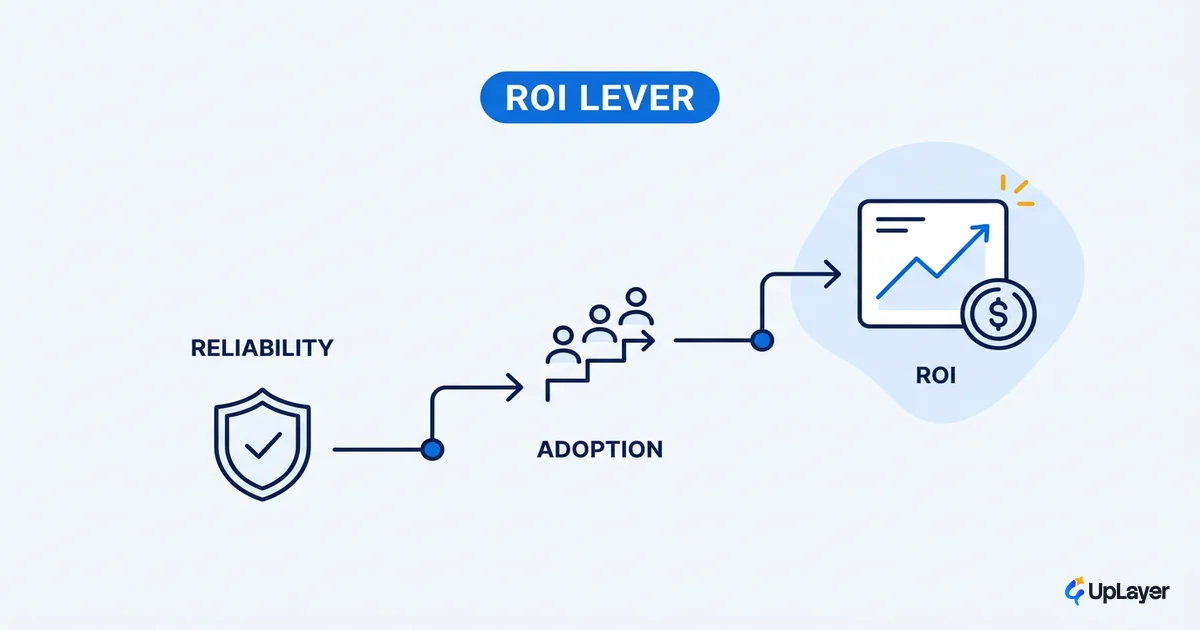
Every AI ROI model has a silent assumption buried in it: that the feature gets used. The spreadsheet multiplies impact-per-use by some number of uses, and that second number is where most projections quietly lie. A feature users don't trust gets opened once, fails them, and never gets opened again. Adoption goes to zero, and so does the return. That is why reliability is not a cost line to trim. It is one of the largest inputs to the return, and almost nobody puts it in the model.
This piece is for the founder or Head of Product who already accepts that AI has to pay off and is now asking the sharper question: what actually determines whether it does? The answer is a chain that runs from reliability to trust to adoption to the metric you already track. We'll walk that chain, show the math, and give you the language to defend reliability spend to a finance team that wants to cut it.
The AI ROI equation has a hidden multiplier: adoption
The benefit half of any AI ROI calculation is simple to write and easy to fake: value-per-use times number-of-uses. Teams obsess over the first term (how much time the summary saves, how many tickets the triage deflects) and wave their hands at the second. The second term is adoption, and reliability sets it.
This is why the failure data is so brutal. In MIT's State of AI in Business 2025 report, about 95% of enterprise generative AI pilots produced no measurable impact on the bottom line. The report's own diagnosis is the part to sit with: the failures are not about model quality. They are about integration and a learning gap. Translated into the equation, the value-per-use was often real, but the number-of-uses collapsed. People tried the feature, it was unreliable in a way that cost them, and they stopped.
The 95% failure rate for enterprise AI solutions represents the clearest manifestation of the GenAI Divide. (MIT NANDA, The GenAI Divide: State of AI in Business 2025)
So the honest version of the model has reliability sitting upstream of the entire benefit term. A feature that is 90% reliable and a feature that is 99% reliable do not differ by nine points of accuracy. They differ by whether the feature still has users in month three. Before you can price that in, it helps to know how to measure the ROI of an AI feature honestly, so the inputs to your projection are real numbers rather than optimism.
Does AI reliability affect ROI?
Yes, directly, and it is the most under-priced input in the whole model. The mechanism is short: unreliable output trains users to stop trusting the feature, trust loss kills reuse, and reuse is the only thing that turns a shipped feature into a moved number.
You can see the cost in the abandonment data. Gartner predicted that at least 30% of generative AI projects would be abandoned after proof of concept by the end of 2025, naming inadequate risk controls and unclear business value among the top causes. Inadequate risk controls is the polite phrase for "we shipped something that was wrong in ways we couldn't catch." That is a reliability failure, and it shows up in the books as a written-off pilot.
The asymmetry matters more for AI than for ordinary features. When a search filter breaks, it shows zero results and the user knows to try again. When an AI summary breaks, it invents a confident number the user forwards to their boss. The first failure is recoverable and the second one poisons trust permanently. So the return on the feature is not set by how good the model is on a good day. It is set by how rarely it betrays the user on a bad one.
Why does trust drive AI adoption and ROI?
Because trust is what converts a feature that works into a feature that gets used, and only the second one moves a metric. Reliability is the engineering property. Trust is what the user feels after enough reliable interactions that they reach for the feature by default. The return lives in that default.
The trust gap is wider than most roadmaps assume. In the KPMG and University of Melbourne global study of more than 48,000 people across 47 countries, 66% of people already use AI regularly but only 46% are willing to trust it. The same study found people have grown less trusting as adoption rose, not more. Usage without trust is fragile usage. It survives until the first bad experience and then it churns.
Although 66% of people are already intentionally using AI with some regularity, less than half of global respondents are willing to trust it. (KPMG / University of Melbourne, Trust, attitudes and use of AI 2025)
For a B2B SaaS product, that fragility is the whole story. A trusted in-product assistant gets reused weekly and quietly compounds into retention and activation. An untrusted one gets a launch-week spike and a flat line after. If you want the feature to increase AI adoption in your product durably, you are really asking how to earn trust fast enough that adoption survives contact with reality. Trust is the bridge between a feature that ships and a feature that moves a metric.
How do guardrails improve AI ROI?
Reliability guardrails raise the trust ceiling, and the trust ceiling caps the adoption ceiling, which caps the return. Guardrails are not a safety tax bolted on at the end. They are the mechanism that keeps the benefit term in your ROI model from leaking away. Understanding what guardrails actually are (input controls, output validation, and behavioral limits) is the prerequisite to pricing them as an ROI input.
The clearest way to think about it is as a multiplier on the benefit you already projected.
Reliability-adjusted AI ROI

ROI = (Value-per-use  ×  Uses-per-period  ×  Adoption rate) − Cost
                                              ▲
                                    set by trust, set by reliability

Adoption rate ≈ f(trust)
trust         ≈ f(reliability over time)
reliability   ≈ f(guardrails + human-in-the-loop on high-stakes actions)

A feature with 2× the guardrail coverage doesn't return 2× more.
It returns the difference between an adoption rate that holds and one
that decays to zero. That is the whole investment case.
Each guardrail type buys back a specific slice of trust, and each slice of trust protects a specific slice of return.
| Guardrail | What it controls | Trust effect | ROI effect |
|---|---|---|---|
| Input validation | What the model is allowed to act on | Users stop seeing garbage-in failures | Fewer wrong outputs that trigger abandonment |
| Output checks | Catching wrong or fabricated answers before display | Confident-but-wrong answers don't reach the user | Protects the value-per-use term from going negative |
| Behavioral limits | What the feature can and can't do autonomously | Users trust it won't take an action they'd regret | Keeps adoption rate from collapsing after one bad event |
| Human-in-the-loop | A person approves high-stakes actions | Reversibility makes the feature safe to rely on | Opens use cases that are too risky to ship without it |
The human-in-the-loop row is the one teams cut first to save money, and it is usually the one protecting the highest-value use case. A checkpoint on an irreversible action is not friction. It is the thing that lets a cautious user adopt the feature at all. Spend > 0 there and the use case opens; spend nothing and it stays a demo.
Put reliability in your AI value framework
Most teams score AI ideas on impact and effort and leave reliability out of the scoring entirely. That is the modeling error. A useful ai value framework treats reliability as a first-class scored input, weighted by blast radius: how wrong the feature can be, how often, and how publicly. The wider the blast radius, the heavier reliability counts against the projected return until guardrails bring it down.
This matters most for agentic AI ROI, where the math shifts. An agent that takes actions on a user's behalf has a far wider blast radius than a copilot that only suggests. The novelty of autonomy is not the return; the return is task completion that holds up reliably, and the risk weight on an agent is higher precisely because being wrong is more expensive. Measure the agent against reliability and completion, not against how impressive the autonomy looks. The reliability under your features is also under-instrumented at exactly the wrong moment: Stanford's 2025 AI Index reports that AI-related incidents are rising sharply while standardized reliability evaluations remain rare and a gap persists between recognizing the risk and acting on it.
WARNING
The most common AI ROI mistake is modeling the benefit as if the feature is always used. It isn't. Multiply every benefit projection by an honest adoption rate, and make reliability the input that sets it. A 95%-reliable feature and a 99%-reliable one can differ by your entire return.
The practical move is to make reliability a number you can defend, not a vibe. Decide what reliability means for each feature, set a threshold below which you don't ship, and instrument it after launch so you can measure AI reliability the same way you measure the metric it's meant to move. In a UpLayer audit this becomes the reliability and risk map: a Concept Demo of the highest-ROI feature with the guardrails priced in, and a projection that shows the adoption rate the reliability buys. The numbers are framed as projected, never achieved, because the point is to make the assumption visible, not to assert a result.
Reliability is the cheapest lever on ai roi that most teams never pull, because they file it under risk instead of return. Move it to the return side of the ledger. The feature that earns trust is the feature that keeps getting used, and a feature that keeps getting used is the only kind that will move a metric you can take to the board. Price reliability into your ai roi model before you build, and you stop shipping pilots that work in the demo and vanish in production.
TIP
Want a reliability and risk map that shows the AI ROI your guardrails actually buy? How the AX Audit works.