An AI product strategy framework you can run
An AI product strategy framework is a repeatable scorecard from opportunity to projected ROI to a build-or-kill call. Here is the one you can run.
 Sohanur RahmanAI ROI & Strategy8 min read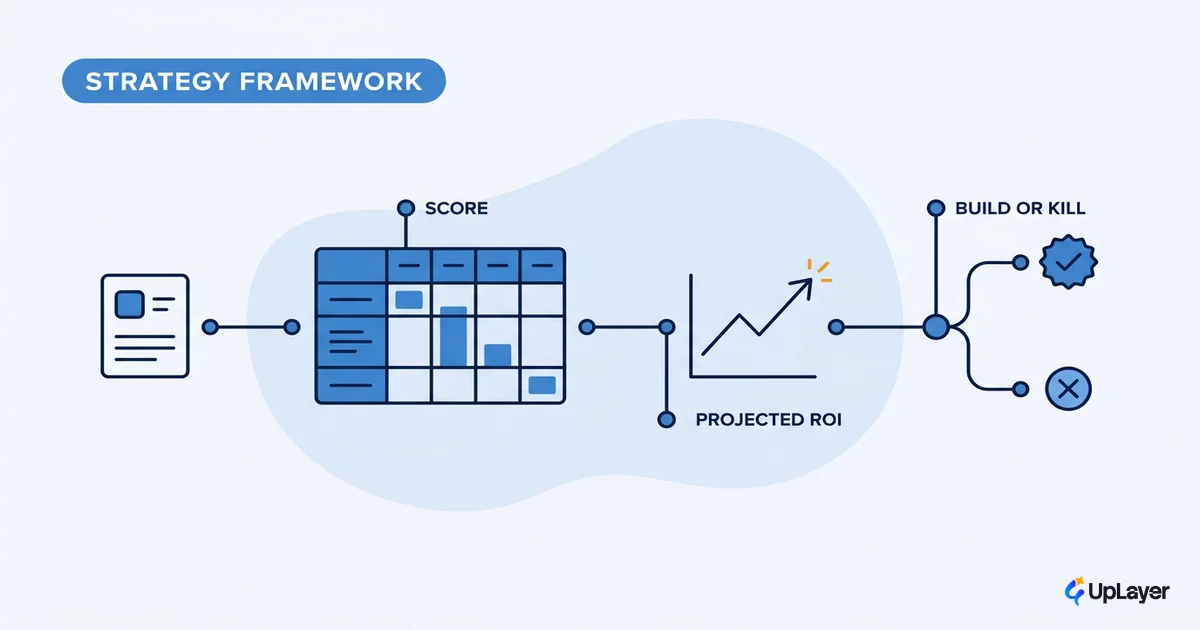
A strategy deck is not a framework. A deck is a one-time argument for what you want to do next. An AI product strategy framework is a repeatable procedure that gives the same answer no matter who runs it, because the inputs and the scoring are fixed. Most "AI product strategy" is a wishlist with a confidence problem, and that is exactly why so much of it ships and moves nothing.
This piece hands you the runnable artifact. Five stages that take an AI idea from opportunity to a projected-ROI number to a build-or-kill call, plus a weighted scorecard you can copy into a spreadsheet this week. If you have not yet sorted the raw ideas, start one level up with deciding which AI features to build; this framework is what you run on the survivors.
What an AI product strategy framework actually is
An AI product strategy framework is a decision procedure: a fixed set of inputs, a fixed way to score them, and a go-or-kill output that ties every AI idea to a metric you already track. Inputs in, ranked verdict out. That repeatability is the whole point, and it is what separates a framework from a deck.
A deck describes a future and has no way to be wrong. A framework forces a choice. Marty Cagan's team at SVPG puts it plainly: product strategy starts with focus, then depends on insights, then converts those insights into action. Focus, insights, action. A wishlist of AI features has none of those properties, which is why it cannot guide a decision.
This is the runnable companion to how to write an AI product strategy. That piece is the narrative: what a strategy contains and why it stalls. This one is the operating system you execute. Same philosophy, different artifact. If you only read one as prose, read that one. If you want the template you run each quarter, stay here.
Why most AI product strategy fails the ROI test
Most AI product strategy fails for a structural reason, not a motivational one: features get chosen by hype and demo appeal, never scored against a projected return. It is the same trap an AI driven product strategy falls into when the word AI leads the plan instead of the metric the work is supposed to move. So they ship, the metric does not move, and the project quietly dies. Gartner predicts that at least 30% of generative AI projects will be abandoned after proof of concept by the end of 2025, citing poor data quality, weak risk controls, escalating costs, and unclear business value.
At least 30% of generative AI projects will be abandoned after proof of concept by the end of 2025, due to poor data quality, inadequate risk controls, escalating costs or unclear business value.
"Unclear business value" is the tell. That is a polite way of saying nobody projected the ROI or attached a metric, so when the bill arrived there was no number to defend. A framework does not fix this with discipline alone. It fixes it by refusing to let an idea advance without a metric and a projected number on it.
The five-stage AI product strategy framework
The framework is five stages run in order. Each stage has one job, and an idea cannot skip ahead. The first three stages do the thinking; the last two do the deciding.
- Anchor to a tracked metric. Pick one number leadership already reports: activation, churn, time-to-value, support deflection, conversion. An AI idea pointed at no existing metric is decoration, and it stops here.
- Map the opportunity. State the mechanism in one line. What does the AI do, and how does that action move the anchored metric? If you cannot draw the line from feature to number, the mechanism is a hand-wave.
- Project the ROI. Estimate the metric delta, the value per unit of that delta, and the full cost to build and run. This is projected roi, shown with assumptions, never an achieved claim.
- Score and rank. Run every surviving idea through the scorecard below. This is the ai feature prioritization step, and it produces one comparable number per idea.
- Run the build-or-kill gate. Draw a line under the ranked list. Above it, build. Below it, document and do not build. Decide which AI features to build by the score, not the volume of the pitch.
AI PRODUCT STRATEGY FRAMEWORK
=============================
[1] METRIC      anchor to a number you already track
       |
[2] OPPORTUNITY map the mechanism (feature -> metric)
       |
[3] ROI         project delta x value - total cost of ownership
       |
[4] SCORE       weighted scorecard -> one comparable number
       |
[5] GATE        rank, draw the line, BUILD or KILL
Stages 1 through 3 are where ideas die cheaply, on a page, before anyone writes model code. That is the point of running them in order.
How do I apply the framework? The AI value framework scorecard
You apply it with a weighted scorecard: an ai value framework that scores each surviving idea on the criteria that actually predict whether an AI feature pays off. The weights are yours to tune, but the criteria are the load-bearing part. Here is the scorecard we use.
| Criterion | Weight | What a strong answer looks like |
|---|---|---|
| Metric fit | 30% | Targets a number already tracked and reported; baseline is known today |
| Projected ROI | 25% | Positive after full build and run cost; assumptions written down |
| Mechanism clarity | 15% | Direct, explainable path from the feature to the metric |
| Reliability risk | 15% | Degrades gracefully as a layer; wrong output never breaks the core |
| Effort | 15% | Honest person-months, including data and integration, not just the model |
Score each criterion 1 to 5, multiply by its weight, and sum. The lineage here is the RICE prioritization framework Intercom built to turn Reach, Impact, Confidence, and Effort into one comparable number. We adapt it for AI by replacing generic impact with metric fit and projected ROI, and by adding a reliability-risk criterion that normal feature scoring ignores.
score = (metric_fit    * 0.30)
      + (projected_roi * 0.25)
      + (mechanism     * 0.15)
      + (reliability   * 0.15)
      + (effort_inv    * 0.15)   # effort_inv = 6 - effort, so lower effort scores higher

# each input is scored 1-5; output is one number you can rank
One number per idea. Sort descending. That ranked column is the answer to which AI features to build, and it is reproducible by anyone on the team who has the same inputs. For a deeper read on the scoring layer itself, see an AI value framework and the mechanics of AI feature prioritization.
Projecting ROI before you build, and the cost side nobody models
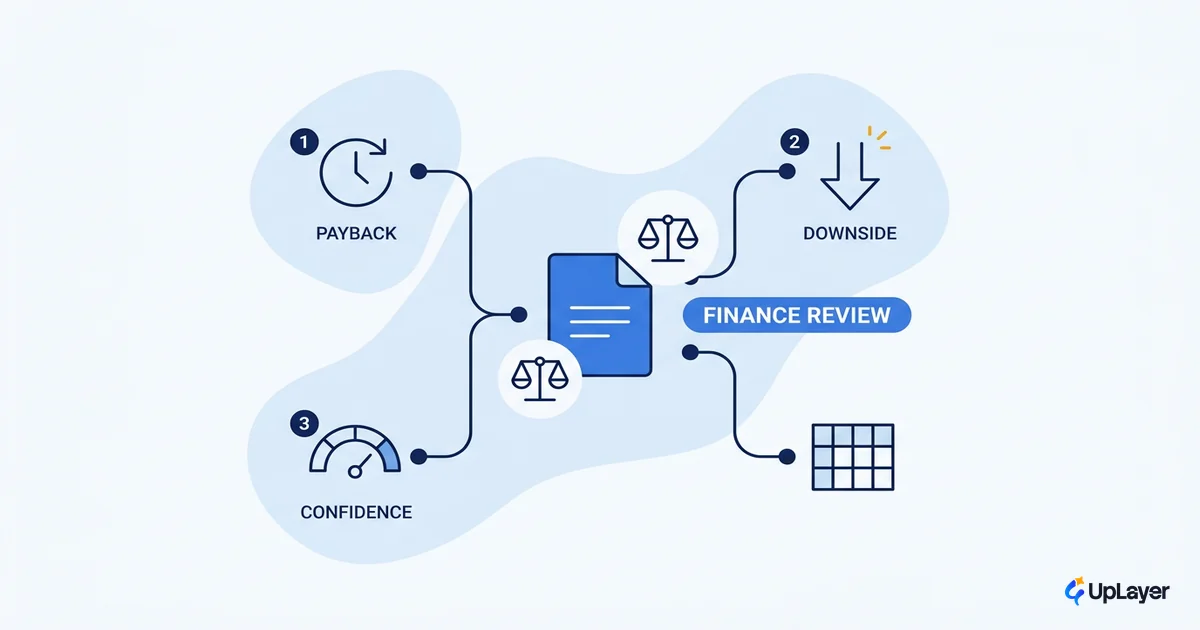
The projected ROI stage is where most frameworks get lazy. They estimate the upside and wave at the cost. Model the cost honestly and the ranking changes. The formula is simple; the rigor is in the inputs.
projected_roi = (metric_delta * value_per_unit) - total_cost_of_ownership

total_cost_of_ownership =
    design + front-end build
  + data prep + integration
  + reliability work (guardrails, eval, human-in-the-loop)
  + inference + ongoing run cost
WARNING
The inference bill is the smallest line in that equation, and it is the only one most teams estimate. The cost that actually sinks AI projects is integration, data preparation, and reliability work, the parts that do not show up in a model pricing page.
That asymmetry is widening. Stanford's AI Index reports the inference cost for a system at the level of GPT-3.5 dropped over 280-fold between November 2022 and October 2024, with hardware costs falling about 30% per year. The model is getting cheaper fast. The integration, data, and trust work around it is not. Project against the total cost of ownership, not the API line, or your ROI math will lie to you. When you do build, you will want to measure the ROI of an AI feature against the same baseline you projected from.
The step-by-step build-or-kill gate: what not to build
The gate is the stage that earns the framework its keep, because its main output is the list of features you decided not to build. Run each ranked idea against these kill criteria. Any single failure sends it below the line.
- No baseline you can state today, so no way to prove a delta later.
- Projected ROI negative or genuinely unknowable after honest costing.
- The core product breaks if the model returns a wrong answer.
- The mechanism is "AI will make it smarter," with no traceable path to the metric.
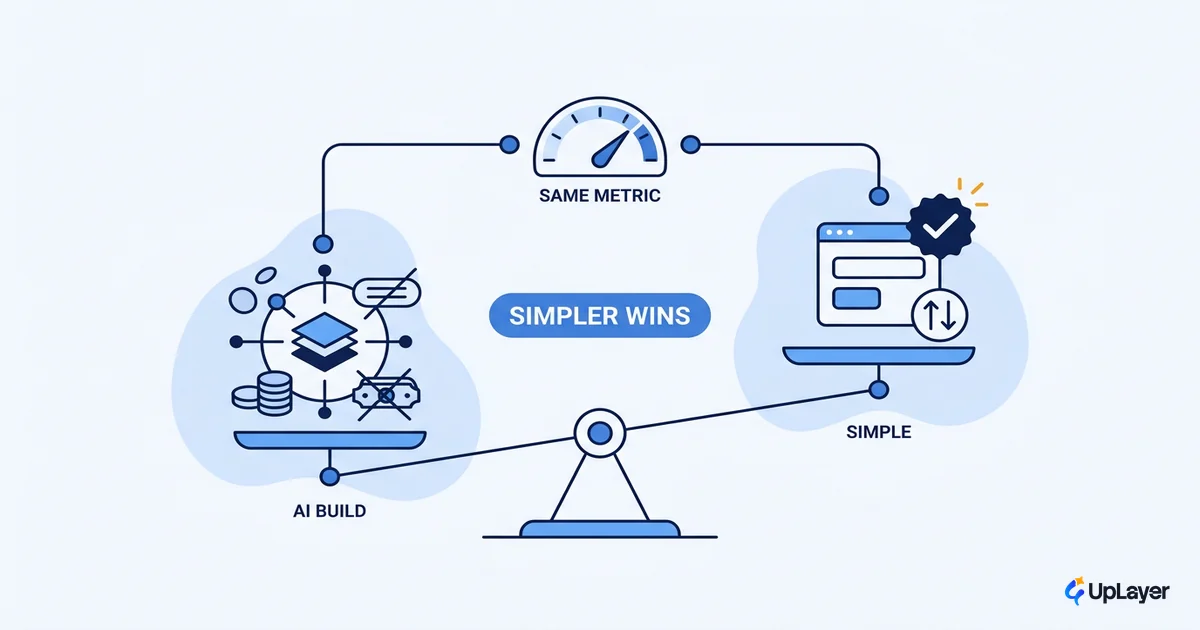
- A simpler non-AI change would move the same metric for less.
Saying no to revenue on purpose is the discipline most teams lack. The features you kill protect the metric, the budget, and the trust you would have spent shipping something that demos well and moves nothing.
Anything that fails the gate goes onto the explicit list of AI features not to build and out of the roadmap. The kill list is not waste. It is the proof that the framework is doing its job instead of rubber-stamping the loudest idea in the room.
Running the framework on a real cadence
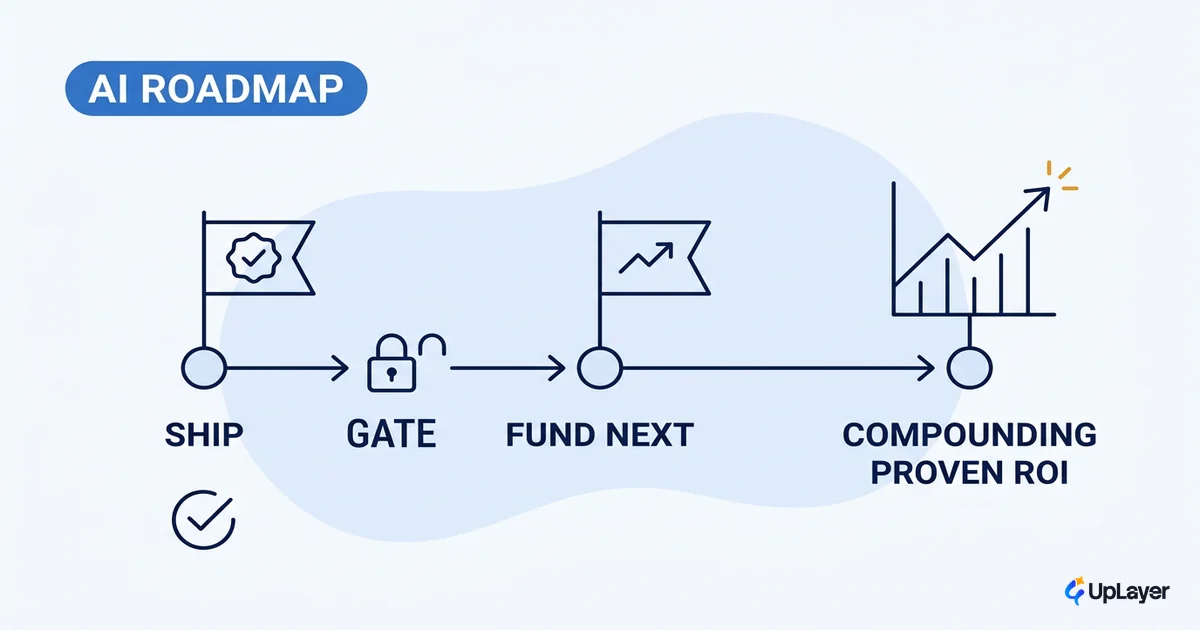
A framework you run once is just a deck with extra steps. Run this one on a fixed quarterly cadence, with one owner who holds the scorecard and one review where the ranked list and the kill list both get read aloud. New ideas enter at stage one. Shipped features come back through stage three to check projected ROI against the real number.
TIP
Keep the projected figures labeled as projected. Our own scorecards and Concept Demos show "designed to move" and "projected" numbers with their assumptions, never an "achieved" claim we have not earned. That honesty is what makes the ranking trustworthy enough to act on.
The point of running it this way is that the strategy stays alive. The metric you anchored to keeps the conversation grounded, the gate keeps the roadmap from bloating, and the cadence keeps both honest as the product and the model costs change underneath you.
An AI product strategy framework is only worth running if it can tell you no. The version here does that on purpose: it forces a metric, projects the full cost, scores every idea the same way, and kills the ones that do not pay. Run it next quarter and let the ranked list, not the hype, decide what you build.
TIP
Want the highest-ROI AI feature in your product scored and projected before you build anything? How the AX Audit works.